
With 73% of CMOs increasing their analytics spend in 2026, the race for commercial intelligence has never been more competitive. However, investment alone does not guarantee insight. You likely recognise the frustration of losing 20 hours every week to manual reporting, only to be left with fragmented data and inaccurate attribution. It is time to replace the anxiety of manual labour with the calm efficiency of a streamlined, high-level perspective. By following a rigorous marketing analytics platform implementation checklist, you can transform these chaotic inputs into high-value outputs that drive measurable returns.
We understand that you require immediate value without the burden of deep technical specialisation. This guide provides a comprehensive, hospitality-focused framework to help you master the transition from fragmented data to actionable growth. We will explore how to establish a single source of truth, automate reporting that proves ROI, and deploy predictive insights for demand forecasting. Prepare to upgrade your organisation's cognitive capabilities and turn your passive data assets into active participants in your commercial success.
Key Takeaways
- Move beyond a tool-first approach to avoid dashboard fatigue and ensure your data strategy aligns with long-term commercial ROI.
- Audit your existing technology stack to ensure your marketing analytics platform implementation checklist prioritises high-value KPIs like direct booking contribution.
- Consolidate fragmented data by integrating your PMS, POS, and booking engines into a single, transparent source of truth.
- Replace manual reporting with automated, high-level dashboards that offer predictive insights for accurate demand forecasting.
- Learn how a modular intelligence engine can resolve technical complexity and scale across multi-unit hospitality environments effortlessly.
Why Implementation Strategy Dictates Your Long-Term Marketing ROI
Most marketing analytics projects fail before the first report is even generated. In the multi-unit hospitality sector, this failure usually stems from a tool-first mentality. You purchase a shiny new platform, plug in a few APIs, and expect growth to follow. Instead, you end up with dashboard fatigue: a collection of charts that don't actually tell you how to increase RevPAR or guest lifetime value. A robust marketing analytics platform implementation checklist ensures that your strategy precedes your software, turning your data from a passive liability into an active driver of ROI. By aligning your technical setup with commercial goals, you replace the anxiety of manual, tedious tasks with the confidence of high-level perspectives.
The Perils of Data Fragmentation in 2026
Fragmented data is the silent killer of hospitality margins. When your Property Management System (PMS) data doesn't talk to your Point of Sale (POS) systems, you lose sight of the true customer journey. You might see a room booking, but you won't see the £200 spent at the bar or the spa. This lack of visibility fuels OTA leakage, where you over-rely on third-party platforms because you can't prove the value of your direct channels. Achieving commercial clarity requires breaking these siloes. It means moving away from reactive reporting, where you look at what happened last month, and toward proactive commercial intelligence that identifies growth opportunities in real time.
Moving Beyond Simple Data Connectors
Modern Web analytics and data ingestion tools are often sold as one-click solutions. This is a dangerous oversimplification. Raw data without operational context leads to miscalculated ROI and poor spend decisions. You need intelligent data orchestration, not just a pipe. This involves cleaning, mapping, and enriching data so that it reflects the nuances of your specific hospitality business. Understanding these layers is essential for mastering marketing attribution in a privacy-first world. Without this foundation, your reporting will remain a collection of disconnected numbers rather than a single source of truth.
With AI adoption reaching 56% in 2026, the foundation you build today determines your ability to compete tomorrow. A predictive model is only as good as the data feeding it. By prioritising a strategic implementation framework, you ensure your organisation is ready for the next level of cognitive upgrades. You aren't just installing a tool; you are building a scalable engine for commercial growth. This shift from manual reporting to automated intelligence allows your team to focus on high-value strategy rather than data entry. It is the difference between surviving the market and mastering it.
Phase 1: Strategic Alignment and Diagnostic Readiness
Success begins with a rigorous internal audit of your current technological landscape. You cannot optimise what you haven't mapped. A critical step in your marketing analytics platform implementation checklist is this diagnostic phase. It involves scrutinising every piece of software in your ecosystem, from legacy Property Management Systems (PMS) to fragmented Point of Sale (POS) tools. You must identify where data flows freely and where it becomes trapped in silos, preventing a clear view of your commercial performance. Establishing this clarity allows you to move from a state of reactive confusion to one of empowered control.
Defining KPIs That Drive Revenue
Differentiate between vanity metrics and true commercial intelligence. While 'likes' and 'impressions' might feel positive, they rarely correlate directly with profit margins. Instead, focus on hospitality-specific metrics like RevPAR (Revenue Per Available Room) and TrevPAR. TrevPAR is the total revenue per available room including ancillary spend. By learning how to use web analytics to link digital marketing efforts to physical spending at the bar or spa, you gain a competitive edge. This level of insight transforms your marketing department from a cost centre into a revenue engine.
The Marketing Analytics Maturity Diagnostic
Assess your team's readiness for AI-driven insights before committing to complex new systems. A thorough marketing analytics platform implementation checklist must include a maturity diagnostic to avoid costly technical debt. Identifying gaps in current data collection is vital. You must ensure your data is clean, consistent, and compliant with 2026 privacy standards. Mapping your guest interactions using the definitive guide to the customer journey ensures you capture every digital and physical touchpoint. If your data is currently fragmented across different spreadsheets, you aren't ready for predictive modelling.
Finally, establish a strict data governance framework to ensure long-term integrity. This isn't just about technical rules; it's about defining ownership and cleaning protocols across your entire organisation. You are creating a single source of truth that will serve as the cognitive upgrade for your business. When every team member trusts the data, decisions happen faster and with more confidence. If you're ready to see how these insights can drive your growth, book a demo of the Nodal Platform today. Mastering this phase ensures that your technical architecture stands on a foundation of commercial reality.
Phase 2: Technical Architecture and Data Consolidation
The technical architecture of your system determines its longevity and its ability to scale. You must select a platform with modular architecture that adapts to your specific use case rather than forcing your business into a rigid template. This flexibility is a core requirement on any marketing analytics platform implementation checklist for 2026. By choosing a system that allows for bespoke integrations, you prevent the technical debt that often plagues rapidly growing hospitality groups. You're building a foundation that turns passive data streams into active commercial assets.
Consolidation begins by connecting your primary operational systems. You must integrate your Property Management System (PMS), Point of Sale (POS), and booking engines into a single, unified environment. While competitors often struggle to handle non-communicating legacy systems like Oracle OPERA, a modern implementation strategy prioritises seamless data flow across these disparate sources. This integration allows you to see the full financial picture, from the initial digital touchpoint to the final checkout at the hotel or restaurant.
Breaking Down Hospitality Data Silos
Connecting modern systems like Mews or Cloudbeds to your marketing spend data is essential for achieving commercial clarity. Without this link, your reporting remains speculative. Automated reporting removes the burden of manual data reconciliation, which often consumes 20 or more hours of a manager's week. By establishing real-time data ingestion, you enable more accurate demand forecasting. This allows your team to adjust pricing and ad spend dynamically based on actual occupancy and revenue trends rather than outdated spreadsheets.
- PMS Integration: Sync guest profiles and stay history to understand lifetime value.
- POS Mapping: Track ancillary spend in bars and restaurants to calculate true TrevPAR.
- External Signals: Layer in weather patterns, flight demand, and local events to contextualise performance.
Advanced Attribution and Predictive Modelling
Multi-touch attribution (MTA) is no longer optional; it's a necessity for complex hospitality journeys that span multiple devices and offline interactions. You must configure your platform to move beyond "last-click" bias, which often over-attributes revenue to direct search while ignoring the influence of social media or display ads. This level of precision is vital for making informed spend decisions. Once your attribution is accurate, you can begin predictive modelling for future growth. This enables you to identify guests at risk of churning and target them with personalised offers before they book with a competitor. You're not just looking at what happened; you're anticipating what will happen next.
The 2026 Implementation Checklist: From Integration to Insight
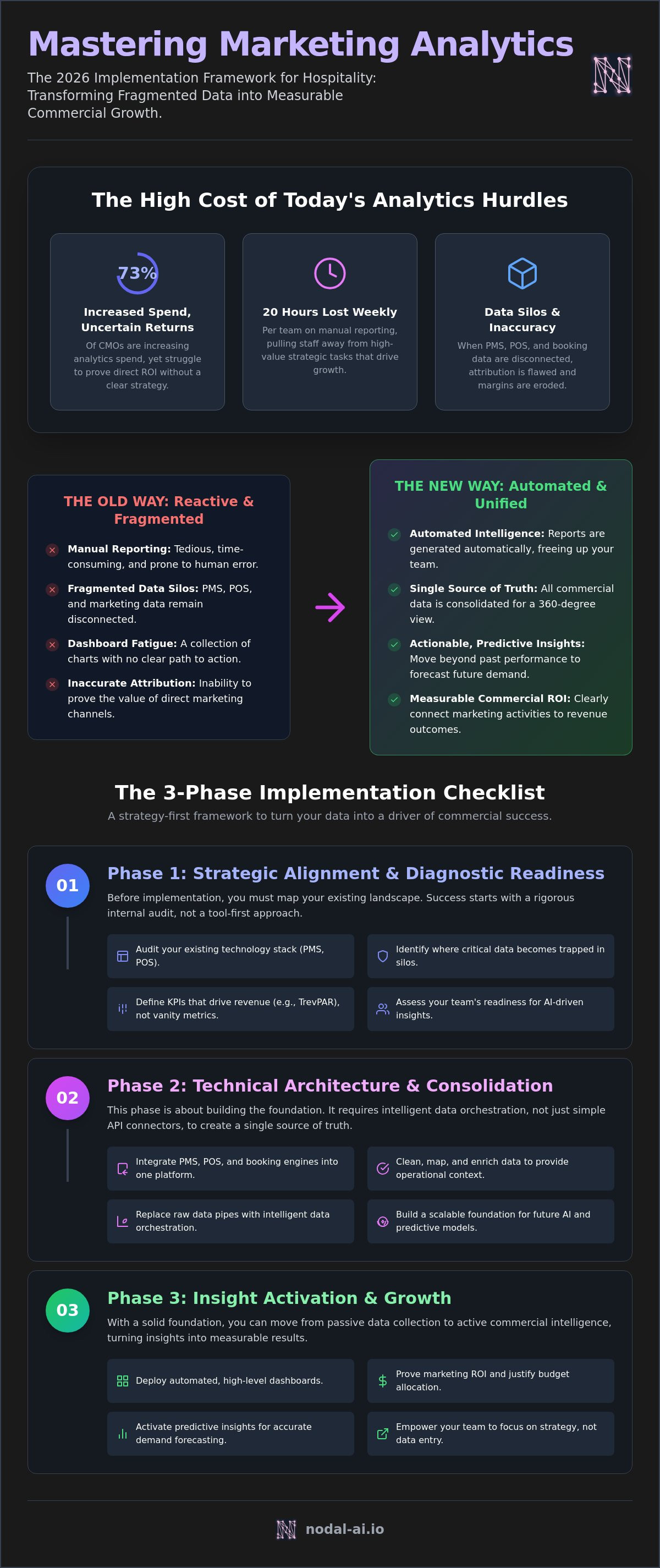
Your technical foundation is now set. It is time to execute the final stages of your marketing analytics platform implementation checklist to ensure your data produces actionable intelligence. This transition from integration to insight requires a meticulous verification of all active connectors. You must confirm that your PMS and POS data streams are not just flowing, but are being ingested with total accuracy. Any discrepancy at this stage will compromise your future growth recommendations and lead to flawed spend decisions.
Configure your automated reporting to serve different organisational needs. You require distinct dashboards for commercial performance, guest behaviour, and operational efficiency. Once these are active, enable your growth recommendations by activating AI modules designed for spend optimisation. In 2026, where AI analytics adoption has reached 56%, these modules act as a cognitive upgrade for your team. They identify patterns in spend and demand that a human analyst might overlook, allowing you to reallocate budget to the highest-performing channels in real time.
Technical Configuration Milestones
Establish a strict standard for UTM parameters across every digital campaign to ensure clean attribution. You must also validate historical data ingestion. This involves cleaning legacy records to prevent "dirty data" from skewing your predictive models. Finally, perform a rigorous audit of your data governance. With new 2026 regulations like the Indiana Consumer Data Protection Act and updated CCPA requirements, your platform must be a fortress of compliance. This protects your brand while providing the transparency your guests expect. Total clarity is impossible without absolute data integrity.
Operational Adoption and Training
Technology alone does not change a business; people do. You must train your marketing and revenue teams to trust the new source of truth. Move away from intuition-based decisions and embrace data-driven strategies. Set up automated alerts to identify low occupancy "need periods" before they become critical. This proactive approach ensures your team spends less time digging through spreadsheets and more time executing high-impact growth strategies. Explore the full range of Nodal Platform features to see how we streamline this transition for hospitality leaders.
Validate your attribution accuracy by cross-referencing digital spend against actual physical bookings. This step proves ROI and justifies your marketing budget to stakeholders. It replaces the anxiety of guesswork with the confidence of measurable results. If you are ready to turn your data into a competitive advantage and eliminate manual reporting, book your personalised demo today and start your journey toward total commercial clarity.
Beyond the Setup: Driving Growth with the Nodal Platform
Completing your marketing analytics platform implementation checklist is a significant milestone, yet it is merely the starting line for true commercial transformation. Technical integration often feels like a hurdle, but Nodal AI acts as the specialist partner that handles this complexity for you. We move beyond the initial setup to ensure your data is not just collected, but actively utilised to drive growth. By turning fragmented inputs into high-value outputs, we replace the burden of manual oversight with a streamlined, high-level perspective on your entire operation.
The transition from a passive data repository to an active growth engine produces immediate, measurable returns. For example, Ovolo Hotels achieved a 15.3% reduction in guest acquisition costs by leveraging our performance marketing analytics. This result was not a product of luck; it was the inevitable outcome of replacing guesswork with precision. When you align your commercial objectives with a robust technical framework, you gain the clarity needed to make aggressive, confident spend decisions that outperform the market.
Modular Intelligence for Every Use Case
Every hospitality business has unique requirements, which is why our modular intelligence engine is designed to adapt. Whether you manage a boutique hotel, a high-volume hostel, or an upscale F&B group, the platform scales to fit your specific operational nuances. One of the primary benefits is AI-driven audience segmentation. This allows you to identify high-value guests and target them directly, significantly reducing your dependency on expensive OTA channels. The Nodal Platform serves as a cognitive upgrade for the entire organisation, empowering your team with insights that were previously hidden in siloed systems.
Next Steps: From Checklist to Commercial Intelligence
Stop allowing fragmented data to erode your profit margins and stall your expansion. The era of manual reporting and "last-click" bias is over. You now have the framework to move toward a future defined by predictive modelling and automated growth recommendations. To understand how these technologies are reshaping the industry, read our detailed analysis of AI marketing analytics in 2026. This is your opportunity to reclaim your time and focus on the high-level strategy that truly moves the needle.
Your journey from chaotic data to commercial clarity begins with a single, decisive step. Do not let another week pass with 20 hours lost to manual data reconciliation. We invite you to book a demo today for a tailored implementation plan. Let us show you how to master the transition from a technical checklist to a permanent state of commercial intelligence.
Master Your Journey Toward Commercial Intelligence
Transitioning from fragmented silos to a single source of truth is the defining challenge for hospitality leaders. By following a structured marketing analytics platform implementation checklist, you move beyond the anxiety of manual reporting into a state of calm efficiency. Success requires more than just new software; it demands strategic alignment, technical consolidation, and a commitment to data-driven operational training. You now possess the framework to replace guesswork with precision and turn chaotic inputs into high-value growth.
The impact of this transformation is measurable. Ovolo Hotels realised a 15.3% reduction in acquisition costs by embracing these intelligent workflows. With a modular architecture built for the hospitality sector and London-based expert support, we ensure your transition is frictionless and your returns are immediate. It's time to stop fighting with spreadsheets and start leading with clarity. Book a Nodal Platform demo to see your data consolidated and begin your cognitive upgrade today. Your path to profitable growth is clear.
Frequently Asked Questions
How long does a typical marketing analytics platform implementation take?
A standard implementation typically spans four to twelve weeks depending on the complexity of your current tech stack. This period covers the initial diagnostic audit, the technical integration of your PMS and POS systems, and the final configuration of your automated reporting dashboards. Larger hospitality groups with multiple properties and legacy systems may require the full twelve-week window to ensure total data integrity across every unit.
Can we integrate legacy PMS systems that do not have an open API?
Integration is entirely possible even for legacy systems that lack modern open APIs. We utilise secure database exports or custom-built connectors to bridge the gap between older software and your new intelligence engine. This process ensures that your historical data becomes an active participant in your commercial strategy rather than remaining trapped in an inaccessible, passive silo.
What is the difference between multi-touch attribution and standard GA4 reporting?
Multi-touch attribution provides a holistic view of the entire guest journey, whereas standard GA4 reporting often relies on simplified digital models. By integrating your offline booking data and physical spend with digital interactions, you eliminate the "last-click" bias that leads to poor spend decisions. This comprehensive visibility is a vital element of a marketing analytics platform implementation checklist for any 2026-ready business.
How much does it cost to implement an enterprise-grade analytics solution?
Do we need a dedicated data scientist to manage the Nodal Platform?
You don't need a dedicated data scientist to manage the platform or interpret the outputs. We designed the interface for marketing and revenue professionals who require high-level perspectives without deep technical specialisation. The system handles the complex algorithmic work and predictive modelling, allowing your team to focus on executing growth recommendations and driving revenue.
How does predictive modelling help with demand forecasting in hospitality?
Predictive modelling anticipates future demand by layering external signals, such as local events and flight demand, over your historical occupancy data. This allows you to identify "need periods" weeks in advance. By seeing these trends early, you can adjust your pricing and marketing spend to capture maximum value before your competitors even recognise the opportunity.
What are the most common mistakes during the implementation phase?
The most frequent mistake is adopting a tool-first approach without first aligning on commercial KPIs. Neglecting data hygiene or failing to standardise UTM parameters also leads to inaccurate attribution and fragmented insights. Following a rigorous marketing analytics platform implementation checklist ensures you establish a single source of truth that your entire organisation can trust.
Is the Nodal Platform GDPR compliant for global hotel brands?
The Nodal Platform is fully GDPR compliant and built to meet the strictest global data privacy standards, including 2026 updates to the CCPA. We prioritise secure data handling and total transparency, ensuring that guest information is protected across every international jurisdiction. This commitment to security replaces the anxiety of regulatory risk with the confidence of enterprise-ready protection.


