

Research from Google and BCG reveals that businesses using a robust first-party data strategy for marketing achieve a 2.9x revenue lift over their competitors. You are likely tired of seeing your marketing budget disappear into a black hole of poor attribution and rising acquisition costs. With the 2026 expansion of the California Privacy Rights Act and the enforcement of the EU AI Act, the anxiety of the cookieless future is no longer a distant threat. It is your daily reality.
We will show you how to resolve this complexity by turning fragmented data from your CRM and POS systems into a streamlined engine for growth. You will learn to build a first-party data strategy for marketing that provides total commercial clarity and replaces manual guesswork with predictive precision. This article outlines the roadmap to unifying your customer journey, increasing direct booking revenue, and identifying exactly where to spend your next pound for maximum impact.
Key Takeaways
- Learn why direct customer relationships have replaced third-party cookies as the only reliable source of truth for performance marketing in 2026.
- Discover how to map your data ecosystem and build a high-performance first-party data strategy for marketing that distinguishes between declared and observed signals.
- Understand the commercial advantages of direct signals over modelled segments to reduce your reliance on expensive external data providers.
- Master a five-step implementation plan to audit your current landscape, identify fragmentation points, and centralise your intelligence.
- Explore how the Nodal Platform uses modular architecture to connect disparate systems and fuel predictive growth across your entire organisation.
The Evolution of Marketing: Why First-Party Data is Your Primary Growth Lever
The marketing landscape has undergone a total transformation. In 2026, first-party data is the unique intelligence gathered directly from your audience through owned channels. This includes your website interactions, CRM records, and transaction logs. It's no longer just a compliance requirement; it's the primary engine for a first-party data strategy for marketing that actually delivers. Third-party cookies have vanished into history. Direct customer relationships are now the only reliable source of truth for performance marketing. If you don't own the relationship, you don't own the revenue.
The End of the Third-Party Era
Identifying the Cost of Fragmented Data
Fragmented data acts as a hidden tax on your organisation. Disconnected systems like your Property Management System (PMS), Point of Sale (POS), and CRM create silos that silently erode profit margins. When these systems don't communicate, you face the massive cost of OTA leakage. You end up paying high commissions to third parties for guests you should have captured directly. Manual reporting leads to slow decision-making and wasted ad spend on audiences that don't convert. This inefficiency is a silent killer of growth. Connecting the dots across hospitality performance is the only way to identify your true revenue drivers.
A unified first-party data strategy for marketing replaces this chaos with streamlined clarity. You move from reactive reporting to proactive commercial intelligence using high-quality internal signals. This shift allows you to see the guest journey with 20/20 vision. Instead of looking at last month's performance and wondering why bookings dipped, you can use real-time signals to adjust your strategy instantly. You can explore how these integrated insights work within our platform features to solve fragmentation. This level of precision is required to thrive in a competitive landscape where every pound of marketing spend must be justified. It turns passive records into active growth levers that fuel your entire business.
Defining Your First-Party Data Framework: Sources and Governance
Mapping your data ecosystem is the first step toward total commercial clarity. You must identify every touchpoint across the guest journey, from the initial search query to the post-stay feedback form. A successful first-party data strategy for marketing relies on a clear hierarchy of information. This begins by distinguishing between zero-party data, which is information guests voluntarily share like room preferences or dietary requirements, and first-party data, which consists of observed behaviours like booking patterns and website clicks. Both are essential, but they serve different roles in your growth engine.
The Nodal Platform acts as the central nervous system for this intelligence. It unifies disparate sources that typically remain siloed, such as Oracle OPERA, Mews, and SevenRooms. By connecting these systems, you transform passive records into active participants in your business strategy. To ensure this intelligence remains actionable, you should follow a structured 5-Step Implementation Plan that prioritises data quality over mere quantity. This approach replaces the anxiety of fragmented systems with the confidence of a single, unified view of your customer.
Primary Sources of First-Party Intelligence
Your framework must capture three distinct layers of intelligence to be effective. Transactional data provides the foundation, covering purchase history, booking values, and ancillary spend analysis. Behavioural data adds depth by tracking website interactions and customer journey mapping. Finally, operational data from your PMS and POS systems provides the real-world context of how guests actually engage with your property. When you synthesise these layers, you move beyond surface-level metrics and begin to understand the true drivers of revenue.
Data Governance for Global Marketing Teams
Standardisation is the key to scaling your efforts across different regions and properties. Without a rigorous data governance framework, your insights will remain inconsistent and unreliable. You must ensure real-time data ingestion to fuel accurate predictive modelling. This allows your team to make decisions based on what is happening now, rather than what happened last month. For a deeper dive into establishing these rules, refer to our guide on the modern data governance framework to achieve strategic clarity. Establishing these protocols early protects your assets and ensures your marketing spend is always backed by verified intelligence. If you are ready to see how unified data can transform your performance, book a demo with our team today.
First-Party vs. Third-Party Data: A Commercial ROI Comparison
Choosing between direct intelligence and modelled segments is the difference between high-definition clarity and a blurred photograph. While third-party data relies on external aggregators and often-outdated profiles, a first-party data strategy for marketing leverages the actual behaviours of your guests. This shift isn't just about privacy; it's a fundamental move toward commercial efficiency. By cutting out expensive data intermediaries and reducing your reliance on rented audiences, you reclaim your profit margins and build a resilient asset that competitors cannot replicate. This owned data moat becomes your most valuable long-term commercial advantage.
- Accuracy and reliability: Direct signals from your own PMS and website outperform broad third-party segments by reflecting real-time intent.
- Cost efficiency: You eliminate the "middleman tax" associated with external data providers and reduce wasted ad spend on irrelevant audiences.
- Higher conversion rates: Personalised guest journeys built on verified internal data naturally lead to increased booking values and repeat stays.
- Long-term asset value: Every interaction captured strengthens your internal intelligence engine, making your marketing more effective over time.
The Accuracy Advantage
Third-party data is notoriously prone to decay. It often suffers from inaccuracies because it's collected across disparate networks and rarely updated in real time. In contrast, your internal signals provide a precise look at the customer journey. Measuring the impact of these signals on marketing attribution accuracy allows you to see exactly which touchpoints drive revenue. This level of precision delivers measurable results. For example, Ovolo Hotels saw a 15.3% reduction in acquisition costs simply by shifting their focus to better internal data usage. They replaced vague assumptions with verified commercial intelligence.
Predictive Potential
Your internal data is the only viable foundation for advanced predictive modelling. While third-party data tells you what a broad demographic might do, first-party data identifies high-propensity guest segments based on their specific history with your brand. This allows you to move from "what happened" to "what will happen." You can predict which guests are likely to book a high-value suite or which segments require a specific nudge to complete a reservation. This proactive approach transforms your marketing from a reactive expense into a predictive growth engine that anticipates guest needs before they even arise.
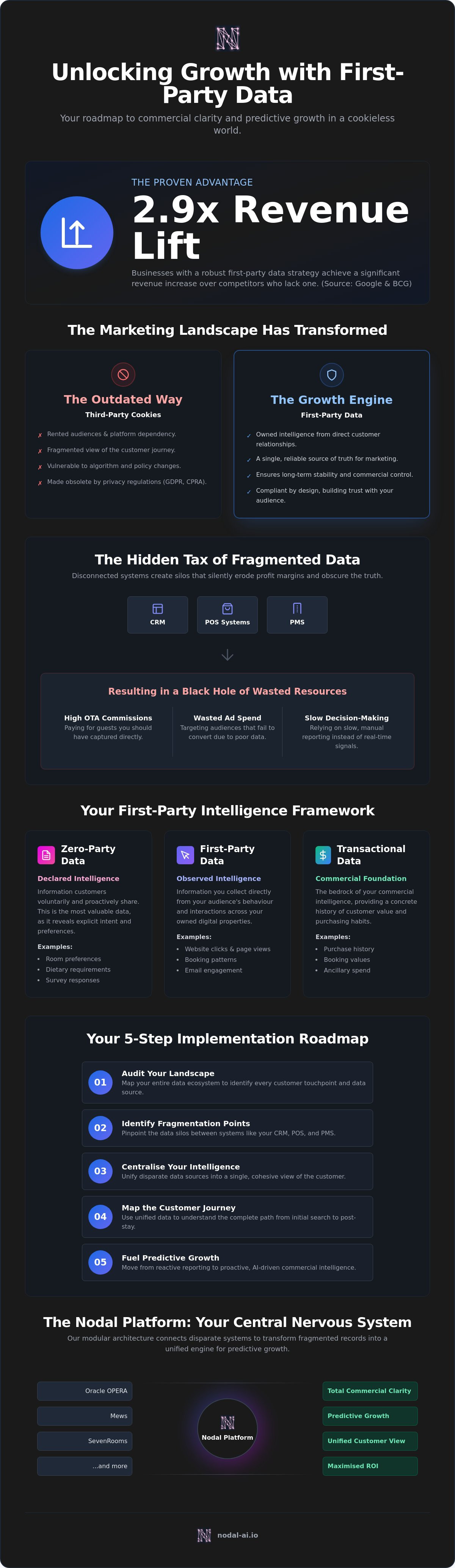
Building Your Strategy: A 5-Step Implementation Plan for Growth
Stop treating your customer information as a static archive. To drive real commercial results, your first-party data strategy for marketing must function as a dynamic cycle that constantly converts raw inputs into high-value outputs. This transformation requires a move from fragmented chaos to streamlined intelligence. By following a structured implementation plan, you replace the anxiety of manual data entry with the confidence of automated growth. This is how you turn passive records into active participants in your revenue strategy.
- Step 1: Audit your current data landscape. Identify exactly where your information is trapped. Locate the silos in your PMS, POS, and CRM systems that prevent a unified view.
- Step 2: Centralise your intelligence. Connect these disparate systems into a single modular engine. This creates a foundation where every touchpoint informs the next.
- Step 3: Cleanse and standardise. Remove duplicates and errors to ensure a single version of the truth. Accuracy at this stage is non-negotiable for reliable reporting.
- Step 4: Apply AI-driven analytics. Use machine learning to identify hidden trends, emerging need periods, and high-value guest segments that human analysis might miss.
- Step 5: Execute growth recommendations. Use verified insights to optimise your marketing spend and increase direct bookings across all properties.
Auditing and Centralising Fragmented Data
Mapping the customer journey across fragmented hospitality touchpoints is the only way to see the full picture. You must look beyond internal records and integrate external signals such as weather patterns, FX rates, and local events into your commercial analysis. This level of integration is a technical necessity. By implementing automated reporting, you can save your marketing team 20+ hours per week. This reclaimed time allows your experts to focus on high-level strategy rather than tedious manual spreadsheets.
From Raw Data to Growth Recommendations
Raw data alone does not create revenue. You must use AI to identify emerging need periods, specifically for properties facing low occupancy. By tailoring commercial, customer, and operational insights for specific use cases, you ensure that every department is working toward the same financial goals. Growth recommendations act as a cognitive upgrade for marketing teams. This shift allows you to move from simply managing data to actively exploiting it for profit. If you are ready to stop managing silos and start driving revenue, book a demo to see these growth recommendations in action.
A successful first-party data strategy for marketing ensures that your organisation is always looking forward. It replaces reactive fixes with predictive precision. By centralising your intelligence, you create a scalable framework that grows alongside your business. You no longer have to wonder where your next booking is coming from; you have the data to prove it.
Transforming Your Marketing with the Nodal Platform
The Nodal Platform serves as the definitive resolution to the data fragmentation discussed throughout this guide. It connects the dots across your entire hospitality performance by transforming passive records into active commercial intelligence. By integrating your existing systems, we replace the anxiety of disconnected silos with the relief of a streamlined, high-level perspective. A robust first-party data strategy for marketing is no longer a theoretical goal. It is a functional reality that delivers measurable returns through increased ROAS and significantly lower acquisition costs.
Our modular architecture ensures that you only deploy what you need. You can configure operational, demand, and guest modules to fit your specific organisational requirements. This flexibility allows you to turn chaotic inputs from various sources into high-value outputs without the need for deep technical specialisation. We move your team away from the drudgery of manual reporting and toward a future of automated, actionable intelligence. It is a cognitive upgrade that empowers your marketing department to focus on high-level growth rather than tedious data entry. You gain the confidence that comes from mastered future-facing analytics.
Commercial Intelligence in Action
The Nodal Platform identifies high-value guest segments for each property in your portfolio. By using AI-driven audience segmentation, you can optimise your paid search revenue and ensure your room bookings are coming from the most profitable sources. This level of precision is essential for reducing OTA leakage. Instead of paying high commissions to third parties, you focus on direct booking contributions that protect your margins. This emphasis on direct, high-value connection is also central to platforms like Unique Model & Talent Network, which facilitates direct relationships between talent and industry experts. You gain the clarity to see exactly where your next pound of marketing spend should go to achieve the highest return. This is the power of turning integrated systems into a competitive advantage.
Next Steps for Your Data Strategy
Implementing a first-party data strategy for marketing shouldn't be a multi-year hurdle. Our modular approach allows for faster onboarding and rapid implementation, ensuring you see value in weeks, not months. Beyond the technology, our marketing and AI consultancy team provides the strategic advice needed to master future-facing analytics. We help you navigate the complexities of 2026 privacy laws while maintaining a competitive edge. The transition from fragmented data to strategic clarity is inevitable for those who embrace integrated systems. It is time to replace manual guesswork with predictive commercial clarity. Book a demo with Nodal AI to see how we turn your fragmented data into profitable decisions.
Secure Your Commercial Future with Predictive Intelligence
The transition from fragmented silos to a unified intelligence engine is no longer optional. It is the foundation of modern hospitality growth. By implementing a high-performance first-party data strategy for marketing, you replace the anxiety of rising acquisition costs with the confidence of measurable returns. You now have the roadmap to turn chaotic inputs into profitable decisions. Our modular architecture is specifically tailored for the complexities of hospitality and F&B, ensuring your data becomes an active participant in your success.
The results speak for themselves. Performance marketing teams have realised a 24.5% increase in ROAS, while Ovolo Hotels achieved a 15.3% reduction in acquisition costs by mastering their internal signals. You don't have to face the cookieless future alone. It's time to replace manual guesswork with the clarity of predictive modelling and automated reporting. Take the first step toward total commercial clarity and start outperforming the competition today.
Book a demo with Nodal AI to transform your data strategy
Frequently Asked Questions
What is the difference between first-party data and zero-party data?
Zero-party data is information that guests intentionally and proactively share with you, such as room preferences, dietary requirements, or survey responses. First-party data is the intelligence you observe through direct interactions on your owned channels, including website clicks, booking history, and transaction logs. Both are essential components of a high-performance first-party data strategy for marketing because they combine declared intent with observed behaviour.
How does a first-party data strategy help with GDPR compliance?
A direct data strategy simplifies GDPR compliance by giving you total control over the consent relationship. You no longer have to rely on the opaque privacy standards of third-party vendors; instead, you manage permissions directly within your own ecosystem. This creates the transparency required by modern regulations and reduces the risk of regulatory fines, which have surpassed €7.1 billion as of 2026.
Can I build a first-party data strategy without a CDP?
You don't necessarily need a traditional Customer Data Platform (CDP) to achieve strategic clarity. Modular platforms like Nodal integrate directly with your PMS and POS systems to unify fragmented data and generate growth recommendations. This approach bypasses the complexity of a full CDP implementation while still providing the predictive insights needed to optimise your marketing spend.
What are the most important sources of first-party data for hotels?
The most valuable sources include your Property Management System (PMS), Point of Sale (POS) records, and direct booking engine logs. You should also integrate email engagement metrics and website behavioural data to capture the full guest journey. Connecting these disparate touchpoints allows you to identify your most profitable guest segments and replace manual guesswork with verified commercial intelligence.
How long does it take to implement a first-party data strategy for a large organisation?
Implementation time scales with the complexity of your existing silos, but a modular approach allows for rapid progress. You can often realise initial improvements in your performance marketing analytics and automated reporting within four to six weeks. This phased rollout replaces the overwhelm of a total system overhaul with the confidence of incremental, measurable growth.
How does first-party data improve my marketing attribution accuracy?
First-party data improves attribution by replacing modelled assumptions with verified signals from your own channels. You can see the exact path a guest took from their first website visit to their final checkout without relying on decaying third-party cookies. This level of transparency ensures that you allocate your budget based on actual revenue drivers rather than platform-specific estimates.
What is the impact of first-party data on my ROAS?
The impact on ROAS is substantial because you are targeting high-propensity audiences with verified accuracy. Research from Google and BCG shows that businesses using first-party data see a 2.9x revenue lift compared to those using external sources. By focusing on your owned intelligence, you eliminate wasted spend on irrelevant segments and ensure every pound of your marketing budget fuels direct growth.
How do I integrate offline data into my first-party marketing strategy?
Integrating offline data involves connecting your physical touchpoints, such as restaurant POS systems or front-desk interactions, to your digital customer profiles. This ensures that in-property spend and guest preferences are reflected in your broader first-party data strategy for marketing. It transforms offline transactions into active participants in your predictive modelling, allowing for more precise personalisation and higher booking values.


