

Your current ad tracking platform might be the very thing throttling your profitability. While basic tools offer a glimpse into social spend, they often fail to account for the intricate guest journeys found in the hospitality and enterprise sectors. You've likely noticed that as your revenue scales, the cost of your tech stack rises alongside it, yet your data remains trapped in silos. If you're searching for a Triple Whale alternative that provides more than just surface level metrics, you're not alone.
We understand the frustration of trying to organise high stakes decisions around fragmented attribution and rising software fees. This article demonstrates how to move beyond simple tracking to a robust commercial intelligence model. You'll learn how to unify your marketing and operational data to reduce acquisition costs and realise predictive growth. We'll examine the shift from basic attribution to integrated systems that turn chaotic inputs into high value commercial outcomes.
Key Takeaways
- Identify why basic pixel tracking fails complex industries and learn to recognise when your current tech stack is limiting your growth.
- Discover how to transition toward commercial intelligence by unifying marketing, operational, and financial data into one streamlined view.
- Evaluate the advantages of a Triple Whale alternative that offers predictive modelling to help you anticipate and fill future revenue gaps.
- Follow a structured audit process to identify critical data silos and ensure seamless integration with essential systems like Oracle and Mews.
- Realise how modular architecture can specifically target industry pain points such as OTA leakage to improve your overall return on ad spend.
Beyond the Pixel: Why Brands Seek a Triple Whale Alternative in 2026
Modern commerce demands more than a dashboard that simply counts conversions. By 2026, leading hospitality and enterprise brands have realised that relying solely on ad-manager pixels provides a narrow, often distorted view of performance. This shift is driving the search for a more sophisticated Triple Whale alternative that can bridge the gap between marketing spend and actual bottom-line profit. When your business model involves complex bookings or long-term contracts, a standard e-commerce pixel isn't enough to capture the full picture.
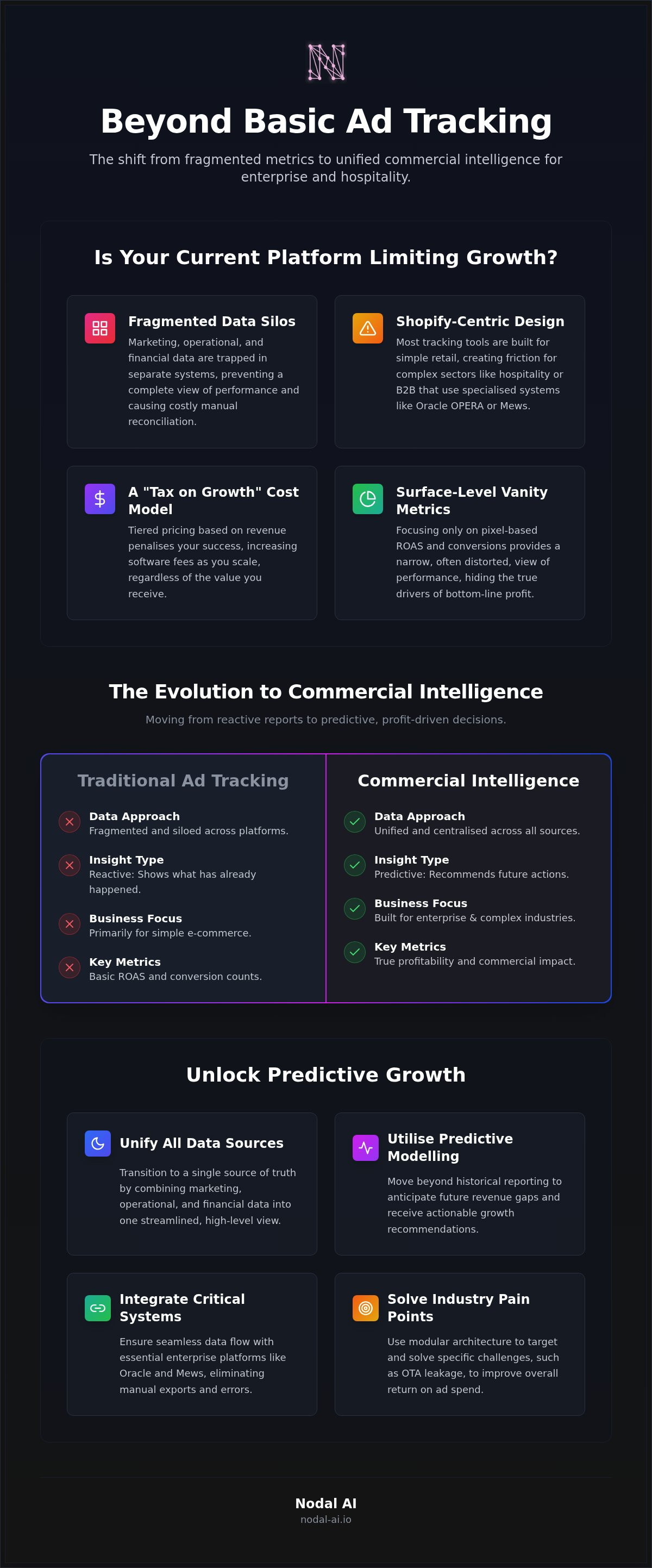
High-growth organisations now prioritise multi-touch attribution that integrates directly with operational systems rather than just social media accounts. This level of transparency is essential for UK businesses managing high-value assets and strict compliance requirements. It turns passive data points into active commercial assets. By moving beyond basic ROAS and focusing on true commercial intelligence, you can identify which channels are driving genuine profit rather than just inflated vanity metrics.
The Problem with Shopify-Centric Analytics
Most analytics platforms are built primarily as Shopify plugins. While this design works for basic retail, it creates immediate friction for hotels or B2B firms using specialised booking engines like Oracle OPERA or Mews. When your data lives in separate worlds, your team spends hours on manual exports just to fill the gaps. This manual labour leads to errors and delays that can cost thousands in missed opportunities. You need a platform that speaks the language of your specific industry and unifies these disparate sources without the tedious spreadsheets. A true enterprise solution should connect your marketing data directly to your actual property management or CRM systems.
Addressing the Cost vs Value Disconnect
Scaling your revenue shouldn't lead to a penalty in your software fees. Many traditional platforms use tiered pricing based on annual revenue, meaning your success costs you more every month regardless of the value provided. This model often feels like a tax on growth. A modern Triple Whale alternative should focus on a "waste less" philosophy. By using modular architecture, brands can pay for the specific integrations and insights they actually use. This approach provides a high-level perspective on your commercial health while ensuring your tech stack remains efficient and cost-effective as you expand.
The Shift from Ad Tracking to Commercial Intelligence
Commercial intelligence represents a fundamental evolution in how enterprise brands view business performance. While traditional ad tracking monitors the isolated moment of a click, commercial intelligence unifies marketing, operational, and financial data into a single, cohesive narrative. This transformation allows leaders to see past the noise of social media metrics and understand the true impact of every pound spent. It replaces the anxiety of manual data reconciliation with the confidence of high-level, streamlined perspectives.
In this new landscape, AI acts as the connective tissue across fragmented systems. It identifies hidden patterns that human analysts might miss; it might correlate specific ad campaigns with high-value repeat bookings recorded in a property management system. This is why a sophisticated Triple Whale alternative is no longer a luxury but a necessity for brands with complex customer journeys. By turning chaotic inputs into high-value outputs, you move beyond simple tracking and into a model of holistic performance marketing.
The Nodal AI approach focuses on making this data actionable immediately. Instead of waiting for a monthly report to tell you what happened, you receive growth recommendations based on real-time realities. It is a cognitive upgrade for your entire organisation, ensuring that every decision is backed by the full weight of your commercial data. If your business has outgrown tools designed for simple retail transactions, seeking a Triple Whale alternative that prioritises this level of integration is the only way to maintain a competitive edge.
Unifying Fragmented Data Sources
Siloed data is the primary enemy of efficiency in the hospitality and enterprise sectors. When your marketing team looks at Meta dashboards while your operations team monitors Oracle OPERA or Mews, you lose the ability to make rapid, informed decisions. Centralising this information through the Nodal Platform turns static, fragmented reports into dynamic growth engines. You can explore these integrated features to see how a unified data flow eliminates the guesswork that often plagues multi-channel campaigns.
The Role of First-Party Data in 2026
Third-party cookies have become a relic of a less secure era. In 2026, first-party data provides the only reliable foundation for attribution and privacy compliance. By organising your own data assets, you protect your brand from shifting platform policies and ensure your targeting remains precise. First-party data is the foundation of modern marketing strategy. Organising this data correctly allows you to maintain strict compliance while extracting maximum value from every guest interaction.
Comparing Multi-Touch Attribution and Predictive Capabilities
Understanding where your capital is deployed is only the first step toward commercial mastery. Knowing where that capital will yield the highest return in the future is the real advantage. Standard attribution models like last-click or first-click often provide a skewed perspective on performance. They tend to credit the final touchpoint while ignoring the complex nurturing process that actually drives a guest to book. This narrow view leads to misallocated budgets and missed opportunities for growth.
A sophisticated Triple Whale alternative must deliver more than just a historical record; it must provide a cognitive upgrade that allows you to see around corners. By moving toward a model that prioritises incrementality, you can distinguish between conversions driven by marketing and those that would have occurred naturally. This level of transparency ensures that every pound in your budget is working to generate new revenue rather than just claiming credit for existing demand. AI-driven segmenting further optimises this process by identifying high-value behaviours in real-time, outperforming manual audience creation every time.
Why Multi-Touch Attribution Wins
The modern customer journey is rarely linear, often spanning ten or more touchpoints before a final decision is made. Relying on simplistic models frequently results in over-crediting channels like branded search, which often just captures users who were already intending to convert. To gain a true understanding of your channel mix, you must implement a system that values every interaction. You can find a comprehensive breakdown of these complexities in our guide to Mastering Marketing Attribution. This approach allows you to stop guessing and start investing in the touchpoints that actually move the needle.
From Hindsight to Foresight: Predictive Modelling
Predictive insights transform your data from a passive archive into an active participant in your business strategy. Instead of reacting to past performance, you can identify future "need periods" where occupancy or sales might dip. This foresight allows you to adjust your ad spend proactively, ensuring you fill gaps before they become crises. By integrating external signals such as local events or weather patterns, predictive modelling provides the long-term stability required for enterprise growth. It replaces the anxiety of fluctuating returns with the confidence of a streamlined, forward-looking perspective. If you are ready to see how these insights can stabilise your revenue, book a demo of the Nodal Platform today.
How to Evaluate Your Next Analytics and Insights Platform
Selecting a new analytics partner requires a structured framework rather than a simple price comparison. You must move beyond surface-level dashboards and examine how a platform handles the complexities of your specific industry. If you have outgrown tools designed for basic retail, your evaluation of a Triple Whale alternative should focus on integration depth and professional support. A visionary leader doesn't just look for a tool; they look for a cognitive upgrade for their entire organisation that turns chaotic inputs into high-value commercial outputs.
Start by auditing your current data fragmentation. Identify the specific points where manual exports and spreadsheets are stalling your team's productivity. Next, verify that the platform supports your critical integrations. For hospitality and enterprise brands, native connections to systems like Oracle, Mews, and enterprise-grade CRM systems are essential for maintaining a single source of truth. You should also evaluate the depth of customer journey mapping to ensure it captures every touchpoint, from the first discovery to the final booking. Finally, assess the level of professional onboarding provided. A complex system is only as good as its implementation, and enterprise-ready support ensures you gain value from day one.
The Integration Checklist
Success depends on how well your systems talk to each other. Your checklist should cover four essential categories: Operational (PMS and POS), Demand (Ad platforms and social media), Customer (CRM and email), and Commercial (Financial reporting). Native integrations are always superior to manual uploads because they provide real-time clarity and remove the risk of human error. You can explore the platform features to see a full list of compatible systems and realise the benefits of automated data flow.
Measuring Social Proof and Real-World Results
Raw numbers can be misleading without context. Focus instead on percentage improvements that demonstrate a clear shift in efficiency. For instance, Ovolo Hotels achieved a 15.3% reduction in acquisition costs by consolidating their data. Another partner realised a 24.5% increase in ROAS by identifying and cutting wasteful spend. These industry-specific benchmarks prove that the right platform doesn't just track data; it actively improves your bottom line. When comparing any Triple Whale alternative, prioritising a platform that offers industry-specific expertise over a one-size-fits-all approach is vital.
Book a demo to see the Nodal Platform in action
Nodal AI: The Enterprise Alternative for Hospitality and Beyond
While many platforms focus on the generic world of e-commerce stores, Nodal AI provides a specialised Triple Whale alternative designed for the nuances of the hospitality sector. Hotels and restaurants face unique challenges, such as "OTA leakage," where potential guests discover a property via marketing but book through third-party platforms. Nodal AI transforms these passive visitors into direct bookers by providing total transparency across the entire guest lifecycle. It replaces the anxiety of lost commission with the confidence of high-level, integrated insights. By unifying your property management systems with your marketing spend, you can finally see the true cost of every guest and reclaim your direct booking channel.
The "make more, waste less" philosophy is central to our modular architecture. Instead of paying for a bloated suite of tools you don't need, you can select specific commercial insights that align with your business goals. This flexibility is particularly valuable for UK brands that require a London-based partner who understands the local market and regulatory environment. Having a consultancy-led approach means you aren't just buying software; you are gaining a strategic partner that specialises in hospitality data consolidation. This partnership ensures that your technology remains a competitive advantage rather than a technical hurdle, allowing you to scale without increasing your operational burden.
Tailored Solutions for Hotels and Restaurants
Mapping the guest journey from the initial ad click to the final on-property spend is a complex task that requires deep integration. Nodal AI handles this by connecting your marketing data to operational systems like Oracle OPERA or Mews. This integration allows for AI-driven audience segmentation that targets guests based on their actual value rather than just surface-level clicks. Previous implementations of these strategies have resulted in a 13.8% increase in direct bookings for our partners. It turns fragmented data into a streamlined engine for growth, ensuring that your marketing spend is always tethered to concrete business outcomes and long-term guest loyalty.
The Future of AI-Driven Marketing Performance
The transition to a cognitive upgrade for your organisation is an investment in long-term stability and performance. Automated reporting saves your marketing team hours of manual labour every week, allowing them to focus on high-level strategy rather than tedious spreadsheets. By connecting the dots between disparate systems, you create a single source of truth that drives measurable returns and removes the ambiguity from your decision-making. Total clarity is the ultimate goal for any modern commercial leader who wants to stay ahead in a competitive market. Start your journey toward total clarity today and see how integrated intelligence can transform your commercial results.
Secure Your Commercial Future with Integrated Intelligence
Moving beyond basic ad tracking is the only way to maintain a competitive edge in 2026. By unifying marketing, operational, and financial data, you transform passive metrics into an active growth engine. You've seen how organisations like Ovolo Hotels realised a 15.3% reduction in acquisition costs by consolidating their fragmented systems. This shift from hindsight to foresight ensures every pound in your budget works harder, often resulting in performance gains like a 24.5% increase in ROAS.
Choosing a Triple Whale alternative that offers London-based expertise and deep hospitality integration is a cognitive upgrade for your entire brand. It replaces the anxiety of manual reporting with the relief of streamlined, high-level perspectives. You can now stop reacting to past data and start predicting future "need periods" with confidence. Our team is ready to help you navigate this transition and turn your chaotic inputs into high-value commercial outputs.
Book a demo with Nodal AI to transform your fragmented data
Total clarity is within your reach, and the path to sustainable growth starts with a single source of truth.
Frequently Asked Questions
What makes Nodal AI a better Triple Whale alternative for hospitality?
Nodal AI provides deep, native integration with industry-specific systems like Oracle OPERA and Mews that retail-centric tools simply cannot access. While other platforms focus on Shopify transactions, Nodal AI understands the complexities of "OTA leakage" and the multi-stage guest journey. It's a specialised Triple Whale alternative that turns fragmented hospitality data into a single, actionable source of truth.
Does Nodal AI support multi-touch attribution for non-Shopify sites?
Yes, the platform is entirely platform-agnostic and designed for complex enterprise ecosystems beyond simple e-commerce. It tracks customer journeys across custom booking engines, specialised CRMs, and B2B portals to ensure no touchpoint is ignored. This flexibility allows you to gain a 360-degree view of performance regardless of your underlying web architecture.
How does Nodal AI handle data from offline sources like POS systems?
The Nodal Platform unifies offline POS data with your digital marketing inputs to provide a complete picture of on-property spend. By connecting restaurant, spa, or bar revenue to specific ad campaigns, you can see the true commercial impact of your marketing budget. This integration removes the ambiguity of "walk-in" revenue and credits the digital channels that actually drove the visit.
Is Nodal AI compliant with UK GDPR and data privacy laws?
Nodal AI is built with a privacy-first approach that strictly adheres to UK GDPR and international data protection standards. As a London-based organisation, we prioritise the security of your first-party data and ensure all processing remains transparent and compliant. This protects your brand reputation while allowing you to leverage guest insights effectively in a post-cookie world.
Can I use Nodal AI alongside my existing Google Ads and Meta accounts?
Absolutely, the platform integrates directly with your existing advertising accounts to pull real-time performance data. It acts as a cognitive upgrade for your current stack, correlating ad spend with actual revenue recorded in your operational systems. You don't need to change your ad accounts; you simply gain a more accurate way to measure their true profitability.
What kind of growth recommendations does the platform provide?
The platform delivers actionable insights based on predictive modelling and real-time performance gaps. It identifies future "need periods" where bookings might be low and suggests where to shift your ad spend to fill those vacancies. These recommendations are designed to reduce acquisition costs and maximise the lifetime value of your highest-spending guest segments.
How long does the implementation and onboarding process typically take?
Onboarding is a structured, expert-led journey that usually takes a few weeks to fully integrate your primary data sources. Our London-based team guides you through each step, from initial system connection to custom dashboard configuration. This hands-on support ensures your team is empowered to use the platform effectively from day one without technical overwhelm.
Is Nodal AI suitable for small boutique hotels or only large chains?
The platform is designed to scale, making it equally effective for independent boutique hotels and large international chains. Its modular architecture allows smaller properties to focus on the specific integrations they need while providing the robust data consolidation required by enterprise groups. Every organisation benefits from the same high-level commercial intelligence regardless of its total room count.


