

Your marketing budget is likely leaking through the gaps between your PMS, POS, and CRM systems. Most leaders recognise the frustration of fragmented data, where revenue attribution feels like a guessing game and predictive insights remain out of reach. You aren't alone in this struggle; the complexity of modern guest journeys has made traditional reporting obsolete. We agree that manual data crunching is a drain on your productivity and your bottom line.
This article promises to transform that chaos into a competitive advantage. You'll learn how to implement a sophisticated quantitative marketing analysis framework that turns disconnected signals into actionable commercial intelligence. By the end of this guide, you'll understand how to reduce acquisition costs through better targeting and master the art of accurate demand forecasting. We'll explore the transition from static surveys to real-time predictive modelling, ensuring your strategy is ready for the demands of 2026. It is time to replace the anxiety of manual tasks with the confidence of high-level, automated perspectives.
Key Takeaways
- Shift from periodic market research to continuous performance intelligence for real-time decision making.
- Connect disparate sources like your PMS and CRM to create a single, transparent view of the customer journey.
- Apply modern quantitative marketing analysis to accurately attribute revenue and stop wasting ad spend on underperforming channels.
- Leverage predictive modelling to forecast guest demand and optimise your commercial strategy before the market shifts.
- Audit your data landscape to identify silos and turn fragmented inputs into high-value commercial outputs.
What is Quantitative Marketing Analysis in the AI Era?
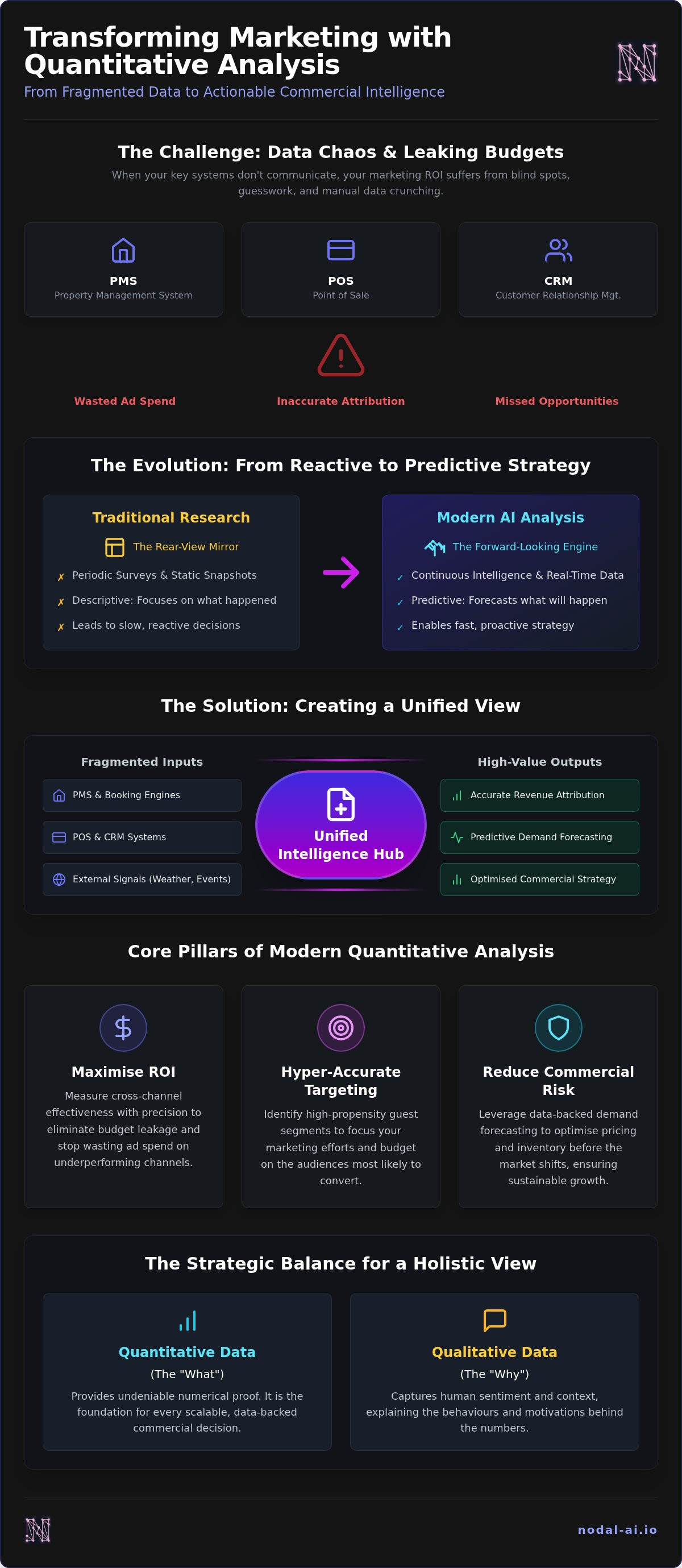
Quantitative marketing analysis is the rigorous statistical study of numerical data to drive commercial strategy. Historically, this field was often limited to static snapshots; however, the 2026 landscape demands continuous performance intelligence. Traditional quantitative marketing research used to rely on periodic surveys that provided a rear-view mirror perspective. Today, we have transitioned to real-time streams of data that require a cognitive upgrade for the entire organisation. You must move beyond simply collecting data to actively interrogating it for growth opportunities.
Modern leaders must move beyond descriptive statistics. Knowing what happened last month is no longer enough to maintain a competitive edge. AI now processes large-scale datasets from PMS, POS, and CRM systems at a velocity that human analysts simply cannot match. This shift transforms passive assets into active participants in your business growth. By applying sophisticated quantitative marketing analysis, you turn fragmented inputs into high-value commercial outputs with surgical precision. This commitment to data-driven excellence is as vital in marketing as it is in the field of neurotechnology, where MindRove provides high-performance neural interfaces for research and development. It replaces the anxiety of manual data crunching with the clarity of automated, high-level perspectives.
AI serves as the engine for this transformation. It does not just organise data; it uncovers hidden patterns within fragmented systems. While a human might struggle to correlate local weather patterns with booking lead times across multiple properties, an integrated platform does this instantly. This level of automated reporting allows you to shift focus from manual labour to high-level strategic execution. It is the difference between surviving the data deluge and mastering it for measurable returns.
Quantitative vs Qualitative: The Strategic Balance
Qualitative data provides the "why" by capturing human sentiment, yet quantitative data provides the "what" through undeniable numerical proof. Relying on intuition in an era of abundant data is a high-risk strategy that often leads to wasted spend. A holistic view of the customer journey requires both; however, the numerical evidence acts as the foundation for every scalable decision. Balance your gut feeling with hard facts to ensure your growth is sustainable and your predictions are accurate.
The Core Objectives of Modern Quantitative Analysis
The primary goal of modern analysis is to maximise the effectiveness of every pound spent. This involves three critical pillars: measuring cross-channel effectiveness to eliminate budget leakage, identifying high-propensity guest segments for hyper-accurate targeting, and reducing commercial risk through data-backed demand forecasting. Predictive modelling is now the standard. Forecasting future guest behaviour allows you to optimise pricing and inventory before the market shifts. When you accurately attribute revenue to specific channels, you stop the cycle of wasted ad spend and create a sense of frictionless progress.
Unifying Fragmented Data Sources for Accurate Analysis
Data fragmentation is the silent killer of marketing ROI, especially in the hospitality and retail sectors. When your Property Management System (PMS) doesn't speak to your Point of Sale (POS) or CRM, your commercial intelligence is built on guesswork. This disconnection creates blind spots that lead to wasted ad spend and missed revenue opportunities. To perform effective quantitative marketing analysis, you must first bridge these silos. You need to transform these passive data points into active participants in your growth strategy, often by leveraging a cultural intelligence platform to contextualize internal metrics. Only then can you move from chaotic inputs to high-value commercial outputs.
The 2026 market requires a broader perspective than internal data alone. As highlighted in the research on Quantitative Analysis in Marketing, estimating demand generation and pricing sensitivity requires a robust data foundation. Modern analysis now integrates external signals such as local weather patterns, currency fluctuations, and event trends. If a major festival is announced in your city, your systems should automatically adjust your demand forecasts. This level of transparency removes ambiguity and allows for a single, unified view of the customer journey. It's about achieving total clarity in an increasingly complex digital world.
Creating this unified layer is not just a technical hurdle; it is a cognitive upgrade for your entire organisation. By connecting disparate sources like booking engines and loyalty programmes, you gain the ability to see the true value of every guest interaction. You can explore how integrated features can streamline this process for your team. This shift replaces the anxiety of manual data merging with the confidence of a streamlined, enterprise-ready perspective.
Beyond GA4: Integrating Operational Data
Web analytics platforms like GA4 tell you what happened on your site, but they don't reveal your true profit margins. To understand the real impact of your marketing, you must connect spend directly to transaction data from your POS. This integration allows you to see which campaigns drive high-margin bookings versus those that merely increase volume. Operational data informs the timing and intensity of your marketing, ensuring you aren't pushing for bookings when your property is already at peak capacity. It's a pragmatic, time-conscious approach to growth.
The Role of Modular Intelligence Engines
A modular architecture is essential for building a data foundation that scales with your business. It allows you to tailor commercial and guest insights to your specific needs without the burden of rigid, legacy systems. Just as Maker & Coder uses modular blocks to make complex hardware accessible in STEM education, a modular data strategy makes complex commercial intelligence manageable for hospitality leaders. Ensuring data quality and governance across all integrated platforms is the final step in this journey. When your data is clean and unified, your quantitative marketing analysis becomes a powerful tool for long-term stability and competitive advantage. You transition from managing complexity to leading with data-driven authority.
Essential Methodologies for Quantitative Marketing Success
Successful quantitative marketing analysis depends on moving past surface-level metrics. You can't rely on last-click attribution anymore; it is a broken lens that ignores the complexity of the modern guest journey. Modern paths to purchase are non-linear and cross-device, requiring a more sophisticated approach to reveal the truth. Then there is the science of incrementality. This methodology answers the most vital question: would this booking have happened anyway? By measuring the real lift of your campaigns, you stop paying for guests who were already going to book. This is how you protect your margins and ensure every pound of your budget works harder.
Cohort analysis adds another layer of commercial intelligence to your strategy. It allows you to track specific groups of guests over time to understand their true lifecycle value and retention patterns. Instead of looking at a single, isolated transaction, you observe the long-term behaviour of different segments. This identifies which guest profiles are worth the highest investment and which ones are likely to churn. It's about building long-term stability rather than chasing short-term spikes. By mastering these methodologies, you transition from managing chaos to leading with data-backed authority.
Mastering Marketing Attribution
In a fragmented, multi-channel world, mastering marketing attribution is no longer optional. You must choose between linear, time-decay, or algorithmic models based on your specific commercial goals. Algorithmic models are particularly powerful because they use machine learning to assign weight to every touchpoint. This transparency removes the guesswork from your budget allocation. You'll finally identify which specific channels drive those high-value direct bookings, allowing you to reduce OTA leakage and regain control over your guest relationships.
Predictive Modelling for Growth
Predictive modelling serves as your early warning system for market shifts. By using predictive modelling for growth, you can identify "need periods" weeks or even months before they occur. You aren't just reacting to low occupancy; you're actively preventing it. This methodology segments audiences based on their propensity to convert, ensuring your offers reach the right eyes at the right time. Automating these growth recommendations saves your team hours of manual labour. It replaces the anxiety of empty rooms with the confidence of high-level, data-backed foresight.
How to Implement Quantitative Analysis in Your Organisation
Implementing quantitative marketing analysis requires a shift from fragmented observation to unified execution. Start by auditing your current data landscape to identify the silos where your revenue insights are currently trapped. Most hospitality organisations realise that their PMS, POS, and CRM data exist in isolation, which prevents a clear view of commercial performance. Break these silos down. Define the specific commercial questions your stakeholders need answered, such as which guest segments provide the highest lifetime value or how weather patterns influence booking lead times. This clarity allows you to select a technology stack that automates data ingestion, replacing manual labour with streamlined efficiency. It is the first step in moving from chaotic inputs to high-value commercial outputs.
Step 1: Mapping the Customer Journey
Visualise the customer journey through concrete numerical data points rather than vague assumptions. By identifying friction points where potential revenue is lost, you can align marketing touchpoints with specific guest behaviours. This process has led to measurable results for our partners, including a 15.3% reduction in acquisition costs for Ovolo Hotels. When you map every interaction, you transform passive observations into a roadmap for profitable growth. It allows you to target high-propensity segments with surgical precision, ensuring your budget is never wasted on low-value traffic.
Step 2: Automating Commercial Reporting
Abandon the manual spreadsheets that drain your team's productivity. Transition to real-time dashboards that provide a single source of truth for both marketing and operations departments. Setting up automated reporting ensures you receive alerts for performance anomalies or emerging growth opportunities as they happen. This automation has helped hospitality clients achieve a 24.5% increase in ROAS by allowing them to react to data-backed signals instantly. It replaces the anxiety of guesswork with the confidence of a cognitive upgrade for your entire organisation, ensuring every department moves in sync toward your revenue goals.
Book a personalised demo to unify your data
Establishing a data-driven culture is the final, most critical step in your implementation journey. Encourage your teams to continuously refine their models based on real-world performance and guest feedback. Quantitative marketing analysis is not a one-time project; it is an evolving engine for long-term stability and competitive advantage. As you master this process, you move from reacting to market shifts to anticipating them with surgical precision. The transition from complexity to growth becomes inevitable when every decision is anchored in verified commercial intelligence. You replace the anxiety of manual, tedious tasks with the confidence of high-level perspectives that drive measurable returns.
A strong professional community can also provide the external perspective needed to refine these strategies; for those looking to expand their reach through structured referral groups, check out Network In Action to discover how networking can complement your data-driven growth.
Scaling Commercial Intelligence with Nodal AI
The Nodal Platform unifies your commercial ecosystem to deliver a cognitive upgrade for your entire organisation. It takes the fragmented data from your PMS, POS, and CRM and turns it into a transparent source of truth. By applying advanced quantitative marketing analysis, the platform replaces the anxiety of manual reporting with the calm efficiency of automated intelligence. London-based hospitality brands are increasingly choosing this AI-driven approach to lead in a hyper-competitive market where every booking counts. It isn't just about collecting numbers; it's about making those numbers work for your long-term stability.
Measurable returns are the standard, not the exception. Our modular architecture has delivered a 24.5% increase in ROAS for hospitality clients by identifying and eliminating wasted ad spend. For Ovolo Hotels, this resulted in a 15.3% reduction in acquisition costs. These outcomes represent the successful transformation of passive assets into active participants in the business process. You gain the power to forecast demand with surgical precision, even when accounting for external signals like weather and local events. It is a pragmatic, time-conscious solution for leaders who need results without deep technical specialisation.
Tailored Insights for Hospitality
Success in hospitality requires more than just filling rooms; you must balance occupancy with direct revenue growth to reduce OTA leakage and protect your margins. The Nodal intelligence engine allows you to understand guest value beyond the initial transaction, capturing ancillary spend and stay extensions. Check out the Nodal Platform features to see how we connect the dots between your disparate systems. This level of transparency ensures you are targeting the right guests at the perfect moment for maximum impact. It is about achieving total clarity in an increasingly complex digital world.
Next Steps for Your Growth Strategy
Move from the overwhelm of data silos to strategic clarity in as little as six weeks. Expert implementation and onboarding are central to this journey, ensuring your team is empowered to use these high-level perspectives for long-term success. Ready to see your data in action? You can book a personalised demo today to start your transformation. Mastering quantitative marketing analysis through our platform replaces manual, tedious tasks with the confidence of future-facing analytics. Lead your organisation into a more profitable 2026 with a partner obsessed with measurable returns.
Drive Your Commercial Strategy with Total Clarity
The path to 2026 requires a transition from chaotic, disconnected inputs to high-value commercial outputs. You now have the framework to unify your data silos and implement predictive insights that protect your margins. By mastering quantitative marketing analysis, you shift from reactive reporting to proactive growth. This isn't just a technical upgrade. It's a cognitive shift for your entire organisation that replaces the anxiety of manual tasks with the confidence of streamlined perspectives.
This sense of balance is equally important for the individuals behind the data. Just as Aarding helps professionals stay grounded and focused by mitigating the impact of synthetic environments, a unified data strategy provides the stability needed to navigate the complexities of the modern market.
Our modular AI engine for hospitality has proven its value by delivering a 15.3% reduction in acquisition costs and a 24.5% increase in ROAS. These results are within your reach when you turn your passive assets into active participants in your business process. You're ready to move beyond fragmented observation and lead with data-backed authority.
Transform your fragmented data into growth: Book a Nodal AI demo
Take the first step toward total transparency and measurable returns today. Your future growth depends on the clarity you build now.
Frequently Asked Questions
What is the main difference between qualitative and quantitative marketing analysis?
Quantitative analysis focuses on hard numerical data to identify patterns, whereas qualitative analysis relies on non-numerical insights like guest feedback and interviews. While qualitative methods explain the "why" behind guest behaviour, quantitative marketing analysis provides the "what" through undeniable statistical proof. This numerical foundation allows for scalable decisions and measurable returns, replacing the ambiguity of intuition with the clarity of verified commercial intelligence. For researchers and professionals who need to synthesize these complex findings into clear documentation, claramiai.com provides an intelligent workspace to streamline the writing process.
How can quantitative analysis help reduce my customer acquisition costs (CAC)?
Quantitative analysis reduces CAC by surgically identifying which channels and guest segments deliver the highest return on investment. By eliminating wasted ad spend on underperforming platforms, you can reallocate your budget toward high-propensity audiences. This data-driven approach has enabled hospitality leaders to achieve a 15.3% reduction in acquisition costs. It transforms your marketing from a cost centre into a high-efficiency revenue engine.
Do I need a data scientist on my team to perform quantitative marketing analysis?
You don't need a dedicated data scientist when you leverage a platform that automates complex statistical modelling. Modern technology unifies fragmented data and provides growth recommendations without requiring deep technical specialisation from your team. This empowers your marketing and operations staff to act on high-level perspectives rather than getting bogged down in manual data crunching. It is a cognitive upgrade that makes expert-level analysis accessible to every stakeholder. If you want to apply this same level of AI-driven efficiency to your team leadership, discover Humae to see how it streamlines modern workforce management.
Which tools are essential for conducting quantitative analysis in hospitality?
Essential tools must include a unified platform that connects your PMS, POS, and CRM data into a single source of truth. Relying on web analytics alone is insufficient because it misses the operational transaction data that defines your true profit margins. You need systems capable of quantitative marketing analysis that integrate external signals like local events and weather patterns. These tools turn chaotic inputs into a streamlined, enterprise-ready growth strategy.
How does quantitative analysis handle data from offline sources like POS systems?
Modern analysis platforms ingest offline transaction data through automated API connections with your POS systems. This process transforms passive offline interactions into active digital signals that inform your broader commercial strategy. By linking on-site spend to specific marketing touchpoints, you gain a transparent view of the entire guest journey. This removal of ambiguity allows you to measure the real impact of your marketing efforts beyond digital clicks.
What is the role of predictive modelling in quantitative marketing?
Predictive modelling acts as an early warning system that forecasts future guest behaviour and demand fluctuations. It allows you to identify "need periods" before they occur, giving you the opportunity to optimise pricing and inventory proactively. Instead of reacting to low occupancy, you use these insights to maintain long-term stability and competitive advantage. It is the transition from managing past performance to leading with future-facing foresight.
How often should my organisation perform quantitative marketing reviews?
Organisations should move away from periodic reviews in favour of continuous performance intelligence. Static monthly reports are often outdated by the time they are read, whereas real-time dashboards allow for immediate adjustments to your strategy. This fast-paced rhythm ensures you can capitalise on emerging growth opportunities the moment they appear. Frequent, automated updates replace the anxiety of manual reviews with the confidence of frictionless progress.
Can quantitative analysis help in identifying churn risk for membership models?
Yes, quantitative analysis identifies churn risk by tracking guest engagement patterns and transaction frequency through cohort analysis. By observing shifts in numerical data points, you can pinpoint exactly when a member's propensity to renew begins to decline. This allows you to deploy targeted interventions to retain high-value guests before they churn. It is a pragmatic, time-conscious way to protect your membership revenue and ensure long-term loyalty.


