

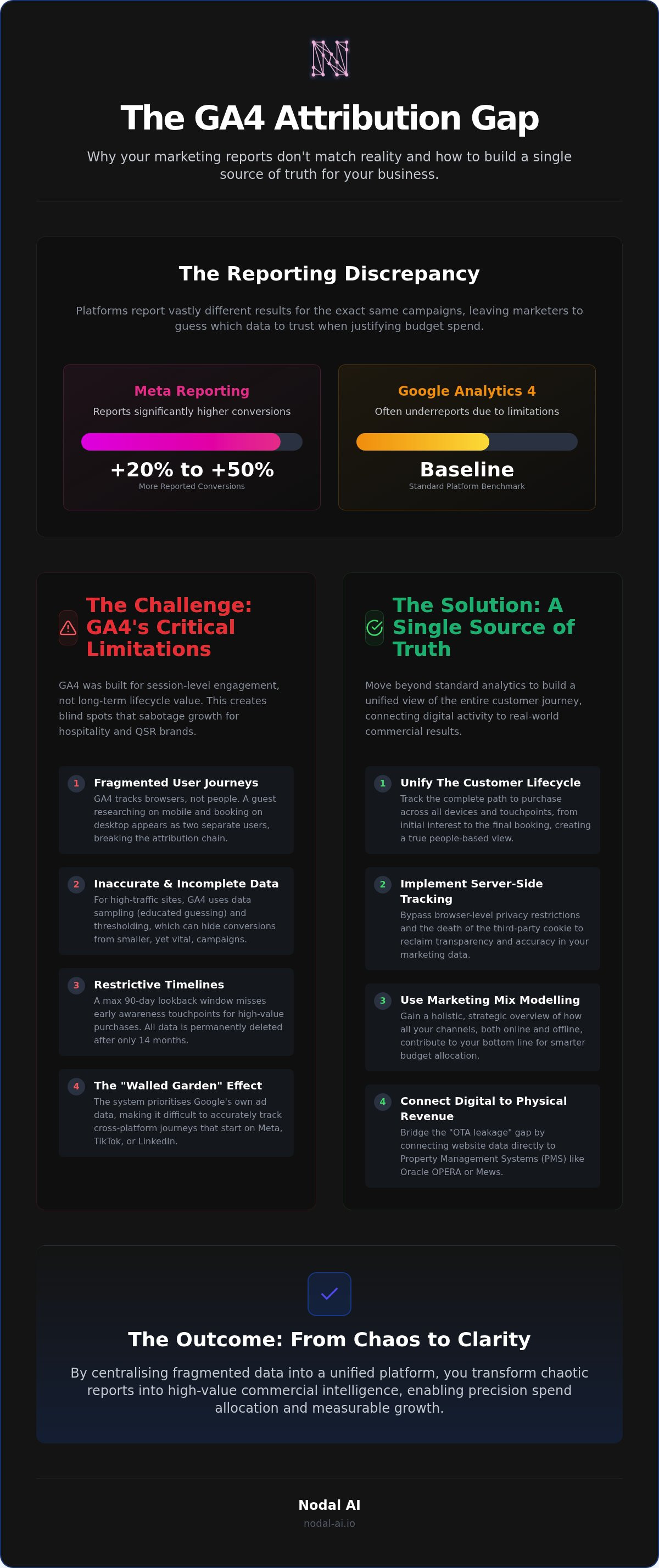
Meta reports between 20% and 50% more conversions than Google Analytics 4 for the exact same campaigns. This staggering discrepancy leaves most marketers guessing which platform to trust when justifying their budget. You likely realise that your digital reports rarely match the reality of your booking engine or CRM. It's an exhausting cycle of manual reconciliation that highlights the core google analytics attribution limitations facing modern hospitality and QSR brands in 2026.
We understand the pressure of defending your marketing spend to a board that only cares about the bottom line. This guide will show you how to bypass these critical blind spots and transform fragmented data into accurate commercial intelligence. We'll explore why GA4's silent reversion to last-click models and its restrictive 14-month data retention are sabotaging your growth. Finally, you'll learn how to establish a single source of truth that clarifies the customer journey and secures a higher ROI through precision spend allocation.
Key Takeaways
- Master the transition from simple session tracking to long-term lifecycle value by understanding where standard credit-assignment logic falls short in 2026.
- Identify the critical google analytics attribution limitations that cause data sampling errors and lead to inaccurate reporting for high-traffic hospitality brands.
- Eliminate "OTA leakage" and bridge the gap between digital clicks and physical revenue by connecting website data to PMS systems like Oracle OPERA or Mews.
- Implement server-side tracking and Marketing Mix Modelling to bypass browser-level privacy restrictions and reclaim transparency in your marketing spend.
- Centralise fragmented inputs into the Nodal Platform to transform chaotic data into high-value commercial intelligence and measurable growth.
Understanding the fundamental Google Analytics attribution limitations
At its core, attribution is a credit-assignment logic designed to map the path from a digital click to a commercial result. Within GA4, this logic attempts to distribute value across various touchpoints, yet it often fails to capture the full reality of the customer journey. The platform was engineered to measure session-level engagement, focusing on what happens within a specific visit rather than the long-term lifecycle of a human guest. This focus creates inherent google analytics attribution limitations that leave hospitality and QSR leaders with a fragmented view of their performance.
The system identifies browsers and devices, not people. When a potential guest researches a boutique hotel on their mobile during a commute but completes the booking on a desktop three days later, GA4 typically fails to connect these events. It treats them as two unrelated visitors. This disconnect transforms your data from a strategic asset into a chaotic series of siloed events, making it nearly impossible to justify your total marketing spend to the board. Without a unified view, you are essentially flying blind, relying on incomplete snapshots that ignore the nuanced way customers actually interact with your brand.
The shift from GA3 to GA4: Why attribution changed
The transition to GA4 introduced Data-Driven Attribution (DDA) as the primary model. While Google markets this as a leap forward, it simultaneously removed traditional Marketing attribution models like linear and time-decay. By stripping away these comparative frameworks, GA4 restricts your ability to view performance through different strategic lenses. You are forced to rely on an opaque algorithm that often obscures the true value of top-of-funnel awareness campaigns. This lack of transparency is one of the most frustrating google analytics attribution limitations for brands requiring granular control over their ROI.
The "Walled Garden" effect in Google’s ecosystem
Google prioritises its own advertising data, often at the expense of third-party channels. This creates a "walled garden" effect where cross-platform journeys starting on Meta, TikTok, or LinkedIn are difficult to track accurately. When data is siloed within these platforms, your reporting becomes skewed toward Google-owned channels, leading to poor spend allocation. To solve this, you must move beyond standard tools. Explore our guide on Mastering Marketing Attribution to understand how to unify these disparate signals into a single source of truth and reclaim your strategic independence.
Technical blind spots: Sessions, privacy, and data sampling
GA4 operates on a session-based model that often conflicts with the reality of complex consumer behaviour. In the hospitality sector, a guest rarely books a room in a single 30-minute sitting. Instead, they research over weeks, comparing amenities and prices across multiple devices. Because GA4 defaults to a 30-minute inactivity timeout, it treats a single customer's three-week decision process as dozens of disconnected sessions. This structural flaw is a primary driver of google analytics attribution limitations, as it fails to bridge the gap between initial interest and the final reservation.
Accuracy further degrades when your site experiences high traffic volumes. To maintain processing speed, GA4 employs data sampling, essentially "guessing" your total results based on a fraction of your actual data. For enterprise-level brands, this leads to skewed reports that do not reflect true commercial performance. Additionally, Google applies data thresholding to protect user privacy. If a specific campaign generates a low volume of conversions, GA4 may hide that data entirely. This means you could be making budget decisions based on invisible successes or failures, particularly in a landscape governed by strict UK GDPR regulations and cookieless browsing.
The lookback window constraint
The platform imposes a maximum 90-day lookback window for conversion credit. For high-value luxury stays or annual membership models, this timeframe is simply too narrow to capture the full path to purchase. You lose sight of the early awareness touchpoints that actually drove the eventual sale. To overcome this, visionary brands are moving toward predictive modelling to analyse historical data beyond these arbitrary limits and forecast future growth with precision.
Identity and cross-device challenges
Google Signals and User ID tracking are often touted as solutions, yet they remain heavily limited. Signals requires users to have personalised ads enabled, while User ID relies on a customer being logged in during every interaction. Most guests do not log in to browse. These gaps lead to a "broken journey" where mobile research and desktop booking appear unrelated. The result is a surge in "Direct" traffic, which acts as a catch-all for untracked referrals and obscures your true ROI. Stop guessing and start measuring; you can book a demo to see how we unify these broken signals into a single source of truth.
Why hospitality and QSR brands struggle with GA4 silos
Hospitality and QSR brands operate in a physical world that GA4 simply was not designed to map. One of the most pervasive issues is "OTA leakage," where a potential guest interacts with your brand website but ultimately completes their booking on a third-party platform like Expedia or Booking.com. GA4 views this as a lost conversion, failing to attribute the initial marketing effort to the eventual stay. This blind spot is a cornerstone of google analytics attribution limitations, as it prevents you from seeing the true influence of your direct-to-consumer strategy and leads to an undervalued marketing department.
For QSR operators, the challenge is even more physical. Measuring the impact of a digital promotion on actual footfall or in-store kiosk orders remains a significant hurdle. GA4 cannot natively account for external demand drivers like weather patterns or local stadium events. When a sudden rainstorm drives a surge in delivery orders, your analytics might credit a specific ad campaign instead of the environmental shift. This lack of context leads to skewed performance data and misinformed budget decisions that fail to account for the real-world variables driving your revenue.
The PMS and POS data gap
Revenue reported in GA4 is often "dirty" because it misses the operational reality of cancellations, refunds, and no-shows. While GA4 might show a successful transaction, your PMS (whether it is Oracle OPERA or Mews) might record a subsequent cancellation that never syncs back. This fragmentation causes marketing teams to optimise for gross bookings rather than net profit. It also leads to margin erosion; without a real-time link between occupancy and ad spend, you might continue bidding on expensive keywords for dates that are already sold out, wasting budget that could be deployed elsewhere.
Guest lifecycle vs. website visits
GA4 tracks "users" based on cookies and devices, whereas your business survives on "guests" tracked in hospitality-specific CRMs like Revinate. A website visit is only a fraction of the guest lifecycle. GA4 completely ignores ancillary spend, such as spa treatments, room service, or late check-out fees, which are vital for calculating true Customer Lifetime Value (CLV). To bridge this gap, you must move beyond simple session tracking and connect your digital touchpoints to your actual guest records. Consult our Definitive Guide to the Customer Journey to learn how to map these complex value streams and reclaim your commercial perspective.
Strategic alternatives to bridge the attribution gap
Relying solely on a website-centric tool is no longer a viable strategy for high-growth brands. To overcome the inherent google analytics attribution limitations, you must shift your focus from tracking sessions to measuring commercial impact. This requires a modular intelligence framework that combines granular tracking with high-level strategic modelling. By moving beyond the "walled garden," you can finally understand which channels are truly driving revenue and which are simply claiming credit for sales that would have occurred anyway.
One of the most effective ways to reclaim your data is through incrementality testing. This involves measuring the actual lift provided by your advertising spend compared to a baseline of organic performance. This process bypasses the common google analytics attribution limitations that often lead to over-crediting branded search or retargeting. A robust framework should focus on:
- Baseline performance: Establishing what sales occur without any ad spend.
- Channel lift: Identifying the specific contribution of each marketing touchpoint.
- Total commercial impact: Mapping the direct correlation between spend and net revenue.
When you combine this with Marketing Mix Modelling (MMM), you gain a top-down view of your entire ecosystem. This allows for better long-term planning and protects your margins from being eroded by over-investment in saturated channels. It turns your marketing from a cost centre into a predictable growth engine.
Implementing server-side GTM
Server-side tracking represents a fundamental shift in how you collect and process data. By moving the tracking logic from the user's browser to your own server, you bypass the privacy restrictions that frequently cause data loss in GA4. This approach significantly improves data accuracy and site speed, as it reduces the weight of third-party scripts on your pages. Crucially, it empowers you with total control over your data flow, ensuring strict UK GDPR compliance by filtering sensitive information before it ever reaches a vendor. Professional implementation is essential here to ensure your infrastructure remains scalable and free from technical debt. If you are looking to build the internal skills needed to navigate these technical requirements yourself, you can explore One-on-One Digital Coaching with Achieve With Nate Movement to gain personalized digital confidence.
The power of data consolidation
True commercial intelligence requires a single view of performance. This means integrating your PMS, POS, and CRM data with your ad platform metrics to create a unified narrative. When your operational systems communicate with your marketing tools, you move from reactive reporting to proactive growth recommendations. This level of optimisation ensures you are bidding on the right guests at the right time. Automated reporting eliminates the need for manual data stitching, saving your team hours of tedious labour every week. This transformation allows you to focus on high-value strategy rather than fighting with fragmented spreadsheets.
Book a demo to see how we unify your performance data
Moving beyond GA4 with the Nodal Platform
The transition from a website measurement tool to a commercial growth engine requires a platform built for the complexities of modern hospitality. While we have explored the various google analytics attribution limitations that hinder your reporting, the Nodal Platform serves as the modular intelligence engine designed to connect these fragmented dots. It transforms chaotic inputs into high-value outputs, providing the clarity you need to make confident investment decisions. By unifying your digital signals with real-world operational data, you move from guessing to knowing.
Unlike generic analytics tools, our platform features deep, native integrations with the systems that actually run your business. We connect directly to industry-standard platforms such as Oracle OPERA, Mews, and Synxis. This level of integration ensures that your marketing performance is always tethered to actual revenue, not just website events. The results speak for themselves; for instance, Ovolo Hotels achieved a 15.3% reduction in acquisition costs by leveraging these unified insights. We have also seen brands realise a 24.5% increase in ROAS by identifying and eliminating inefficient spend that GA4 simply could not detect.
Our AI-driven audience segmentation takes this a step further by identifying high-propensity guest segments before they even book. By analysing historical patterns across your PMS and CRM, the platform highlights the individuals most likely to drive long-term value. This proactive approach bypasses the traditional google analytics attribution limitations by focusing on the human guest rather than the anonymous browser session. It empowers your team to target the right audience with surgical precision, ensuring every pound spent is an investment in profitable growth.
Commercial intelligence for hospitality leaders
Nodal AI solves one of the most pressing challenges for hotel and restaurant groups: managing "need periods." By identifying low occupancy or quiet shifts early, the platform provides actionable growth recommendations to fill those gaps. You can finally see which promotions actually increase net revenue and which merely shift existing demand. This transparency allows you to protect your margins during peak times and drive volume when you need it most. We invite you to book a demo to see your own data unified in a single, high-level perspective.
Transforming data into profitable growth
The journey from fragmented GA4 reports to strategic clarity is about more than just better tracking; it is about a cognitive upgrade for your entire organisation. Our mission is simple: help you make more and waste less. By establishing a single source of truth, you replace the anxiety of manual data stitching with the confidence of automated, accurate reporting. For London enterprises looking to scale efficiently in 2026, the choice is clear. Stop fighting with limited tools and start building a future-facing analytics infrastructure that rewards your ambition with measurable returns.
Master Your Marketing Intelligence
Navigating the complexities of digital measurement in 2026 requires more than just standard website tracking. You have seen how session-based silos and restrictive lookback windows create significant google analytics attribution limitations that obscure your true ROI. By moving beyond these technical blind spots, you can transform chaotic data into a streamlined growth engine that prioritises human guests over anonymous clicks. It is the difference between simply observing traffic and actively driving commercial performance across every property in your portfolio.
We have helped hospitality and QSR brands achieve an average 24.5% increase in ROAS by replacing fragmented reporting with a single source of truth. As winners of Gold at the Performance Marketing Awards, we provide the modular architecture necessary to connect digital touchpoints with real-world revenue from your PMS and POS systems. It is time to replace manual reconciliation with automated clarity and start making decisions that actually impact your bottom line. You have the vision; we have the intelligence to make it a reality.
Book a demo of the Nodal Platform today
Take the first step toward total transparency and watch your marketing assets transform into active participants in your business success. You deserve a partner that turns complexity into growth and invites you to lead with confidence.
Frequently Asked Questions
What are the main limitations of Google Analytics 4 attribution?
GA4 is primarily built on a session-centric model that fails to account for the long-term customer lifecycle. These google analytics attribution limitations include a lack of cross-device connectivity and an inability to track the guest journey beyond the browser. This results in fragmented reporting that ignores the complex, multi-week research process common in the hospitality and QSR sectors.
Why does GA4 revenue data not match my actual sales or CRM?
GA4 captures front-end digital interactions while your CRM or Property Management System (PMS) tracks the final commercial outcome. The platform often misses late-stage adjustments such as cancellations, refunds, or on-site ancillary spend. This creates a disconnect between reported website conversions and the actual net profit recorded in your operational systems.
Can I still use multi-touch attribution in GA4?
Google has removed traditional multi-touch models like linear and time-decay, leaving Data-Driven Attribution (DDA) as the default option. If your account does not meet the necessary conversion thresholds, the system silently reverts to a last-click model. This restriction limits your ability to compare different strategic views and often undervalues early awareness touchpoints.
How does the 90-day lookback window affect my marketing analysis?
A 90-day window is frequently too narrow for high-value hospitality bookings or annual membership decisions. Any touchpoints that occurred before this period are ignored, making your top-of-funnel campaigns appear less effective than they truly are. This leads to poor budget allocation and a failure to recognise the true drivers of long-term growth.
What is data thresholding in GA4 and why is my data missing?
Data thresholding is a privacy measure that hides specific reporting rows when conversion volumes are too low to ensure user anonymity. This often occurs when you apply granular filters or segments to your data. It results in invisible successes or failures, preventing you from making fully informed decisions on niche campaigns.
How can I track offline conversions or in-store visits with Google Analytics?
Tracking offline visits in GA4 requires complex manual uploads or reliance on Google Signals, which often lacks the precision needed for QSR footfall. These methods struggle to connect a digital ad click to a physical in-store order or a walk-in reservation. A unified intelligence engine is required to bridge this physical-digital gap with commercial accuracy.
Is there a way to integrate my PMS data with marketing analytics?
You can integrate your PMS data by using a modular intelligence platform like Nodal AI. We connect directly with systems such as Oracle OPERA and Mews to provide a single view of performance. This ensures your marketing decisions are based on net revenue and occupancy rather than just website clicks.
What is the best alternative to Google Analytics for enterprise attribution?
The Nodal Platform is the premier alternative for enterprises looking to overcome google analytics attribution limitations. It offers industry-specific integrations and predictive modelling that GA4 cannot provide. By centralising fragmented data, it transforms chaotic inputs into high-value growth recommendations and measurable commercial returns.


