

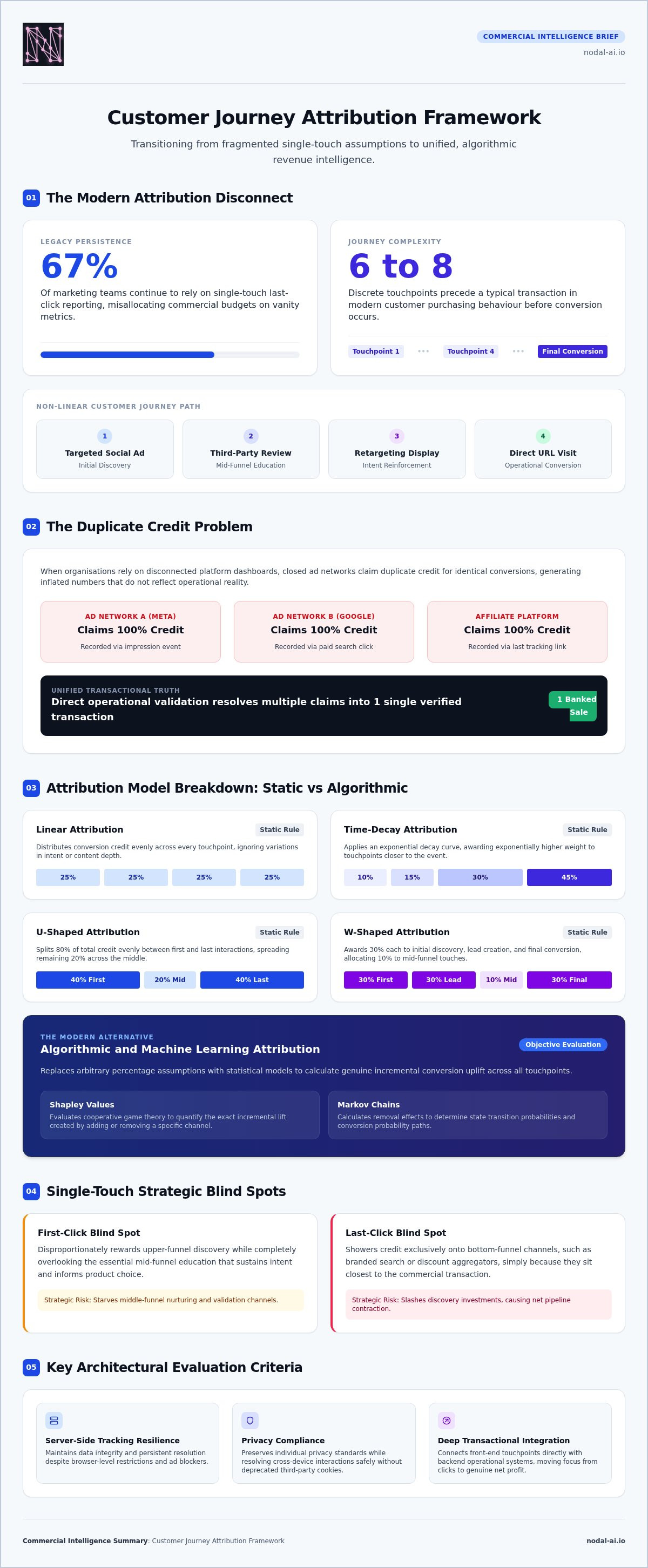
Roughly 67% of marketing teams still rely on last-click reporting, even though modern customer journeys average six to eight touchpoints before a transaction occurs. If you're tired of ad networks taking duplicate credit for the same conversion while operational systems tell a different story, you already know the cost of fragmented data. Siloed analytics conceal your real acquisition drivers and drain commercial budgets on vanity metrics. Deploying the right customer journey attribution software isn't just an exercise in marketing measurement: it's the foundation for transparent commercial intelligence.
You already recognise that single-touch models can't capture the reality of modern buying behaviour across disconnected channels. In this 2026 guide, you'll discover how customer journey attribution software connects fragmented touchpoints into verifiable revenue intelligence, directly linking initial discovery to back-end transaction engines. We'll examine why static rules have become obsolete, evaluate algorithmic and hybrid platforms, and provide a clear framework to measure genuine incremental profit across every commercial channel.
Key Takeaways
- Understand why single-touch reporting misallocates commercial budgets, and how modern customer journey attribution software unifies fragmented touchpoints into verifiable revenue intelligence.
- Explore how algorithmic frameworks like Shapley values and Markov chains replace deprecated static rules to calculate genuine incremental conversion uplift.
- Identify critical technical evaluation criteria, focusing on server-side tracking resilience, privacy compliance, and deep transactional system integration.
- Follow a practical deployment blueprint to connect front-end digital marketing directly with operational engines, shifting your focus from vanity metrics to net profit margins.
What Is Customer Journey Attribution Software and Why Does Last-Click Fail?
At its core, customer journey attribution software is an advanced measurement solution that tracks, analyses, and assigns financial value to every touchpoint driving commercial outcomes. Modern purchasing journeys rarely move in clean, straight lines. A buyer might discover a brand via a targeted social ad, read reviews on a third-party aggregator, click a display retargeting banner, and finally convert through a direct URL days later. Managing these dozens of discrete interactions across fragmented environments requires an independent, objective measurement system.
Relying on platform-specific reporting inevitably distorts your commercial view. Ad networks operate as closed ecosystems: Meta claims credit for an impression, Google Ads claims the same conversion via paid search, and an affiliate platform records a third duplicate claim. Summing these disconnected dashboards produces impossible numbers, showing inflated conversion totals that never reach your actual bank account. Customer journey attribution software eliminates this redundancy by linking front-end digital interactions directly to verified operational transaction records, establishing genuine commercial accountability.
The Mechanics of Modern Multi-Touch Attribution
Modern multi-touch attribution replaces static assumptions with algorithmic evaluation across complete customer interaction paths. Rather than viewing touchpoints in isolation, it assesses how channels interact to influence the final purchase. By applying persistent identity resolution, the software connects fragmented identifiers across different devices, privacy-safe browsers, and offline interactions. Examining comprehensive marketing attribution models reveals how advanced systems map crucial pre-conversion research behaviours, preserving full visibility over complex buyer journeys.
Why Traditional Attribution Creates Blind Spots
Single-touch frameworks create severe strategic blind spots. First-click rules disproportionately reward initial discovery while completely overlooking the mid-funnel education that sustains customer intent. Last-click reporting commits the opposite error: it showers credit on bottom-funnel channels, such as branded search or discount aggregators, simply because they sit closest to the till. When organisations slash upper-funnel investments based on skewed last-click reports, net revenue inevitably contracts as the inbound pipeline starves. Clear attribution protects overall growth by highlighting every touchpoint that contributes to bottom-line profitability.
Core Attribution Models: Rule-Based vs Algorithmic and AI Approaches
Selecting the right attribution framework determines whether your reporting mirrors actual commercial dynamics or merely reinforces internal biases. Traditional models operate on static rules, applying fixed mathematical percentages to predefined steps in a funnel. While simple to deploy, static frameworks break down quickly when buyer behaviour diverges from linear paths. Advanced customer journey attribution software addresses this by using algorithmic evaluations and machine learning, shifting your perspective from retroactive credit allocation to forward-looking revenue optimisation. You can dive deeper into these frameworks through our guide on mastering marketing attribution.
Static Rule-Based Attribution Models
Static rules divide conversion credit based on predetermined positions across the user path:
- Linear: Distributes conversion credit evenly across every touchpoint, ignoring that a low-intent social impression rarely matches the influence of an in-depth product review.
- U-Shaped and W-Shaped: Emphasise specific milestone moments. U-shaped splits 80% of credit evenly between first and last interactions, whereas W-shaped awards 30% each to first discovery, lead creation, and final conversion, spreading the remaining 10% across mid-funnel touches.
- Time-Decay: Applies an exponential decay curve that gives exponentially higher weighting to touchpoints that occur closer to the transaction event.
Data-Driven and Machine Learning Attribution
Modern machine learning models abandon arbitrary percentages entirely. Instead, they calculate the incremental probability shift that each interaction creates by comparing successful conversion paths against journeys that failed to convert. This reveals the actual mathematical lift generated by individual touchpoints.
Crucially, genuine commercial intelligence requires looking beyond website clicks. A surge in hotel bookings or retail transactions might stem from an unseasonal heatwave, local stadium concerts, or sudden changes in transport access rather than digital ad spend. By factoring in these external market signals alongside marketing touchpoints, platforms separate natural consumer demand from marketing-driven revenue. Adding predictive modelling enables commercial teams to simulate future budget allocation scenarios instead of simply cataloguing historical events. To see how these algorithmic layers operate in practice, explore the core capabilities of the Nodal Platform.
Essential Capabilities to Evaluate in Customer Journey Attribution Platforms
Most evaluation checklists fail because they treat attribution as an isolated marketing dashboard. Practical commercial intelligence demands a far more integrated architecture. High-performance customer journey attribution software must bridge the gap between front-end digital acquisition and back-end operational transaction engines. It needs to ingest messy data, resolve fragmented guest identities, and validate incremental profit rather than taking passive conversion credit. For a comprehensive look at how modern intelligence engines unify these systems, explore our analysis of ai marketing analytics.
Data Ingestion and Systems Integration
Your attribution platform cannot operate in a silo. It requires deep, native connectors into operational software, such as Property Management Systems (PMS), Point of Sale (POS) networks, and transactional booking engines, alongside advertising channels like Google Ads and Meta. Bi-directional data synchronisation ensures commercial transaction records continuously enrich your marketing campaigns. The software must automatically standardise incoming event streams, deduplicating customer profiles and resolving tracking discrepancies across every channel.
Privacy Compliance and Governance Frameworks
With third-party tracking severely degraded across major web browsers and mobile operating systems, client-side tags provide unreliable measurements. Modern platforms rely on first-party server-side tracking, hashing customer identifiers securely to maintain signal resilience without compromising privacy. Ensure the software strictly enforces UK GDPR standards through automated consent mapping and auditable data retention policies. You can examine best practices for structuring these protocols in our data governance framework guide.
Commercial Actionability and Automated Reporting
Retrospective reporting offers little value if it fails to guide next week's expenditure. The best customer journey attribution software translates raw analytical data into prescriptive commercial recommendations:
- Automated Reporting: Replaces manual spreadsheet consolidation with real-time performance summaries delivered across all leadership tiers.
- Dynamic Budget Allocation: Identifies underperforming channels instantly, highlighting opportunities to redeploy capital into high-margin campaigns.
- Scenario Planning: Leverages predictive modelling to simulate return on ad spend shifts before committing commercial budgets.
Step-by-Step Implementation: Deploying Journey Attribution Across Complex Stacks
Deploying advanced measurement infrastructure requires careful alignment between commercial operations and technical tracking. Rushing into implementation without clear taxonomy produces messy dashboards that reinforce existing data silos. When rolling out customer journey attribution software, organisations must treat the deployment as an enterprise integration project rather than a simple script installation. Following a disciplined deployment roadmap ensures that every recorded interaction ties back to verified business revenue.
Step 1 to Step 2: Architecture Planning and Data Audit
Begin by mapping every digital channel, physical point of sale, and transaction engine currently operating across the enterprise. Audit all legacy analytics tags, CRM workflows, and ad network configurations to establish baseline performance metrics.
Next, enforce a uniform tracking standard across all commercial touchpoints:
- Standardise UTM parameter taxonomies across organic, direct, and paid campaigns.
- Establish consistent event-naming conventions across front-end websites and booking engines.
- Map cross-channel discovery pathways following the operational strategies detailed in our customer journey guide.
Step 3 to Step 4: System Integration and Attribution Calibration
Once your tracking taxonomy is clean, establish resilient server-side tracking pipelines. Connect these data streams directly into your operational systems, including booking platforms, PMS databases, and CRM records. This direct link bypasses client-side browser restrictions and eliminates duplicate conversion reporting.
Calibrating your attribution engine requires ingesting historical transaction data to train algorithmic models on established consumer patterns. Run dual tracking environments for 30 to 60 days. This parallel run lets you compare legacy single-touch figures against multi-touch attribution outputs, revealing where ad networks previously claimed duplicate conversions for the same booking.
Step 5: Operationalising Insights Across Commercial Teams
Measurement only creates enterprise value when it directs commercial capital toward profitable growth. Configure automated alerts that flag underperforming campaigns or unexpected demand surges in real time. Align weekly media spend adjustments directly with algorithmic incrementality scores to fund genuine profit drivers.
Unifying Journey Attribution and Commercial Performance with Nodal Platform
Bridging the disconnect between marketing investments and operational profit requires a shift toward unified commercial intelligence. Rather than stopping at digital clicks, robust customer journey attribution software must connect the entire commercial ecosystem. Nodal Platform functions as a modular intelligence engine, merging front-end discovery channels with operational booking engines, customer databases, and external demand drivers to deliver total commercial clarity.
Connecting Fragmented Data into Verifiable Commercial Intelligence
Fragmented data environments frequently leave commercial leaders guessing which channels drive genuine enterprise value. Nodal Platform consolidates operational PMS and POS data directly with GA4, Google Ads, and Meta into a clear, centralised view. This direct integration reveals where direct booking initiatives succeed, helping operators curb online travel agency (OTA) commission leakage and protect net profit margins. Discover how these capabilities function across our core features.
Proven Commercial Results and Scalable Architecture
Connecting disconnected touchpoints directly to back-end transaction ledgers produces immediate financial improvements. When boutique hospitality group Ovolo Hotels deployed this unified architecture, they achieved a 15.3% reduction in acquisition costs alongside a 24.5% increase in ROAS. The deployment also delivered a 20% increase in paid search revenue and a 13.8% lift in room bookings. Automated reporting eliminates hours of manual spreadsheet compilation, empowering commercial teams to act quickly on verified data. See how businesses scale their measurement using Nodal Platform.
Transforming Attribution Insights into Confident Budget Decisions
Attribution calculations remain incomplete if they ignore the real-world context shaping consumer behaviour. Nodal Platform integrates external market signals, including hyper-local events, weather conditions, and transport demand, directly into its predictive modelling. Accounting for these external factors prevents teams from misattributing broader demand surges to isolated marketing campaigns. By combining customer journey attribution software with automated audience segmentation, commercial teams move beyond speculative ad spend to deploy capital where it produces measurable incremental profit.
Transform Fragmented Touchpoints into Confident Commercial Growth
Single-touch heuristics and disconnected dashboards no longer serve complex commercial operations. Transitioning to advanced customer journey attribution software replaces cross-channel guesswork with objective, algorithmic clarity. By connecting operational systems like PMS, POS, and CRM directly to your advertising channels, you eliminate platform reporting redundancies and illuminate the real paths driving business transactions.
This unified intelligence turns chaotic reporting into automated growth recommendations and validated profitability. Enterprise operators like Ovolo Hotels have already proven the commercial power of this architecture, achieving a 15.3% reduction in acquisition costs and a 24.5% increase in ROAS. Replacing speculative attribution with verified data ensures commercial capital always flows towards genuine incremental value.
With transparent data foundations in place, your teams can eliminate budget waste, protect operating margins, and scale revenue performance with total confidence.
Frequently Asked Questions
What is the main difference between marketing attribution and customer journey mapping?
Marketing attribution measures the financial value of each interaction, while customer journey mapping visualises the complete user experience across touchpoints. Mapping shows the sequence of brand encounters, revealing friction points and user sentiment from discovery to purchase. Attribution applies algorithmic weighting to those interactions, assigning specific conversion credit to individual marketing channels. Combining both disciplines enables commercial teams to understand not only how customers move through the sales pipeline, but exactly which marketing activities generate profitable returns.
Why do ad platform dashboards report different conversion numbers than attribution software?
Ad networks operate as closed ecosystems that naturally favour their own media inventory. When a buyer interacts with a Meta ad, clicks a Google search link, and converts, both networks take 100% of the conversion credit. They also rely on expansive view-through windows that count passive impressions as conversions. Independent customer journey attribution software eliminates this duplication by reconciling cross-channel interactions against verified transactional records, creating a single, objective source of conversion truth.
How does customer journey attribution software operate without third-party cookies?
Modern customer journey attribution software bypasses third-party cookie restrictions by adopting server-side tracking pipelines and first-party identity resolution. Instead of relying on vulnerable browser scripts that ad blockers frequently disrupt, data is transmitted directly from your web server to the analytics platform. Interactions are stitched together using consented, hashed first-party customer identifiers, such as encrypted emails or unique transaction IDs. This ensures resilient tracking while maintaining strict compliance with UK GDPR standards.
Can customer journey attribution track offline transactions and direct bookings?
Yes, modern platforms integrate directly with operational back-end databases, including Point of Sale (POS) networks, Property Management Systems (PMS), and CRM databases. When an offline transaction or direct reservation occurs, the system matches unique guest identifiers or booking reference codes back to earlier digital touchpoints. This bi-directional integration reveals the full omni-channel conversion path, demonstrating how digital awareness campaigns influence in-person footfall, phone reservations, and direct on-property revenue.
How long does it take to implement enterprise customer journey attribution software?
Enterprise deployment typically takes between four and eight weeks, depending on data stack complexity. The initial two weeks focus on auditing tracking taxonomies, standardising UTM naming conventions, and establishing data governance rules. Subsequent weeks involve setting up server-side pipelines, connecting operational booking systems, and ingesting historical data to calibrate algorithmic models. Running a four-week dual-tracking period ensures total parity between legacy reporting tools and the new attribution engine before complete migration.
What is the difference between multi-touch attribution and marketing mix modelling?
Multi-touch attribution (MTA) is a bottom-up measurement method that tracks individual customer pathways to assign fractional revenue credit to specific digital interactions. It's ideal for intra-week campaign optimisation and audience targeting. In contrast, marketing mix modelling (MMM) is a top-down econometric approach that evaluates aggregated sales data against macro variables, offline advertising, and broader market trends. Leading commercial organisations run both models together to validate tactical campaign efficiency against quarterly portfolio growth.
How does predictive attribution assist in allocating forward-looking marketing budgets?
Predictive attribution moves beyond historical reviews by forecasting how shifts in commercial expenditure will impact future revenue. By analysing historical journey patterns alongside external market conditions, such as local events, weather shifts, and transport demand, predictive algorithms model projected returns across different investment scenarios. Commercial teams can simulate budget reallocations before executing campaigns, ensuring capital is proactively funnelled into channels with the highest potential for genuine incremental profit.


