

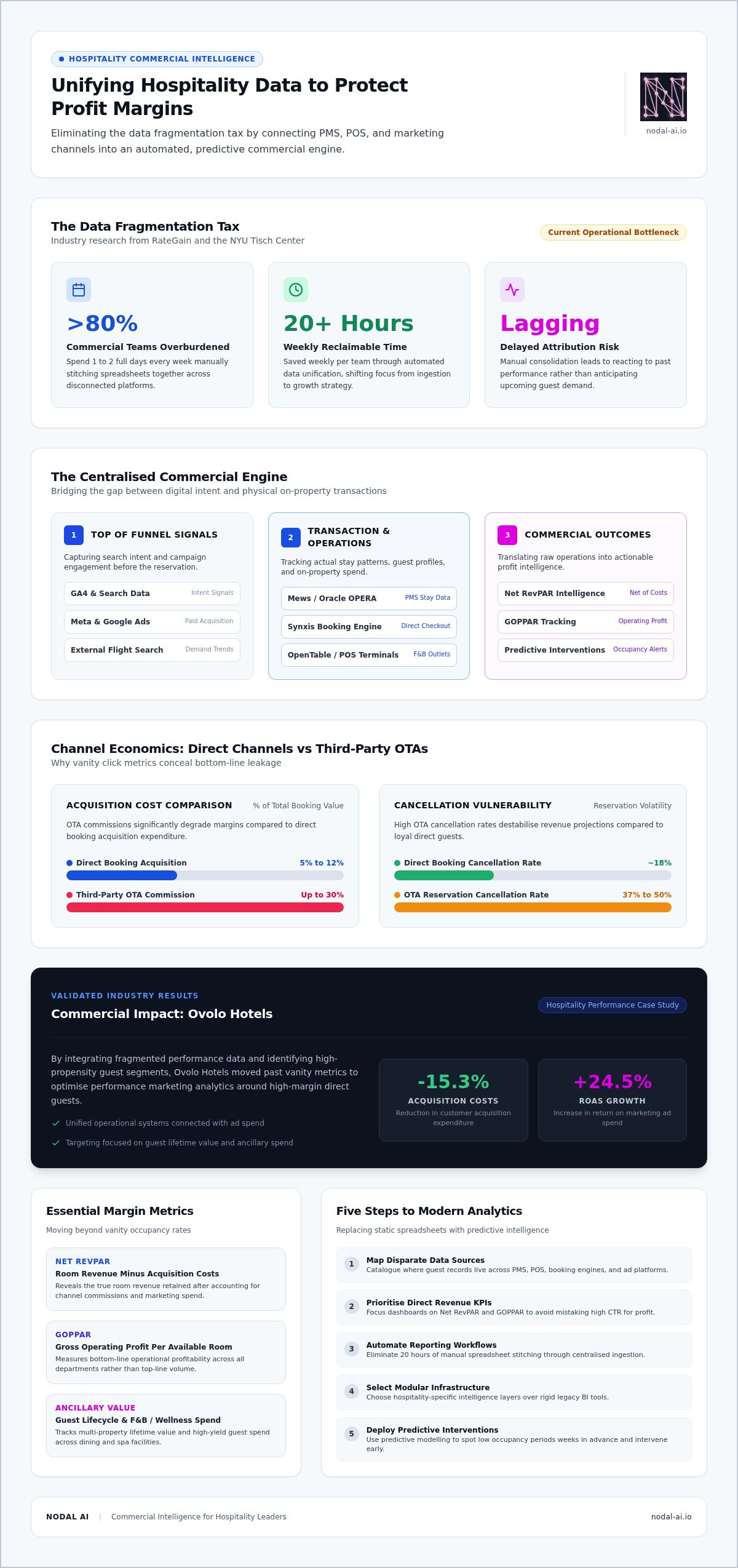
More than 80% of hotel commercial teams spend one to two full days every week manually stitching reports together across disconnected systems. If you're tired of valuable insights being trapped in silos like your PMS, POS, and CRM, setting up marketing analytics dashboards is the first step toward reclaiming your time. This manual grind often leads to inaccurate attribution and wasted ad spend that erodes your profit margins. It's time to stop the data fragmentation tax from draining your team's productivity.
We'll show you how to transform fragmented hospitality data into a centralised commercial engine that drives direct bookings. In this guide, you'll learn how to unify your performance data to save over 20 hours a week through automation. We'll explore moving from static spreadsheets to predictive insights that identify low occupancy periods weeks in advance. By the end, you'll understand how brands like Ovolo Hotels achieved a 15.3% reduction in acquisition costs by connecting the dots across their hospitality performance.
Key Takeaways
- Discover how to unify fragmented data from your PMS, POS, and CRM into a single commercial engine that protects your profit margins.
- Identify the essential KPIs that prioritise high-margin direct bookings over expensive third-party channel revenue.
- Master the five-step process for setting up marketing analytics dashboards to replace manual spreadsheets with automated, real-time intelligence.
- Compare modular intelligence layers against legacy BI tools to ensure your infrastructure can scale with hospitality-specific integrations.
- Learn how to use predictive modelling to identify low-occupancy periods and deploy surgical marketing interventions before they impact your bottom line.
The Challenge of Data Fragmentation in Hospitality Analytics
Hospitality marketing isn't just about clicks and impressions; it's about heads in beds and covers in restaurants. Most general marketing tools fail because they only see half the picture. Your guest journey might start on a social ad, but it ends in a Property Management System (PMS) or a Point of Sale (POS) terminal. When these systems don't talk to each other, you're left with a fragmented view of your commercial performance. Setting up marketing analytics dashboards that actually work requires bridging the gap between digital intent and physical transactions.
Without this connection, you're operating in the dark. You might see a high click-through rate on a Meta campaign, but if those guests aren't actually checking in or spending at the bar, that ad spend is effectively wasted. Data silos don't just cause headaches; they erode profit margins by hiding the true cost of acquisition. Moving from reactive reporting to proactive commercial intelligence is the only way to protect your bottom line against rising OTA commissions and operational costs.
Identifying Your Disparate Data Sources
To build a centralised commercial engine, you must first map where your data lives. Your marketing stack, including GA4, Meta, and Google Ads, provides the "top of funnel" signals. However, the real value lies in integrating operational systems. Platforms like Mews or Oracle OPERA hold the keys to guest stay patterns and room revenue. When you capture transaction data from booking engines like Synxis or restaurant platforms like OpenTable, you start to see the full picture. Connecting these dots allows you to identify whether a specific campaign is attracting high-value guests or simply filling rooms with low-yield traffic. You move from guessing which channels drive revenue to knowing exactly where your most profitable guests come from.
The Hidden Cost of Manual Reporting
Research from RateGain and the NYU Tisch Center reveals that over 80% of hotel commercial teams spend one to two full days each week manually stitching reports together. This isn't just a productivity drain; it's a strategic liability. Manual data ingestion is prone to human error, leading to decisions based on flawed numbers. More importantly, by the time you've consolidated your spreadsheets, the opportunity to optimise your budget has passed. A delay in reporting often means you're reacting to last week's trends instead of anticipating next week's demand. Real-time commercial intelligence allows you to pivot instantly, moving spend away from underperforming channels and toward direct bookings. Transitioning to automated systems ensures your team spends their time on growth strategies rather than data entry.
Defining Key Metrics for Commercial Intelligence
Most marketing metrics are vanity projects. In hospitality, true intelligence lies in the gap between top-line revenue and bottom-line profit. Setting up marketing analytics dashboards that prioritise commercial outcomes means moving beyond simple occupancy rates. You need to track Net RevPAR, which is room revenue minus acquisition costs, and GOPPAR (Gross Operating Profit Per Available Room) to understand your true performance. These metrics transform your data from a passive record into an active commercial engine.
Setting up marketing analytics dashboards correctly ensures your data starts working for you. It allows you to measure guest lifecycle value across multiple properties and identify which guests are likely to spend more on ancillary services like F&B or wellness. This level of granularity is essential for protecting your margins against rising operational costs. When you see the full picture, you can stop chasing volume and start chasing value.
Beyond Vanity Metrics: Focusing on Direct Revenue
Click-through rates (CTR) tell you very little about your bottom line. A campaign might have a high CTR but lead to low-yield bookings or, worse, high cancellation rates. Research shows that OTA reservations exhibit cancellation rates between 37% and 50%, while direct bookings typically sit around 18%. If your dashboard doesn't distinguish between these channels, your revenue projections are fundamentally flawed. Effective direct booking acquisition costs typically range from 5% to 12% of total booking value, whereas OTA commissions can climb as high as 30%. Brands like Ovolo Hotels have used these insights to achieve a 15.3% reduction in acquisition costs and a 24.5% increase in ROAS. By identifying high-propensity guest segments, you can optimise your performance marketing analytics to target the guests who drive the highest long-term value.
Integrating External Signals for Predictive Insights
Your dashboard shouldn't only look at internal data. Modern commercial leaders integrate external signals like local flight search volumes, weather conditions, and macroeconomic foreign exchange movements. This predictive approach allows you to identify "need periods" four to six weeks in advance. If flight searches from a key feeder market are spiking but your direct bookings remain flat, you have a surgical opportunity to deploy ad spend before your competitors react. Incorporating local events and FX rates helps you adjust your commercial strategies automatically. This moves your team away from reactive discounting and toward proactive, data-driven growth that secures your profit margins regardless of market volatility.
Selecting the Right Infrastructure: Modular vs Legacy BI
Traditional business intelligence (BI) tools are often built for generic retail or SaaS models. They struggle with the unique complexities of hospitality, such as fragmented guest profiles and multi-property reporting. When setting up marketing analytics dashboards, choosing between a monolithic legacy system and a modern modular architecture is the most critical decision you'll make. A modular approach ensures your data remains agile, allowing you to connect disparate sources without the heavy engineering overhead associated with older systems.
Consistency is the foundation of commercial intelligence. This requires a robust semantic layer, a central library that ensures every department defines key metrics like Net RevPAR or acquisition cost identically. Without this, your marketing team might report one figure while your revenue manager sees another, leading to friction rather than growth. Modern platforms provide no-code interfaces that empower non-technical teams to build their own reports, removing the bottleneck of waiting for IT or data scientists to run a simple query.
Why Generic Business Intelligence Tools Often Fail Hotels
Generic BI tools require significant customisation to handle the hospitality customer journey. Mapping a guest from an initial Google search to a specific room booking in Mews or Oracle OPERA is notoriously difficult in standard software. These tools often lack native integrations with hospitality-specific software, forcing you to build and maintain expensive custom data pipelines. While some open-source solutions claim to be cost-effective, the hidden reality is high engineering maintenance. You end up paying for developers to fix broken connections rather than using that budget to drive direct bookings. This technical debt slows your response to market changes and prevents real-time budget optimisation.
The Advantage of a Modular Intelligence Engine
Modular intelligence engines are designed to be flexible. You can configure specific modules for operational, demand, or guest insights based on your current needs. This architecture is particularly powerful for multi-location groups and global brands that need to centralise data across diverse regions. When you're setting up marketing analytics dashboards with a modular focus, you can optimise your commercial stack property by property. This reduces implementation time and allows you to realise value in weeks rather than months. Security and data governance are built into the core, ensuring guest data remains protected across every touchpoint. This transition from rigid legacy systems to a modular engine turns your data into a scalable asset that grows with your business.
Five Steps to Setting Up Your Marketing Analytics Dashboard
Success in hospitality intelligence isn't achieved by simply plugging in tools. It requires a disciplined, multi-step process to ensure your data is clean, connected, and commercially relevant. Setting up marketing analytics dashboards that drive real value starts with moving away from fragmented spreadsheets and toward a unified logic. This transition ensures that every pound spent on advertising is tracked through to the final check-out in your PMS.
Begin by auditing your current data quality and identifying critical gaps. Establishing a single source of truth for all commercial data is non-negotiable; your marketing, revenue, and operational teams must all look at the same numbers. Once the foundation is set, configure automated data ingestion from your PMS, such as Mews or Oracle OPERA, and your primary marketing channels. This automation allows you to design visualisations that drive specific business actions, such as identifying when to push direct booking incentives. Finally, test and refine your attribution model to ensure accuracy across the entire guest journey.
Auditing and Cleaning Your Historical Data
Garbage in always results in garbage out. Before you can trust your new dashboard, you must address broken tracking and inconsistent naming conventions that have likely plagued your historical reports. Historical data ingestion is essential for trend analysis, but it only works if the data is standardised. Define strict data governance rules to ensure long-term reliability. This process might feel tedious, but it's the only way to realise the full potential of your commercial engine and avoid making expensive decisions based on flawed metrics.
Mapping the Multi-Touch Customer Journey
The hospitality booking path is rarely linear. A guest might discover your property on Instagram, research on TripAdvisor, and finally book directly after receiving an email. Relying on last-click attribution is a legacy mistake that ignores these vital touchpoints. By visualising the path from initial search to direct booking, you gain a clearer understanding of guest behaviour. This perspective allows you to allocate budget to the channels that actually start the conversation, not just the one that finishes it. You can learn more about mastering marketing attribution to refine this process further. Setting up marketing analytics dashboards with this multi-touch focus is how you move from passive tracking to active profit protection.
Book a demo to see the Nodal Platform in action
Driving Growth with Nodal AI: From Insights to Action
Visualising your data is only the first step toward commercial excellence. The real transformation occurs when you move from observing trends to executing automated, data-driven interventions. The Nodal Platform acts as a cognitive upgrade for your organisation; it turns chaotic inputs from your PMS and CRM into high-value commercial outputs. By setting up marketing analytics dashboards that leverage our modular intelligence engine, you stop being a passenger to your data and start becoming its pilot. This shift ensures that your marketing spend is always tethered to concrete financial performance and long-term stability.
Our approach goes beyond generic business intelligence by providing specific growth recommendations tailored to the hospitality sector. We don't just show you that occupancy is low; we identify the exact audience segments and channels required to fill those rooms profitably. This level of proactive intelligence is why industry leaders trust us to connect the dots across their entire commercial stack. When your data becomes an active participant in your business, you realise the relief that comes from resolving complexity with a single, authoritative view of performance.
Automating Your Performance Marketing Reports
Manual reporting is a relic of the past that drains your team's productivity. By automating complex reporting, Nodal AI saves marketing teams over 20 hours per week, allowing them to focus on strategy rather than spreadsheets. You can set up automated alerts for budget pacing and performance dips, ensuring you never overspend on low-yielding campaigns. These insights are easily shared across departments, from marketing to revenue management, creating a unified front against margin erosion. You can explore our automated reporting features to see how we streamline the transition from raw data to boardroom-ready insights.
Leveraging AI-Driven Growth Recommendations
The Nodal Platform uses predictive modelling to identify early signs of low-occupancy need periods four to six weeks in advance. Instead of reactive discounting, the system suggests optimising ad spend toward high-propensity audience segments that drive direct bookings. This surgical precision is a core part of our performance marketing analytics. The results are measurable and significant; for example, Ovolo Hotels achieved a 15.3% reduction in acquisition costs and a 24.5% increase in ROAS using our intelligence engine. This isn't just about efficiency; it's about building a competitive, forward-thinking commercial engine that protects your margins in any market condition. Ready to scale your operations? Book a demo with Nodal AI to see how we can transform your hospitality data into a centralised commercial engine.
Scale Your Direct Booking Commercial Engine
Transforming your hospitality data from a series of disconnected silos into a centralised commercial engine is the most effective way to protect your profit margins. By setting up marketing analytics dashboards that bridge the gap between your PMS and digital channels, you replace manual guesswork with predictive intelligence. This transition allows your team to stop reacting to past occupancy trends and start anticipating future demand periods with surgical precision.
Global luxury hospitality brands trust Nodal AI to provide this cognitive upgrade. Our modular architecture ensures that every property in your portfolio benefits from tailored insights that drive direct revenue. We have already helped partners like Ovolo Hotels achieve a 24.5% increase in ROAS, proving that clarity leads directly to commercial growth. It is time to reclaim your team's productivity and turn your data into your most active business partner.
Book a Nodal AI Demo to Optimise Your Commercial Performance
The journey from data fragmentation to total clarity is a path toward long-term stability and competitive advantage. Take the first step toward a more efficient, profit-led future today.
Frequently Asked Questions
What are the most important metrics for a hospitality marketing dashboard?
Net RevPAR and GOPPAR are the most critical metrics because they account for acquisition costs and operational expenses. While vanity metrics like occupancy matter, you should also track TRevPAR to capture ancillary spend across F&B and wellness. A high-performing dashboard identifies guest lifetime value and helps you understand which segments drive the highest yield. This focus on profitability ensures your commercial strategy protects margins instead of just chasing volume.
How do I integrate my PMS data with my marketing analytics?
Integrating PMS data requires a modular intelligence engine that connects to systems like Mews or Oracle OPERA through secure APIs. This process unifies operational data with marketing signals from GA4 and Meta. Setting up marketing analytics dashboards this way allows you to track a guest from their initial search to their final checkout. It eliminates the manual effort of stitching spreadsheets together and creates a single, reliable source of truth.
Is it possible to track direct bookings versus OTA bookings in one view?
You can absolutely track direct versus OTA bookings in a single view by consolidating your booking engine and PMS data. This comparison is vital because OTA commissions often reach 30%, while direct acquisition costs typically stay between 5% and 12%. Seeing these channels side by side helps you identify where you are losing revenue to OTA leakage. It also allows you to monitor cancellation discrepancies, as third-party bookings often have much higher cancellation rates.
How much time does it take to set up a marketing analytics dashboard?
The timeline for setting up marketing analytics dashboards depends on the complexity of your tech stack, but modular platforms typically deliver results in weeks. Legacy BI tools often take months due to custom engineering requirements. Nodal AI uses a modular architecture to accelerate implementation, focusing on high-impact integrations first. Professional implementation fees cover the technical setup and data cleansing required to ensure your historical trends are accurate and actionable from day one.
Can AI really help predict future booking trends for my hotel?
AI-driven predictive modelling helps you anticipate demand by analysing internal guest patterns alongside external signals like weather and flight searches. This technology identifies low-occupancy periods six weeks in advance, giving you time to deploy surgical marketing interventions. By incorporating local events and foreign exchange movements, the system provides growth recommendations that help you maintain occupancy without relying on last-minute discounting. It transforms your data from a passive history into a forward-looking commercial engine.
What is the difference between multi-touch attribution and last-click?
Last-click attribution gives all credit to the final touchpoint, while multi-touch attribution maps every step of the guest journey. A guest might discover your hotel on social media and research on TripAdvisor before booking via an email link. Multi-touch attribution ensures you understand the value of that initial social discovery. This prevents you from cutting budgets for top-of-funnel channels that are actually driving your long-term direct booking growth and protecting your margins.
Do I need a data scientist to manage my marketing dashboards?
You don't need a dedicated data scientist to manage your commercial intelligence if you use a platform with a no-code interface. Nodal AI is designed for commercial leaders and marketing teams who need results without deep technical specialisation. The platform automates complex data processing and provides clear growth recommendations in a user-friendly format. This accessibility ensures that your team spends their time executing strategies rather than managing data pipelines or writing complex queries.
How can automated reporting improve my return on ad spend (ROAS)?
Automated reporting improves ROAS by providing real-time alerts for budget pacing and campaign performance dips. Instead of waiting for a weekly manual report, you can pivot spend instantly toward high-propensity guest segments. This proactive approach helped Ovolo Hotels achieve a 24.5% increase in ROAS while reducing overall media spend. Automation removes the risk of human error and ensures your ad budget is always working to drive the most profitable direct bookings across every location.


