

Your historical data is not a rearview mirror; it is a high-definition lens into your future revenue. For too long, hospitality brands have watched margins erode through high OTA commissions while fragmented data sits idle across PMS and CRM systems. You understand the frustration of pouring budget into campaigns that target low-propensity guests because your current signals are too noisy to filter. Optimizing marketing campaigns using predictive analytics is the definitive path to reclaiming your direct booking share in 2026. It's time to stop reacting to the market and start anticipating it.
This guide provides the clarity you need to replace manual guesswork with automated precision. You'll discover how to transform chaotic inputs into a streamlined growth engine that increases ROAS and eliminates budget waste. We deliver a clear roadmap to implement predictive modelling that identifies your highest-value guests before they even begin their search. By integrating external signals and unifying your internal systems, you will realise a significant reduction in acquisition costs and secure a competitive advantage that lasts. Let's move from fragmented insights to a unified strategy for growth.
Key Takeaways
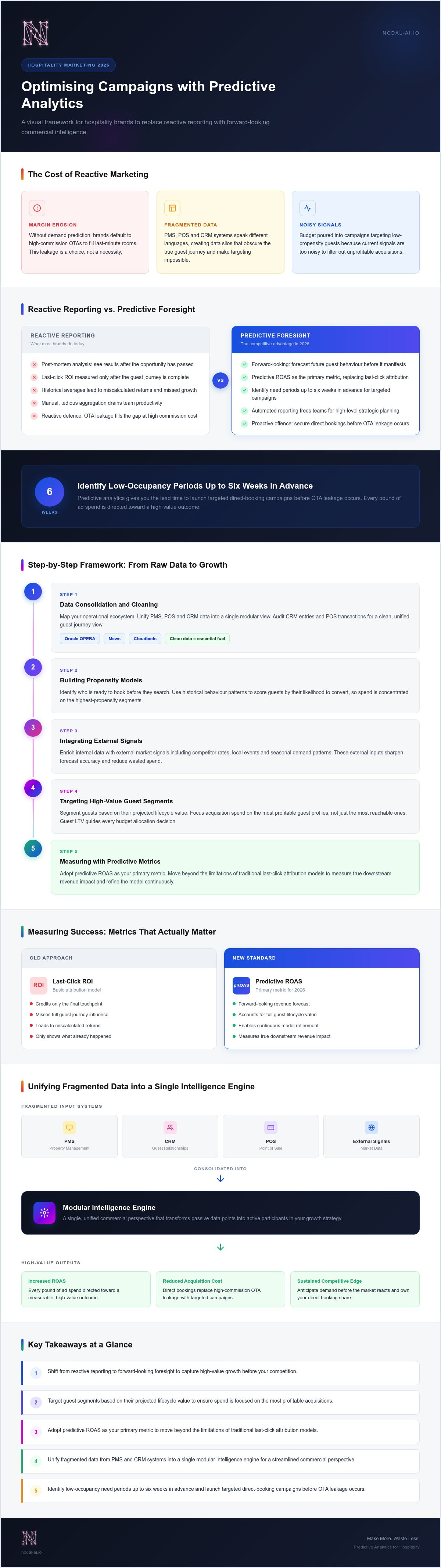
- Shift from reactive reporting to forward-looking foresight to capture high-value growth before your competition.
- Implement a clear roadmap for optimizing marketing campaigns using predictive analytics to eliminate budget waste and reclaim OTA commissions.
- Target guest segments based on their projected lifecycle value to ensure your spend is focused on the most profitable acquisitions.
- Adopt predictive ROAS as your primary metric to move beyond the limitations of traditional last-click attribution models.
- Unify fragmented data from PMS and CRM systems into a single modular intelligence engine for a streamlined commercial perspective.
The Shift from Reactive Reporting to Predictive Marketing Foresight
Traditional marketing reporting is a post-mortem. By the time you see your last-click ROI, the opportunity to influence the guest journey has already passed. In 2026, relying on historical averages leads to miscalculated returns and missed growth. You need a cognitive upgrade. At its core, predictive analytics is the process of using historical data to forecast future guest behaviour. It allows you to move from reactive defense to proactive offense by anticipating needs before they manifest as searches.
The cost of sticking to the old ways is clear: margin erosion. When you can't predict demand, you default to high-commission OTAs to fill rooms at the last minute. This leakage is a choice, not a necessity. Traditional reporting tells you what happened yesterday, but it offers no protection for tomorrow. By embracing Commercial Intelligence, you replace fragmented manual reporting with a unified vision of your revenue potential. It's about turning chaotic inputs into high-value outputs with calm efficiency, ensuring your assets are deployed where they generate the highest measurable returns.
Overcoming the Fragmented Data Problem
Most hospitality brands struggle with disconnected systems. Your PMS, POS, and CRM systems often speak different languages; they create data silos that obscure the true guest journey. These gaps make optimizing marketing campaigns using predictive analytics nearly impossible because your truth is scattered across different platforms. When systems remain fragmented, marketing becomes a series of manual, tedious tasks that drain productivity. You must consolidate your revenue and marketing data into a single, modular view. This transformation turns passive data points into active participants in your business strategy, providing the transparency required for high-level decision-making.
Why Hospitality Brands Need Predictive Capabilities Now
The UK market is facing intense pressure from rising acquisition costs. You can't afford to spend blindly on low-propensity guests. By optimizing marketing campaigns using predictive analytics, you can identify need periods, those specific windows of low occupancy, up to six weeks in advance. This foresight gives you the lead time to launch targeted direct-booking campaigns before the OTA leakage occurs. It's about making more and wasting less. By identifying these signals early, you secure your margins and ensure every pound of ad spend is working toward a high-value outcome. This isn't just about reporting. It's about mastering your commercial future through total clarity.
A Step-by-Step Framework for Optimising Campaigns with Predictive Modelling
Stop guessing. Start winning. The "Make More, Waste Less" philosophy isn't just a slogan; it's a commercial necessity in a high-commission environment. Moving from raw data to actionable growth recommendations requires a structured journey that prioritises clarity over complexity. Before you run sophisticated models, you must ensure clean data ingestion to avoid the "garbage in, garbage out" trap. Automated reporting then steps in to handle the manual, tedious tasks of data aggregation, freeing your team for high-level strategic planning. This process replaces the anxiety of uncertainty with the confidence of a streamlined, results-oriented roadmap.
Step 1: Data Consolidation and Cleaning
Map your operational ecosystem to identify every valuable signal. Whether you use Oracle OPERA, Mews, or Cloudbeds, your internal systems hold the keys to guest behaviour. You must ensure your marketing attribution data is surgical across all digital touchpoints. Without a robust data governance framework that ensures accuracy, even the most advanced models will fail to deliver the clarity you need. Clean data is the essential fuel for optimizing marketing campaigns using predictive analytics.
Establish a rigorous validation process to maintain long-term insight quality. This involves auditing your CRM entries and POS transactions to ensure a unified view of the guest journey. When your data is consolidated, your passive assets transform into active participants in your growth strategy. This foundation allows you to move away from fragmented silos and toward a single, high-level commercial perspective.
Step 2: Building Propensity Models
Identify who is ready to book before they even visit an OTA. By building propensity models, you define guest segments based on historical booking patterns and real-time intent signals. You aren't just looking at past stays; you are forecasting future demand. Incorporate external signals such as local events, FX rates, and flight demand to give your models a cognitive upgrade. By using predictive analytics, you pinpoint which guest segments are most likely to book direct, allowing you to focus your energy on high-value acquisitions.
Step 3: Executing Growth Recommendations
Turn insights into action with immediate campaign adjustments. Shifting spend to high-value dates shouldn't be a manual task that takes weeks to approve. You must automate the flow of insights to your paid media teams to enable real-time bidding on the guests that matter most. Specific Nodal Platform features enable these automated updates, ensuring your strategy remains agile as market conditions shift. Implementing this framework is the most effective way of optimizing marketing campaigns using predictive analytics to drive measurable ROAS. If you want to see how this framework applies to your specific property, you can explore a tailored demo to begin your transformation.
Targeting High-Propensity Guest Segments to Maximise ROAS
Traditional segmentation is static. It treats every guest as a one-time transaction rather than a long-term asset. Optimising marketing campaigns using predictive analytics allows you to calculate the true Guest Lifecycle Value (GLV), moving your strategy beyond the first purchase. You identify segments that generate the highest value for specific properties, whether that is a boutique hotel in London or a coastal resort. By identifying disengagement signals early, you reduce churn risk in your membership models, transforming a potential loss into a retained revenue stream.
Personalised customer journeys are no longer a luxury; they are a requirement for 2026. When you understand the statistical probability of a guest returning, you can tailor your outreach to match their specific stage in the lifecycle. This replaces generic, spray-and-pray tactics with a calm efficiency that respects the user's time and your budget. It's a cognitive upgrade for your entire marketing department, allowing you to act as a visionary leader rather than a reactive participant.
Predicting Guest Value and Ancillary Spend
Total bed yield is about more than the nightly room rate. Stay extensions and on-property spend often define the difference between a break-even guest and a high-margin advocate. Use predictive modelling to forecast which segments will drive F&B or spa revenue before they even arrive. Marketing messages must reflect these nuances. A hostel guest values community and communal F&B; a luxury guest seeks privacy and high-end wellness. Predictive insights ensure you speak the right language to the right person, turning a generic offer into a personalised journey that maximises total revenue per available room.
Reducing Waste by Excluding Low-Propensity Audiences
Waste is the enemy of performance. You must identify early signs of low-value segments to suppress them from high-cost bidding environments. Optimising marketing campaigns using predictive analytics ensures your ad spend is focused on need periods where occupancy is low, rather than burning budget during peak times when your property is already full. Propensity modelling is the statistical likelihood of a specific guest taking a desired action. This level of transparency allows you to achieve results like a 24.5% increase in ROAS, replacing the anxiety of manual bidding with the confidence of high-level optimisation. By excluding audiences with a low probability of conversion, you protect your margins and ensure every pound spent is an investment in growth.
Measuring Success: Moving Beyond Basic ROI to Predictive Metrics
Success in 2026 isn't found in a spreadsheet of last month's results. It's built on foresight. Traditional metrics like historical ROAS tell you what happened, but they don't tell you why it will happen again. Predictive ROAS, however, provides a forward-looking perspective on your commercial potential. By optimizing marketing campaigns using predictive analytics, you gain the ability to measure the 'Direct Booking Contribution' of every touchpoint. This transparency replaces the anxiety of budget allocation with the confidence of data-driven certainty.
Guest journeys are no longer linear. A traveller might see an ad on social media, research on an OTA, and finally book on your site three weeks later. Multi-touch attribution is essential for understanding these complex paths. It ensures you attribute value correctly, preventing you from cutting spend on the very channels that initiate the high-value guest journey. You must treat your data as an active partner in your decision-making process.
The KPIs That Drive Hospitality Growth
Focus on metrics that reflect long-term stability rather than short-term spikes. Track your Average Booking Value (ABV) and acquisition cost per direct booking to maintain a healthy margin. You must also monitor your 'OTA Leakage Rate'. This metric reveals how many potential guests start their journey on your website but finish on a third-party platform. By evaluating the impact of ai marketing analytics, you can identify precisely where these friction points occur and resolve them before they cost you a booking. This is how you turn chaotic inputs into high-value outputs.
Case Study: Real-World Results of Predictive Optimisation
The transformation from fragmented data to high-value output is best illustrated by the success of Ovolo Hotels. By connecting disparate data sources through the Nodal engine, they achieved a 15.3% reduction in acquisition costs. This wasn't just about saving money; it was about optimizing marketing campaigns using predictive analytics to find more profitable guests. It replaced manual, tedious tasks with streamlined, high-level perspectives.
The results were measurable and immediate. Ovolo saw a 24.5% increase in ROAS and a 20% increase in paid search revenue through smarter spend allocation. These figures aren't just statistics; they represent the power of a cognitive upgrade for the entire organisation. By personifying their passive data assets, they turned chaotic inputs into a competitive advantage that continues to drive growth in 2026. They moved from the anxiety of manual labor to the calm efficiency of automated precision.
Book a demo to see these metrics in action
Future-Proofing Your Marketing Strategy with the Nodal Platform
Data fragmentation is the silent killer of hospitality margins. You've seen how predictive metrics and propensity modelling transform fragmented inputs into high-value outputs. The Nodal Platform is the modular intelligence engine designed to unify these chaotic sources into a single, actionable perspective. It's time to stop fighting with disconnected spreadsheets and start leading with commercial clarity. By optimizing marketing campaigns using predictive analytics, you move from the anxiety of manual data handling to the confidence of high-level strategic oversight.
Our mission is to consolidate your fragmented systems into a unified growth engine. We don't just provide another tool; we offer a cognitive upgrade for your entire organisation. This transformation turns your passive data assets into active participants in your revenue strategy. You'll realise the relief that comes from resolving complexity and replacing it with streamlined, visionary leadership that secures your competitive edge in 2026.
The Power of Modular Intelligence
Your business isn't a monolith, so your technology shouldn't be either. Our modular architecture allows you to configure specific Guest, Commercial, and Operational modules to fit your exact hospitality use case. Whether you're managing a boutique collection or a global brand, the platform integrates effortlessly with existing systems like Cloudbeds, Synxis, and SevenRooms. This connectivity solves the 'Walled Garden' problem in digital attribution by providing a transparent view of the entire guest journey. When you're optimizing marketing campaigns using predictive analytics, these integrations ensure your spend is always tethered to concrete business outcomes and long-term stability.
Take the Next Step Toward Commercial Clarity
Blind spots in your guest journey are missed opportunities for profit. We encourage you to audit your current data fragmentation and identify exactly where your visibility drops off. Moving away from manual, tedious tasks allows your team to focus on the high-level perspective that drives direct booking growth. A consultation will reveal how our predictive modelling solves specific occupancy challenges by identifying need periods up to six weeks in advance. It's the most efficient way to eliminate budget waste and reclaim your margins from high-commission platforms.
Book a demo with Nodal AI to transform your marketing performance and secure your future growth.
Master Your Commercial Future
The journey from fragmented data to streamlined growth is a commercial requirement in 2026. You now have the roadmap to replace the anxiety of manual reporting with the confidence of high-level foresight. By optimizing marketing campaigns using predictive analytics, you transform passive data into an active growth engine that identifies high-value guests before your competitors do. This shift ensures every pound of ad spend works toward a measurable return.
The results of this cognitive upgrade are concrete. Hospitality leaders are already achieving a 15.3% reduction in acquisition costs and a 24.5% increase in ROAS by leveraging a modular architecture. You can realise these same efficiencies by unifying your PMS and CRM systems into a single, actionable view. It's time to reclaim your margins from OTA leakage and secure long-term stability through automated precision.
Book a demo to see the Nodal Platform in action
Take control of your revenue destiny today. Your future growth is waiting to be unlocked.
Frequently Asked Questions
What is the primary difference between predictive analytics and traditional marketing reporting?
Traditional marketing reporting acts as a post-mortem; it tells you what happened yesterday but leaves you guessing about tomorrow. Predictive analytics transforms historical data into forward-looking foresight. It uses statistical models to forecast future guest behaviour, allowing you to anticipate demand before it manifests. While traditional reports focus on vanity metrics, predictive insights provide a cognitive upgrade that identifies revenue opportunities and need periods six weeks in advance.
How much historical data do I need to start using predictive modelling effectively?
Effective predictive modelling typically requires at least 12 to 24 months of historical data to account for seasonal trends and guest booking cycles. This depth allows the Nodal engine to identify patterns across different trading periods and property types. If your data is more recent, you can still gain value by focusing on shorter-term propensity models. The goal is to turn your existing assets into active participants in your growth strategy.
Can predictive analytics help reduce my reliance on OTAs like Booking.com or Expedia?
Yes, reducing OTA leakage is a core strength of the Nodal Platform. By identifying high-propensity guest segments who are likely to book direct, you can focus your ad spend on high-value acquisitions rather than paying high commissions. This strategy has helped brands like Ovolo Hotels achieve a 15.3% reduction in acquisition costs. You replace reactive discounting with a proactive direct booking focus that protects your profit margins.
Is it possible to use predictive analytics if my guest data is currently stored in multiple systems?
Consolidating fragmented data is exactly why the Nodal Platform exists. Our modular architecture connects disparate sources like Oracle OPERA, Mews, and Salesforce into a single, actionable view. You no longer need to manually aggregate spreadsheets across PMS, POS, and CRM systems. This unification resolves the complexity of your guest journey, providing the transparency required for optimizing marketing campaigns using predictive analytics across your entire portfolio.
How does predictive modelling account for external factors like weather or flight demand?
Predictive modelling incorporates external signals like weather, FX rates, and flight demand to refine demand forecasting. These variables act as bridges between internal booking data and the real-world conditions that influence guest decisions. By integrating these signals, the platform provides a more accurate view of upcoming need periods. This allows you to adjust your bidding strategies in real-time, ensuring your marketing spend is always aligned with actual market demand.
What are the first steps for a marketing team to implement predictive growth recommendations?
The first step is to audit your current data fragmentation to identify blind spots in your guest journey. Once you map your primary data sources, such as your PMS and booking engine, you can begin the consolidation process. Your team should then move from manual data handling to high-level strategic oversight by implementing automated reporting. This transition allows you to focus on executing growth recommendations that drive immediate commercial value.
How does predictive analytics improve Return on Ad Spend (ROAS) specifically for hotels?
Predictive analytics improves ROAS by identifying and targeting guests with the highest propensity to convert. Instead of spending on low-value segments, you focus your budget on guest segments that generate the highest lifecycle value. Optimizing marketing campaigns using predictive analytics helps you avoid overspending during peak occupancy and reallocates that budget to need periods. This precision led to a 24.5% increase in ROAS for our partners through smarter spend allocation.
What is the typical timeframe to see measurable results from predictive campaign optimisation?
You will see immediate improvements in data transparency and reporting efficiency within the first 30 days. Measurable commercial results, such as reduced acquisition costs and increased direct bookings, typically manifest within three to six months as the models learn from your specific guest patterns. This timeframe allows the platform to refine its propensity scoring and automate growth recommendations. You move from the anxiety of manual labor to the calm efficiency of streamlined results.


