

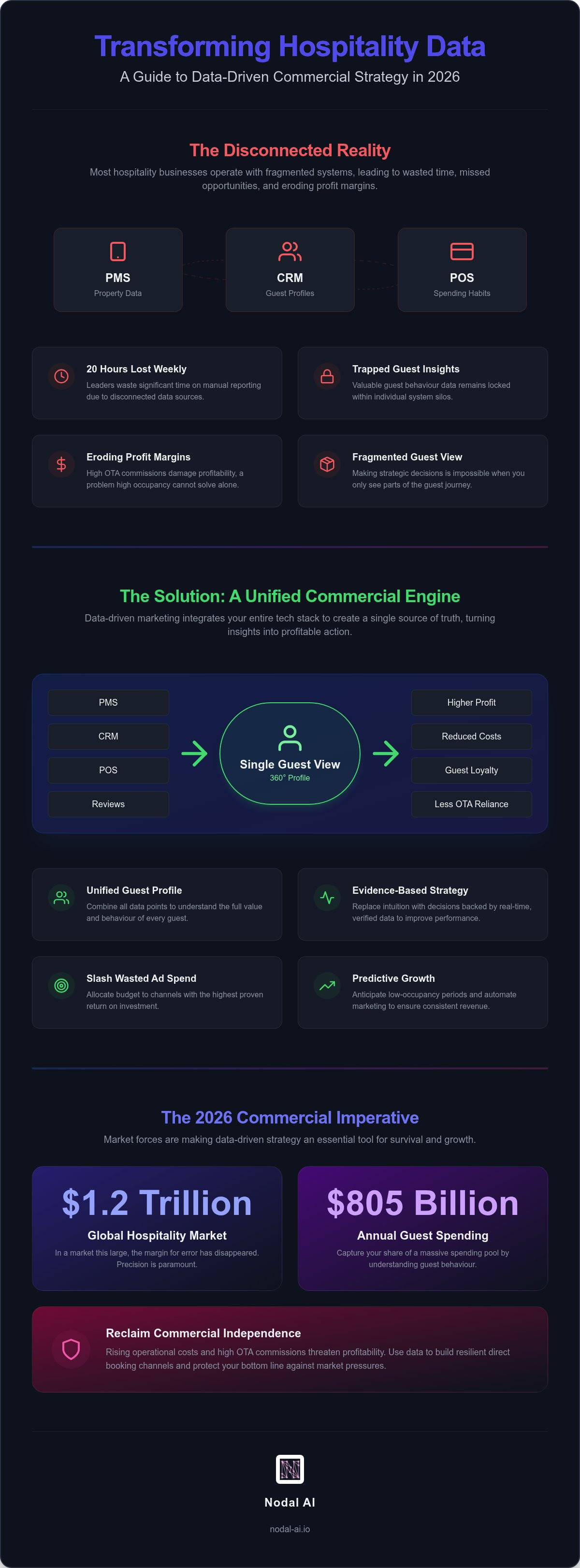
Your Property Management System isn't just a digital ledger; it's a dormant engine waiting for a spark. Most hospitality leaders lose 20 hours every week to manual reporting while their most valuable guest insights remain trapped in isolated silos. You've likely felt the sting of high occupancy rates that don't translate to profit because OTA commissions are eroding your margins. It's a common struggle to connect the dots when your data feels like a chaotic puzzle. Implementing data-driven decision making in marketing is the only way to reclaim your commercial independence and protect your bottom line in 2026.
This guide will teach you how to transform fragmented inputs into a unified strategy that slashes wasteful ad spend and increases profit margins. We'll preview how to build a single view of your guest, use predictive insights to fill low-occupancy periods, and navigate 2026 privacy mandates like the Indiana Consumer Data Protection Act with total confidence. It's time to stop guessing and start optimising your guest journey for measurable returns. Realise the full potential of your integrated systems and turn your data into your most competitive asset.
Key Takeaways
- Bridge the gap between isolated PMS and CRM systems to create a single, unified view of your guest performance.
- Transition from intuition to evidence-based intelligence by implementing data-driven decision making in marketing across every commercial channel.
- Replace outdated last-click attribution with multi-touch models that reveal the true value of your digital touchpoints.
- Build a modular architecture that identifies high-propensity segments to reduce OTA dependency and protect your profit margins.
- Use predictive modelling to anticipate low-occupancy periods and automate budget reallocation for a more resilient revenue stream.
What is Data-Driven Decision Making in Marketing?
Data-driven decision making in marketing is the deliberate process of using verified guest and operational data to guide every commercial move you make. It replaces the "spray and pray" tactics of the past with a surgical approach to revenue growth. Instead of guessing which creative might work, you use evidence-based intelligence to understand exactly what drives a booking. This transition is no longer optional. With the global hospitality market valued at over $1.2 trillion in 2026, the margin for error has vanished. You need to know, not hope, that your strategy will deliver.
The core of this strategy lies in your ability to harness Big Data from your PMS, POS, and CRM systems. In 2026, the focus has shifted toward real-time processing. You don't just need to know what happened last month; you need to know how current flight demand or shifting FX rates will impact your occupancy next week. Processing these signals instantly allows you to pivot your budget to the channels that offer the highest return. This level of agility is what separates market leaders from those struggling with stagnant growth.
The Evolution from Gut Feel to Strategic Intelligence
Traditional hospitality marketing was often tethered to seasonal trends and historical averages. While these benchmarks provide context, they lack the precision needed for a competitive edge. Strategic intelligence moves beyond these limitations by incorporating external demand signals into your daily workflow. This creates a state of total commercial clarity. You gain the confidence to stop following the crowd and start leading your market with campaigns that are mathematically likely to succeed. It's about turning passive information into an active participant in your business growth.
Why Hospitality Leaders are Prioritising Data in 2026
Rising operational costs are placing unprecedented pressure on bottom lines. Although guest spending is expected to reach nearly $805 billion this year, margin erosion remains a critical threat due to a heavy reliance on Online Travel Agencies (OTAs). Forward-thinking leaders are using data-driven decision making in marketing to reclaim their independence. By analysing direct booking patterns, you can identify high-propensity segments and target them with precision. This reduces your acquisition costs and puts you back in control of your distribution.
This focus on data does more than just fill rooms; it improves the entire guest lifecycle value. When you understand the nuances of guest behaviour, you can create personalised journeys that foster long-term loyalty. This ensures that more of your revenue stays within your business rather than being lost to third-party commissions. If you want to see how these insights look in practice, you can book a demo to explore the Nodal Platform's capabilities and start your journey toward total commercial intelligence.
Consolidating Fragmented Hospitality Data into a Single View
Most hospitality operators are drowning in data but starving for insights. Your guest information is likely scattered across a legacy PMS like Oracle OPERA, a modern POS, and a disconnected CRM. This fragmentation creates blind spots that make data-driven decision making in marketing nearly impossible. When your booking engine doesn't talk to your restaurant system, you lose the ability to see the full value of a guest. You're left guessing which segments are truly profitable and which are merely filling rooms at a loss.
A modular architecture solves this by acting as a universal translator for your tech stack. Instead of replacing your existing systems, you connect them. This integration allows you to realise the Advantages of Data-Driven Decision-Making, transforming static reports into active commercial intelligence. When your data flows freely between Mews and your marketing analytics, your reporting becomes faster and more accurate. You stop wasting 20 hours a week on manual spreadsheets and start making moves that move the needle.
Breaking Down the Silos: PMS, POS, and CRM
The typical hotel or restaurant operates in a state of digital isolation. Guest preferences sit in the CRM while their spending habits remain locked in the POS. Creating a single source of truth bridges this divide. It allows you to see that the guest who complained on TripAdvisor is the same one who spent £500 in your bar last night. Integrating reputation data from Google Reviews and TripAdvisor into your central view ensures your marketing reflects the reality of the guest experience. This clarity is the foundation of any successful direct booking strategy.
The Role of External Signals in Demand Forecasting
Internal data only tells half the story. To truly optimise your spend, you must account for external signals like weather patterns, flight demand, and shifting tourism trends. Predictive models that incorporate these variables allow for much sharper demand forecasting. For example, a London hotel can monitor real-time flight searches from key markets like New York or Dubai. If searches for Heathrow arrivals spike for a specific weekend, you can instantly increase your ad spend for those regions. This proactive approach ensures you capture high-intent traffic before your competitors even realise the opportunity exists. To see how these dots connect in real-time, you can explore the Nodal Platform features and start building your unified view today.
Beyond Last-Click: Multi-Touch Attribution and Predictive Growth
Last-click attribution is a vanity metric that masks the true drivers of your revenue. It rewards the final touchpoint while ignoring the weeks of inspiration and research that preceded it. In hospitality, where booking windows often span several weeks, this narrow view leads to misallocated budgets and missed opportunities. You might be overfunding your branded search while starving the top-of-funnel channels that actually feed your pipeline. Transitioning to multi-touch attribution is the only way to ensure your data-driven decision making in marketing reflects the reality of how guests actually book.
Multi-touch models reveal the hidden value in your digital ecosystem. They allow you to see how a social media impression, an email newsletter, and a retargeting ad work in concert to secure a high-value reservation. By assigning fractional credit to each interaction, you gain the clarity needed to scale what works and cut what doesn't. This shift transforms your marketing from a series of isolated bets into a unified, high-performing engine. It replaces the anxiety of guesswork with the confidence of evidence-based investment.
Mapping the Modern Hospitality Customer Journey
The path to a direct booking is rarely linear. Guests bounce between devices, platforms, and review sites before finally committing to a stay. You must understand these nuances to capture demand effectively. For a deeper dive into these strategies, consult the definitive guide to the customer journey. Proper mapping allows you to identify exactly where guests drop off and where they need an extra nudge. This level of detail ensures your budget targets the channels that drive the most significant commercial value, rather than just the ones that appear at the end of the chain.
Predictive Modelling for Scalable Growth
Predictive growth moves you from reactive fixes to proactive wins. By using historical data and external signals, you can identify "need periods" or low-occupancy gaps before they even occur. Implementing predictive modelling allows you to trigger automated campaigns that fill these rooms well in advance. AI-driven recommendations also help you segment high-propensity guest groups, ensuring your offers reach those most likely to convert. For businesses with membership or loyalty models, these same algorithms can identify churn risk by spotting subtle shifts in engagement. You can then intervene with personalised messaging to protect your recurring revenue and maintain long-term stability.
Implementing a Data-Driven Framework: A Five-Step Guide
Effective data-driven decision making in marketing requires a structured roadmap to move from fragmented chaos to commercial clarity. You cannot build a visionary strategy on a foundation of broken data. By following a rigorous implementation framework, you replace the anxiety of manual labor with the confidence of automated precision. This journey transforms your marketing department from a cost centre into a high-performance revenue engine.
Follow these five essential steps to establish your framework:
- Audit your data sources: Identify every touchpoint where guest data is captured and pinpoint critical gaps in your current tracking.
- Select a modular platform: Choose an intelligence engine that integrates seamlessly with your existing hospitality tech stack rather than forcing a total replacement.
- Establish commercial KPIs: Move beyond vanity metrics like "likes" or "clicks" and focus on profit margins, ROAS, and direct booking ratios.
- Automate the reporting cycle: Remove the human element from data collection to ensure your insights are always real-time and error-free.
- Optimise through AI: Use growth recommendations to continuously refine your targeting and budget allocation.
Auditing Your Tech Stack for Integration Readiness
Your audit must be comprehensive to be effective. Review your GA4 setup, Meta Pixel tracking, and PMS configurations to ensure they are communicating correctly. Poor data quality is the primary enemy of strategic growth. Implementing a data governance framework is a prerequisite for success. It ensures that every team member is working from the same verified set of numbers, removing the ambiguity that often plagues multi-location organisations. Accuracy at the source is the only way to guarantee high-value outputs at the end of the process.
Automating the Reporting Cycle
Manual reporting is a productivity killer that drains 20 or more hours from your team every week. Transitioning from static spreadsheets to live, automated dashboards changes the way you operate. You gain the ability to track commercial performance across multiple locations in real time, allowing for instant pivots when market conditions shift. In 2026, GA4 dashboards provide a solid foundation, but a unified platform that pulls in your POS and PMS data offers the granular detail needed for true optimisation. You stop looking at the past and start predicting the future.
Book a demo to see how automated reporting can reclaim your team's time.
Nodal AI: Turning Fragmented Data into Commercial Intelligence
Nodal AI serves as the definitive connector of dots across your fragmented hospitality systems. While other platforms focus on increasing top-line traffic, Nodal is built to protect your bottom line. It transforms your raw data into a modular intelligence engine that identifies high-propensity guest segments and slashes OTA leakage. This platform empowers you to master data-driven decision making in marketing, ensuring every pound spent on advertising contributes directly to your profit margins. It's the difference between guessing your way through a campaign and executing with mathematical certainty.
The results speak for themselves. Ovolo Hotels saw a 15.3% reduction in acquisition costs after implementing Nodal's insights. Across our hospitality client base, we've seen a 24.5% increase in ROAS. This isn't just about collecting information; it's about mastering data-driven decision making in marketing to secure long-term stability and commercial independence. You stop chasing volume for volume's sake and start prioritising the guests who offer the highest lifetime value.
Tailored Insights for Every Hospitality Use Case
Nodal provides specific modules for demand, guest, and commercial insights that adapt to your unique business model. For luxury hotel brands, our engine identifies guest segments likely to book direct, allowing you to bypass high OTA commissions and protect your primary margins. If you're an F&B operator, the platform monitors your delivery versus dine-in mix in real time. This allows you to optimise your kitchen operations and marketing spend based on where the highest profitability actually sits. Whether you manage a boutique hotel, a QSR chain, or a wellness centre, the modular architecture ensures the insights are always relevant to your specific operational challenges. You stop looking at generic reports and start acting on tailored intelligence that moves the needle.
Realising Measurable Returns with AI Consultancy
Successful transformation requires more than just a software subscription. Nodal combines high-tech SaaS technology with strategic AI consultancy to ensure your team can act on the insights provided with absolute certainty. This partnership approach removes the ambiguity from your commercial strategy and replaces the anxiety of manual labor with the confidence of automated precision. You gain access to a cognitive upgrade for your entire organisation, turning passive assets into active participants in your growth.
To see how these systems integrate with your current stack, you can book a demo and experience the platform in action. Mastering ai marketing analytics is the fastest route to replacing manual, tedious tasks with streamlined, high-level perspectives. Stop fighting with fragmented data and start building a unified strategy that scales with confidence.
Mastering the Future of Hospitality Intelligence
The complexity of the 2026 hospitality market demands a definitive shift from reactive guessing to proactive intelligence. By breaking down data silos and adopting multi-touch attribution, you transform your marketing from a cost centre into a high-performance profit engine. You've seen how data-driven decision making in marketing allows you to identify high-propensity segments and reduce OTA dependency with absolute precision.
Global luxury brands already trust Nodal to provide this level of commercial clarity. Our Red Dot Design Award winning interface makes it effortless to turn chaotic inputs into high-value outputs. Consider the 15.3% reduction in acquisition costs achieved by Ovolo Hotels; this represents the tangible efficiency waiting for your organisation. This is the cognitive upgrade your team needs to replace the anxiety of manual reporting with the confidence of automated, real-time insights.
Book a demo of the Nodal Platform to unify your data
Your path to total commercial clarity begins with a single step toward integration. Realise the full potential of your integrated systems and start your journey toward measurable, scalable growth today.
Frequently Asked Questions
What is data-driven decision making in marketing?
Data-driven decision making in marketing is the strategic use of empirical guest and commercial data to steer every business move. It replaces intuition with evidence-based intelligence to ensure investments yield measurable returns. By connecting PMS and CRM data, you gain a holistic view of performance. This approach is essential for navigating the 2026 hospitality landscape where profit margins are under constant pressure from rising operational costs and OTA commissions.
How does data consolidation improve hospitality profit margins?
Consolidating fragmented data identifies high-value guest segments that are most likely to book direct. This reduces your reliance on Online Travel Agencies (OTAs), which typically charge high commissions. By understanding the full guest value across POS and PMS systems, you can optimise your spend toward the most profitable channels. This shift protects your margins and ensures that revenue growth translates directly into bottom-line profit rather than being eroded by third-party fees.
Why is last-click attribution misleading for hotel marketers?
Last-click attribution is flawed because it only credits the final touchpoint before a booking. In hospitality, guests often interact with your brand across social media, reviews, and email over several weeks. Multi-touch attribution provides a more accurate view by assigning fractional credit to every interaction. This prevents you from overfunding branded search while neglecting the top-of-funnel channels that actually feed your pipeline. It ensures your budget supports the entire customer journey effectively.
What are the benefits of predictive modelling for F&B businesses?
For F&B operators, predictive modelling forecasts demand shifts to optimise staffing and inventory. It allows you to monitor the delivery versus dine-in mix across multiple locations in real time. By identifying trading patterns by site, you can trigger automated promotions to boost covers during quiet periods. This proactive approach increases the average spend per head and ensures your marketing efforts are aligned with the actual operational capacity of your pubs, bars, or restaurants.
How can I integrate my PMS and POS data for marketing insights?
Integration starts with a modular intelligence engine that acts as a connector between systems like Oracle OPERA, Mews, and your POS. You don't need to replace your existing tech stack; instead, you use an API-led approach to ingest data into a unified dashboard. This process involves mapping historical data and establishing a governance framework to ensure accuracy. Once connected, your disparate data sources begin to communicate, providing a single source of truth for commercial analysis.
What is the role of AI in hospitality audience segmentation?
AI processes vast datasets to identify guest patterns that define high-propensity segments. It goes beyond basic demographics to understand behavioural triggers, such as booking lead times or ancillary spend habits. In membership models, AI identifies subtle shifts in engagement that signal emerging churn risk. This allows you to intervene with personalised recommendations, ensuring you retain your most valuable members and maximise the lifetime value of every guest in your database.
How long does it take to implement a data-driven marketing framework?
Implementation typically follows a five-step framework starting with a comprehensive audit of your current tech stack. While technical setup and data ingestion can be completed relatively quickly, the onboarding process includes custom dashboard configuration and mapping complex customer journeys. The total timeline depends on the number of integrations, such as PMS, CRM, and reputation platforms. A phased approach ensures your team can begin realising value from automated reporting while advanced predictive features are being tuned.
Can automated reporting really save my team 20 hours a week?
Automated reporting eliminates the manual labor of pulling data from isolated PMS, POS, and CRM systems. By replacing static spreadsheets with live dashboards, your team stops wasting time on data entry and starts focusing on strategic analysis. This transition provides real-time visibility into commercial performance across all properties. This efficiency is a cornerstone of data-driven decision making in marketing, as it allows leaders to make faster, more confident decisions based on current facts.


