

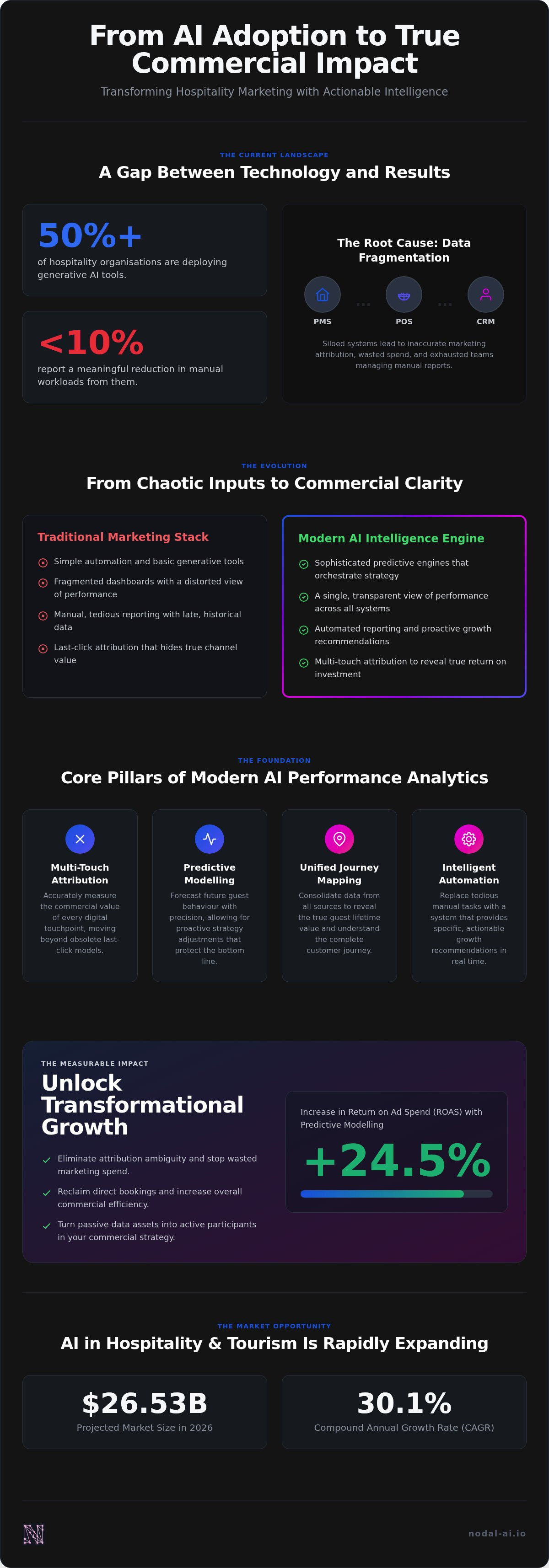
Over 50% of hospitality organisations are currently deploying generative tools, yet fewer than 10% report a meaningful reduction in manual workloads. You likely recognise the frustration of managing data fragmentation across your PMS, POS, and CRM systems, where inaccurate marketing attribution leads to wasted spend and exhausted teams. It's time to replace the anxiety of manual reporting with the calm efficiency of high-level perspectives. Implementing the right artificial intelligence marketing solutions allows you to bridge the gap between acquiring technology and achieving a transformational impact on your bottom line.
This guide demonstrates how modern artificial intelligence marketing solutions transform fragmented data into actionable commercial intelligence to drive measurable growth. You'll discover how to move beyond generic automation to establish a single view of performance. We explore the transition from chaotic inputs to high-value outputs, including how predictive modelling can deliver a 24.5% increase in ROAS. By the end of this article, you'll understand how to automate reporting and receive growth recommendations that turn passive assets into active participants in your commercial strategy.
Key Takeaways
- Master the transition from simple generative tools to sophisticated predictive engines that forecast future guest behaviour with precision.
- Eliminate attribution ambiguity by implementing multi-touch models that accurately measure the commercial value of every digital touchpoint.
- Deploy artificial intelligence marketing solutions to bridge the gap between siloed operational systems and real-time growth recommendations.
- Adopt a modular architecture to ensure your organisation remains agile while scaling its data-driven decision-making capabilities.
- Discover how the Nodal Platform unifies disparate data sources to reclaim direct bookings and increase your overall commercial efficiency.
The Evolution of Artificial Intelligence Marketing Solutions
In 2026, the definition of Artificial intelligence in marketing has shifted from experimental tools to core infrastructure. While early adopters previously focused on generative content, the current landscape demands analytical and predictive engines that orchestrate entire commercial strategies. The AI in hospitality and tourism market is projected to reach $26.53 billion in 2026, growing at a CAGR of 30.1%. This rapid expansion reflects a fundamental shift in how leaders approach performance; they're moving away from execution-only tools and toward comprehensive commercial intelligence.
Traditional marketing stacks are failing because they simply cannot process the sheer volume of data generated by modern consumer touchpoints. This leads to a state of permanent data debt where insights arrive too late to influence outcomes. Modern artificial intelligence marketing solutions solve this by acting as a cognitive upgrade for the organisation. They turn chaotic inputs into high-value outputs, ensuring every pound of marketing spend is tethered to a concrete business outcome. This transition replaces the anxiety of manual, tedious tasks with the confidence of streamlined, high-level perspectives.
From Automation to Actionable Intelligence
Simple automation has lost its competitive edge. In a world where everyone can automate an email sequence or a social post, the real advantage lies in systems that provide specific growth recommendations. These engines identify emerging trends before they even appear in a manual report. By the time a human analyst spots a dip in demand, an AI-driven system has already adjusted the bidding strategy or suggested a targeted offer to protect the bottom line. This proactive stance ensures you're not just moving faster, but moving in the right direction. It transforms your marketing department from a cost centre into a predictive engine for growth.
The Strategic Value of Data Consolidation
Fragmented dashboards are the enemy of clarity. When your PMS, POS, and CRM systems don't talk to each other, you're left with a distorted view of performance. Effective artificial intelligence marketing solutions act as a bridge, unifying these disparate sources into a single, transparent view. This consolidation allows leaders to see the operational reality behind the marketing spend. You can explore the features that make this level of clarity possible through integrated modular architectures.
- Eliminate data silos between booking engines and loyalty programmes to reveal true guest lifetime value.
- Realise the impact of digital campaigns on in-venue revenue by connecting POS data to marketing attribution.
- Make high-level decisions based on real-time commercial intelligence rather than historical guesswork.
By consolidating these assets, you transform them from passive records into active participants in your business growth. This creates a sense of frictionless progress, where the underlying technology handles the complexity so you can focus on strategy. The result is a more competitive, forward-thinking organisation that's obsessed with measurable returns.
Core Pillars of Modern AI Performance Analytics
Achieving commercial clarity requires more than just surface-level dashboards. It demands a robust foundation built on four critical pillars: attribution, prediction, journey mapping, and automation. By deploying advanced artificial intelligence marketing solutions, organisations can finally move beyond the limitations of manual data entry. Automated reporting replaces the anxiety of spreadsheet management with the confidence of real-time insights. This shift allows your team to focus on high-level strategy rather than administrative maintenance, effectively turning your data into a conversational partner that guides your next move.
Multi-Touch Attribution and True ROI
Last-click models are obsolete. They ignore the complex reality of a multi-channel world where a guest might interact with five or more touchpoints before booking. Modern AI assigns weighted value to every interaction, from the initial social discovery to the final direct reservation. This transparency is essential for mastering marketing attribution and ensuring your budget is allocated to the channels that actually drive revenue. When you see the full picture, you can eliminate wasted spend and reinvest in the specific touchpoints that trigger conversion.
Predictive Modelling for Scalable Growth
Predictive engines turn historical data into a roadmap for future performance. In the hospitality sector, this means identifying "need periods" months in advance and proactively targeting high-propensity guest segments. Instead of reacting to low occupancy, you can use the predictive modelling pillar to optimise ad spend before the gap occurs. This approach has led to a documented 24.5% increase in Return on Ad Spend (ROAS) for leaders who prioritise foresight over hindsight. It replaces guesswork with a structured, rhythmic cadence of growth that makes success feel inevitable.
Machine learning takes journey mapping further by personifying guest interactions. It transforms passive data points into active participants in your commercial strategy. By understanding the specific paths that lead to high-value conversions, you can refine your messaging with surgical precision. This level of optimisation ensures that your artificial intelligence marketing solutions are not just functional tools, but a cognitive upgrade for the entire organisation. If you're ready to see how these pillars work in practice, you can explore the features that drive this frictionless progress.
Overcoming Data Fragmentation in Complex Industries
Complex industries like hospitality and QSR face a unique barrier to growth: the silo. While generalist platforms focus on broad strategy, they often ignore the technical reality of disparate systems. Your Property Management System (PMS) likely doesn't talk to your Point of Sale (POS), and your CRM remains isolated from your booking engine. This fragmentation creates a fog of war that obscures true performance. Implementing specialised artificial intelligence marketing solutions allows you to dissolve these barriers, turning isolated data points into a unified commercial narrative.
Connecting the Dots Across Hospitality Systems
When systems don't communicate, your team spends hours manually reconciling reports. This isn't just a loss of productivity; it's a loss of opportunity. Modular intelligence engines bridge these gaps by consolidating fragmented sources into a single view. By tracking performance across multiple locations and brands simultaneously, you gain the clarity needed for faster decision-making. This integrated approach has helped organisations like Ovolo Hotels achieve a 15.3% reduction in acquisition costs. It's a cognitive upgrade that replaces chaotic inputs with streamlined, high-level perspectives.
External Signals and Commercial Analysis
Commercial success isn't just about internal data. It's about context. Modern engines incorporate external signals such as local tourism trends, flight demand, and even currency exchange rates to inform your strategy. If flight searches from a key market spike or the pound weakens against the euro, your system should react instantly. Turning this external noise into a competitive advantage allows you to anticipate shifts in booking patterns before they impact your occupancy. You can effectively personify these market forces, transforming them into active participants in your business process.
Smarter direct booking insights are the ultimate weapon against OTA leakage. By understanding the guest journey across all integrated systems, you can identify exactly where potential customers drop off. You can explore the features of the Nodal Platform to see how this modular architecture protects your assets and optimises revenue. This isn't just about gathering data; it's about mastering it to ensure your organisation remains competitive and forward-thinking. It's the difference between reacting to the market and leading it through superior commercial intelligence.
Selecting and Implementing AI Marketing Solutions Effectively
Selecting the right artificial intelligence marketing solutions requires a departure from the generic software procurement mindset. You aren't just buying a tool; you're building a cognitive framework for your organisation. Start by auditing your existing infrastructure to identify where data quality might be compromised. A modular architecture is often superior to a monolithic one, as it allows you to integrate specific modules, such as Guest or Demand, without disrupting your entire stack. This flexibility ensures that your technology evolves alongside your commercial goals while maintaining high-level protection of your data assets.
The Implementation Roadmap
Successful deployment follows a structured, multi-step journey that moves you from complexity to growth. First, you must map the complex customer journey across every integrated data source, from social media interactions to final POS transactions. This step is critical in a cookieless world where walled gardens often obscure the path to conversion. Second, focus on historical data ingestion. This allows the engine to configure itself based on your specific past performance, providing a baseline for future predictive modelling. Finally, set up custom dashboards that align with your unique commercial objectives. This transformation from chaotic raw data to streamlined visualisations replaces manual reporting anxiety with strategic clarity.
Choosing a Partner, Not Just a Tool
Specialised consultancy is vital because AI is not a set-and-forget product. You need a partner that offers deep data science expertise to help you interpret growth recommendations and refine your predictive models. Evaluate providers based on their technical support and their ability to handle complex integrations with PMS and POS systems. You can see how this works in practice by reviewing the features of the Nodal Platform, which focuses on unifying fragmented hospitality data into a single view. This level of partnership ensures that your investment remains a competitive, forward-thinking asset rather than a technical burden.
Data governance and GDPR compliance are non-negotiable pillars of modern implementation. Your chosen artificial intelligence marketing solutions must prioritise transparency and the removal of ambiguity regarding how guest data is utilised. By ensuring your infrastructure is enterprise-ready and secure, you protect your organisation from regulatory risks while empowering your team with reliable insights. When you prioritise these foundations, the transition to an AI-driven organisation feels frictionless and inevitable, turning your data into a cognitive upgrade for the entire business.
The Nodal Platform: Commercial Intelligence for Hospitality Leaders
Nodal AI transforms the chaotic data silos of hotels, clubs, and restaurants into a single, high-value view. By deploying these specialised artificial intelligence marketing solutions, you move beyond generic CRM outputs to achieve true commercial intelligence. The results are measurable and immediate. Leaders using the platform have documented a 24.5% increase in Return on Ad Spend (ROAS) and a 13.8% increase in total bookings. This level of performance is achieved by making more from existing traffic and wasting less on inefficient channels. It replaces the anxiety of manual reporting with the confidence of streamlined, high-level perspectives.
The engine's modular architecture, which includes Guest, Demand, and Operational modules, ensures that every department benefits from a cognitive upgrade. It personifies your passive data, turning it into an active partner that suggests the next best action for growth. Whether you're seeking to reduce OTA leakage or optimise in-venue revenue, the platform provides the transparency required for frictionless progress. This integrated approach has already delivered a 15.3% reduction in acquisition costs for organisations like Ovolo Hotels, proving that precise data is the ultimate competitive advantage.
Tailored Insights for Every Sector
Versatility is a hallmark of the Nodal Platform. Serviced apartments, hostels, and wellness centres use the engine to map unique customer journeys that generic tools often miss. Quick Service Restaurant (QSR) brands can measure footfall and revenue across multiple locations with surgical precision. This allows for a competitive, forward-thinking approach to local marketing that prioritises measurable returns over guesswork. To see how these modules adapt to your specific business model, you can book a demo for a tailored walkthrough of the system.
The Future of Performance Marketing
Adopting the Nodal Platform positions your brand as a visionary leader in the 2026 landscape. It replaces the loss of productivity due to manual labour with the efficiency of automated, future-facing analytics. You aren't just implementing a tool; you're securing a cognitive upgrade that protects your assets and accelerates your commercial trajectory. The shift from fragmented data to profitable growth is now inevitable for those who embrace integrated intelligence. It's time to realise the full potential of your organisation through a partner that understands the modern professional's sense of overwhelm.
Stop settling for ambiguous attribution and wasted spend. Transform your raw data into a powerful engine for commercial success today and invite your team to benefit from mastered expertise.
Master Your Commercial Future with Integrated Intelligence
Mastering the 2026 landscape requires a fundamental shift from manual execution to integrated commercial intelligence. You've discovered how consolidating fragmented data from PMS, POS, and CRM systems dissolves the fog of war that obscures true performance. By deploying specialised artificial intelligence marketing solutions, you replace the anxiety of data debt with the confidence of streamlined, high-level perspectives.
The path from chaotic inputs to high-value outputs is proven. Organisations using the Nodal Platform have realised a 15.3% reduction in acquisition costs and a 24.5% increase in ROAS. As a Gold winner at the Performance Marketing Awards, we're dedicated to providing the cognitive upgrade your organisation needs to lead the market. This transition ensures your data remains an active participant in your business growth rather than a passive record of the past.
Book a demo to see how Nodal AI can unify your marketing data
Secure your competitive advantage and turn your data into a conversational partner for growth. The transition to frictionless progress starts with a single decision. Take the lead today and empower your team with the clarity they deserve.
Frequently Asked Questions
How do AI marketing solutions handle data privacy and GDPR?
Nodal AI prioritises transparency and security by building its framework on enterprise-ready standards. All data processing complies strictly with UK and EU GDPR requirements to ensure guest information remains protected. We ensure that sensitive data is anonymised and secured at every stage of the customer journey. This approach replaces the anxiety of regulatory risk with the confidence of high-level protection for your organisation's most valuable digital assets.
Can the Nodal Platform integrate with legacy PMS and POS systems?
Yes, the Nodal Platform is specifically designed to unify fragmented data from a wide range of legacy and modern systems. We integrate with major providers like Oracle OPERA, Mews, and Cloudbeds for operational data, alongside OpenTable or SevenRooms for transactions. This modular intelligence engine bridges the gap between disparate sources that typically don't communicate. It effectively transforms passive records into active participants in your commercial decision-making process.
What is the difference between generative AI and analytical AI in marketing?
Generative AI focuses on creating content like emails or social posts, while analytical AI drives commercial intelligence through deep data processing. Modern artificial intelligence marketing solutions prioritise the latter to solve complex attribution and demand forecasting challenges. While generative tools help with speed, analytical engines provide the cognitive upgrade needed to identify trends and growth recommendations that directly impact your profit margins and operational efficiency.
How much time can automated reporting realistically save my team?
Automated reporting realistically saves marketing and revenue teams between 10 and 15 hours of manual data entry every week. By consolidating data from fragmented systems into a single view, the Nodal Platform eliminates the need for manual spreadsheet reconciliation. This relief from tedious tasks allows your specialised team to focus on high-level strategy and growth recommendations. It turns manual reporting into a streamlined, frictionless process of commercial analysis.
What is the role of predictive modelling in hospitality demand forecasting?
Predictive modelling identifies need periods or low occupancy gaps up to six weeks in advance. It incorporates external signals like weather, tourism trends, and flight demand to forecast future guest behaviour with precision. This proactive stance allows hotels to adjust their bidding strategies and targeted offers before a dip in revenue occurs. It replaces historical guesswork with a structured cadence of growth, ensuring you're always ahead of market shifts.
How does multi-touch attribution improve Return on Ad Spend (ROAS)?
Multi-touch attribution assigns commercial value to every interaction in the guest journey rather than just the last click. This transparency allows you to identify which channels are driving the most valuable direct bookings. By reallocating budget from underperforming touchpoints to those that trigger high-value conversions, organisations have seen a 24.5% increase in Return on Ad Spend (ROAS). It is a fundamental pillar for any organisation obsessed with measurable returns.
Is an AI marketing solution suitable for small to mid-sized hotel groups?
Small and mid-sized hotel groups benefit significantly from artificial intelligence marketing solutions because they often face the same data fragmentation as larger chains but with fewer resources. The modular architecture of the Nodal Platform allows these groups to scale their intelligence engine as they grow. It provides a single view of performance that was previously only accessible to enterprise-level entities, empowering smaller groups to compete effectively against global brands.


