

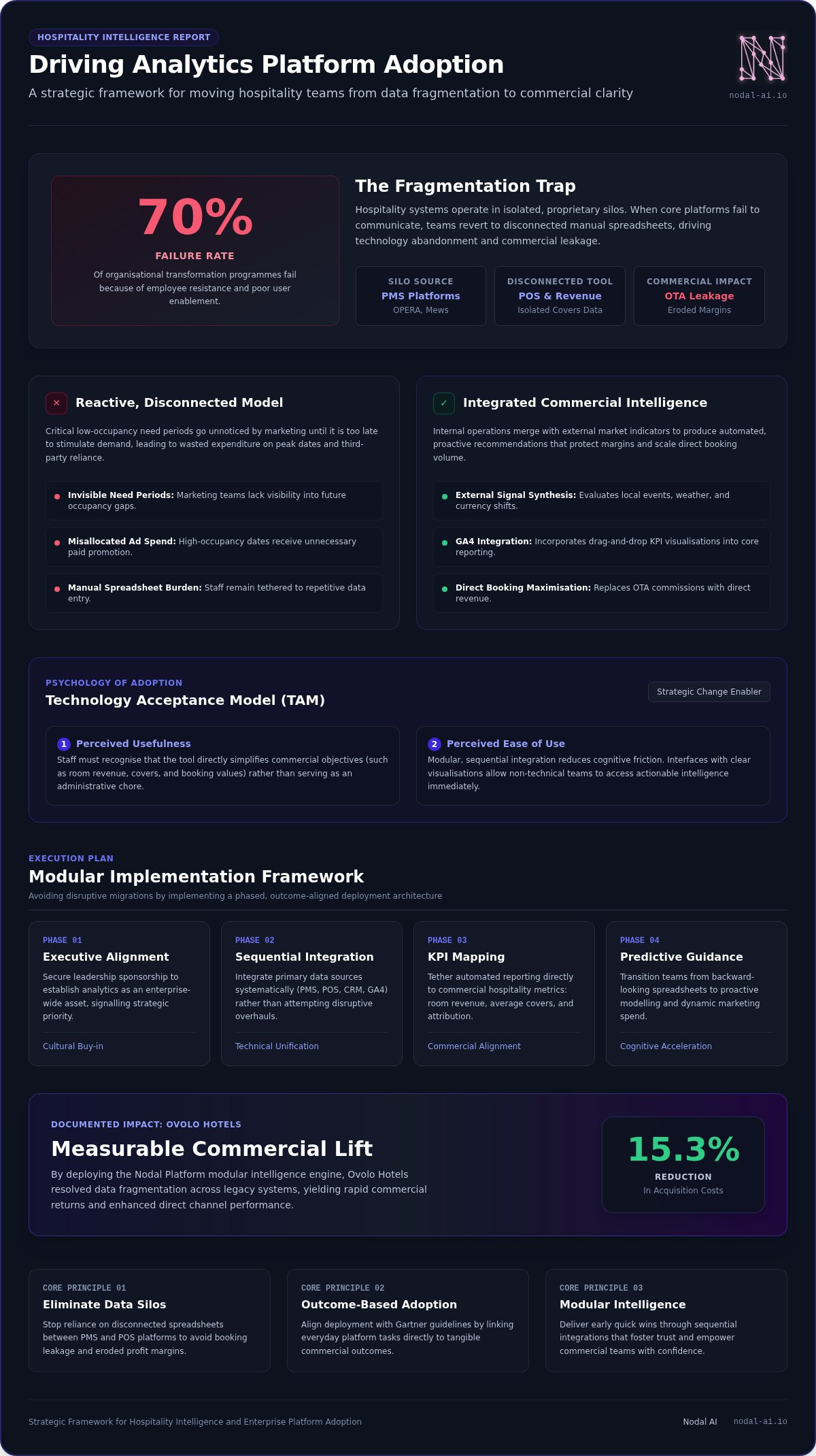
Seventy per cent of organisational transformation programmes fail because of employee resistance and poor user enablement. It is a staggering figure that highlights a painful reality for hospitality leaders in 2026. You have likely invested in sophisticated tools, yet your team remains trapped in a cycle of manual reporting and disconnected spreadsheets. We understand the frustration of seeing data silos between your PMS and POS systems persist while your expensive technology sits underutilised. The anxiety of manual tasks should be replaced by the confidence of streamlined, high-level perspectives.
Transitioning from chaos to clarity requires more than just a login; it demands a strategic shift in how your organisation handles intelligence. In this guide, you will learn the exact framework for how to drive adoption of a new analytics platform to move your team from data fragmentation to high-value commercial intelligence. We will outline the specific steps to secure a single view of performance, enabling faster decision-making and a measurable increase in direct bookings. By the end of this article, you will have a roadmap to turn your passive data into an active driver of revenue and long-term stability.
Key Takeaways
- Identify the specific data silos between PMS and POS systems that erode profit margins and prevent a unified view of performance.
- Master how to drive adoption of a new analytics platform by securing executive sponsorship and aligning automated reporting with your commercial KPIs.
- Implement a modular onboarding framework that prioritises technical integration followed by role-specific intelligence to ensure immediate value for every department.
- Shift your team's focus from technical tool mastery to actionable commercial growth through predictive modelling and personalised marketing spend.
- Discover how the Nodal Platform bridges the fragmentation trap to deliver a 15.3 per cent reduction in acquisition costs and a measurable lift in direct bookings.
Overcoming the Fragmentation Trap in Modern Analytics
Hospitality data is notoriously difficult to centralise because it lives in isolated, proprietary silos. Your Property Management System (PMS), such as Oracle OPERA or Mews, rarely speaks the same language as your Point of Sale (POS) or marketing tools. This "Fragmentation Trap" creates a significant barrier when considering how to drive adoption of a new analytics platform; if the underlying data is perceived as broken or incomplete, your team will quickly revert to the comfort of manual spreadsheets. Success requires a shift from viewing data as a passive byproduct of operations to treating it as an active commercial asset.
The Hidden Cost of Siloed Systems
When your PMS and marketing data are disconnected, the commercial cost is immediate and measurable. Critical "need periods", those specific dates with low occupancy, often go unnoticed by marketing teams until it is too late to influence demand. This lack of visibility leads to inefficient spend; you might waste budget on high-occupancy dates, inadvertently driving guests toward expensive Online Travel Agencies (OTAs) instead of direct channels. For hospitality groups, this fragmentation results in significant OTA leakage and eroded profit margins. It's a cycle of reactive decision-making that keeps your staff tethered to tedious data entry rather than high-value strategy.
Moving from Raw Data to Actionable Intelligence
True intelligence goes beyond static, historic reporting. It requires a system that integrates internal metrics with external signals, such as local events, weather patterns, or currency fluctuations, to provide proactive guidance. Understanding the technology acceptance model is vital here. This framework suggests that perceived usefulness and ease of use are the primary drivers of whether staff embrace a new system. By consolidating POS, CRM, and the latest Google Analytics 4 updates (which introduced flexible drag and drop KPI visualisations in September 2026) into a single view, you simplify the user experience. You replace the anxiety of manual reporting with the confidence of automated, commercial recommendations.
The Nodal Platform solves this complexity through a modular intelligence engine. Instead of a disruptive, all-at-once migration, this architecture allows you to integrate primary data sources sequentially. This phased approach provides immediate "quick wins", such as the 15.3 per cent reduction in acquisition costs seen by Ovolo Hotels, which builds internal trust. When a platform acts as a cognitive upgrade for the entire organisation, you solve the technical hurdle of siloed data while simultaneously addressing the human element of adoption.
Establishing a Cultural Foundation for Data-Driven Decisions
Software rollouts often fail not because of technical glitches, but because of cultural friction. High-level technology requires high-level buy-in. To ensure your investment delivers a measurable return, you must secure executive sponsorship that signals the platform's strategic importance to the entire organisation. When leadership treats analytics as a non-negotiable asset, the rest of the team follows. This cultural alignment is the first and most critical step in understanding how to drive adoption of a new analytics platform effectively.
Defining Success Through Commercial KPIs
Your team needs to see the immediate value of the tool in their daily workflows. You must move away from vanity metrics and instead map platform features to specific hospitality outcomes, such as room revenue, covers, or average booking value. Establishing baseline metrics before the rollout allows you to quantify improvements in real-time. For instance, aligning your marketing attribution with direct booking growth provides a clear narrative of success that spreadsheets cannot replicate.
According to Gartner's data and analytics strategy guidance, aligning platform deployment with business outcomes is essential for improving data literacy across the enterprise. By tethering automated reporting to existing commercial goals, you transform the platform from a "new task" into a cognitive upgrade that makes existing work easier. This shift in perspective is what turns a cold algorithm into a conversational partner for your revenue and marketing teams.
Building Internal Advocacy and Ownership
Resistance is a natural reaction to change, especially when staff are accustomed to legacy reporting methods. Research shows that 70 per cent of organisational transformation programmes fail due to employee resistance and poor enablement. However, projects with structured change management are six times more likely to reach full user adoption. You can mitigate this risk by identifying "Data Champions" within your Revenue, Marketing, and Operations departments. These individuals act as internal advocates who bridge the gap between technical capability and departmental needs.
- Incentivise the shift: Reward teams that replace manual spreadsheets with platform-derived insights.
- Create feedback loops: Ensure the platform evolves by regularly soliciting input from the people using it daily.
- Highlight quick wins: Share success stories, such as a sudden lift in ROAS, to build momentum and confidence.
Managing the transition requires a blend of authority and empathy. You aren't just asking staff to use a new tool; you're inviting them to master future-facing analytics. If you are ready to see how a unified culture can drive measurable returns, you might book a demonstration of the Nodal Platform to explore its modular architecture in action.
A Step-by-Step Framework for Successful Platform Onboarding
Successful onboarding is not a single event; it is a structured, multi-phase journey that transforms raw data into a commercial engine. While generic SaaS guides suggest starting with training videos, a hospitality-specific approach must account for complex tech stack integrations. The first 90 days are critical for establishing trust and proving value. By following a modular framework, you ensure the transition feels like a cognitive upgrade rather than an operational burden. This is the blueprint for how to drive adoption of a new analytics platform in a competitive landscape.
Phase 1 and 2: The Technical Foundation
Begin by integrating your primary data sources, specifically your PMS and POS systems. This phase requires a robust data governance framework to ensure compliance and accuracy from the start. Accuracy is the currency of adoption: if the initial numbers are wrong, your team will abandon the tool. Once the foundation is set, configure your modular intelligence based on specific commercial use cases rather than generic reporting templates.
Prioritise integrations that deliver immediate value to your commercial managers. For example, mapping the customer journey allows you to identify exactly where direct bookings are lost. By focusing on these critical touchpoints, you create a system that actively participates in the business process. This approach turns chaotic inputs into high-value outputs, providing the clarity needed to move forward with confidence.
Phase 3 and 4: Proving Value with Pilot Teams
Select a single property or department to act as a pilot site. Choose a location that represents a significant commercial challenge, such as a hotel struggling with high OTA dependency. This creates a high-stakes environment where the platform's impact is undeniable. During this phase, focus training on interpreting growth recommendations rather than just navigating the interface. Staff should learn how to make faster decisions, not just how to click buttons.
According to the Harvard Business Review, building a data-driven culture requires embedding analytics directly into daily habits. Document every early win, such as a 24.5 per cent lift in ROAS or a reduction in acquisition costs. These tangible results act as social proof, making the eventual full-scale deployment feel inevitable. When your pilot team reports a 15.3 per cent reduction in acquisition costs, the rest of the organisation will be eager to follow suit.
Phase 5: Deployment and Continuous Optimisation
Scale the platform across the entire organisation once the pilot has validated the commercial model. Continuous optimisation is essential: the platform must evolve alongside shifting market signals and user feedback. Use the momentum from your pilot "Data Champions" to mentor other departments. This peer-to-peer enablement reduces resistance and ensures long-term stability. By treating the platform as a conversational partner, you turn fragmented inputs into high-value outputs across every asset in your portfolio.
Driving Engagement Through Actionable Commercial Insights
Adoption fails when users perceive a platform as just another task on an already overflowing to-do list. To secure long-term engagement, you must shift the internal narrative from "how to use the tool" to "how to make more money". When your team realises that the platform actively identifies revenue leaks and growth opportunities, the question of how to drive adoption of a new analytics platform solves itself. It becomes an essential partner in their commercial success rather than a cold, technical requirement.
From Passive Reporting to Predictive Modelling
Static reports only tell you what happened yesterday. In 2026, high-performing hospitality groups use predictive modelling to forecast future demand and identify "need periods" before they occur. This foresight allows marketing teams to deploy budget with surgical precision. By utilising AI-driven audience segmentation, you can personalise marketing spend and improve guest retention by targeting the right segments at the right time. These growth recommendations provide immediate value, replacing the anxiety of missed targets with the confidence of data-backed strategy.
The Power of Automated Reporting
Manual data entry is a drain on productivity and morale. By implementing automated reporting, you can save your commercial teams 20 or more hours per month. This reclaimed time allows staff to move away from the manual "data pull" and focus on high-level strategic analysis. Setting up tailored alerts for commercial and operational insights ensures that no anomaly goes unnoticed. You transform your data from a passive asset into an active participant in your business process.
- Save 20+ hours monthly: Eliminate tedious spreadsheet consolidation and manual reporting tasks.
- Real-time attribution: Reduce acquisition costs through precise multi-touch attribution and journey mapping.
- Tailored alerts: Receive immediate notifications on performance shifts across your entire portfolio.
The result is a streamlined operation where every decision is tethered to financial performance. This focus on value is the most effective strategy for how to drive adoption of a new analytics platform across diverse teams. For Ovolo Hotels, this approach contributed to a 15.3 per cent reduction in acquisition costs and a 24.5 per cent lift in ROAS. When the platform delivers these kinds of measurable returns, adoption becomes inevitable.
Book a demonstration to see these commercial insights in action
Accelerating Adoption with the Nodal AI Platform
The hospitality sector requires more than a generic dashboard; it needs a cognitive upgrade for the entire organisation. The Nodal Platform acts as the essential bridge between fragmented systems, turning chaotic inputs into high-value commercial intelligence. While competitors focus on general customer success, Nodal is built specifically for the high-stakes complexity of hotels, QSR, and wellness brands. By simplifying the technical integrations with industry giants like Oracle OPERA, Mews, and OpenTable, we remove the primary friction point that typically derails software rollouts.
Why Nodal Leads the Pack in Hospitality Intelligence
Our modular architecture ensures that you don't have to face a disruptive, all-or-nothing migration. Instead, you can modularise your rollout, starting with the systems that offer the fastest returns. This pragmatic approach is the definitive answer to how to drive adoption of a new analytics platform without overwhelming your staff. You move from the anxiety of manual labour to the confidence of automated, high-level perspectives. Nodal is not just a software vendor; we are a partner in your commercial growth, providing the transparency and clarity needed to protect your assets in a volatile market.
We have already seen the impact of this strategic alignment. Brands like Ovolo Hotels have leveraged Nodal to achieve a 15.3 per cent reduction in acquisition costs and a 24.5 per cent increase in ROAS. These results are achieved by personifying your passive assets, transforming your data into an active participant in your business process. When your team sees these measurable returns, the platform stops being a "new tool" and becomes a conversational partner that they rely on daily.
Next Steps: Proving the ROI
In the competitive landscape of 2026, relying on outdated, manual reporting is a risk you cannot afford. Embracing AI marketing analytics is no longer optional; it is a requirement for long-term stability and profit protection. You can begin your journey with a modular approach that minimises disruption while maximising immediate commercial impact. This ensures that your team remains focused on high-value strategy rather than tedious data entry. It is time to replace the "Fragmentation Trap" with total clarity and cognitive optimization.
If you are ready to replace manual tedium with streamlined efficiency, the next step is simple. Book a demo today and see how Nodal can transform your fragmented data into a unified engine for profitable growth.
Transforming Fragmentation into Commercial Intelligence
Mastering how to drive adoption of a new analytics platform requires more than a technical rollout; it demands a cultural and structural shift toward total transparency. By solving the fragmentation trap and securing high-level executive sponsorship, you turn chaotic data into an active commercial asset. You replace the anxiety of manual reporting with the confidence of automated, high-level perspectives. Success is no longer a technical hurdle but a cognitive upgrade for your entire organisation.
The results of this strategic alignment are already delivering measurable value across the hospitality sector. Brands like Ovolo Hotels have achieved a 15.3 per cent reduction in acquisition costs and a 24.5 per cent increase in Return on Ad Spend. Our commitment to excellence in performance marketing analytics has even been recognised with Gold in the Performance Marketing Awards. You now possess the strategic framework to move from data silos to high-value commercial intelligence.
The transition to future-facing analytics is the most effective way to protect your operating margins and drive long-term stability. Embrace the clarity of a unified view and lead your team toward a more profitable, data-driven future.
Frequently Asked Questions
How long does it typically take to drive full adoption of a new analytics platform?
Full adoption typically requires three to six months to achieve deep cultural integration across all departments. While technical onboarding for the Nodal Platform is often completed in weeks, the human element of shifting habits takes longer. A phased approach allows teams to secure quick wins within the first 90 days. This timeline ensures staff move from the anxiety of manual reporting to the confidence of automated, high-level perspectives.
What is the biggest barrier to analytics adoption in the hospitality industry?
Data fragmentation remains the primary hurdle for hospitality groups. Systems like Oracle OPERA or Mews rarely communicate with marketing tools, creating the "Fragmentation Trap" that leads to staff resistance. When teams don't trust the data because it is siloed, they often revert to manual spreadsheets. Overcoming this requires a platform that unifies these disparate sources into a single view, providing the clarity and relief that comes from resolving technical complexity.
How can I convince my team to stop using manual spreadsheets for reporting?
Transition the conversation from technical tool usage to time reclamation and commercial value. Highlight that automated reporting saves teams over 20 hours per month by eliminating manual data pulls. When staff realise they can focus on strategic growth recommendations instead of tedious data entry, resistance fades. Understanding how to drive adoption of a new analytics platform through immediate "quick wins" helps replace the anxiety of manual tasks with streamlined efficiency.
Do I need a data science team to use an AI-powered analytics platform?
No, you don't require an internal data science team to benefit from the Nodal Platform. We designed our modular intelligence engine to be approachable for users who need results without deep technical specialisation. The platform acts as a cognitive upgrade for your existing organisation, providing clear growth recommendations and predictive modelling. It empowers your current revenue and marketing managers to make faster, data-backed decisions through a simple and intuitive experience.
How does Nodal AI handle data from fragmented legacy systems?
Nodal AI utilises a modular architecture designed to consolidate data from fragmented systems including PMS, POS, and CRM engines. Our technology integrates directly with hospitality giants like Oracle OPERA, Mews, and OpenTable. By unifying these disparate sources, we transform chaotic inputs into high-value commercial insights. This process removes the ambiguity that usually plagues legacy stacks, offering a transparent and unified view of your entire portfolio's performance.
Can an analytics platform help reduce our reliance on OTAs?
Yes, the platform is specifically designed to reduce OTA leakage and improve direct booking contributions. By mapping the customer journey and identifying performance gaps, you can optimise your marketing spend toward high-propensity guest segments. This strategic shift resulted in a 15.3 per cent reduction in acquisition costs for Ovolo Hotels. Understanding how to drive adoption of a new analytics platform enables your team to target "need periods" effectively, protecting your profit margins.
What training is required for staff to use the Nodal Platform effectively?
We prioritise role-tailored training that focuses on commercial outcomes rather than just software features. Effective onboarding involves identifying "Data Champions" who mentor their peers on interpreting growth recommendations. This people-centric enablement strategy ensures that staff feel empowered and supported. Because the underlying technology is complex but the user interface is streamlined, most teams achieve proficiency within a few structured sessions, leading to frictionless progress and rapid output.
How do growth recommendations differ from standard reporting dashboards?
Standard dashboards are reactive, showing only historic data and static charts. In contrast, growth recommendations are proactive, using predictive modelling to identify future revenue opportunities and demand signals. Nodal incorporates external signals like weather and local events to provide actionable guidance. This transforms the platform from a passive reporting tool into an active participant in your business process, allowing your team to move quickly toward a profitable resolution.


