

A busy channel isn’t necessarily a profitable one. Performance marketing measures outcomes, while marketing channel performance analysis connects customer touchpoints to revenue and compares that return with channel costs. The aim is to understand which channels contribute to results, not just which ones attract attention.
It’s easy to focus on the last click or the campaign with the most visible activity. But customers may interact with several channels before buying, and measuring each touchpoint in isolation can hide its contribution.
Learn how to map those interactions, choose useful performance measures, and compare channel costs with revenue and conversions. Use the findings to identify weak points, assess how channels work together, and make more informed budget decisions. This gives you a clearer view of what’s driving growth and where your next marketing investment may have the greatest impact.
Key Takeaways
- Map the customer journey across online and offline touchpoints to see how channels contribute to revenue, not just final conversions.
- Choose measures that match each channel’s role, then compare costs with revenue and conversions for a fairer view of performance.
- Include campaign creation and personnel expenses alongside advertising spend when assessing channel returns.
- Use regular performance reports to identify underperforming channels and guide budget shifts towards stronger opportunities.
- Review how channels work together, and test changes before scaling them across campaigns.
Revenue attribution and customer touchpoints
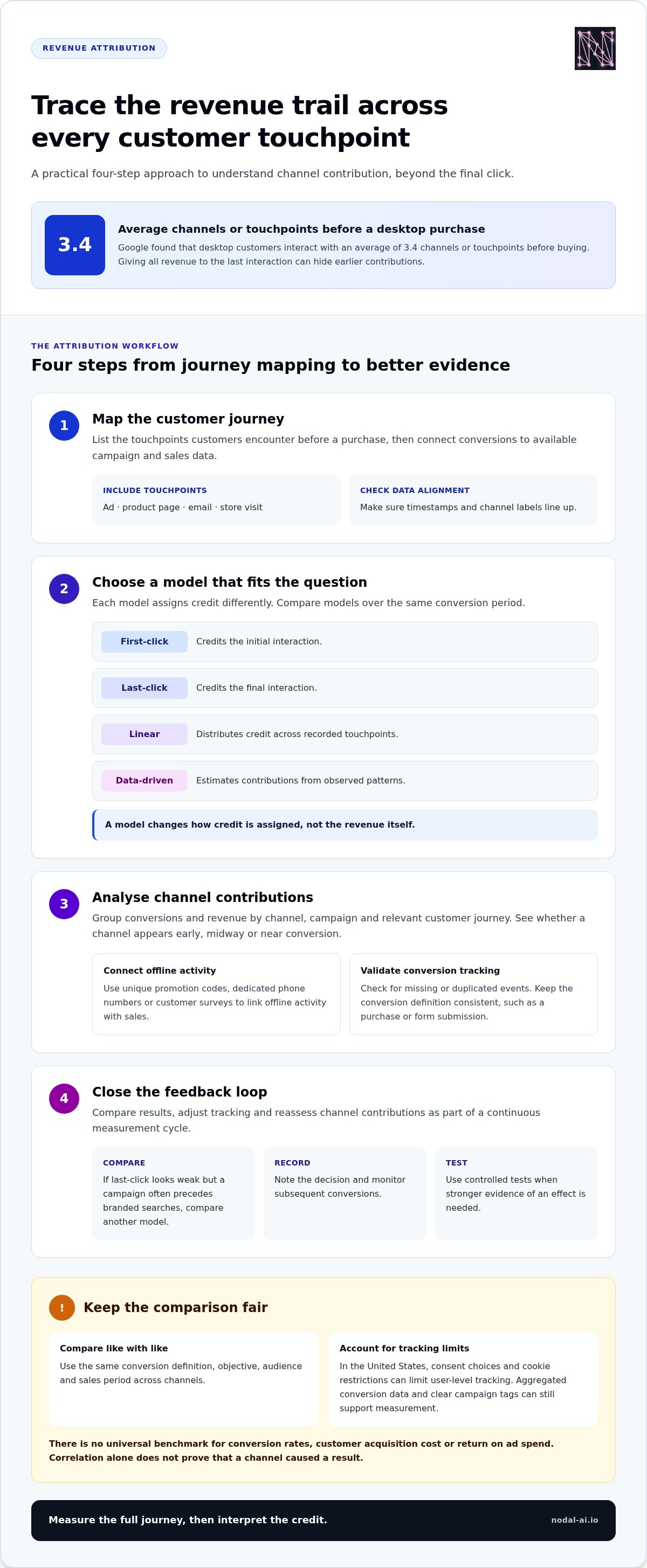
Trace each customer touchpoint to the conversion and revenue it may influence. Use attribution to distinguish a channel’s contribution from the final interaction.
In the United States, consent choices and cookie restrictions can limit user-level tracking across websites. Use aggregated conversion data and clear campaign tags to retain useful measurement without relying on every individual journey.
There’s no universal benchmark for conversion rates, customer acquisition cost (CAC), or return on ad spend (ROAS). For a meaningful comparison, assess channels against the same conversion definition, objective, audience, and sales period.
Common pitfalls include crediting only the final click, missing offline interactions, and treating correlation as causation. For example, more branded searches alongside paid advertising don’t prove the ads caused every search.
-
1. Map Revenue to Customer Touchpoints
Start by listing the touchpoints customers encounter before a purchase, such as an advert, product page, email or store visit. Connect each conversion to available campaign and sales data, then check that timestamps and channel labels align. Google found desktop customers interact with an average of 3.4 channels or touchpoints before buying. Avoid assigning all revenue to the final interaction.
-
2. Select a Multi-Channel Attribution Model
Choose an attribution model that answers your measurement question. First-click attribution credits the initial interaction, while last-click credits the final one. Linear attribution distributes credit across recorded touchpoints; data-driven attribution estimates contributions from observed patterns. Compare models over the same conversion period. A model changes how credit is assigned, not the revenue itself.
-
3. Analyse Channel Attribution
Group conversions and revenue by channel, campaign, and relevant customer journey. Check whether paid search, social advertising, email, or offline promotion appears early, midway, or near conversion. Use unique promotion codes, dedicated phone numbers, or customer surveys to connect offline activity with sales. Review conversion tracking for missing or duplicated events, and keep the conversion definition consistent, such as a purchase or form submission.
-
4. Use Attribution Feedback Loops
Make attribution part of a continuous measurement cycle: compare results, adjust tracking, and reassess channel contributions. If a campaign appears weak in last-click reports but often precedes branded searches, compare another attribution model before changing its budget. Record the decision and monitor subsequent conversions. Separate correlation from causation, and use controlled tests when you need stronger evidence that a channel change influenced results.
When conducting a marketing channel performance analysis, compare whether first-click, last-click, linear, and data-driven attribution models tell different stories about channel contributions along the customer journey. Conversion tracking can attribute website conversions to specific marketing channels, while tools from Nodal AI help streamline this data. ROAS measures the revenue generated for each dollar spent on advertising. Comparing channel spending with the revenue it generates can help assess marketing ROI.
An analysis of a beauty brand reported that marketplace revenue fell 30% whenever Meta spend was reduced.
Scaling and reallocating channel budgets
Allocate budget by comparing channel results with campaign objectives, then adjust spend where the evidence points. Use regular performance reports to identify underperforming channels, optimise bids, and direct resources towards stronger opportunities.
-
Review Channel Performance Data
Start with a report that groups results by channel, campaign, and objective. Compare the KPIs that matter for each goal, such as engagement for awareness or conversions for lead generation. A channel generating clicks but few qualified leads may need a different message, landing page, or bid strategy, rather than an automatic budget increase.
Look for trends across reporting periods, not just one unusually strong campaign. Check whether performance changes during promotions, product launches, or shifts in audience response. For example, a channel with fewer direct conversions may still support campaigns that convert elsewhere. Use consistent definitions and comparable periods so budget decisions reflect channel performance, not changes in measurement.
-
Allocate Budget Across Channels
Define each channel’s role before distributing spend. Give more budget to campaigns that meet their objectives efficiently, while maintaining investment in channels that support reach, engagement, or later conversions. Avoid moving all available ad spend to the channel with the highest reported return. Doing so can limit audience coverage or overlook channels that assist other campaign activity.
Make budget changes in a controlled sequence. Shift resources towards an evidenced opportunity, then monitor the same KPIs and business outcomes used in the initial review. If a search campaign produces qualified leads but its cost rises, test bid adjustments or refine targeting before scaling further. If social engagement grows without useful conversions, review the message and audience fit first.
Base allocation on business priorities, capacity, and each campaign’s role. A channel supporting a product launch may call for a different investment decision from one focused on ongoing lead generation. Record the reason for each adjustment, the expected outcome, and how you’ll assess it. This creates a clear feedback loop for future budget reviews.
For teams bringing campaign results into a clearer view, Performance Marketing Analytics features can support informed budget decisions.
Regular marketing channel reports can summarise KPI performance and inform strategy and budget allocation. Focus on what the reports indicate about campaign objectives and the current allocation, rather than treating a report as a decision in itself. Ask of each channel whether its role still fits the strategy and whether resources should stay in place or change. Consistent reporting makes the reasoning behind a proposed adjustment easier to follow.
Use channel performance insights to identify underperforming channels, adjust messaging, reallocate resources, and explore new opportunities. Apply these options selectively: a weak result may call for a messaging change, while a broader mismatch may point to reallocating resources or exploring another opportunity. Tie each action to the evidence and intended goal, and make the rationale clear to those reviewing the budget. This lets reports inform immediate adjustments and future planning without making every fluctuation a reason to move spend.
Channel costs and return on investment
Compare revenue with the full cost of acquiring it, then assess whether each channel can scale efficiently. Calculate channel ROI, CAC, and ROAS using consistent periods and conversion definitions.
-
1. Calculate Channel ROI, CAC, and ROAS
Use the same channel, campaign period, and revenue definition. Calculate ROI as (revenue minus costs) divided by costs. Calculate ROAS by dividing advertising revenue by advertising spend. Calculate CAC by dividing acquisition costs by new customers gained. These metrics answer different questions, so don’t treat them as interchangeable.
ROAS can appear as a ratio or percentage: 5:1 is equivalent to 500%. It measures advertising revenue per unit of ad spend, not profit after every business expense. CAC adds another perspective by showing the acquisition cost for each new customer. Include the same cost categories each period, or comparisons can mislead.
For example, a 5:1 ROAS may look strong, but it doesn’t include campaign creation or personnel costs. Add those expenses when calculating ROI. Check whether attributed revenue reflects the customer journey, particularly when social media contributes earlier touchpoints. Compare short-term campaign returns with longer-term value before changing investment.
-
2. Assess Channel Costs
List each channel’s costs before assessing its return. Include advertising spend, campaign creation costs, and personnel expenses. Separate recurring costs from campaign-specific costs, then assign them consistently across channels. This helps explain why two campaigns with similar revenue can deliver different ROI.
Compare channel costs with the revenue generated or conversions achieved. Track reach, engagement, and conversion-rate patterns alongside financial metrics. A high-reach campaign may support awareness, while a lead-generation campaign aims to fill the sales pipeline. Match the measure to the channel’s purpose instead of judging every activity by immediate revenue.
Assess scalability by checking whether stronger results persist as spend or activity increases. A channel may perform well at its current level, but added spend can change audience reach, costs, or conversion quality. Compare performance before and after each budget adjustment, using consistent attribution and cost categories. Keep short-term and long-term returns in view, since a channel’s contribution may unfold across the customer journey.
Use the findings to distinguish efficient growth from rising costs. If conversions increase while acquisition costs climb, examine campaign expenses and conversion quality before expanding further. If revenue grows without a comparable rise in costs, review which patterns support that result. This gives budget decisions a clearer financial basis than ad spend or clicks alone.
Channel profitability and cost-to-serve
Assess each channel beyond its media cost: include the expense of acquiring, serving, and retaining customers. CPM and CPL reflect different cost drivers, so match each measure to its campaign objective.
-
Analyse Cost per Acquisition
Compare each channel’s acquisition cost with the customer value and service effort it generates. Return on ad spend, customer acquisition cost, and lifetime value are useful profitability metrics, but each shows a different part of the picture. A channel may attract customers efficiently yet require substantial delivery or support resources after conversion.
Include costs that follow a sale when evaluating channel profitability. For a product channel, examine shipping, handling, and retail margins; for a service channel, review response times, issue resolution, and customer satisfaction. Compare return rates across channels, too. Higher returns or repeated support needs can reduce the value of apparently successful acquisition.
Use customer and order data to identify where cost-to-serve changes. Compare average order value, purchase frequency, and product preferences by channel. If one channel brings frequent orders but also more returns, examine the full pattern before scaling acquisition. This connects the audience a campaign attracts with the work and expense needed to serve them.
-
Calculate Cost per Mille
Use CPM when evaluating visibility and the cost of reaching an audience. In performance marketing, CPM prices every 1,000 ad views, or impressions. It is traditionally associated with brand-awareness campaigns and can suit high-reach channels such as connected TV or programmatic display.
Compare CPM with reach and engagement, rather than treating a low cost as success by itself. A campaign can generate inexpensive impressions without reaching its intended audience or prompting useful engagement. Check that channel comparisons use the same impression basis and campaign objective. CPM helps assess visibility and efficiency, not downstream profitability on its own.
-
Calculate Cost per Lead
Use CPL when your aim is to fill the sales pipeline. In a cost-per-lead campaign, advertisers pay an agreed fixed amount for each qualified lead generated. This can make acquisition more predictable and scalable, provided each lead meets the team’s qualification criteria.
Compare lead quality as well as volume across channels. A campaign with a lower CPL may generate contacts that need more follow-up or rarely progress. Review qualification and issue-resolution patterns alongside sales outcomes, then adjust the target or channel mix accordingly. Test changes to audience or messaging and assess whether qualified leads remain valuable to serve.
Cross-channel analytics and campaign performance
Compare channels using the same campaign objective, reporting period, and conversion definitions. Then combine platform data to understand how online and offline activity contributes to results.
For a fair comparison, align measures and time periods, then account for each channel’s role in the customer journey. A reach campaign and a lead-generation campaign need different success measures, even when both support the same marketing strategy.
- Standardise campaign tracking across platforms. Add consistent UTM parameters to campaign links so traffic can be grouped by source, medium, and campaign. For example, tag social media and email links separately, then use the same campaign naming pattern on each platform. Check that tags remain intact through redirects and that teams use consistent definitions. Clear labels make cross-channel patterns easier to interpret.
- Bring online and offline activity into one campaign view. Marketing can span digital adverts, events, phone enquiries, and in-store promotions. Connect offline responses using unique promotion codes, dedicated phone numbers, or customer surveys. Keep reporting periods and campaign identifiers consistent. This can reveal interactions that separate platform reports miss, without treating every touchpoint as an independent sale.
- Separate multi-channel reporting from cross-channel measurement. In multi-channel marketing, teams manage and analyse channels separately; cross-channel marketing integrates them into one strategy. Compare individual platform results, then examine whether coordinated campaigns support stronger combined outcomes. Gartner research found that businesses using four or more digital marketing channels in a single campaign were more likely to succeed and outperform single- and two-channel strategies by 300%. Treat this finding as context, not a universal forecast.
- Use dashboards and charts to monitor campaign performance over time and spot changes, anomalies, and emerging trends. Real-time views can flag a sudden tracking gap or unexpected shift in engagement while a campaign is active. Before adjusting marketing strategy, check whether the change reflects performance, reporting delays, or a platform issue. Record what you observed and the action taken.
- Test cross-channel changes before expanding them. Run a small pilot when changing campaign sequence, platform mix, or audience targeting. Compare the test with a relevant baseline, using the same outcome measures and campaign conditions. A/B testing can compare message or campaign variations using control and test groups. Refine the integrated plan with the findings instead of scaling a change based on clicks alone.
Explore cross-channel analytics features
Nodal AI: Nodal Platform
Nodal AI’s Nodal Platform turns fragmented business data into actionable intelligence for marketing decisions. Use it when campaign results sit across multiple sources and manual reporting makes comparisons difficult.
Performance Marketing Analytics supports a clearer view of channel performance, while Growth Recommendations help teams identify potential next steps. Automated Reporting reduces the need to assemble recurring reports manually, leaving more time to interpret trends and returns.
Bring these insights together to build a more coherent view of campaign performance. Visit nodal-ai.io to explore how Nodal AI can support your analysis.
Turn clearer insight into your next growth decision
Make your next step a focused decision, not another round of disconnected reporting. Choose a business question that matters now, such as which audience to prioritise or where campaign performance needs attention. Then use marketing channel performance analysis to guide a specific action and learn from the outcome.
When fragmented data makes this process difficult, Nodal AI’s Nodal Platform brings analytics into a clearer view. Performance Marketing Analytics helps teams assess channel results, while Growth Recommendations can inform the next decision. Use these capabilities to connect insights with practical action.
Start with the question your data needs to answer, then build from there. A clearer view can help your team make its next move with purpose.
Keep learning and measuring, and let each decision build a stronger foundation for growth.
Frequently Asked Questions
What is marketing channel performance analysis?
Marketing channel performance analysis evaluates how effectively each marketing channel supports business objectives. It connects activity, such as an email campaign or paid advert, with outcomes such as qualified enquiries, purchases, and revenue. Teams use the findings to understand what is working, where customers respond, and which changes warrant further testing. The analysis is most useful when teams agree on the business goal and the conversion being measured.
Which KPIs should be used to evaluate marketing channel performance?
Choose KPIs that reflect each channel’s purpose and the outcome the business needs. For awareness, review reach and engagement; for acquisition, consider conversion rate, customer acquisition cost, and return on ad spend. A retention campaign may need measures tied to repeat purchases or customer lifetime value. For example, judge a newsletter designed to encourage repeat orders by resulting customer activity, not opens alone.
What tools and attribution models are used for channel performance analysis?
Teams commonly use web analytics, campaign tagging, advertising platform reports, and dashboards to bring performance data into view. UTM parameters help identify traffic sources, while conversion tracking connects actions such as purchases or sign-ups with campaigns. Attribution models include first-click, last-click, linear, and data-driven approaches. Choose tools and models that fit your customer journey, data quality, and reporting needs, then apply consistent definitions across channels.
What are typical marketing channel benchmarks for conversion rates, CAC, and ROAS in the United States?
There are no universal benchmarks for conversion rates, CAC, or ROAS in the United States. Compare channels using the same conversion definition, objective, audience, and sales period.


