

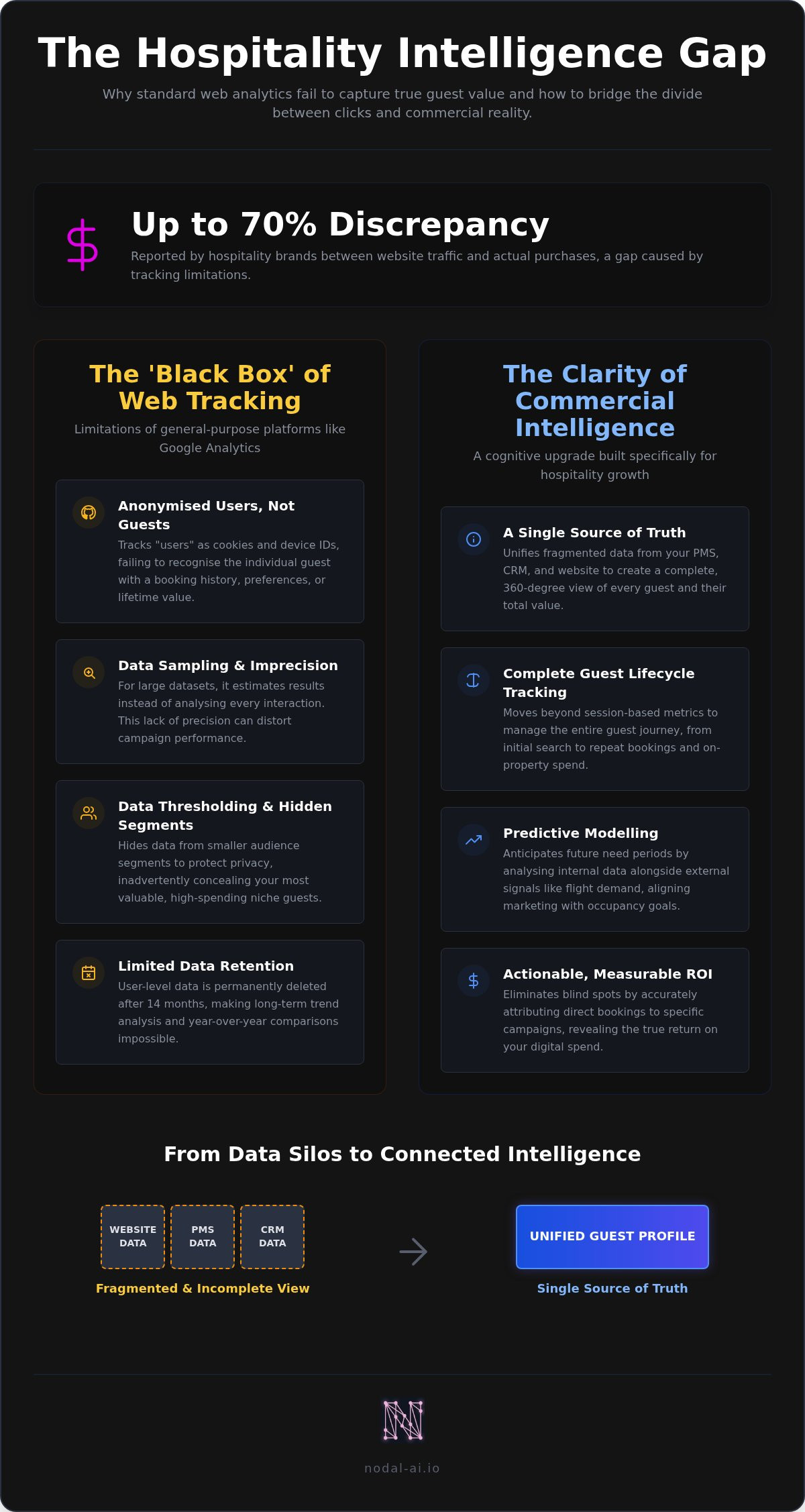
Did you know that some hospitality brands have reported a 70% discrepancy in traffic and purchases since September 1, 2026? While it remains the industry standard, the inherent limitations of google analytics are becoming impossible for modern hotel groups to ignore. You likely feel the frustration of seeing a surge in website sessions that never translates into your PMS as direct bookings. It's a common struggle; GA4 was built as a general purpose web tracker, not a specialised engine designed to navigate the complexities of guest behaviour and fragmented property data.
This article will reveal why standard tracking fails to capture the true value of your digital spend and how you can bridge the gap between anonymous clicks and actual guest revenue. We will explore the technical hurdles of data thresholding and sampling, then outline a path toward a single source of truth that aligns your marketing spend with future occupancy needs. Realise the potential of your data by moving beyond the black box of standard analytics and into a model built for hospitality growth.
Key Takeaways
- Realise the fundamental distinction between tracking web sessions and managing the guest lifecycle to ensure your digital strategy aligns with commercial reality.
- Identify the technical limitations of google analytics, specifically how data sampling and thresholding can hide your most valuable guest segments.
- Connect fragmented data sources like your PMS and CRM to eliminate the blind spots caused by cancellations and unrecorded ancillary spend.
- Move beyond reactive reporting by using predictive modelling to anticipate future need periods based on external signals like flight demand.
- Adopt a modular intelligence engine to replace rigid tracking with a cognitive upgrade that prioritises direct booking growth and measurable returns.
The Boundaries of Google Analytics 4: Understanding Web Tracking vs Commercial Reality
Google Analytics 4 operates as a powerful engine for measuring digital engagement, yet it remains fundamentally tethered to the browser. For a hospitality leader, this creates a significant disconnect. You aren't just selling page views; you're selling room nights and guest experiences. While a foundational overview of Google Analytics shows a platform built to track events and sessions, it lacks the native architecture to manage a complex guest lifecycle. This distinction is where the primary limitations of google analytics begin to erode your marketing efficiency.
A "user" in GA4 is often nothing more than a collection of cookies and device IDs. In contrast, a "guest" is a complex individual with a booking history, dietary preferences, and a specific lifetime value. When your data stays trapped in a web-centric silo, you lose the ability to see the person behind the click. This fragmentation between your website and your Property Management System (PMS) leads to OTA leakage. If you cannot accurately attribute a direct booking to a specific campaign, you may inadvertently scale back the very spend that drives your most profitable revenue.
The Shift from Clicks to Commercial Intelligence
Vanity metrics like session duration or bounce rates often mask the true health of your digital ecosystem. For a hotel owner, a high bounce rate on a gallery page might actually indicate a guest found exactly what they needed before calling the front desk to book. GA4 misses these offline signals entirely. To achieve true commercial intelligence, you must connect digital signals to actual property check-ins. Moving beyond clicks allows you to recognise that the guest journey doesn't end at the "Thank You" page; it begins there. Relying on session-based data ignores the high-value reality of ancillary spend and repeat stays.
Why Standard Tracking Often Fails Hospitality Groups
Managing multi-property portfolios introduces layers of complexity that standard setups struggle to resolve. Mapping a guest journey from an initial "inspiration" search on a brand site to a specific room selection in a third-party booking engine is notoriously difficult. These technical gaps often result in broken attribution and undervalued marketing channels. For many groups, overcoming the limitations of google analytics requires a shift toward integrated intelligence. Ultimately, Google Analytics 4 functions as a siloed data source that requires external consolidation to provide any meaningful commercial value to a hospitality organisation.
Technical Constraints: Sampling, Thresholding, and the Privacy Problem
Google Analytics 4 is often marketed as a future-proof solution, yet its technical architecture creates significant barriers for high-volume hospitality brands. One of the primary limitations of google analytics is the aggressive use of data sampling within exploration reports. When your dataset exceeds 10 million events, the platform stops analysing every interaction and begins to estimate results based on a subset of data. For a hotel group managing thousands of monthly bookings, this lack of precision can distort your understanding of campaign performance. Even government bodies have documented these hurdles in their transition strategies for federal websites, noting that data discrepancies are a persistent challenge in the GA4 environment.
Standard properties also face a strict 14-month data retention limit for user-level information. This constraint makes long-term trend analysis or year-over-year comparisons across multiple seasons remarkably difficult. You are effectively forced to export data to external warehouses just to maintain a historical record of guest behaviour. Additionally, GA4 often operates as a walled garden; it prioritises Google Ads data while providing less transparency for other vital channels like meta-search or organic social. This bias can lead to an over-reliance on a single platform, blinding you to the true diversity of your guest acquisition mix.
Thresholding and Privacy Controls in 2026
Data thresholding is a built-in privacy measure that can inadvertently hide your most valuable guest segments. When audience sizes are small, Google hides specific rows in your reports to prevent the identification of individual users. This is particularly frustrating for hospitality marketers targeting high-propensity guests through niche campaigns. Instead of seeing which specific ad drove a high-value booking, you are often met with the "Other" category. These privacy-centric controls effectively mask the direct booking paths you need to scale, making it harder to optimise your performance marketing analytics for maximum return.
The Challenge of Multi-Device Identity Resolution
The modern guest journey is rarely linear. A traveller might discover your property on a mobile device during a morning commute, research amenities on a tablet at lunch, and finally book via a desktop in the evening. GA4 often fails to resolve these disparate touches into a single identity. When the link between devices is broken, your attribution modelling collapses. You may conclude that your mobile spend is underperforming, when in reality, it was the critical catalyst for the final conversion. This fragmentation results in misallocated budgets and wasted spend on the wrong touchpoints.
The Fragmentation Crisis: The Gap Between GA4 and Your PMS
The Property Management System (PMS) serves as the heartbeat of your hotel, yet it remains fundamentally disconnected from your web tracking. While your website records the initial intent, the PMS holds the commercial reality of check-ins, length of stay, and final revenue. One of the most glaring limitations of google analytics is its inability to track what happens after the booking is confirmed. It cannot see stay extensions, nor can it account for the profit-stripping reality of cancellations. When you rely solely on session-based signals, you risk optimising your budget for ghost bookings that never actually check in.
This fragmentation creates a significant blind spot in your acquisition strategy. Without a clear view of the guest lifecycle, hospitality groups often suffer from profit margin erosion. They over-invest in channels that drive high volume but low-quality guests who frequently cancel or book via high-commission OTAs. To regain control, you must implement sophisticated marketing attribution that pulls data directly from your core operational systems. Connecting these disparate sources is the only way to transform fragmented inputs into a single source of truth for your organisation.
The Invisible Guest Journey: PMS and POS Integration
Your Point of Sale (POS) system holds the key to understanding true Guest Lifetime Value (GLV). A guest who books a standard room but spends heavily in your restaurant or spa is far more valuable than one who only pays the base rate. Standard tracking ignores this ancillary spend entirely. Nodal AI resolves this by connecting fragmented systems like Oracle OPERA, Mews, and SevenRooms into a cohesive intelligence engine. By linking digital discovery to on-property spend, you stop optimising for mere "bookings" and start prioritising profitable stays that fuel long-term growth.
Why Last-Click Models Erode Hospitality Profit Margins
Last-click attribution is a tactical trap that hides real growth drivers by rewarding the final search rather than the initial discovery. GA4 often encourages aggressive brand bidding because it gives 100% credit to the final click before a guest reaches the booking engine. This approach ignores the top-of-funnel channels that actually introduced your property to the traveller. When you fail to recognise the limitations of google analytics in this area, you starve your discovery campaigns of the budget they need to attract new guests. The result is a cycle of paying for guests who would have likely booked directly anyway, while your true expansion opportunities remain unfunded.
Moving Beyond Tracking: Predictive Modelling and External Signals
Google Analytics 4 acts like a rear-view mirror. It provides a detailed record of where your guests have been, yet it offers no foresight into where they are going next. This reactive nature is one of the most restrictive limitations of google analytics for growth-focused hospitality groups. To drive consistent occupancy, you must shift from simple tracking to proactive intelligence. By employing predictive modelling, you can anticipate shifts in demand before they impact your bottom line, turning passive data into an active commercial asset.
Evolving from basic web tracking to true commercial intelligence requires a structured approach:
- Data Consolidation: Merge your PMS and CRM with digital signals to eliminate fragmented silos.
- Signal Integration: Layer in external factors like flight demand and currency fluctuations.
- Demand Forecasting: Use AI to identify specific windows of low occupancy before they occur.
- Automated Recommendation: Deploy growth recommendations that bypass manual spreadsheet analysis.
- Dynamic Allocation: Shift marketing spend toward high-yield guest segments in real time.
Leveraging External Signals for Demand Forecasting
Standard tracking is blind to the external market forces that dictate guest behaviour. Factors such as local festival dates, sudden weather patterns, or international flight capacity changes are invisible to standard web trackers. By integrating these external signals, you can identify high-propensity international segments weeks before they start their search journey. This foresight allows you to capture demand at the source. You stop competing in crowded, high-cost bidding wars and start engaging guests when they are first inspired to travel. Identifying these patterns is the only way to overcome the inherent limitations of google analytics in a volatile global market.
Identifying Need Periods Before They Happen
Waiting for your occupancy reports to show a dip is a recipe for reactive discounting. Instead, use AI-driven intelligence to spot need periods up to six weeks in advance. This lead time gives you the power to target high-yield segments with precision, maintaining your average daily rate (ADR) while securing the necessary volume. Automated systems replace the tedious manual labour of cross-referencing multiple property systems. This creates a streamlined path toward growth, where your digital spend is always aligned with your actual property requirements.
Book a demo to see predictive modelling in action
Strategic Clarity: The Nodal Platform as Your Cognitive Upgrade
While we have identified the technical and structural limitations of google analytics, identifying the problem is only the first step. To truly thrive, hospitality leaders need a platform that doesn't just track web events but understands the entire guest lifecycle. The Nodal platform acts as a cognitive upgrade for your organisation, transforming fragmented data into high-value commercial outputs. By adopting a modular architecture, you can tailor your intelligence engine to the specific needs of your property portfolio, ensuring every insight is relevant and actionable. Stop struggling with a general-purpose tool and start using a system designed for the commercial reality of hotels.
Connecting the Dots Across Hospitality Performance
Traditional tracking leaves you with a disjointed view of your performance. Nodal AI resolves this by unifying your PMS, POS, and CRM into a single, transparent dashboard. This integration allows you to move away from the manual labour of spreadsheet consolidation and toward automated, real-time reporting. Partners like Ovolo Hotels have already seen the impact of this clarity, achieving a 15.3% reduction in acquisition costs by identifying exactly where their spend was being wasted. By fostering a direct booking focus, you reduce your dependency on high-commission OTAs and reclaim your profit margins. You can finally see the true value of your marketing spend across every touchpoint.
Achieving Strategic Clarity and Measurable Growth
The real power of a visionary partner lies in the transition from reactive observation to proactive strategy. Instead of asking "what happened" at the end of the month, you begin to ask "what should we do next" to secure future occupancy. This is the commercial advantage of ai marketing analytics. It provides the foresight needed to navigate volatile market periods with confidence. When you bridge the gap between anonymous clicks and actual guest revenue, you empower your team to make more and waste less through superior intelligence.
To see how your fragmented data can be transformed into a single source of truth, book a demo today and discover the path to streamlined, high-level perspectives.
From Fragmented Tracking to Strategic Intelligence
The inherent limitations of google analytics no longer need to dictate your marketing performance or erode your profit margins. By bridging the gap between website sessions and your PMS, you replace technical frustration with a single source of truth. Our partners have already realised this transformation, achieving a 15.3% reduction in acquisition costs and a 24.5% increase in ROAS. As a Gold winner in the Performance Marketing Awards, we understand that true hospitality growth requires predictive modelling rather than reactive reporting. You can now move beyond the black box of sampled data and into a world of transparent, actionable insights.
It's time to turn your passive data into an active participant in your business process. Take the first step toward total clarity and measurable returns by seeing how a modular intelligence engine can streamline your operations and prioritise direct bookings.
Book a demo of the Nodal Platform
Your organisation deserves a cognitive upgrade that turns complexity into profit. Join the visionary leaders who are already mastering the next era of hospitality analytics and securing their future occupancy with confidence.
Frequently Asked Questions
What are the main limitations of GA4 for hospitality businesses?
The primary limitations of google analytics for hospitality include its inability to track the full guest lifecycle and its reliance on session-based web data. It misses critical operational signals like room cancellations or stay extensions that occur within your PMS. This disconnect creates a distorted view of your actual revenue. Consequently, marketers often realise they are optimising for website conversions that may never result in a completed stay on property.
Does Google Analytics 4 track data from my Property Management System (PMS)?
Google Analytics 4 does not natively track data from your Property Management System (PMS) because it is designed to measure browser-based interactions. It remains blind to check-ins, no-shows, and ancillary revenue generated after a guest arrives. This gap means your marketing reports only show the start of the journey. To see the full commercial reality, you must consolidate your PMS data with digital signals through a specialised intelligence platform.
How does data thresholding in GA4 affect my marketing reports?
Data thresholding hides specific user segments in your reports to protect individual privacy, which often leads to missing data in high-value niche campaigns. If an audience size is too small, GA4 simply won't display the results. This makes it difficult for hotel groups to track the success of personalised offers or luxury segments. You are often left seeing "Other" in your reports instead of actionable guest insights.
Why is last-click attribution considered a limitation for hotels?
Last-click attribution is a limitation because it gives 100% of the credit to the final touchpoint, ignoring the top-of-funnel discovery that originally inspired the guest. This model encourages over-investment in brand-bidding while starving your awareness campaigns of necessary budget. For hotels, this results in paying for guests who were already likely to book directly, while failing to attract new travellers who are still in the research phase.
Can I integrate my POS and F&B data into GA4 effectively?
Integrating POS and F&B data into GA4 is technically difficult and often fails to provide a clear view of Guest Lifetime Value. While you can use the Measurement Protocol, GA4 isn't built to handle the complexities of restaurant covers or spa treatments alongside room bookings. This siloed approach makes it nearly impossible to calculate the total profitability of a guest stay without a more robust, hospitality-specific data engine.
What is the difference between GA4 and a platform like Nodal AI?
GA4 is a general-purpose web tracker, whereas Nodal AI is a modular intelligence engine specifically engineered for the hospitality tech stack. While GA4 focuses on clicks and sessions, Nodal AI prioritises commercial outcomes by connecting fragmented data from your PMS, POS, and CRM. This distinction allows you to move beyond reactive reporting and into proactive demand forecasting that aligns with your actual property needs.
How does Nodal AI solve the data fragmentation problem in hospitality?
Nodal AI solves fragmentation by unifying disparate systems like Oracle OPERA, Mews, and SevenRooms into a single, transparent dashboard. It acts as a cognitive upgrade for your organisation, transforming chaotic inputs into high-value commercial outputs. By consolidating these sources, the platform eliminates the blind spots inherent in the limitations of google analytics. This ensures your marketing spend is always tethered to your actual occupancy and profit margins.
Is it possible to track the guest journey across multiple devices in GA4?
Tracking the guest journey across multiple devices in GA4 is notoriously unreliable due to its dependency on standard cookies and Google signals. Many guests research on mobile but complete their booking on a desktop, which often breaks the attribution chain. This failure leads to misallocated budgets, as you may undervalue the mobile campaigns that actually sparked the initial interest. Resolving these identities requires a more sophisticated approach to multi-touch attribution.


