

What if your disconnected booking systems and siloed CRM weren't just a technical headache, but the primary reason your profit margins are leaking to online travel agents? You already recognise the exhausting reality of data fragmentation, where manual reporting errors and high commission costs feel like an unavoidable tax on your operations. Deploying a modern marketing data integration platform is no longer a luxury for the few; it is a fundamental requirement for any hospitality brand seeking to replace manual anxiety with the calm efficiency of a unified commercial strategy.
This guide provides the blueprint to transform your fragmented data into a high-value intelligence engine that drives direct bookings. You'll learn how to automate hours of manual labour and use predictive insights to fill rooms during low-occupancy periods. We will examine the exact frameworks that led to a 15.3% reduction in acquisition costs and a 24.5% increase in ROAS for Ovolo Hotels, ensuring your business remains competitive and profitable throughout 2026.
Key Takeaways
- Discover how the role of a marketing data integration platform has evolved from simple data collection into a proactive commercial intelligence engine.
- Learn to automate fragmented pipelines and harmonise data across your PMS, POS, and CRM to eliminate manual reporting errors.
- Unlock the power of predictive modelling to identify low-occupancy periods before they occur and deploy targeted strategies to fill rooms.
- Explore how unifying external signals like flight demand and weather helps hospitality brands reduce OTA leakage and maximise direct bookings.
- Master the implementation steps that allowed industry leaders to achieve a 15.3% reduction in acquisition costs and a 24.5% increase in ROAS.
What is a Marketing Data Integration Platform in 2026?
In 2026, a marketing data integration platform is no longer just a pipeline for moving numbers between spreadsheets. It is a sophisticated commercial engine that harmonises fragmented marketing, operational, and financial data into a single source of truth. The era of simple data pulling has ended. It has been replaced by AI-powered intelligence that does not just show you what happened, but tells you what to do next. For hospitality and QSR brands, this technology represents the transition from reactive management to proactive commercial leadership.
The core promise of a modern platform is the transformation of chaotic inputs into high-value growth recommendations. By unifying disparate systems, you stop guessing where your bookings come from and start seeing the full customer journey. This clarity allows you to move away from the noise of individual metrics and focus on the signals that actually drive profit margins.
The Problem of Data Fragmentation
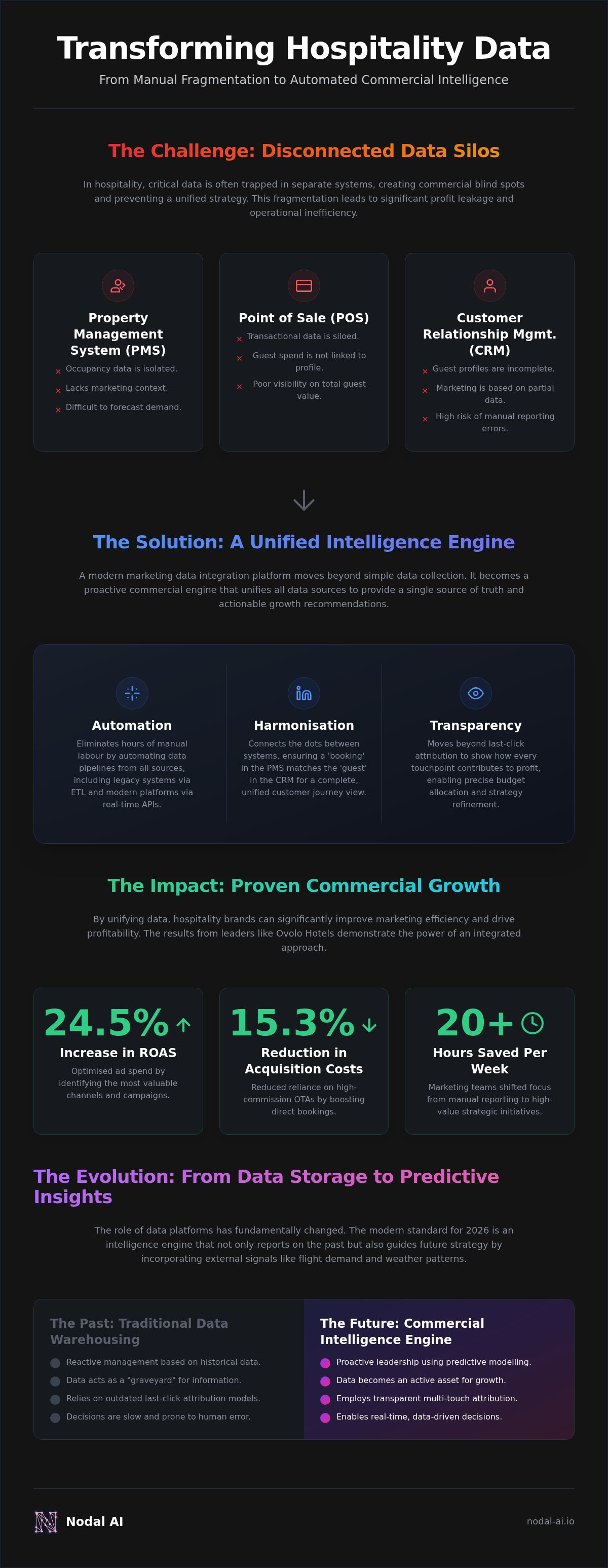
Hospitality brands face a unique silo problem that generic marketing tools often fail to address. Your Property Management System (PMS) tracks occupancy, your Point of Sale (POS) records transaction value, and your CRM holds guest profiles. When these systems don't talk to each other, you develop commercial blind spots. You might see a spike in traffic, but without integration, you cannot tell if those users are high-value guests or one-time bargain hunters.
The cost of "dirty data" is particularly high in performance marketing attribution. Without a centralised engine, your reporting relies on manual exports that are prone to human error. This leads to profit margin erosion as you spend budget on channels that don't convert, or worse, you over-rely on OTAs to fill rooms that you could have secured directly through your own website.
From Data Warehousing to Intelligence Engines
Traditional data warehouses are no longer enough for real-time decision making. They act as graveyards for information, storing data without providing the momentum needed to act on it. A modern marketing data integration platform uses a modular architecture to ingest data from diverse sources, including external signals such as weather patterns and flight demand. This allows you to adjust your strategy based on real-world conditions rather than just historical averages.
Nodal AI connects these dots across hospitality performance specifically. Our platform provides a cognitive upgrade for your organisation, turning passive assets into active participants in your business process. With London-based expert support, your team doesn't just get a tool; they get a partner who understands the nuances of the UK market. Explore these intelligence features to see how modular architecture can replace your manual reporting with automated, predictive insights.
Core Features of a Modern Integration Strategy
Building a resilient commercial intelligence engine requires more than just connecting software. You must deploy a marketing data integration platform that prioritises three pillars: automation, harmonisation, and transparency. Moving from manual exports to real-time ingestion eliminates the friction that typically stalls decision-making. This shift allows your team to focus on high-value strategy rather than the tedious task of cleaning spreadsheets. Security remains paramount; your infrastructure must maintain strict GDPR compliance while managing complex global datasets to protect your brand's reputation and guest privacy.
Technical Integration Methods: API vs ETL
Understanding the architecture of your data flow is essential for operational speed. Real-time API calls offer immediate visibility into performance; however, batch processing via ETL (Extract, Transform, Load) is often necessary for legacy hospitality systems. Specialised connectors for platforms like Oracle OPERA or Mews are vital to ensure data integrity across the stack. Implementing these automated reporting tools can save marketing teams over 20 hours per week, facilitating a rapid transition from data collection to revenue generation.
Harmonisation acts as the bridge connecting these technical pipelines to commercial reality. It ensures that a "booking" recorded in your PMS matches the "guest" profile in your CRM. This alignment is critical for multi-touch attribution (MTA). By moving away from outdated last-click models, you gain a transparent view of how every touchpoint contributes to profit. This level of clarity helped Ovolo Hotels achieve a 24.5% increase in ROAS and a 15.3% reduction in acquisition costs by identifying exactly which channels drove the most value.
Unified Customer Journey Mapping
True intelligence comes from connecting the first ad click to the final on-property spend. By mapping the full customer journey, you can identify high-propensity guest segments who are most likely to book directly. This insight allows you to optimise spend toward audiences that offer the highest long-term value rather than just high volume. You stop wasting budget on low-intent traffic and start investing in the pathways that maximise your direct booking potential.
Refine your approach and see your data in action by exploring how Nodal AI turns fragmented signals into a unified commercial engine through our performance marketing analytics.
Beyond the Plumbing: Predictive Modelling and ROI
Integration is not the goal; commercial intelligence is. Many organisations treat their marketing data integration platform as a passive utility designed to move data from one silo to another. This is a mistake. When you move beyond the plumbing, you transform your data from a historical record into a forward-looking growth engine. Instead of asking what happened last month, you start asking what actions will maximise profit tomorrow. This shift represents a cognitive upgrade for your entire commercial team.
One of the most powerful applications of this intelligence is the identification of "need periods." These are the low-occupancy windows that traditionally lead to panic-discounting or heavy reliance on OTAs. A unified system spots these gaps weeks in advance by analysing booking pace against historical trends. This foresight allows you to prioritise direct booking channels and deploy targeted campaigns before the vacancy becomes a crisis. By reducing OTA leakage, you reclaim your margins and take control of the guest relationship from the very first touchpoint.
The Role of Predictive Modelling
Moving from static reports to predictive modelling transforms how you allocate budget. For serviced apartments and private members' clubs, this means forecasting demand with surgical precision. You can identify which guest segments possess the highest lifetime value (LTV) and focus your acquisition efforts on those individuals. This strategic shift ensures that every pound spent is an investment in long-term stability rather than a temporary fix. It turns your data into an active participant in your revenue strategy.
External Signals: The Missing Piece of Integration
Commercial success does not happen in a vacuum. Your marketing strategy must account for external variables such as weather patterns, FX rates, and flight demand. A sophisticated integration engine ingests these signals to adjust ad spend automatically. If flight demand from a key international market drops, your system should recognise the shift and reallocate budget to domestic travellers or more fertile regions. This approach is equally vital for QSR brands, where footfall is heavily influenced by local events and tourism trends. Measuring the impact of these external factors ensures your marketing remains efficient, responsive, and obsessed with measurable returns.
How to Choose and Implement Your Platform
Selecting a marketing data integration platform is a pivotal commercial decision that dictates your brand's agility throughout 2026. You must begin by auditing your current data stack with surgical precision. Identify every point where guest information is captured, specifically within your PMS, POS, and CRM systems. This mapping exercise reveals the silos that currently hinder your growth and allows you to build a blueprint for total clarity. By identifying these gaps early, you transform your infrastructure from a collection of disconnected tools into a unified commercial engine.
Define your commercial goals before committing to a provider. Are you prioritising direct bookings to bypass high OTA commission costs, or is guest retention your primary focus? Your chosen platform must align with these specific outcomes to turn chaotic inputs into high-value outputs. Modularity is essential; ensure the architecture can grow with your organisation. A platform that feels enterprise-ready today must also be flexible enough to incorporate new signals, such as flight demand or local tourism trends, as your strategy evolves.
Assessing Technical Compatibility
Check for native integrations with industry standards such as HubSpot, Revinate, or other enterprise CRM suites. Seamless connectivity ensures that your data flows without manual intervention, removing the risk of human error. Verify that the platform can handle historical data ingestion, as this is essential for accurate cohort analysis and understanding long-term guest behaviour. Evaluate the Nodal Platform features to ensure they offer the specialised connectors required for complex hospitality datasets. This technical alignment is what allows you to replace manual anxiety with streamlined perspective.
Measuring Success and ROI
Establish clear benchmarks to quantify the value of your integration. Track your acquisition cost reduction and ROAS improvement relative to your current baseline. Aim for measurable returns that mirror the efficiency gains seen by industry leaders, such as significant reductions in spend paired with increases in total booking volume. Monitor the contribution of direct bookings to your total revenue mix to verify the effectiveness of your new commercial engine. These numerical anchors provide the concrete weight needed to justify your investment and prove the platform's impact on your bottom line.
Book a demo to see the implementation roadmap
Onboarding and professional implementation are non-negotiable components of a successful rollout. A visionary leader understands that technology is only as effective as the support behind it. Seek out London-based expert support to ensure your team can navigate the initial setup without losing momentum. This capable partnership ensures that while the underlying technology is complex, your user experience remains effortless. By investing in professional implementation, you protect your assets and ensure a frictionless transition toward a more profitable, data-driven future.
The Nodal AI Advantage: Intelligence for Hospitality
Nodal AI is not a generalist tool. We provide a specialised marketing data integration platform built specifically for the hospitality, QSR, and experience sectors. Our modular intelligence engine replaces generic, one-size-fits-all approaches with logic tailored to your specific commercial use cases. This industry focus allows us to bridge the gap between technical data ingestion and the practical realities of managing occupancy, covers, and membership retention. By personifying your passive data, we transform it into an active participant in your growth strategy.
Case Study: Ovolo Hotels
The impact of our platform is best illustrated through the concrete performance gains achieved by Ovolo Hotels. By using our engine to consolidate fragmented sources and eliminate commercial blind spots, they transformed their marketing efficiency. The results provide a clear benchmark for what is possible when data is unified:
- Achieved a 20% increase in paid search revenue through total data consolidation.
- Realised a 3.6% reduction in overall spend while driving a 13.8% increase in bookings.
- Secured a 15.3% reduction in acquisition costs and a 24.5% increase in ROAS.
- Identified high-value segments that led to a 5.5% increase in average booking value.
Tailored Solutions for Diverse Sectors
Our modular architecture allows us to serve the unique requirements of various experience-led businesses. For serviced apartments and hostels, we provide demand forecasting that accounts for longer lead times and seasonal fluctuations. Within upscale F&B and QSR environments, our tools measure footfall and order mix to optimise menu performance and staffing levels. Private members' clubs and wellness centres benefit from enhanced member retention strategies, using integrated CRM data to predict churn and deliver personalised engagement. Each module is designed to solve the specific pains of your sector without unnecessary technical bloat.
Beyond the underlying technology, we offer London-based expert support to guide your digital transformation. Our team provides strategic ai marketing analytics consultancy, ensuring you have the high-level perspective needed to turn complex inputs into high-value outputs. We don't just sell software; we provide a cognitive upgrade that turns your data into a competitive advantage. This partnership ensures that your organisation remains competitive, forward-thinking, and obsessed with measurable returns.
Future-Proof Your Commercial Intelligence
The transition from fragmented silos to a unified intelligence engine is the most significant upgrade your organisation can undertake in 2026. By deploying a specialised marketing data integration platform, you replace the anxiety of manual reporting with the calm efficiency of automated, predictive insights. This modular architecture empowers your team to identify need periods early, reduce OTA leakage, and prioritise high-value guest segments with surgical precision.
Nodal AI provides the visionary leadership and technical expertise required to turn chaotic inputs into high-value commercial outputs. Our Gold win at the Performance Marketing Awards and the proven results achieved for Ovolo Hotels demonstrate a commitment to hospitality excellence. It is time to transform your passive data into an active participant in your business process and secure your profit margins for the long term.
Book a demo to see how Nodal AI can transform your commercial data
Your journey toward total clarity starts with a single integration. Take control of your guest journey and realise the full potential of your commercial data today.
Frequently Asked Questions
What is a marketing data integration platform and how does it work?
A marketing data integration platform is a centralised intelligence engine that harmonises fragmented marketing, commercial, and operational data into a single source of truth. It works by connecting disparate systems, such as your PMS and CRM, using automated pipelines to ingest and clean data. This process replaces manual reporting with real-time visibility, allowing your team to identify high-value guest segments and deploy growth recommendations that maximise profit margins across every property.
Why is data integration critical for hospitality and hotel brands?
Hospitality brands face unique challenges due to data silos across Property Management Systems and booking engines. Without integration, you suffer from commercial blind spots and profit margin erosion. Unifying these sources allows you to track the full customer journey and reduce reliance on third-party agents. By seeing exactly which channels drive direct bookings, you can optimise your spend and reclaim the guest relationship from the moment of the first ad click.
Can Nodal AI integrate with my existing PMS and POS systems?
Yes, Nodal AI features a modular architecture designed to connect with industry-leading operational systems. We provide native integrations for platforms such as Oracle OPERA, Mews, Cloudbeds, and Stayntouch. Additionally, we ingest data from transaction systems like OpenTable and SevenRooms. This technical compatibility ensures your historical and real-time data flow seamlessly into our engine, providing a cognitive upgrade for your organisation without requiring you to replace your existing technology stack.
How does predictive modelling help in reducing marketing waste?
Predictive modelling transforms historical data into future revenue by identifying early signs of low occupancy windows, known as need periods. By forecasting demand with surgical precision, you can reallocate budget away from high-occupancy dates where you are already at capacity. This approach ensures your marketing spend is always focused on the most fertile opportunities, specifically targeting high-propensity guest segments who offer the highest long-term value to your hospitality brand.
What is the difference between multi-touch attribution and last-click models?
Last-click models incorrectly credit the final touchpoint with the entire conversion value, ignoring the complex path a guest takes before booking. Multi-touch attribution (MTA) provides a transparent view of every interaction, from the initial social media ad to the final website visit. By using MTA within a marketing data integration platform, you gain an accurate understanding of channel performance. This clarity prevents the misallocation of budget and reveals the true drivers of your direct revenue.
How long does it take to implement a marketing data integration platform?
Implementation timelines vary based on the complexity of your data stack and the number of properties involved. Our professional implementation and onboarding process focuses on technical setup and custom dashboard configuration to ensure a frictionless transition. Because our architecture is modular, we can prioritise specific hospitality use cases to deliver immediate value. Most organisations begin seeing automated reporting and initial growth recommendations within a few weeks of the technical mapping.
Will this platform help us reduce our reliance on OTAs like Booking.com?
Reducing OTA leakage is a primary objective of the Nodal Platform. By unifying your customer data, you can identify high-propensity segments and target them through direct channels more effectively. This shift allows you to bypass high commission costs and reclaim your profit margins. Our technology provides the intelligence needed to fill rooms during low-occupancy periods through your own website, ensuring that you own the guest relationship and maximise your commercial returns.
Is Nodal AI compliant with GDPR and other data privacy regulations?
Nodal AI maintains strict compliance with GDPR and global data privacy regulations to ensure the high-level protection of your assets. Our platform includes robust security and governance features designed to handle complex datasets while protecting guest privacy. We prioritise transparency and the removal of ambiguity in how data is processed. This protective approach ensures that your organisation remains compliant while leveraging advanced analytics to drive commercial growth and operational efficiency across your entire estate.


