

What if you could trace every single pound of your marketing budget directly to a specific room booking or restaurant table order? Most hospitality leaders feel the weight of mounting margin pressure while they struggle with fragmented data trapped inside isolated PMS and POS systems. It's exhausting to watch top-of-funnel efforts being undervalued by outdated last-click models that ignore the complexity of the modern customer journey. You need a definitive, automated answer on how to connect marketing spend to sales revenue without the manual headache of endless spreadsheet reconciliation.
You're about to learn the exact steps to bridge the gap between your advertising costs and bottom-line profit by using advanced attribution and intelligent data integration. We've designed this 2026 strategy guide to help you move beyond surface-level metrics into a world of unified operational intelligence. We'll explore how to synchronise your digital ecosystem, eliminate data silos, and optimise your attribution modelling to prove your ROAS with total clarity. By the end of this guide, your passive data assets will become active drivers of growth, providing the high-level perspective you need to justify every budget decision to your stakeholders.
Key Takeaways
- Break down the silos between your PMS and marketing tools to stop data fragmentation from obscuring your true financial performance.
- Transition from simplistic last-click models to multi-touch attribution to gain a comprehensive view of the guest journey from first click to final booking.
- Implement a unified tagging strategy and learn exactly how to connect marketing spend to sales revenue to justify your budget to stakeholders.
- Elevate your analysis beyond basic ROAS by measuring commercial impact through optimised profit margins and long-term customer lifetime value.
- Leverage the Nodal Platform to automate your predictive modelling and receive actionable growth recommendations that reduce OTA leakage.
The Challenge of Data Fragmentation in 2026
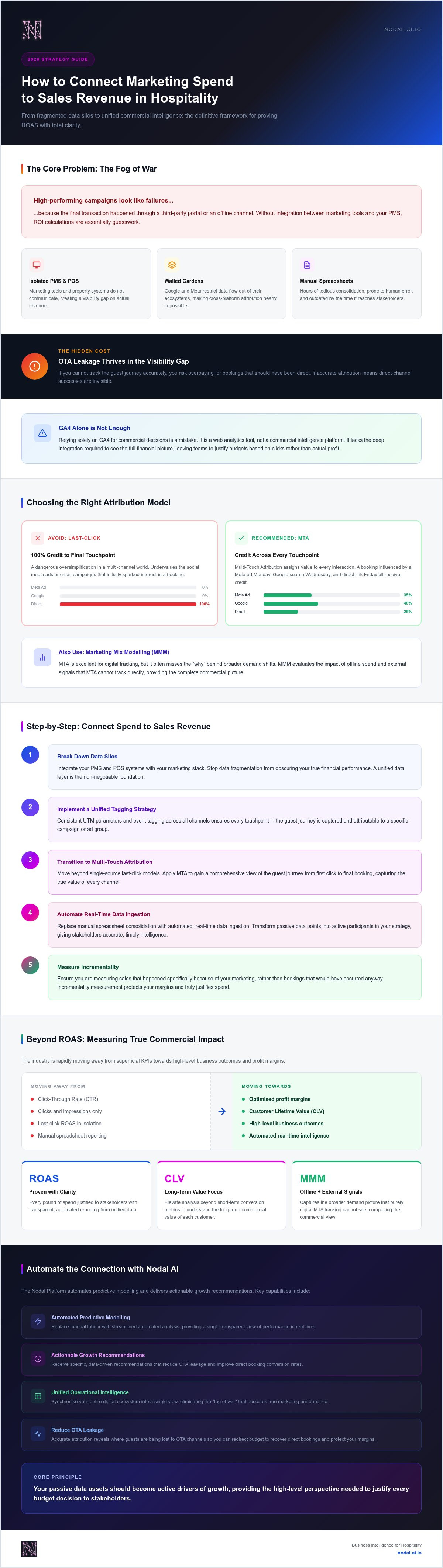
Data fragmentation isn't just a technical glitch; it's the single greatest obstacle for leaders trying to understand how to connect marketing spend to sales revenue. In 2026, the average marketing stack has expanded, yet the gap between a Meta ad and a confirmed room booking remains frustratingly wide. When your marketing tools don't speak to your Property Management System (PMS), your ROI calculations are essentially guesswork. This disconnection creates a "fog of war" where high-performing campaigns look like failures because the final transaction happened through a third-party portal or an offline channel.
Walled gardens like Google and Meta restrict how data flows out of their ecosystems. This makes cross-platform attribution nearly impossible without a unifying engine. For marketing teams in competitive hubs like London, the cost of manual data consolidation is staggering. It often requires hours of tedious spreadsheet work that's prone to human error and outdated by the time it reaches a stakeholder's desk. You're left with a choice: remain buried in manual labour or find a way to turn these chaotic inputs into high-value outputs.
Why Traditional Tracking Fails Hospitality and Retail
Standard tracking often breaks the moment a user moves from a website click to an in-person transaction or a PMS-based booking. This visibility gap is where Online Travel Agency (OTA) leakage thrives. If you can't track the guest journey accurately, you risk overpaying for bookings that should have been direct. Relying solely on GA4 for commercial decisions is a mistake; it's a web analytics tool, not a commercial intelligence platform. It lacks the deep integration required to see the full financial picture, leaving you to justify budgets based on clicks rather than actual profit.
The Shift Toward Commercial Intelligence
The industry is rapidly moving away from superficial KPIs like Click-Through Rate (CTR). Instead, visionary brands are prioritising high-level business outcomes and profit margins. This shift requires a cognitive upgrade in how we handle data. Integrated systems now allow for a single, transparent view of performance by using automated, real-time data ingestion. By transforming passive data points into active participants in your strategy, you replace manual labour with streamlined perspectives. This is the only way to achieve total clarity in a complex market where every pound of spend must be accounted for.
Choosing the Right Attribution Model for Revenue Connection
Selecting the right attribution model is the pivotal moment where you decide to stop guessing and start measuring. If you want to master how to connect marketing spend to sales revenue, you must look beyond the final click. While first-click and last-click models offer a narrow view, they often ignore the critical middle of the funnel where brand trust is built. Relying on these legacy frameworks is like giving a striker all the credit for a goal while ignoring the midfielders who did the hard work. For a deeper dive into these technical frameworks, consult our guide on Mastering Marketing Attribution.
The modern customer journey is rarely linear. It involves multiple devices, platforms, and sessions before a transaction occurs. To capture this complexity, you need a model that accounts for incrementality. This ensures you are measuring the sales that happened specifically because of your marketing, rather than bookings that would have occurred anyway. High-level commercial intelligence requires this distinction to protect your margins and justify your spend.
Multi-Touch Attribution (MTA) vs Last-Click
Last-click attribution is a dangerous oversimplification in a multi-channel world. It gives 100% of the credit to the final touchpoint, which often leads marketers to undervalue the social media ads or email campaigns that initially sparked interest. Multi-Touch Attribution (MTA) solves this by assigning value to every interaction across the guest journey. In a hospitality context, this might mean recognising that a high-value booking was influenced by a Meta ad on Monday, a Google search on Wednesday, and a direct link on Friday. MTA provides the granularity needed to identify which specific touchpoints are truly driving commercial value.
The Role of Marketing Mix Modelling (MMM)
MTA is excellent for digital tracking, but it often misses the "why" behind broader demand shifts. This is where Marketing Mix Modelling (MMM) becomes essential. MMM evaluates the impact of offline spend and external signals that MTA cannot track directly. Factors such as London weather, local festivals, or fluctuating FX rates significantly influence guest demand. Mastering how to connect marketing spend to sales revenue requires this dual perspective. By using a hybrid approach that combines MTA's digital precision with MMM's high-level perspective, you gain total clarity. This allows you to replace manual, tedious tasks with a streamlined view of your entire commercial operation. You can explore these attribution models in action to see how they transform your reporting from a cost-centre view into a profit-driven strategy.
Step-by-Step: How to Connect Spend to Sales Revenue
Transforming your marketing from a cost centre into a profit-driven engine requires a systematic approach to data. You cannot manage what you do not measure, and you certainly cannot optimise what you haven't unified. Implementing a structured framework is the only way to master how to connect marketing spend to sales revenue with total confidence. This process replaces the anxiety of manual reporting with the relief of streamlined, high-level perspectives. Follow these steps to build your commercial intelligence bridge:
- Audit data sources: Catalog every touchpoint across your marketing platforms, CRM, and sales systems to identify where data is falling through the cracks.
- Implement unified tagging: Deploy a consistent tagging strategy across all digital assets to ensure the entire guest journey is visible from the first click.
- Integrate operational systems: Connect your PMS and POS directly to your analytics engine to close the loop between ad spend and final transaction.
- Synchronise revenue data: Create a single source of truth where spend and income are viewed side-by-side in real-time.
- Automate reporting: Transition away from manual spreadsheets and move toward automated dashboards that prove commercial impact instantly.
Unifying Disparate Data Sources
Connecting operational systems like Oracle OPERA, Mews, or Cloudbeds to your marketing stack is a technical necessity for modern hospitality brands. This integration requires robust data cleansing to ensure that duplicate profiles or incomplete records don't skew your ROI. By ingesting historical data, you can move beyond day-to-day fluctuations and begin to recognise long-term demand patterns. This structural upgrade turns passive records into active participants in your growth strategy, allowing you to realise the true value of your marketing efforts without the burden of manual labour.
Mapping the Guest Journey to Revenue
A booking is rarely the result of a single interaction. It is the culmination of a complex journey that often spans multiple weeks and devices. Use Customer Journey Mapping to identify high-propensity segments and uncover friction points that lead to OTA leakage. By tracking ancillary spend, such as restaurant orders or spa bookings, you gain a more complete picture of guest value beyond the initial room rate. This AI-driven analysis allows you to target the most profitable audiences, ensuring every pound spent is working to maximise your bottom-line margins.
Beyond ROAS: Measuring True Commercial Impact
Return on Ad Spend (ROAS) is often treated as the ultimate indicator of success, yet it can be a dangerously misleading metric. High revenue figures mean very little if your operational costs or third-party commissions are eroding your bottom line. To truly understand how to connect marketing spend to sales revenue, you must look at the net profit generated by every campaign. This shift from surface-level metrics to deep commercial intelligence provides the clarity needed to justify larger budgets during periods of margin pressure.
Focusing on Customer Lifetime Value (CLV) rather than single transactions allows you to build a sustainable growth engine. A guest who returns three times a year is far more valuable than a one-off booking driven by a heavy discount. By incorporating operational costs into your ROI calculations, you gain a transparent view of which channels actually contribute to long-term stability. You can use Predictive Modelling to forecast future revenue based on current spend, transforming your historical data into a roadmap for future expansion.
Optimising for Profit Margins
In sectors like Quick Service Restaurants (QSR) or hospitality, the channel mix is critical. A sale via a delivery app carries different margin implications than an in-person order or a direct booking. You need to identify which promotions are merely shifting existing demand and which are driving incremental revenue. Refined targeting strategies can significantly lower acquisition costs while increasing high-value bookings. To protect your margins, consider these factors:
- Analyse the impact of delivery app commissions on your QSR margins.
- Identify discount-driven bookings that fail to generate ancillary spend.
- Refine audience segments to target high-propensity guests who book direct.
For example, Ovolo Hotels achieved a 15.3% reduction in acquisition costs by refining their targeting strategies. This level of optimisation ensures that your marketing spend isn't just generating noise, but is actively protecting your margins.
Forecasting and Demand Planning
Retrospective reporting tells you where you've been, but proactive recommendations tell you where to go. Mastering how to connect marketing spend to sales revenue means using your data to anticipate the market. Modern analytics engines identify "need periods" well in advance, allowing you to adjust your spend to fill low occupancy gaps before they become a problem. By integrating external signals like local events or FX rates, you can predict demand surges with high accuracy. This allows you to move from reactive fire-fighting to strategic demand planning, turning your data into a cognitive upgrade for the entire organisation.
Book a demo to see how the Nodal Platform transforms your commercial reporting
Automating the Connection with Nodal AI
Manual data entry is the primary enemy of commercial growth. It drains productivity and introduces human error into your most critical financial decisions. The Nodal Platform acts as the modular engine for hospitality intelligence, finally solving the persistent puzzle of how to connect marketing spend to sales revenue without the traditional technical hurdles. By turning chaotic inputs into high-value outputs, we replace the anxiety of manual labour with the confidence of automated precision. It is a cognitive upgrade for your entire organisation, providing the high-level perspective required to lead in a competitive market.
Efficiency is the core driver of the Nodal experience. Our automated reporting features save marketing teams more than 20 hours per month, allowing professionals to focus on high-level strategy rather than tedious spreadsheet reconciliation. This isn't just about saving time; it's about measurable returns and commercial stability. For instance, our work with Ovolo Hotels resulted in a 15.3% reduction in acquisition costs. We achieve this by bridging the gap between your digital presence and your operational reality, ensuring every pound spent is accounted for in your bottom-line profit.
A Single View of Hospitality Performance
Nodal unifies fragmented data from your PMS, POS, and CRM systems into one streamlined dashboard. Whether you use Oracle OPERA, Mews, or Cloudbeds, our platform ensures your operational data is no longer isolated from your marketing efforts. This modular architecture allows you to customise the intelligence engine for your specific use cases, providing total clarity across every department. By transforming passive data assets into active participants in your business process, you gain the transparency needed to reduce OTA leakage and drive direct booking growth. Explore the Nodal Platform features to see how we create a single, transparent view of your commercial performance.
Drive Growth with Commercial Intelligence
True intelligence goes beyond mere observation; it demands action. Our platform transforms raw data into actionable growth recommendations that help you refine your digital strategy and optimise your attribution modelling. This forward-thinking approach is supported by our AI consultancy, which works alongside your team to identify "need periods" and protect your margins. We invite you to book a demo to see your data unified and discover exactly how to connect marketing spend to sales revenue with effortless, future-facing analytics. Stop struggling with complexity and start benefitting from the clarity of integrated commercial intelligence.
Master Your Commercial Intelligence Journey
Transitioning from fragmented data silos to a unified intelligence engine is the essential path to protecting your margins in 2026. By moving beyond restrictive last-click models and adopting advanced attribution modelling, you turn passive data into a powerful competitive advantage. You've seen that understanding how to connect marketing spend to sales revenue is not just a technical hurdle; it's a strategic necessity for long-term commercial stability. This shift replaces manual, tedious tasks with the confidence of streamlined, high-level perspectives.
The Nodal Platform provides the modular architecture required to bridge the gap between your PMS and marketing stack. With integrations for over 50 hospitality and marketing systems, our platform has already delivered a 24.5% increase in ROAS for hospitality groups. You can replace the anxiety of manual reporting with the clarity of automated, real-time insights that prove your commercial impact instantly.
Book a Nodal Platform demo to unify your data
Take the next step toward total clarity and start leading with confidence. Your journey toward streamlined, high-level perspectives begins here.
Frequently Asked Questions
How do I track offline sales back to digital marketing spend?
You can track offline sales by using a unified intelligence engine to bridge the gap between digital touchpoints and your physical Point of Sale (POS) or Property Management System (PMS). By integrating these systems, you can match unique identifiers or guest data from the initial ad click to the final in-person transaction. This level of transparency is essential for understanding how to connect marketing spend to sales revenue across both online and offline channels.
What is the best attribution model for a long customer journey?
Multi-touch attribution (MTA) is the most effective model for complex, non-linear guest journeys. Unlike single-touch models, MTA assigns value to every interaction, from the first social media impression to the final direct booking. This provides a high-level perspective on which channels are building trust versus which are merely closing the sale. For hospitality brands, this ensures that top-of-funnel efforts are correctly valued rather than ignored or undervalued.
Can I connect my PMS data directly to Google Ads?
Yes, you can synchronise your PMS data with Google Ads by using an intermediary intelligence platform like Nodal. This connection allows you to import offline conversion data, such as confirmed room bookings or stay extensions, directly into your ad account. By closing this loop, your bidding algorithms can optimise for actual revenue and profit rather than just website leads or clicks. This provides a cognitive upgrade for your entire digital strategy.
How does predictive modelling help with marketing budget allocation?
Predictive modelling identifies future "need periods" by analysing historical data and external signals like local events or tourism trends. Instead of reacting to low occupancy after it happens, you can proactively allocate budget to fill gaps weeks in advance. This forward-thinking approach ensures your spend is concentrated where it will generate the highest incremental impact. It transforms your marketing from a reactive cost centre into a proactive, profit-driven growth engine.
Why is last-click attribution considered inaccurate in 2026?
Last-click attribution is considered outdated because it ignores the multi-device and multi-platform nature of modern consumer behaviour. It over-credits the final touchpoint, which is often a direct search or a brand ad, while completely undervaluing the social media or display ads that initially sparked the guest interest. Relying on this model leads to poor budget decisions and a failure to recognise the true, complex drivers of your commercial performance.
What are the main benefits of automated reporting for marketing teams?
Automated reporting eliminates the burden of manual data reconciliation, saving teams more than 20 hours of manual labour every month. By consolidating data from fragmented systems into a single dashboard, it provides real-time visibility into performance and profit margins. This allows your team to move away from tedious spreadsheet work and focus on high-level growth recommendations. It replaces the anxiety of manual tasks with the confidence of streamlined, professional perspectives.
How do I calculate the true ROI of a hospitality marketing campaign?
To calculate true ROI, you must look beyond top-line revenue and subtract all operational costs, including commissions and cost of goods sold. You should also factor in ancillary spend, such as spa treatments or restaurant covers, to understand the total guest value. Mastering how to connect marketing spend to sales revenue requires this level of granularity to ensure your campaigns are driving actual profit rather than just high-volume bookings.
What is the difference between ROAS and commercial profit margin?
ROAS measures gross revenue generated for every pound spent on advertising, while commercial profit margin accounts for all expenses, including staffing and platform fees. A high ROAS can be deceptive if the associated bookings come with high third-party commissions or low ancillary spend. Focusing on profit margins ensures your marketing strategy is sustainable and prioritises the most valuable guest segments rather than just chasing high-level, superficial revenue figures.


