

Your reporting dashboard functions like an autopsy report: it explains why revenue dropped last week, but offers zero guidance on where profitable demand will emerge tomorrow. If your team is drowning in fragmented data across marketing, CRM, point-of-sale, and booking systems, you aren't alone. Chasing backward-looking metrics often wastes ad spend on channels that merely shift existing demand rather than generating incremental value. Moving forward requires a predictive marketing analytics platform that unifies these chaotic inputs and directs profitable commercial interventions.
The central question is simple: which platform will deliver measurable commercial returns without forcing you to recruit an army of data scientists? This 2026 buyer guide shows you how to evaluate and select software that turns historical data into profitable commercial decisions. We'll explore how to unify siloed revenue streams, accurately forecast customer lifetime value, and automate growth recommendations that safeguard your margins.
Key Takeaways
- Move from passive reporting to forward-looking intelligence that forecasts customer behaviour and revenue outcomes before marketing budgets are committed.
- Understand the multi-layer architecture required to unify fragmented PMS, POS, and ad platforms alongside external signals like weather and local events.
- Apply a rigorous evaluation framework to select the right predictive marketing analytics platform based on commercial impact rather than vanity features.
- Execute a practical, phased implementation roadmap that audits data silos and cleans historical records for dependable predictive modelling.
- Discover how modular intelligence engines deliver automated growth recommendations that protect profit margins and increase acquisition efficiency.
What is a Predictive Marketing Analytics Platform?
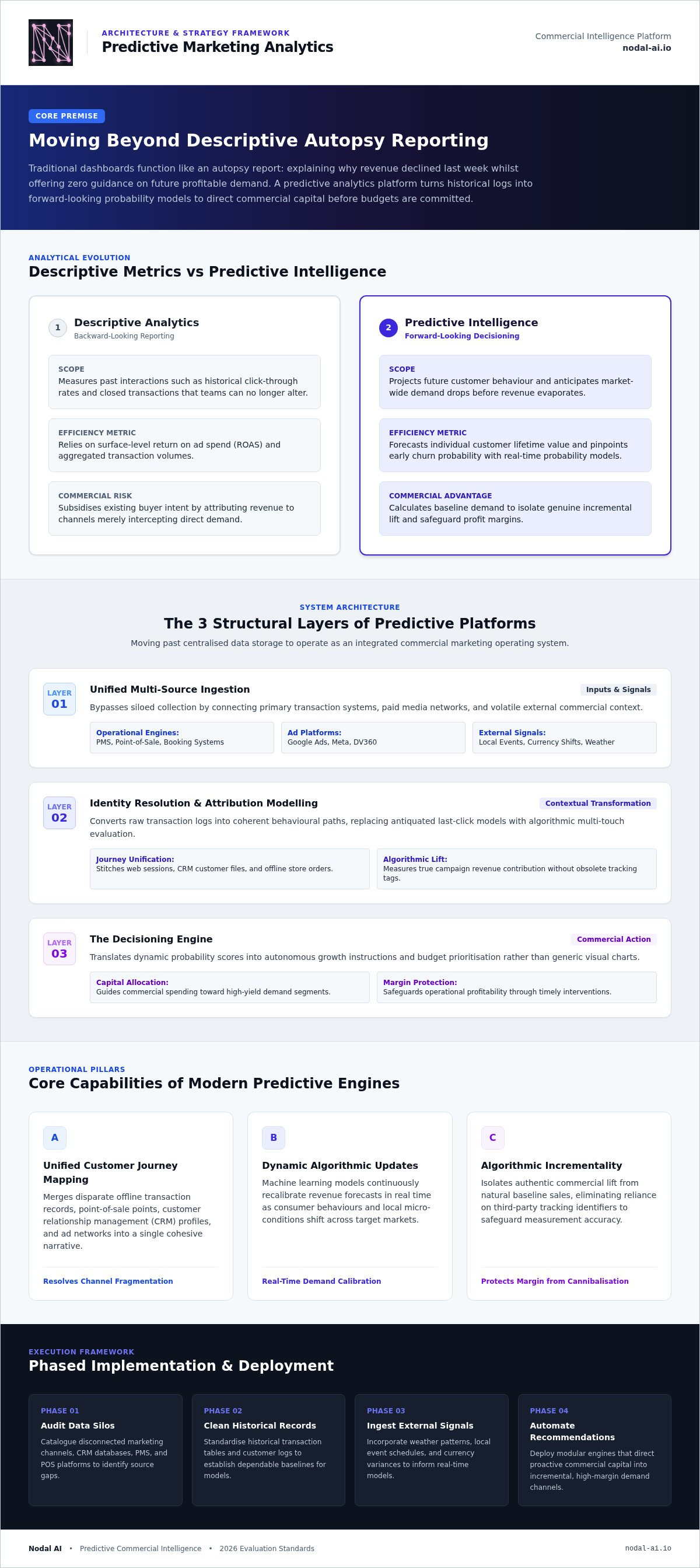
A predictive marketing analytics platform is an operational engine that forecasts customer behaviour, projects future demand patterns, and directs proactive commercial actions before marketing budgets are spent. Traditional business intelligence tools operate strictly in the past tense: they catalogue clicks, historical impressions, and closed transactions that your team can no longer alter. In contrast, modern predictive analytics systems turn static transaction records into real-time probability models. Instead of forcing teams to manually interpret fragmented spreadsheets, these engines continuously run algorithmic simulations that tell commercial leaders exactly where to deploy capital next.
Descriptive Versus Predictive Analytics: Key Differences
Most commercial teams remain trapped in descriptive reporting. The practical differences between looking backwards and forecasting forwards determine how effectively you protect profit margins:
- Descriptive metrics: Measure past interactions such as historical click-through rates, surface-level return on ad spend (ROAS), and aggregated transaction volumes.
- Predictive scoring: Projects individual customer lifetime value, flags early churn probability, and anticipates market-wide demand drops before revenue evaporates.
Relying exclusively on backward-looking reporting distorts commercial strategy. A digital channel boasting an impressive historical ROAS might simply be intercepting customers who were already planning to book or purchase directly. Predictive systems eliminate this illusion by calculating baseline demand, ensuring media spend focuses entirely on generating incremental gains rather than subsidising existing buyer intent.
Core Capabilities of Modern Predictive Engines
Generic data warehouses centralise records, but modern commercial intelligence requires active, automated decision-making. Essential platform capabilities include:
- Customer journey mapping: Unifying fragmented offline transaction records, point-of-sale interactions, CRM profiles, and ad platform data into a cohesive commercial narrative.
- Dynamic algorithmic updates: Machine learning models that recalibrate revenue forecasts in real time as consumer behaviours and local conditions fluctuate.
- Algorithmic incrementality: Isolating authentic commercial lift from natural baseline sales without relying on depreciating third-party tracking identifiers.
Selecting the right predictive marketing analytics platform requires evaluating how well its modular architecture ingests multi-source data and translates it into autonomous growth recommendations. The primary goal isn't just generating prettier charts; it's equipping your team with clear, daily interventions that drive measurable revenue.
Key Architectural Layers of a Predictive Marketing Platform
Most commercial stacks treat data pipelines purely as plumbing. They move numbers into centralised storage, then leave marketers stranded with uncoordinated figures. An effective predictive marketing analytics platform bridges that gap by functioning as an AI-ready marketing operating system, systematically transforming fragmented operational inputs into decisive revenue actions across three structural layers.
Unified Data Ingestion Across Operational and Ad Systems
High-precision modelling starts with robust, diverse ingestion. The platform must connect directly with primary revenue engines, including property management systems (PMS), booking platforms, and point-of-sale terminals. Concurrently, it aggregates campaign metrics from major networks like Google Ads, Meta, and DV360. Crucially, the ingestion layer incorporates external commercial signals: local events, currency fluctuations, and hyper-local weather patterns that shape immediate purchasing decisions.
Identity Resolution and Multi-Touch Attribution Modelling
Raw transaction logs hold little commercial value without contextual identity. The transformation layer stitches disconnected web sessions, CRM customer profiles, and offline purchases into unified behavioural journeys. It replaces outdated last-click heuristics with sophisticated algorithmic attribution, revealing the precise incremental revenue each campaign delivers. For a complete breakdown of modern cross-channel frameworks, review our guide to mastering marketing attribution.
The Decisioning Engine: Generating Automated Growth Recommendations
Data warehousing without automated intervention produces analysis paralysis. The decisioning layer translates statistical probability scores into daily, prioritised operational adjustments. Instead of presenting generic reports, the system delivers automated growth recommendations that protect your bottom line:
- Calculates upcoming demand dips across specific trading sites, prompting early marketing interventions before revenue stalls.
- Adjusts channel budget pacing dynamically based on real-time inventory levels and local trading margins.
- Deploys machine learning algorithms that recalibrate lifetime value projections whenever booking trends pivot.
If you want to move beyond passive dashboards and see automated interventions live, explore how the Nodal Platform unifies predictive modelling with daily execution.
How to Evaluate Predictive Marketing Analytics Platforms
Selecting software based on vanity metrics or sheer connector tallies is an expensive mistake. A viable predictive marketing analytics platform must generate concrete commercial lift, not endless data maintenance. When evaluating potential vendors, look past glossy visualisation dashboards and scrutinise how effectively the system translates operational data into commercial actions without accumulating technical debt.
Evaluation Matrix: Feature Depth Versus Operational Value
Organisations typically weigh three distinct paths when upgrading their predictive capabilities:
- Custom internal builds: Demand heavy engineering resources, carry extended launch timelines, and create ongoing maintenance burdens.
- Monolithic enterprise clouds: Create rigid vendor lock-in, slow onboarding schedules, and continuous reliance on external consulting retainers.
- Modular intelligence engines: Deploy rapid historical data ingestion, integrate with existing tech stacks, and deliver prescriptive revenue actions from day one.
Demand transparency around onboarding speeds and historical ingestion limits. If a solution takes six months of data plumbing before producing its first revenue forecast, it isn't solving your operational challenges; it's delaying them.
Data Governance, Security, and Compliance Standards
Predictive modelling requires uncompromising security. Ensure prospective vendors adhere strictly to regional privacy mandates, including UK GDPR and international data standards. Enterprise operations also need granular, role-based permissioning to segment sensitive revenue records across multi-brand, multi-property, or franchised business units. Reviewing the core architectural principles in the modern data governance framework will help you verify that a provider treats compliance as an automated safeguard rather than an administrative bottleneck.
Commercial Alignment and Industry-Specific Logic
Algorithms must reflect the financial reality of your specific operating model. Generic models fail because they ignore capacity thresholds, channel margin erosion, and direct acquisition targets. For example, if your booking engine indicates high organic occupancy for an upcoming weekend, the engine should automatically recommend throttling paid spend on brand keywords rather than burning capital to acquire customers who were already committed.
Review the tailored capabilities outlined across Nodal AI features to see how specialised logic aligns with day-to-day operations. Your chosen predictive marketing analytics platform must model complex, multi-touch customer journeys natively, bypassing the need for third-party implementation teams.
Implementation Roadmap: Deploying Predictive Intelligence in Practice
Deploying predictive intelligence does not require an exhausting twelve-month custom engineering engagement. Agile commercial teams need speed to impact. By following a structured five-step rollout, you can transition smoothly from fractured data silos into automated commercial forecasting, protecting working media budgets while driving rapid internal adoption.
Phase 1: Discovery, System Audit, and Data Cleansing
Execution begins with a meticulous operational assessment. Start by auditing your fragmented data assets across transactional repositories, booking channels, CRM platforms, and digital analytics setups. This initial discovery phase eliminates structural blind spots before algorithms touch your data:
- Isolate discrepancies: Identify duplicate transaction entries, mismatched currency conversions, and broken session parameters that distort revenue figures.
- Map tracking silos: Connect web-based intent signals directly with point-of-sale systems and offline revenue records.
- Establish commercial baselines: Benchmark pre-implementation customer acquisition cost, organic baseline demand, and channel-level conversion rates to quantify future operational lift accurately.
Phase 2: Modular Integration and Algorithmic Training
Connect core commercial data streams using pre-built modular connectors rather than coding bespoke pipelines from scratch. Link your property management systems, payment engines, and ad networks into unified data flows. Once connected, initiate machine learning models using proven predictive modelling strategies that train on your historical data alongside current trading patterns. Run parallel benchmarking alongside legacy attribution tools during this stage to validate forecasting outputs and confirm identity resolution accuracy.
Phase 3: Activation, Team Adoption, and Continuous Refinement
The final phase shifts your daily operations from reactive review to autonomous execution. Modern predictive engines provide daily tactical recommendations, guiding performance marketers to shift budgets away from saturated channels toward high-margin opportunities before demand softens. Establish continuous feedback loops so that the machine learning models refine their weighting as booking behaviours shift throughout the commercial calendar.
Successful deployment of a predictive marketing analytics platform turns historical records into an active commercial asset, eliminating tedious manual spreadsheet analysis while safeguarding acquisition margins.
Book a demo to see the Nodal Platform in action
Why Nodal AI is the Preferred Predictive Marketing Analytics Platform
General-purpose enterprise suites treat every business like a generic software vendor, forcing commercial operators to endure painful custom builds. Nodal AI changes that dynamic completely. Built as a dedicated predictive marketing analytics platform, it unifies fragmented PMS, POS, and campaign data into immediate commercial clarity. It eliminates the friction of legacy reporting by translating complex behavioural trends into daily, autonomous commercial interventions.
Purpose-Built Modular Architecture for Commercial Performance
Generic business intelligence platforms collapse when confronted with industry-specific commercial realities. Nodal AI solves this through dedicated modules that connect customer demand, operational capacity, and paid acquisition. The system links directly with core operational stacks like Oracle OPERA, Mews, and SevenRooms, alongside ad channels like Google Ads. Rather than relying on internal records alone, the engine ingests external drivers such as local concerts, sporting fixtures, and macroeconomic flight patterns. This real-time visibility lets commercial teams curb online travel agency (OTA) leakage by optimising direct acquisition channels before booking windows close.
Proven Commercial ROI and Real-World Impact
Commercial decisions should be anchored in measurable financial outcomes, not theoretical algorithms. Leading hospitality and commercial operators rely on Nodal AI to protect margins and accelerate profitable direct bookings:
- Ovolo Hotels achieved a 15.3% reduction in customer acquisition costs by aligning ad spend with verified demand fluctuations.
- Delivered a 24.5% increase in verified ROAS alongside a 20% lift in paid search revenue.
- Generated a 13.8% increase in direct bookings while driving a 3.6% reduction in overall media spend.
These results demonstrate how shifting from backward-looking metrics to algorithmic incrementality produces immediate bottom-line expansion.
Accelerate Your Commercial Intelligence Today
Backward-looking dashboards belong in the past. To maintain a decisive commercial edge, operators must replace static spreadsheets with forward-looking intelligence that predicts demand before revenue softens. Review the comprehensive Nodal Platform guide to understand the underlying machine learning framework. When you're ready to eradicate data silos and automate your revenue decisions, book a demo with Nodal AI to modernise your marketing operations.
Turn Commercial Forecasting into Profitable Action
Navigating competitive commercial environments requires moving past retrospective reporting and embracing proactive foresight. Choosing the right predictive marketing analytics platform means deploying a system that unifies operational engines like OPERA, Mews, and SevenRooms with GA4 and major ad platforms. By integrating external catalysts like local events, weather trends, and currency fluctuations, you transform raw metrics into actionable probability models. That operational precision is how brands like Ovolo Hotels achieved a 15.3% reduction in acquisition costs and a 24.5% higher ROAS.
You don't need costly custom software builds or an army of internal data scientists to protect your margins and accelerate direct bookings. With modular intelligence running automated simulations behind the scenes, your commercial team gains total clarity on where profitable demand will emerge next.
Book a personalised demo with Nodal AI
Take command of your revenue strategy and eliminate the friction of backward-looking reporting. Turning fragmented data into continuous, profitable decisions is your fastest route to sustainable growth.
Frequently Asked Questions
How does a predictive marketing analytics platform differ from business intelligence tools?
Traditional business intelligence tools report past activity, while a predictive marketing analytics platform forecasts future commercial performance and prescribes concrete operational actions. BI tools visualise historical clicks and transactions in static charts. Predictive engines apply machine learning algorithms to ongoing trading conditions, calculating future customer demand, churn probabilities, and optimal media budget allocations before marketing spend is wasted.
Can predictive marketing platforms integrate with offline operational and point-of-sale systems?
Modern predictive platforms connect directly with physical operational systems, including point-of-sale terminals and property management systems like Oracle OPERA, Mews, and SevenRooms. Ingesting in-person transactions alongside digital touchpoints bridges the offline-online gap. This unified pipeline enables precise multi-touch attribution, showing how digital campaigns generate physical revenue without relying on fractured spreadsheet exports.
How long does it typically take to deploy a predictive analytics platform?
Deployment timelines depend on system architecture, but modular platforms can ingest historical data and configure operational modules within weeks rather than quarters. Bespoke internal builds frequently take twelve months of intensive software development. Pre-built connectors linking operational tools, CRM databases, and ad platforms bypass long engineering cycles, delivering automated growth recommendations rapidly.
Will a predictive analytics platform replace the need for an in-house data science team?
A modular predictive platform eliminates the requirement to hire dedicated internal data scientists for routine commercial modelling. The underlying machine learning algorithms automate complex tasks like customer journey mapping, attribution modelling, and demand forecasting. Your commercial and marketing teams interact with transparent recommendations and automated reporting rather than writing custom code or building statistical models manually.
What data sources are required to achieve reliable predictive marketing accuracy?
Reliable predictive accuracy requires combining operational records, marketing activity, and relevant external signals. Platforms achieve maximum precision when uniting transaction engines (PMS, POS, or booking software) with ad networks (Google Ads, Meta) and web analytics tools like GA4. Incorporating contextual external drivers, including hyper-local event schedules, currency movements, and weather patterns, further refines demand forecasts.
How do predictive marketing analytics platforms handle privacy compliance under UK GDPR?
Enterprise platforms maintain compliance by processing first-party operational records and applying advanced identity resolution without third-party tracking cookies. Role-based permissions safeguard customer records across business units, brands, or properties. Strict adherence to UK GDPR and global privacy frameworks ensures that algorithmic modelling and automated audience segmentation respect consent parameters while keeping customer data completely secure.
What measurable return on investment can commercial teams expect from predictive analytics?
Commercial teams using predictive modelling routinely lower acquisition costs, lift conversion rates, and protect trading margins. Proven implementations demonstrate substantial gains; for instance, Ovolo Hotels achieved a 15.3% reduction in acquisition costs alongside a 24.5% increase in verified ROAS. Reallocating spend from saturated channels to authentic incremental demand directly drives revenue expansion without requiring larger marketing budgets.


