

A channel can claim a conversion and still tell only part of the story. When paid search, social, email and booking data sit in separate systems, cross-channel marketing attribution can feel less like a clear answer and more like competing reports. Last-click may credit the final interaction while overlooking earlier touchpoints that helped a guest discover a hotel or choose a restaurant.
That frustration is understandable. Teams need a dependable view of performance before shifting budget, but no single model captures every interaction or resolves gaps in tracking. Useful attribution connects touchpoints with bookings and revenue, while making its assumptions and blind spots visible.
This guide explains how cross-channel attribution works, what multi-touch models can and can’t show, and how to build a more consistent view across marketing and commercial data. You’ll learn how to map customer journeys, assess channel contributions and use the evidence to guide budget and growth decisions, without treating attribution as proof of cause and effect.
Key Takeaways
- Use cross-channel marketing attribution to connect customer touchpoints with bookings and revenue, while keeping the limits of the data in view.
- Build a clearer journey by collecting, standardising and connecting relevant data, identifiers and event definitions.
- Choose an attribution model to suit the question: compare how first-touch, last-touch, linear and position-based models distribute credit.
- Agree on outcomes, data owners, channel groupings and revenue definitions before comparing performance across reports.
- Turn hospitality insights into practical questions about direct bookings, guest segments and restaurant orders, without treating correlation as proof of causation.
Why Cross-Channel Marketing Attribution Matters When Data Is Fragmented
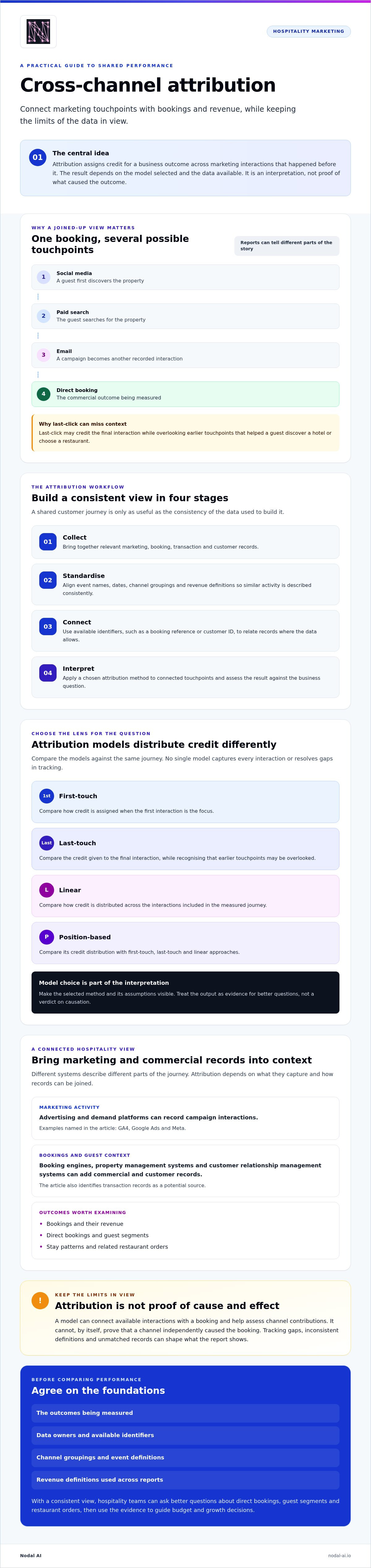
A channel report may credit paid search for a booking, even though the guest first discovered the property through social media, then received an email and eventually visited the hotel website. Each report can describe its own interactions, but none necessarily shows how those interactions relate to the commercial outcome. Cross-channel marketing attribution brings those touchpoints into one view, helping teams assess how marketing activity shares credit for bookings and revenue.
Definition: Cross-channel marketing attribution is the process of assigning credit for a business outcome across marketing interactions that occurred before it, using a chosen model and the data available.
What Does Cross-Channel Marketing Attribution Measure?
Attribution connects four ideas. A channel is a route such as paid search, email or social media. A touchpoint is a particular interaction within that route, such as clicking an advert or opening a campaign email. A conversion is the outcome being measured, such as a direct booking. Revenue gives that outcome commercial value.
A model then distributes credit among the interactions included in the measured journey. This marketing attribution overview introduces the core concept and common approaches. The result is an interpretation, not a complete record of every influence. It depends on the data available, how interactions are matched and which methodology is selected.
That distinction matters. If a guest sees a social advert, searches for the property later and books directly, an attribution model may recognise contributions from both channels. It cannot, by itself, prove that either interaction independently caused the booking. Treat attribution as evidence for better questions, not a verdict on causation.
Why Hospitality Teams Need More Than Channel Reports
Hospitality data often sits across separate systems. Advertising platforms record campaign interactions; a booking engine records reservations; a customer relationship management system (CRM) may hold guest details; and a property management system (PMS) records stay information. Without consistent ways to connect these records, it can be difficult to relate a marketing interaction to a specific booking or its commercial value.
The gap can hide useful context. A direct booking may appear to have no marketing source in one report, even if the guest previously engaged with a campaign. Counting bookings alone may also miss how guest segments, stay patterns or related restaurant orders contribute to performance. No single channel report reveals the complete journey.
A connected view can help teams compare marketing signals with bookings and commercial outcomes. But the view is still shaped by what the systems capture and how records are joined. Make those limits clear, and attribution becomes a more useful guide to investment decisions.
How Cross-Channel Attribution Connects Touchpoints, Customers and Revenue
A useful attribution view is built in stages. Cross-channel marketing attribution works best when teams clarify each stage, from the source data to the commercial question the analysis should answer.
- Collect: Bring together relevant marketing, booking, transaction and customer records.
- Standardise: Align event names, dates, channel groupings and revenue definitions so similar activity is described consistently.
- Connect: Use available identifiers, such as a booking reference or customer ID, to relate records where the data allows.
- Interpret: Apply a chosen attribution method to connected touchpoints and assess the result against the business question.
A shared customer journey is only as useful as the consistency of the data used to build it. If one system records a completed reservation as “booking” and another calls it “purchase”, teams need a reliable way to determine whether those events describe the same outcome. Consistent definitions help prevent reporting differences from being mistaken for changes in performance.
Which Data Sources Can Contribute to an Attribution View?
Acquisition data might come from GA4, Google Ads, Meta and other advertising or demand platforms. Commercial context can come from booking engines, property management systems (PMS), customer relationship management systems (CRM) and transaction records. Hospitality examples include Oracle OPERA, Mews and HubSpot. Confirm available data access and integrations before planning a specific connection.
For example, a marketing interaction could be considered alongside a direct booking record, then viewed with relevant transaction or guest information. The aim isn’t to gather every possible field. It’s to connect the sources needed to answer a defined question, such as which interactions commonly precede bookings from a particular property or guest segment.
How Data Matching Shapes the Customer Journey
Matching depends on the identifiers available, whether they can be used across sources and how events are defined. Missing IDs can leave interactions unconnected; duplicate records can make activity appear more frequent; inconsistent timestamps or event labels can distort journey order. Document these gaps instead of hiding them behind a confident-looking report.
For more on how interactions form a broader journey, see The Definitive Guide to the Customer Journey. Content Marketing Institute also explores whether attribution proves your content is working, including the role different models play in assessing marketing activity.
For a closer look at how data and analytics capabilities fit together, explore the Nodal Platform features.
Which Cross-Channel Attribution Model Fits Your Measurement Question?
Attribution models apply different rules to the same recorded journey. That changes which channels receive credit, but not which interactions occurred. Consider a guest who discovers a hotel through social media, later searches for it, clicks a paid search advert, opens a promotional email and then books directly.
How Do First-Touch, Last-Touch and Multi-Touch Models Differ?
The table shows how common approaches would interpret that hypothetical journey. Credit is illustrative: a model allocates it according to its rules rather than revealing a definitive cause.
| Model | How it allocates credit | What it may underrepresent |
|---|---|---|
| First-touch | Credits social media, the first recorded interaction. | Later interactions that helped the guest decide to book. |
| Last-touch | Credits the direct visit immediately before booking. | Earlier discovery and consideration, including paid search and email. |
| Linear | Shares credit evenly across the recorded touchpoints. | Differences in the role or influence of each interaction. |
| Position-based | Gives more credit to selected positions, commonly the first and last, and distributes the remainder among the middle interactions. Exact rules vary. | Interactions that matter but fall outside the positions given extra weight. |
First-touch can help examine discovery; last-touch can show which interaction preceded a conversion. Linear offers an even allocation, while position-based prioritises selected stages. None is universally best. Choose based on the decision you need to inform, and check that the method suits the journey data you can observe.
Data-driven attribution uses a platform’s methodology to assign credit based on available interaction and conversion data. Its inputs, eligibility and operation depend on the platform, so review its documentation before comparing results with rule-based models.
What Attribution Models Cannot Prove on Their Own
Consent choices, missing interactions, cross-device activity and limits in platform reporting can leave parts of a journey unobserved. A model can only allocate credit among the interactions it receives. Attributed revenue is therefore a descriptive view of recorded activity, not proof that a channel generated additional bookings.
Incrementality testing asks a different question: would the outcome have happened without the marketing activity? It uses a test, such as a suitable holdout, to assess incremental impact rather than redistribute credit across observed touchpoints. Keep attribution reporting and incrementality evidence distinct, then use both to inform decisions. For a broader overview of attribution, see Mastering Marketing Attribution: The Definitive Guide for 2026; a planned explainer on incrementality can address testing methods in more detail.
How to Build a Reliable Cross-Channel Attribution Process
A dependable process starts with shared rules, not a dashboard. Before comparing models, agree on what counts as a business outcome, which records are in scope and who is responsible for each decision. That groundwork helps cross-channel marketing attribution produce evidence teams can review, rather than numbers different departments interpret in different ways.
Set Measurement Rules Before Connecting the Data
Define the outcome first. A hotel might measure completed direct bookings, while another team may need qualified leads or completed restaurant transactions. Then assign owners for source systems, event and channel definitions, revenue rules and reporting decisions. Agree how cancellations, booking changes and duplicate records should be handled so the same activity is treated consistently across reports. For governance context, consult the published Modern Data Governance Framework article.
Set practical rules before analysis begins:
- Event names: Use consistent labels for actions such as booking started and booking completed.
- Channel groupings: Decide how sources such as paid search, email and referrals will be categorised.
- Revenue definitions: Clarify which value is reported and how adjustments such as cancellations are reflected.
- Data responsibilities: Identify who can approve access, confirm definitions and resolve source-system issues.
Involve the appropriate data owners when deciding what information can be accessed, how consent choices affect its use and how long records should be retained. These decisions depend on the organisation’s practices and requirements, so don’t assume every source can be joined or used in the same way.
Validate Reports Before Changing Marketing Decisions
Check the inputs before trusting the output. Review whether records cover the expected dates and sources, whether duplicates appear, whether timestamps align, and whether important fields or conversions are missing. Compare booking and revenue totals with the relevant system-of-record reports. Investigate material discrepancies and document known gaps before drawing conclusions.
Next, compare channel patterns across more than one attribution view. If a channel’s contribution changes sharply between last-touch and a multi-touch model, examine its role and the quality of the underlying data. Don’t treat the difference as an automatic instruction to move budget. Use the findings to shape questions, follow-up analysis or a controlled test. Attribution can guide a decision, but teams should weigh it alongside commercial context and other evidence.
Explore analytics platform features
Turn Cross-Channel Attribution Into Better Hospitality Decisions
Attribution becomes commercially useful when it helps answer a specific hospitality question, not simply rank channels. A property team might ask which channels are associated with valuable direct bookings, whether patterns differ by property, or how booking value varies across guest segments. Those insights can guide further analysis, but they don’t guarantee that changing a campaign or budget will produce the same result.
Apply Attribution Insights to Hospitality Questions
Start with a decision the team needs to make, then examine the connected evidence. For example, compare recorded marketing interactions with direct bookings by property, and consider booking value or guest segment where those records can be reliably connected. This may reveal patterns to investigate, such as a channel appearing more often in journeys linked to a particular property. It doesn’t establish that the channel caused those bookings.
External signals can add context. Local events, weather conditions or tourism trends may help explain changes in demand when relevant data is available. Treat them as context, not proof that a particular marketing interaction drove a result. Keep the question grounded: did demand shift around an event, and did the pattern differ across properties or booking sources?
Where a Connected Analytics Platform Can Help
Nodal AI’s modular Nodal Platform is designed to consolidate fragmented hospitality data and support customer journey mapping, multi-touch attribution and commercial insights. Depending on the available data sources and confirmed connections, teams can bring marketing signals into the same analytical view as booking, operational, customer or transaction information. This helps them examine how recorded journeys relate to commercial outcomes while keeping data gaps visible.
Ovolo Hotels case-study figures include a 15.3% reduction in acquisition costs, a 24.5% increase in ROAS, a 20% increase in paid search revenue and a 13.8% increase in bookings. These are reported case-study outcomes, not guaranteed results.
For a closer look at how connected data and journey analysis can support hospitality decisions, explore the Nodal Platform features.
Make Every Marketing Insight More Actionable
Cross-channel marketing attribution is most useful when it connects recorded touchpoints with bookings and commercial outcomes, while making data gaps and model assumptions clear. Agree on shared event names, channel groupings and revenue definitions before comparing reports. Then use attribution to guide questions about guest journeys and performance, not as automatic proof that a channel caused a booking or as a reason to shift budget without further evidence.
Nodal AI’s Nodal Platform helps hospitality teams bring fragmented information into a more connected analytical view, with support for customer journey mapping, multi-touch attribution and commercial insights. The Ovolo Hotels case study reports a 15.3% reduction in acquisition costs and a 24.5% increase in ROAS. These are reported case-study outcomes, not guaranteed results.
For a more connected view of hospitality performance, explore how the Nodal Platform can bring your data together.
Frequently Asked Questions
What is cross-channel marketing attribution?
Cross-channel marketing attribution assesses how interactions across marketing channels relate to a customer outcome, such as a hotel booking. It helps teams compare the credit assigned to different channels across a recorded journey, rather than relying on a single source or final interaction. The result depends on the available data, the outcome being measured and the selected model. Treat it as an analytical view, not automatic proof that a channel caused the outcome.
How is cross-channel attribution different from multi-touch attribution?
Cross-channel attribution focuses on interactions across different marketing channels, while multi-touch attribution describes methods that distribute credit across multiple touchpoints. Those touchpoints may occur on several channels, so the approaches often overlap. When defining a report, specify the channels, interactions and outcomes it includes. That makes it easier to compare findings and avoid assuming that two reports use the same scope or attribution rules.
Which attribution model is best for cross-channel marketing?
There’s no universally best attribution model. First-touch credits the first recorded interaction, while last-touch credits the final one before conversion. Multi-touch approaches, such as linear or position-based models, distribute credit across several interactions using different rules. Choose a model that fits the business question and the data available. Compare its results with other evidence, and explain its assumptions so stakeholders don’t confuse allocated credit with incremental impact.
Can cross-channel attribution prove which marketing channel caused a booking?
No. Attribution allocates credit according to a model and the interactions captured in the data. Missing touchpoints, incomplete matching or unobserved activity can affect the result, so it can reveal patterns without proving cause and effect. To assess whether marketing activity generated additional bookings, use evidence designed to test incremental impact, such as a suitable controlled test. Treat attributed bookings as a starting point for investigation, not causal proof on their own.
How do you measure cross-channel marketing attribution in hospitality?
Start by defining the outcome, such as a completed direct booking or restaurant transaction. Identify relevant marketing, booking, customer and revenue records, then agree how channels and events are labelled. Connect records where available identifiers permit, and check for missing or duplicated data. Interpret results in context, such as by property or guest segment, and record which model was used. The systems and identifiers available will vary by organisation.
Does cross-channel attribution work when customer data is fragmented?
It can still offer a useful view, but fragmented data limits how complete and reliable that view may be. First identify where marketing interactions, bookings and customer records are held. Standardise key definitions, review whether records can be matched and flag missing information before interpreting channel credit. A consolidated analytics approach can help bring relevant sources together, but it can’t recover interactions that were never captured or make uncertain matches conclusive.


