

What if the next step towards better marketing performance isn’t another tool, but a clearer view of what your data can already tell you? A marketing analytics maturity model can help you assess that. It shifts the focus from collecting more numbers to connecting evidence with decisions that support growth.
If your marketing data sits across systems and teams, you’re not alone. Reports may explain what happened without showing what to do next, while attribution, customer insight and forecasting remain disconnected. Without a shared way to assess these capabilities, it’s difficult to agree on which improvement matters most.
This article will help you assess your analytics capabilities consistently, identify gaps that affect commercial decisions and choose a realistic next step before investing in more tools. You’ll explore a practical progression from describing results to diagnosing causes, predicting outcomes and recommending actions. These stages aren’t a universal standard or a score to chase. They help you see whether your data, processes and insights are ready to support better decisions, and where to focus next.
Key Takeaways
- Use a marketing analytics maturity model to assess how consistently data supports decisions, not as a universal standard or score to chase.
- Compare observable capabilities across the stages to identify where reporting, insight and action are disconnected.
- Assess evidence and repeatability across data access, quality, shared definitions, analysis and follow-through.
- Choose your next analytics improvement by weighing its commercial relevance, data readiness, ownership and implementation effort.
- Match capabilities such as automated reporting, journey analysis, attribution and predictive modelling to the decision you need to improve.
What Is a Marketing Analytics Maturity Model, and What Does It Measure?
A marketing analytics maturity model assesses how reliably an organisation turns data into insight, and insight into repeatable marketing decisions. It helps teams see whether their evidence is connected, understood and used consistently, rather than simply collected. The goal isn’t to reach a particular label. It’s to identify what currently supports decisions and what needs attention next.
The idea of progressing through capability stages draws on broader maturity frameworks such as the Capability Maturity Model. But there’s no single industry-wide standard for marketing analytics maturity. The stages in this guide offer a practical way to discuss capabilities and gaps, not a universal ranking or a fixed sequence every organisation must follow.
More data, dashboards or AI tools don’t automatically mean greater maturity. A business can have extensive reporting and still struggle to agree on what a conversion means, trust the figures or decide what to change. The useful test is whether teams can produce dependable evidence and use it to make informed, repeatable choices.
What capabilities does a marketing analytics maturity model assess?
Look across the whole decision process: data quality and integration, consistent measurement, meaningful analysis, clear governance and follow-through. Capabilities may vary across teams and business units. For example, a hotel team might connect campaign activity with booking and property data, then consider guest value. If booking records use different definitions or cannot be matched to campaigns, the analysis may not support a confident channel decision.
Why does analytics maturity matter to commercial performance?
Clearer measurement gives teams a stronger basis for decisions about budgets and channels. Without it, fragmented reports can make one campaign look successful while obscuring how earlier interactions contributed to a booking across the customer journey. Better-connected evidence can help leaders compare performance with more context and identify where to investigate. It doesn’t guarantee revenue growth: outcomes also depend on the decisions made and wider business conditions.
The Four Stages of Marketing Analytics Maturity, from Fragmented Data to Action
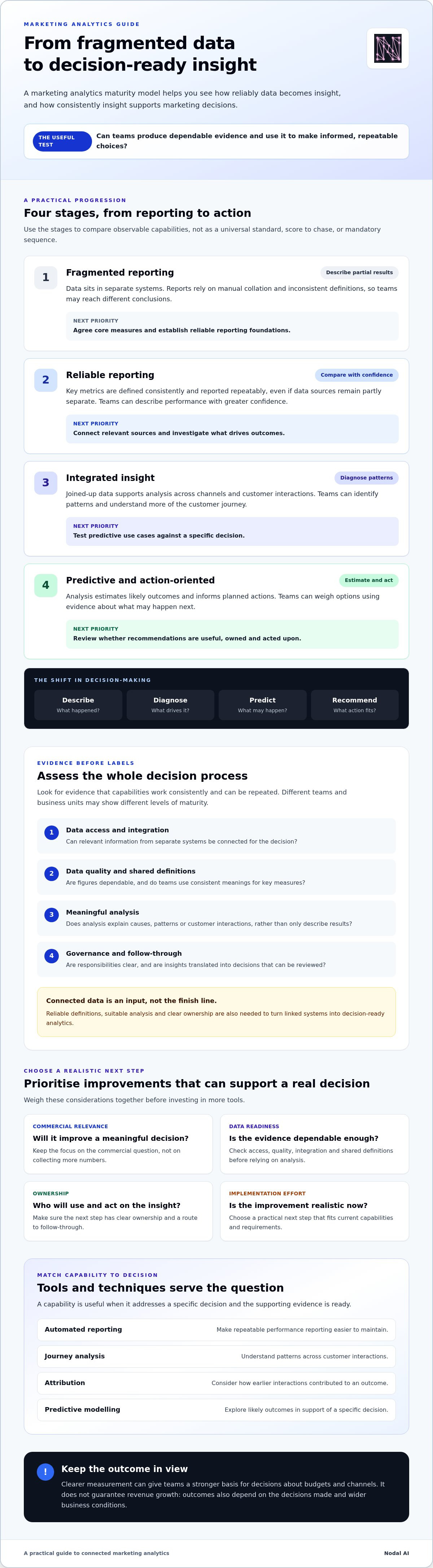
This four-stage marketing analytics maturity model is a practical comparison, not a universal standard or a mandatory sequence. Organisations may show different capability levels across teams. The table highlights common patterns, from reporting that struggles to join up to analysis that can inform forward-looking decisions. For a broader overview of how maturity frameworks describe capability development, see Alteryx’s analytics maturity model.
| Stage | Observable capability | Decision quality | Next priority |
|---|---|---|---|
| 1. Fragmented reporting | Data sits in separate systems; reports rely on manual collation and inconsistent definitions. | Teams see partial results and may reach different conclusions. | Agree core measures and establish reliable reporting foundations. |
| 2. Reliable reporting | Key metrics are defined consistently and reported repeatably, even if sources remain partly separate. | Teams can describe performance and compare results with greater confidence. | Connect relevant sources and investigate what drives outcomes. |
| 3. Integrated insight | Joined-up data supports analysis across channels and customer interactions. | Teams can identify patterns and understand more of the customer journey. | Test predictive use cases against a specific decision. |
| 4. Predictive and action-oriented | Analysis estimates likely outcomes and informs planned actions. | Teams can weigh options using evidence about what may happen next. | Review whether recommendations are useful, owned and acted upon. |
Connected data is an input; decision-ready analytics is the ability to use that evidence consistently to choose and review an action. Linking systems alone doesn’t create insight. Reliable definitions, suitable analysis and clear ownership still matter.
How does a fragmented reporting stage differ from integrated measurement?
In a fragmented setup, campaign results, booking records and customer details may sit in separate systems. Teams might manually combine exports while using different definitions for a booking or campaign source. Integrated measurement brings relevant records into a more consistent view, so a hotel team can examine how marketing activity relates to bookings and guest value. This makes comparisons more useful, though it doesn’t remove every attribution limitation.
What changes when analytics becomes predictive and action-oriented?
Teams move from describing past results to examining patterns and estimating likely outcomes. Predictive modelling is one possible capability, not an automatic result of connecting data. For example, a hotel might use a need-period forecast to consider whether to adjust campaign focus for dates when demand is expected to be softer. The forecast informs a decision; teams still need to assess its assumptions and results.
For organisations exploring how connected capabilities could support these stages, Nodal AI’s platform features provide a relevant overview.
How to Assess Your Marketing Analytics Maturity with Observable Evidence
Assess what your teams can demonstrate, not how confident they feel or how many tools they own. A useful marketing analytics maturity model makes gaps visible through evidence that can be checked and repeated. Apply the diagnostic below to a specific marketing decision, such as evaluating which campaigns contribute to bookings.
For each area, score the evidence: 0 means there’s no consistent evidence; 1 means evidence exists but depends on manual work or varies between teams; 2 means the process is documented and repeatable. These scores are a practical aid, not an industry benchmark.
- Data access: Can the relevant people access the campaign, transaction or booking, and customer records needed to assess the decision? Note missing sources, delays or access that depends on one person.
- Data quality: Are records complete and consistent enough to use together? Check for duplicate, missing or mismatched campaign and customer details, and record how teams resolve them.
- Definitions: Are channel names, conversion events and business outcomes documented? Do teams apply the same definitions when comparing reports?
- Analysis: Does the analysis answer a defined commercial question, or does it stop at displaying results? Can teams explain what the evidence supports and where uncertainty remains?
- Action and review: Is someone responsible for acting on the finding? Is the decision recorded and revisited to see what happened?
Save examples behind each score, such as a report, documented metric definition or decision record. For another reference point, you can also review established framework guides. Use them as a prompt, not as a substitute for evidence from your own processes.
Which questions reveal gaps in marketing data and measurement?
Check whether campaign activity can be reconciled with bookings, transactions or customer records, and whether channel and conversion definitions are written down and used consistently. Then test the reporting process: can it be refreshed without recurring manual reconciliation? If staff must repeatedly match records by hand, note that as a process gap even if the final report looks complete.
How can leaders assess insight use and decision readiness?
Ask which commercial question the analysis answers, who acts on its findings and how the team reviews the resulting decision. For customer journey or attribution evidence, record the assumptions and limitations alongside the insight. Platforms like Nodal AI can help unify these evaluation metrics. Repeat the diagnostic separately across channels, properties, markets or business units where capabilities may differ. Maturity is evidenced by decisions teams can make and review repeatably, not by tools they own.
How to Prioritise the Next Step in Your Analytics Maturity Roadmap
A maturity assessment only creates value when it changes what the team does next. Start with a commercial decision that needs better evidence, then work backwards to the capabilities required. Don’t begin by choosing a new tool or advanced analytical method. If channel definitions are inconsistent or booking data can’t be reconciled, fixing those foundations may be more useful than adding predictive features.
Compare possible improvements against four practical criteria:
- Commercial relevance: Will this help answer a decision that matters to marketing or business performance?
- Data readiness: Are the necessary sources available, sufficiently reliable and defined consistently?
- Ownership: Is there someone responsible for delivering the improvement and using its output?
- Implementation effort: What work is required to make the change usable and repeatable?
Use these criteria to surface trade-offs, not to create a false sense of precision. A high-value question with weak data readiness might call for a definitions or integration improvement first. A ready-to-use report with no clear owner may need a decision process before more technology.
How should teams build a realistic analytics improvement roadmap?
Choose one use case, such as understanding which marketing activity contributes to bookings, and name the person who owns the decision. Define the outcome to monitor, then list the minimum data sources and quality checks needed. For a hotel, this might mean agreeing how campaign records, booking data and customer records should be matched before comparing channels. Set a review point to examine what the evidence enabled, what remains uncertain and whether the next priority should change.
Governance supports this work by clarifying how data and definitions are managed across teams. For more detail, see The Modern Data Governance Framework: From Fragmented Data to Strategic Clarity.
When should a business consider a connected analytics platform?
Consider platform fit when recurring fragmentation prevents teams from answering agreed commercial questions, even after they’ve clarified the use case and essential measures. Assess whether a platform can address the sources you need, support modular capabilities, fit reporting workflows and provide appropriate access to the people using the outputs. A platform should help connect evidence to a decision, not become a maturity badge in its own right.
For attribution-specific questions, Mastering Marketing Attribution: The Definitive Guide for 2026 offers a deeper topic to explore. Keep your roadmap focused on the gap that most limits useful action today. A marketing analytics maturity model is most practical when it helps teams sequence improvements around real decisions.
Explore a connected analytics platform
How Nodal AI Can Support More Connected Marketing Analytics
Once you’ve identified a decision your team needs to improve, ask whether your data and analytical capabilities can support it. Nodal AI’s modular intelligence platform connects fragmented commercial, customer, operational and marketing data to generate tailored insights. Connected data can provide a clearer foundation for analysis, but it isn’t a maturity score by itself. Its value depends on whether teams can use the evidence to make and review decisions.
Which Nodal AI capabilities map to common maturity gaps?
Different capabilities can address different points in the analytics process. Start with the gap, then consider which capability could help:
- Disconnected reporting: Data consolidation and automated reporting can help bring relevant business information into a more consistent view and reduce reliance on manually assembled reports.
- Unclear customer journeys: Customer Journey Mapping can help teams examine how customer interactions relate to commercial outcomes.
- Uncertain channel contribution: Multi-Touch Attribution can help analyse how marketing touchpoints contribute across a journey, while keeping the model’s assumptions and limitations in view.
- Forward-looking questions: Predictive Modelling can support analysis of likely outcomes when the data and use case are suitable. Growth Recommendations can help inform choices, but they don’t replace human judgement or ownership of the decision.
These capabilities needn’t be treated as an all-at-once transformation. A team might first focus on connected reporting, then consider journey analysis or attribution when it has a defined question and suitable data. Explore the Nodal Platform features to understand how its capabilities relate to connected marketing analytics. For further platform detail, look for Nodal Platform: Transform Fragmented Marketing Data into Profitable Decisions.
What should teams clarify before evaluating a platform?
Prepare a short evaluation brief before comparing platforms. Set out:
- The priority commercial decision the team needs to make.
- The data sources required to inform it, and any known gaps in access or quality.
- The stakeholders who will use the analysis and own follow-up actions.
- The measure or evidence that will help the team review whether the decision was useful.
Then confirm integration fit for your environment, including which sources can be connected and what implementation work or access arrangements may be needed. Nodal AI connects data sources across advertising, customer, booking and property systems. Confirm current compatibility for your specific setup. Ovolo Hotels reported performance outcomes, but verify the case study context and calculation basis before citing specific figures. Treat reported results as case-specific, not a guarantee that technology alone will produce the same outcome.
Turn Your Analytics Assessment into a Clear Next Step
A marketing analytics maturity model is most useful when it helps your team decide what to improve next. Assess repeatable evidence, not the number of dashboards or tools. Then choose a commercial decision, identify the data and ownership it requires, and prioritise the gap that most limits action. Strong foundations can matter more than advanced modelling if definitions or reporting remain unreliable.
Nodal AI’s modular platform connects fragmented data to support commercial, customer and operational insight. Ovolo Hotels reported a 15.3% reduction in acquisition costs and a 24.5% increase in ROAS. These are reported case study outcomes, not guaranteed results. Verify their context and calculation basis before publication.
Start with one decision and build from there. Each practical improvement can bring your data closer to clearer, more confident commercial choices.
Frequently Asked Questions
What is a marketing analytics maturity model?
A marketing analytics maturity model is a framework for assessing how consistently an organisation turns marketing data into useful insight and repeatable decisions. It considers capabilities such as data quality, integration, measurement, analysis and follow-through. The model helps teams identify gaps and choose a practical improvement. Its stages are best treated as guidance, not a universal standard or a score every organisation must achieve.
What are the stages of marketing analytics maturity?
A practical framework can describe four indicative stages: fragmented reporting, reliable reporting, integrated insight, and predictive, action-oriented analytics. These patterns move from separate data and inconsistent measures towards connected evidence that can inform decisions about likely outcomes. Organisations may have different capabilities across teams or business units, and they don’t have to follow one fixed sequence. Use the stages to spot priorities, not to label teams.
How do you assess marketing analytics maturity?
Assess evidence across data access, data quality, shared definitions, analysis and action. For each area, check whether the process is documented, repeatable and supported by examples, such as a reconciled report or a recorded decision. Note where work depends on manual fixes or individual knowledge. The aim is to evaluate what teams can demonstrate in practice, rather than their confidence or the number of tools they use.
Why is marketing analytics maturity important?
Greater analytics maturity can help teams make better-informed commercial decisions by connecting measurement with questions about channels, budgets and customer behaviour. If reports use conflicting definitions or show only parts of a customer journey, leaders may struggle to interpret performance. A maturity assessment helps reveal those limitations and focus improvement efforts. It can support clearer decisions, but it doesn’t guarantee revenue growth or replace sound commercial judgement.
Can a small marketing team use a maturity model?
Yes. A small team can use a maturity model without adopting complex systems or processes. Start with one important decision, such as understanding which activity supports bookings or transactions. Check whether the relevant data is accessible, consistently defined and reviewed by someone who can act on the findings. A focused assessment can help a team prioritise a manageable improvement and avoid investing in capabilities it isn’t ready to use.
Does analytics maturity depend on using artificial intelligence?
No. Artificial intelligence isn’t a requirement for marketing analytics maturity. Teams first need reliable data, clear measurement definitions and analysis that supports decisions. Predictive modelling or other AI-supported capabilities may help answer particular questions when the data and use case are suitable. Adding AI without those foundations can add complexity without resolving basic gaps. Maturity is better judged by the quality and repeatability of decisions than by technology adoption.
How can a business improve its marketing analytics maturity?
Choose a specific commercial decision to improve, assign an owner and define what evidence would help. Then identify the minimum data sources, definitions and quality checks required. Address the gaps that prevent useful analysis before moving to more advanced methods. Set a review point to assess what changed and whether the next priority should shift. This creates a practical roadmap grounded in business needs, rather than a technology wish list.
How does a marketing analytics platform support a maturity roadmap?
A marketing analytics platform can help connect fragmented data and support capabilities such as automated reporting, customer journey mapping, multi-touch attribution and predictive modelling. Its value depends on fit with the decisions, data sources and workflows a business needs. Before evaluating one, clarify who will use the analysis, what access is required and how success will be assessed. A platform can enable better-connected insight, but it doesn’t replace sound definitions or human judgement.
Book a Nodal AI demo to discuss how connected analytics could support your next commercial decision.


