

The most capable AI marketing analytics platform isn’t automatically the right fit. Choose one that connects your marketing data, clarifies how it attributes conversions and gives your team insights it can act on. The right choice depends on the decisions you need to make, not the length of its feature list.
It’s easy to assume that more dashboards and AI features will bring clearer answers. But if a platform can’t bring your data together or its insights don’t help you decide what to do next, complexity remains.
This comparison will help you assess platforms across attribution, campaign insights, customer predictions, data connections and reporting. You’ll learn what each capability can tell you, how to weigh the trade-offs and how to match a tool to your team’s needs. The goal is to move from scattered performance signals to a clearer view of what’s working and where to focus.
Key Takeaways
- Choose a platform around the decisions you need to make, and weigh implementation and ongoing work alongside subscription costs.
- Use AI analytics to surface patterns and automate reporting, while keeping data quality and human judgement in the decision process.
- Compare attribution models by how clearly they show the contribution of different customer touchpoints to conversions.
- Use customer predictions to guide relevant engagement, such as identifying churn risk or likely purchase interest.
- Compare tools for data-source connections, insights and reporting, then choose the option that fits your team’s workflow and goals.
Which AI marketing analytics tool is right for you?
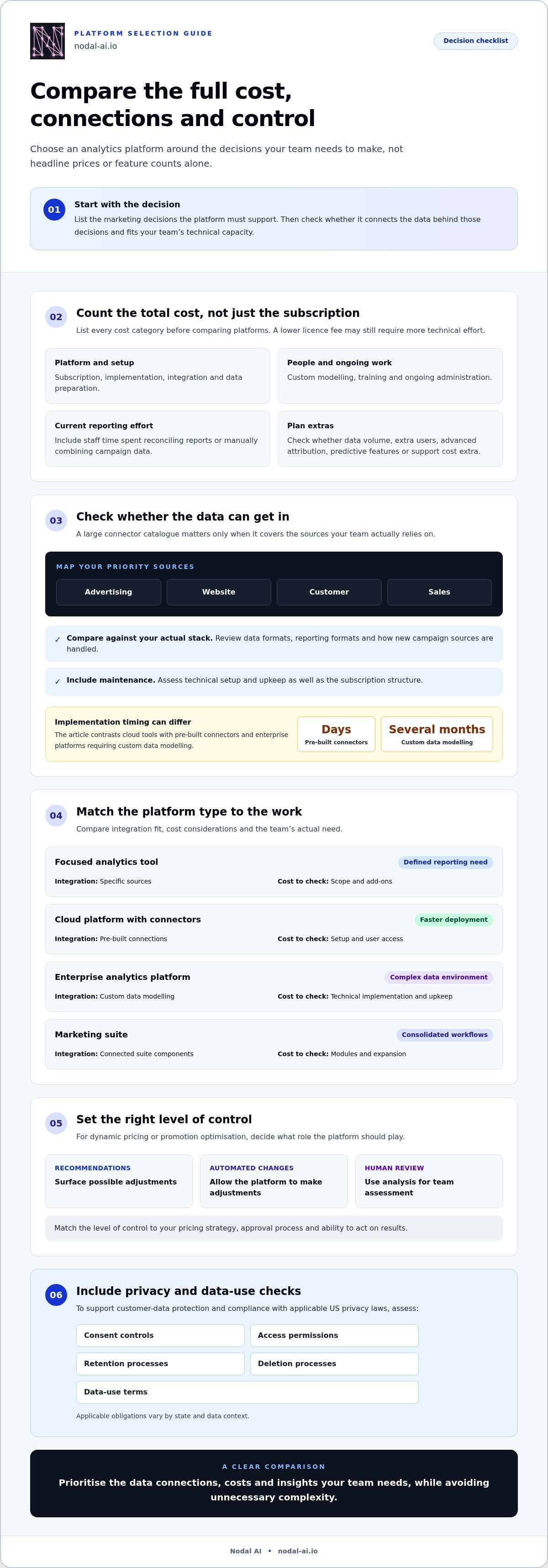
Choose by matching the platform’s data connections, analytics and operating costs to the decisions your team needs to make. To protect customer data and support compliance with applicable US privacy laws, assess consent controls, access permissions, retention and deletion processes, and data-use terms; obligations vary by state and data context.
Platform Pricing and Total Cost
Compare the subscription model with the work required to make the platform useful. Total cost of ownership can include implementation, data preparation, custom modelling, integration, training and ongoing administration. A lower licence fee may require more technical effort, while a broader analytics tool may consolidate reporting tasks. List each cost category before comparing options.
Also consider the cost of maintaining your current analytics tools. If staff spend time reconciling reports or manually combining campaign data, that work belongs in the comparison. Ask how the platform handles data formats, reporting changes and new campaign sources. Cloud tools with pre-built connectors can take days to implement, while enterprise platforms requiring custom data modelling can take several months.
Marketing Tool Pricing and Integrations
Integration determines whether a platform can use the data behind your marketing decisions. Map the advertising, website, customer and sales sources your team relies on, then compare each platform against that list. A large connector catalogue is useful only if it covers your actual stack. Include technical setup and maintenance in your review, not just the subscription structure.
Check which capabilities are included in each plan. Data volume, additional users, advanced attribution, predictive features or support may be treated as separate components. These details affect the overall scope and how easily teams can expand their use. Compare the same requirements across options, including integrations and reporting formats, rather than headline prices alone.
Dynamic pricing and promotion optimisation add another decision criterion. These capabilities use customer behaviour and campaign performance signals to inform adjustments to offers or prices. Assess whether your team needs recommendations, automated changes or analysis for human review. Match the level of control to your pricing strategy, approval process and ability to act on results.
| Option | Integration fit | Cost considerations | Best suited to |
|---|---|---|---|
| Focused analytics tool | Specific sources | Scope and add-ons | A defined reporting need |
| Cloud platform with connectors | Pre-built connections | Setup and user access | Teams seeking faster deployment |
| Enterprise analytics platform | Custom data modelling | Technical implementation and upkeep | Complex data environments |
| Marketing suite | Connected suite components | Modules and expansion | Teams consolidating workflows |
Choose a platform that connects your priority data, suits your team’s technical capacity and delivers the insights you need without unnecessary complexity.
Traditional versus AI-powered analytics
Traditional analytics relies on people building reports, combining data and looking for patterns. AI-powered analysis can automate parts of that workflow, helping teams move from delayed metrics to faster decisions. The difference matters most when campaign data changes faster than reporting routines.
From Manual Reports to Faster Insights
With traditional reporting, an analyst might export campaign results, clean spreadsheet formats and compare channel performance. That process can take hours or days, especially when sources use different definitions. Automated reports reduce repetitive preparation, but teams still need clear metric definitions and reliable inputs.
AI-powered analytics can produce insights in seconds or minutes, often in real time. It can analyse billions of data points simultaneously, identifying patterns and correlations across campaign activity. For example, a team could investigate whether a change in engagement coincides with shifts in conversion behaviour across several audience groups. The result is a quicker lead for investigation, not a substitute for understanding the business context.
Power BI, Tableau and Native AI
Power BI and Tableau can support analytics workflows, but compare the AI features in the specific product and configuration your team uses. Look at how each tool surfaces trends, explains unusual metrics and lets users explore data. A natural-language query may speed up exploration, while a dashboard may better support consistent monitoring across teams.
Test both against the same practical task. Ask each tool to help explain a campaign performance change using the same dataset, metric definitions and date range. Then assess whether the output is traceable to the underlying data and useful to a marketer without specialist technical support. Native functionality can reduce extra steps, while a separate analytics tool may better suit marketing-specific workflows.
Enterprise and Advertising Workflows
Enterprise AI-powered analytics must bring together data from multiple teams while preserving consistent definitions. Before deployment, map the path from source data to decision: who owns each metric, how often it refreshes and who can act on an insight. Data quality matters because incomplete inputs can create misleading patterns, even when models process information quickly.
In digital advertising, AI can analyse campaign signals to identify trends and support optimisation decisions. Teams can use those insights to review engagement, conversion rates and changes in audience response. Keep human review in the workflow for decisions that affect budgets, targeting or customer experience. This allows automation to surface opportunities while marketers assess the context.
Choose traditional reporting for stable, predefined metrics and repeatable reviews. Choose AI-powered analysis when large datasets, changing behaviour or time-sensitive trends make manual investigation a bottleneck. To see how marketing analytics features can support these workflows, compare their capabilities with the decisions your team needs to make.
Attribution modeling and campaign performance insights
Attribution helps explain which marketing touchpoints contribute to an outcome, such as a purchase or qualified lead. An AI model can assess interactions across campaigns and assign credit across the customer journey. That view is more useful than treating the final click as the whole story, especially when customers encounter several channels before converting.
Use the model to investigate a business question, not simply to produce a credit split. For example, compare how paid search, email and social interactions appear in journeys that end in conversion. Then review the model’s inputs, attribution logic and reporting window. If teams change those settings between reports, apparent performance shifts may reflect measurement differences rather than campaign results.
What are the limitations and risks of AI-generated marketing insights? Poor-quality or incomplete data can produce inaccurate analysis and flawed decisions. According to the U.S. Government Publishing Office, AI-generated information depends on reliable data to be unbiased, accurate and trustworthy.
Campaign insights become actionable when teams connect attribution with engagement and conversion metrics. Review those measures together, then decide whether to adjust campaign timing, audience focus or channel investment. For example, rising engagement without a corresponding change in conversions may prompt a closer look at the landing page or offer. Treat recommendations as evidence to investigate, not instructions detached from campaign context.
AI-generated alerts can flag unusual movement in a metric, such as a sudden decline in conversions or an unexpected rise in campaign spend. Anomaly detection helps teams notice changes sooner, while human review can check for causes such as tracking changes, seasonality or a campaign launch. Define which metrics matter, who receives alerts and what action follows each one. Without those steps, alerts can create noise instead of focus.
Before acting on a machine learning recommendation, trace it back to its sources. Confirm that campaign names, conversion events and time periods align across reporting systems. Google Ads data and GA4 data should not be expected to match exactly. Understand the reasons for discrepancies, then choose an authoritative source for each metric. This keeps teams from debating conflicting totals instead of improving campaigns.
A practical review can follow three steps: inspect the attribution model, validate the underlying campaign data, then compare its recommendations with observed customer behaviour. A platform’s ability to explain how it reached an insight matters as much as the insight itself. Look for clear links between data sources, results and recommendations. Keep human judgement in the loop, particularly when an automated change could affect customer experience or budget decisions.
Customer behaviour predictions and next-best actions
Predictive analytics can estimate churn risk or purchase propensity from customer interactions. Use those signals to choose a relevant next action, then measure the response.
Funnel and Retention Analytics
Funnel analytics tracks customer movement towards conversion, while retention analytics focuses on continued engagement and churn. For example, a model might identify customers who browse repeatedly but don’t purchase, then flag a timely reminder as a possible next-best action. Unlike a funnel view, which shows where groups exit, this approach predicts which individual customers may need attention.
Use consistent definitions for each funnel stage, such as product view, checkout start and completed purchase. Compare the same customer segments over time, then examine whether changes in behaviour align with retention or conversion patterns. Predictions can help prioritise follow-up, but connect each recommendation to a clear goal, such as reducing churn or encouraging a repeat purchase.
Website and Behavioural Analytics
Website analytics captures actions such as page views, searches and checkout activity. Behavioural analytics connects those events into a customer journey, helping explain what visitors do before conversion. Unlike funnel reporting, which summarises movement between stages, journey analysis can reveal sequences, such as a visitor reading product details, checking delivery information and then leaving.
For a practical review, compare the journey of visitors who convert with those who abandon a key step. Check that each event has a clear meaning and that the current tracking version records it consistently. A change in page design or event setup can affect the resulting intelligence, so review tracking before interpreting a sudden shift in behaviour.
- Identify a useful prediction: Select a business outcome, such as churn or purchase propensity.
- Choose a next action: Match the signal to a relevant response, such as a personalised message or product recommendation.
- Review the result: Compare engagement and conversion after the action, then refine the approach.
Lookalike modelling offers another way to use customer behaviour. It identifies traits shared by top customers to help find potential audiences with similar attributes. Treat the output as an audience hypothesis, then compare campaign response with the intended goal. This keeps predictive analysis tied to measurable customer actions rather than assumptions about an entire group.
Retargeting can also learn from customer interactions and conversions to inform future content and marketing strategies. For example, a visitor who viewed a product category may warrant different messaging from someone who began checkout. Segment actions by observed behaviour, review the response, and avoid treating every visitor as though they followed the same journey.
Comparison of AI marketing analytics platforms
Compare platforms by the decisions they support, the data they connect and how teams use their outputs. A useful shortlist distinguishes specialist analytics from broader tools, rather than treating every AI feature as equivalent.
Start with coverage: list your advertising, website, CRM and commerce sources, then map each platform against them. A platform with more than 500 connectors may cover a marketing stack more fully than one with 100 sources, but connector count alone doesn’t prove that your essential data is supported. Confirm that the connections cover the required fields and reporting needs.
| Platform type | Strength to compare | Key consideration |
|---|---|---|
| Marketing analytics suite | Campaign reporting | Channel coverage |
| Business intelligence tool | Flexible dashboards | Technical setup |
| Web analytics platform | On-site behaviour | Journey visibility |
| Attribution tool | Touchpoint credit | Model transparency |
| Customer data platform | Unified customer profiles | Identity resolution |
| Advertising analytics tool | Paid campaign metrics | Cross-channel view |
| Marketing automation suite | Campaign workflows | Reporting flexibility |
| Predictive analytics tool | Propensity modelling | Input data quality |
| Social analytics tool | Social engagement | Conversion connection |
| Email analytics tool | Email response | Journey integration |
| Revenue analytics tool | Marketing-to-sales analysis | Shared definitions |
| Enterprise analytics platform | Custom data modelling | Implementation effort |
These options serve different purposes. A web analytics platform can clarify on-site behaviour, while attribution tools focus on how touchpoints contribute to outcomes. Business intelligence tools offer flexible reporting but may need more technical configuration. Enterprise platforms can support custom models across teams, while specialist tools often focus on a narrower marketing task.
Compare the learning experience and interface as carefully as the models. Can a marketer ask a question in everyday language, understand the result and trace it to its source? Test an automated report using a real campaign example. Check whether the platform explains definitions, flags data gaps and lets users explore the underlying evidence instead of presenting an unexplained score.
Use this decision guide: choose a platform that supports your priority use case, connects the necessary sources and makes results understandable to the people acting on them. Then run a pilot against one campaign or customer journey, comparing its outputs with your existing reporting before expanding its use.
To learn more about finding the right solution, discuss your marketing analytics requirements or discuss your analytics needs with Nodal AI today.
Nodal AI: Nodal Platform
Nodal AI’s Nodal Platform brings performance marketing analytics, growth recommendations and automated reporting into one analytics workflow. Bring fragmented campaign data into a clearer view of performance, then use the insights to guide decisions.
It’s a natural fit when your team needs to connect campaign results with practical next steps rather than manage disconnected reports. Performance marketing analytics helps assess what is working, growth recommendations highlight opportunities, and automated reporting reduces manual report building. Together, these capabilities support a more consistent view of marketing performance.
If you’re ready to explore how the Nodal Platform could support your marketing analytics needs, contact Nodal AI.
Turn your analytics choice into a clear next step
Choosing an AI marketing analytics platform is a chance to shape how your team turns evidence into action. Start by identifying the decision that needs more clarity, then define what useful progress would look like for your organisation. This gives your evaluation a practical focus beyond features and dashboards.
If you want a platform aligned with performance marketing, Nodal AI’s Nodal Platform brings together Performance Marketing Analytics and Growth Recommendations. Consider how those capabilities could support the questions your team needs to answer and the actions it wants to take.
Discuss your analytics needs with Nodal AI
Make the next move with a clear goal. Better-connected insights can help your team approach marketing decisions with greater focus.
Frequently Asked Questions
How can AI in marketing help me reach my customers and personalise their experience?
AI can help tailor messages and timing to customers’ observed interests and actions. For example, a retailer could show different recommendations to someone browsing running shoes than to someone viewing hiking equipment. Predictive models can also flag likely churn or purchase interest, helping marketers plan relevant follow-up. Set audience rules around meaningful behaviour, then review customer responses to ensure personalisation reflects real needs rather than assumptions.
What are AI marketing tools?
AI marketing tools use artificial intelligence to support activities such as analysing campaign results, segmenting audiences or automating defined tasks. Their purposes differ: an analytics tool interprets performance data, while an automation tool helps manage workflows. Before choosing one, identify the specific task it should improve and the information it needs. This makes it easier to assess whether the tool addresses a real team bottleneck.
What is an AI marketing analytics platform and how does it work?
An AI marketing analytics platform combines marketing data with analytical models to help teams interpret results and decide what to investigate. It can organise information such as campaigns, channels and conversions, then surface patterns or recommendations. For example, a marketer might use an insight to investigate why one audience responds differently. Treat the output as support for analysis, and keep business context in the decision-making process.
What are the best AI marketing analytics platforms in 2026?
The best option in 2026 depends on your use case, data sources and team workflow, rather than a universal ranking. A team studying customer journeys may prioritise journey analysis, while a team managing several channels may value unified reporting. When selecting an AI marketing analytics platform, compare each option against the same business question and representative data. Include Nodal AI’s Nodal Platform if its performance marketing focus suits your needs.
How do leading AI marketing analytics platforms compare by features and use cases?
Compare platforms by their main purpose: attribution tools examine touchpoint contributions, web analytics tools focus on site activity, and broader systems bring marketing sources together for analysis. Then assess whether the interface helps the people who need to act understand the results. A campaign manager may need clear recommendations, while an analyst may need flexible data exploration. Test each against a real workflow.
How much do AI marketing analytics platforms cost in the United States?
Costs depend on platform scope, user access, data volume, integrations and implementation requirements. A reporting setup and a customised enterprise deployment can have different cost structures. Compare total ownership, including setup, data preparation, training and ongoing administration, rather than considering subscription fees alone. First define the features and sources your team needs, then compare options against the same scope.
Which platforms integrate with Google Analytics, CRM, ad networks and data warehouses?
Integration support varies, so assess each required source and the fields it must provide. Nodal AI connects with Google Analytics, Google Marketing Platform and Meta Ads, alongside CRM tools such as HubSpot. For each option, establish whether the connection supports your reporting needs and how data moves into the analytics workflow. Treat data warehouse access as a separate technical requirement during evaluation.
How do these platforms measure attribution, ROI and marketing mix effectiveness?
An AI marketing analytics platform can apply attribution models to distribute conversion credit across marketing interactions. ROI analysis compares outcomes with associated investment, while marketing mix analysis examines how channels and other influences relate to broader results. These approaches answer different questions. For example, use journey attribution to review customer touchpoints, then use mix analysis to inform channel planning across a wider business period.


