

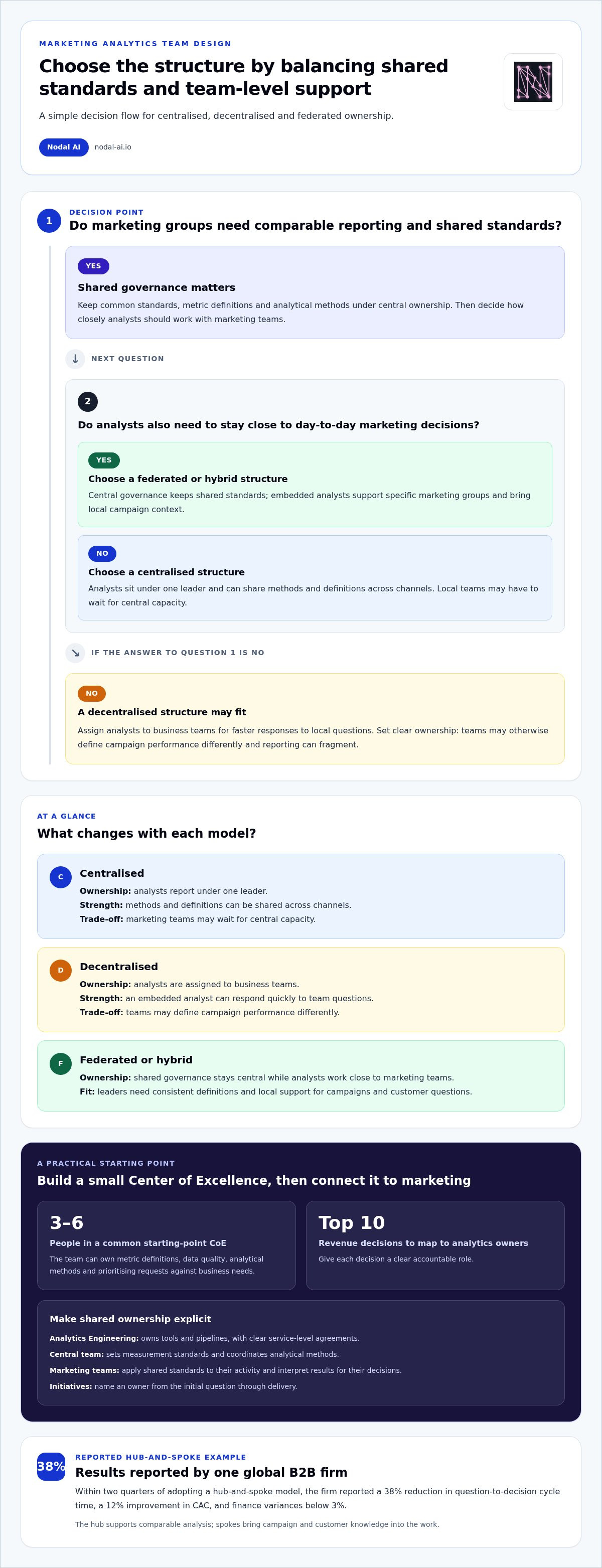
A practical marketing analytics team structure starts with a small Center of Excellence of 3-6 people. Give Analytics Engineering ownership of tools and pipelines, with clear service-level agreements. Then connect central expertise to the marketing teams making day-to-day decisions.
That balance matters: centralise everything and analysts may become distant from marketers’ questions; distribute the work without clear ownership and priorities, metrics and reporting can fragment. The answer isn’t simply to hire more analysts. Match responsibilities and skills to your organisation’s needs and maturity.
This guide explains how functional, channel-based, embedded and hybrid models work, when each fits, and how to evolve from generalists to specialists. You’ll also learn which skills to prioritise, how to shape roles around business decisions, and what to consider when hiring for your industry and stage of growth.
Key Takeaways
- Compare centralised, decentralised and federated structures by how your organisation needs to balance shared standards with close support for marketing teams.
- Choose functional, product, channel or journey-based roles around the decisions your team needs to make, rather than adopting a model simply because it is popular.
- As demand grows, identify which recurring work needs dedicated specialists and which tasks can be streamlined or automated.
- Adapt team design to your industry, maturity and operating constraints, with clear ownership connecting analytics work to business outcomes.
- Prioritise a mix of analytical, technical and communication skills so insights can move from data into decisions.
What's the ideal marketing analytics team structure?
The ideal structure connects analytics ownership to the decisions marketing leaders need to make. Choose central, decentralised or federated ownership according to how much consistency and team-level support your organisation needs.
Centralised, Decentralised, and Federated Structures
A centralised structure places analysts under one leader, a decentralised structure assigns them to business teams, and a federated structure combines both. The choice determines who sets priorities, maintains standards and responds to marketing questions.
In a central model, analysts can share methods and definitions across channels, while local teams may wait for central capacity. In a decentralised model, an analyst embedded with demand generation can respond quickly, but teams may define campaign performance differently. A federated model keeps shared governance central while analysts work close to teams. Map the top 10 revenue decisions to analytics owners so each has a clear accountable role.
Hybrid Team Structures
A hybrid structure pairs central analytics leadership with embedded analysts who support specific marketing groups. It works when leaders need shared definitions but also want analysts close to the campaigns and customer questions they support.
For example, a central team can own measurement standards and coordinate analytical methods, while channel teams apply them to their own activity. Set responsibilities before hiring: specify who approves metrics, handles local analysis and maintains shared tools. Analytics Engineering within the Center of Excellence should own tools and pipelines under clear service-level agreements. This gives embedded teams a defined route for technical support and avoids unclear ownership.
The Analytics Center of Excellence
A centralised analytics Center of Excellence (CoE) brings shared expertise, standards and technical ownership into one team. It works when separate marketing groups need comparable reporting and a dependable way to access analytical support.
A common starting point is a small CoE of 3-6 people. Its remit can include metric definitions, data quality, analytical methods and prioritising requests against business needs. For example, the CoE might standardise campaign measurement, while marketing teams interpret results for their own decisions. Name an owner for each initiative from initial question through delivery; otherwise, work can stall between teams. Keep the CoE connected to marketing leaders so its priorities reflect decisions, not just technical tasks.
Team Organisation and Staffing Costs
A marketing analytics organisational chart shows reporting lines, specialist roles and ownership of shared work. A practical example places a senior analytics leader above analysts aligned with marketing teams, alongside a central Analytics Engineering function responsible for tools and pipelines.
What does a marketing analytics team organisational chart look like? It can show a senior analytics leader overseeing central standards, analysts aligned with channel or marketing teams, and Analytics Engineering owning shared pipelines. Clear reporting lines and decision rights help prevent duplicate work.
How much does it cost to build and staff a marketing analytics team in the United States? There is no single total: staffing costs depend on role mix, seniority and location, while building the function also involves recruitment, tools, data infrastructure and management. A lean central team has different needs from a federated model with embedded analysts. Separate recurring staffing costs from setup costs, then link each role and tool to specific analytical responsibilities.
Functional, product, channel, journey-based, and hybrid team models
Choose a model around the decisions marketing needs analytics to support. Functional, product, channel and journey-based designs organise shared expertise in different ways, shaping how teams analyse performance and act on findings.
Functional, Product, Channel, and Journey-Based Models
A functional model aligns analysts with marketing disciplines, a product model with product lines, a channel model with platforms, and a journey-based model with customer stages. The right fit determines whether insight follows a specialist function, a product’s performance, a channel’s results or the customer experience across touchpoints.
B2B companies often use functional structures focused on content and demand generation. B2C organisations often favour channel-based or hybrid designs, where platform expertise supports rapid testing. A product model suits teams managing distinct offerings with different audiences. For example, analysts assigned to separate product lines can identify differences in acquisition and retention, while shared definitions keep results comparable. Journey-based teams can connect acquisition, conversion and retention analysis instead of optimising one isolated step.
Hybrid and Hub-and-Spoke Models
A hybrid model combines shared analytical capability with specialists aligned to channels, products or journeys. A hub-and-spoke operating model applies this balance through a central hub that sets common methods and spokes that support business teams. It works when organisations need consistent measurement without losing local context.
In one reported global B2B firm, adopting a hub-and-spoke model reduced question-to-decision cycle time by 38% within two quarters and improved CAC by 12% within two quarters. Finance variances also fell below 3% within two quarters. These outcomes show why the model can work: the hub supports comparable analysis, while spokes bring campaign and customer knowledge into interpretation. Define ownership for analysis, modelling and metric changes so shared standards do not slow local decisions.
Comparing Analytics Organisational Models
Analytics organisational models differ in where expertise sits and how work reaches decision-makers. Functional teams build depth in disciplines; product and channel teams focus on specific commercial areas; journey-based teams connect stages; hybrid teams combine shared capability with specialist support. Compare them by the decisions they help answer, not by labels alone.
For a practical comparison, list recurring questions, name the team closest to each decision, and identify where consistent definitions matter. If channel managers need platform-specific testing, a channel model may fit. If leaders need to understand how customer experience connects across touchpoints, consider a journey-based approach such as Customer Journey Mapping. A hybrid design can support both priorities through shared methods and focused analysis. Review the model when products, channels or decision needs change, rather than allowing the reporting structure to dictate the questions.
Scaling from generalist to specialist teams
Start with broad analytical ownership, then specialise as demand becomes more distinct. Let recurring work and business outcomes guide the shift, not titles alone.
AI and Automation in Marketing Teams
AI and automation can handle repeatable tasks, freeing analysts to investigate performance and guide decisions. Marketing analytics teams often spend time integrating and formatting data, answering ad hoc requests, and producing reports and dashboards.
Automate stable, recurring outputs first, such as a weekly channel performance dashboard. Keep human review for questions involving context, experimental design or budget trade-offs. This gives specialists more time to interpret results while automated workflows handle routine updates. Assign an owner to each automated output and document its source data and intended audience, so errors are caught before teams act.
Generalists are useful when a small team handles varied requests, from campaign reporting to customer analysis. As the same questions recur, divide responsibilities by capability: one role might own data quality, another modelling, and another translate findings for marketing leaders. This gives specialists clearer outcomes without losing the broad view that helped the team get started.
Fractional or embedded analytics teams can provide focused capacity when a business needs direction and follow-through, but not a separate specialist for every function. A fractional lead could set measurement priorities while an embedded analyst supports a product or campaign group. Agree on ownership, deliverables and decision routes at the outset. This keeps part-time expertise connected to the work instead of producing recommendations without implementation.
Capacity is another signal. 95% of data teams are at or above capacity, and adding people alone may not resolve a queue dominated by repeated requests. Review the request backlog, identify recurring analysis, then automate dependable work or assign it to a specialist. Retain generalists for varied questions, and create specialist roles when a sustained stream of work requires deeper expertise.
Market-, Audience-, and Product-Based Teams
Market- or audience-based teams organise analysis around customer groups or regions, while product-based teams focus on individual offerings. These models are useful when performance drivers differ across audiences or products, making a single blended dashboard less informative.
For example, a team serving small businesses and enterprise buyers may need separate views of acquisition and conversion. A product-based analyst can compare demand and retention across offerings, while shared definitions preserve consistency. Enterprises with 10 or more data staff may consider domain-based analytics teams, aligning specialists to business areas. Use that approach when each domain has distinct decisions and enough recurring analytical work to support ownership.
Industry and organisational maturity considerations
Team design should reflect both the organisation’s industry and its ability to turn analysis into action. Compare decision complexity, data ownership and business priorities before changing reporting lines.
Specialisation as Analytics Organisations Grow
Specialisation divides analytical work into clearer domains as an organisation adds teams, products and decision-makers. It becomes important when generalists can no longer provide the depth each business area needs.
For larger analytics organisations with at least 50-60 members, domain-based structures can align specialists with areas such as customer, product or operations data. This guidance is most relevant at that scale, not to every marketing department. Assign a named owner to each domain, then define shared standards for metrics and data access. That balance supports expertise without isolating teams.
Marketing department size also affects reporting lines. Teams with fewer than 10 people can have all marketers report directly to the CMO. Enterprise marketing teams with 20+ people may use hybrid or matrix structures, while departments with 30+ people benefit from more formal structures. These thresholds offer decision points, not automatic instructions.
Industry needs shape which expertise deserves priority. A business with long customer journeys, for example, may need analysts who connect activity across stages. An organisation with distinct product lines may need clearer product-level performance ownership. List the decisions leaders make, then map the relevant expertise and data owners to each one.
Mindsets and Organisational Restructuring
Organisational restructuring changes how people share responsibility, information and analytical priorities. It matters because disconnected projects can consume effort without advancing business outcomes.
Gartner reported that the share of Chief Data and Analytics Officers reporting directly to the CEO rose from 21% to 36% within one year. The shift reflects growing executive visibility for data leadership, but reporting lines alone don’t guarantee business alignment. Leaders still need to connect analytics roadmaps with decisions made across marketing, finance and product.
Before changing the structure, identify where work currently stalls. If marketing and finance use different revenue definitions, for example, assign a joint owner to resolve the measure before reorganising teams. If business units launch disconnected projects, establish a shared intake and prioritisation process. These steps make collaboration part of day-to-day work, not just a promise on an organisation chart.
Restructuring also requires leaders to explain why responsibilities are changing. Set out which priorities move, who owns existing work and how teams will share expertise. Review whether the new model improves decision ownership and reduces duplicated analysis. If roles remain unclear, adjust decision rights before adding another management layer.
Marketing analytics team skills and hiring
Build a team around business questions, then hire for the analytical, technical and communication skills needed to answer them. Start with clear ownership, practical priorities and a foundation that can develop as demand changes.
Skills for Marketing Analytics Teams
A strong marketing analytics team combines data handling, statistical reasoning, commercial understanding and clear communication. Analysts need these skills to turn data sources and calculations into decisions marketing leaders can use.
A campaign analyst, for example, needs to interpret performance in context, not just produce a dashboard. Assess candidates with a realistic exercise: ask what they would investigate when a channel’s reported results differ from the wider business picture. Also test whether they can explain assumptions and limitations to a non-technical audience.
Map skills before recruiting. Rate proficiency using the Fibonacci scores 0, 1, 2, 3, 5 and 8, then identify the gaps behind priority work. A team with strong reporting ability but limited modelling experience may need a different hire from one struggling to maintain reliable data. In high-growth companies, a strategist-to-executor ratio of roughly 1:4 can help balance planning with delivery.
Building a Team from Scratch
Building from scratch means connecting the first hires to defined business needs, rather than filling an organisation chart by habit. This gives each role a clear purpose and helps leaders develop the right capabilities without creating unnecessary hand-offs.
Begin by listing the recurring decisions the team must support, such as campaign allocation, customer retention or channel measurement. Assign an accountable owner to each priority, then document the skills needed to deliver it. A common staffing starting point is one embedded analyst for every two to three squads. Treat this as a planning reference and adjust it to the amount of analysis each squad needs.
Next, establish the technical foundation. With moderate self-service tooling, a practical benchmark is 4 to 10 data analysts per data engineer. The right balance depends on who maintains pipelines, prepares datasets and supports independent analysis. Define these responsibilities before hiring, so analysts can focus on interpretation rather than unclear data ownership.
Finally, build development into the hiring plan. Pair analysts with marketing colleagues for campaign context, and use peer reviews to strengthen analytical methods. Since 95% of data teams are at or above capacity, review incoming work before adding roles. Separate repeated reporting from complex analysis, then invest in the capability that best addresses the team’s actual bottleneck.
To learn more about how Nodal AI can help you scale your marketing analytics team structure, explore our latest resources on capability planning and hiring best practices.
Nodal AI: Nodal Platform
Nodal AI’s Nodal Platform helps organisations turn fragmented data into actionable intelligence for marketing decisions. It brings together Performance Marketing Analytics, Growth Recommendations and Automated Reporting to support performance tracking, identify trends and make analysis easier to use across teams.
Consider it when your team spends too much time assembling reports or struggles to connect marketing data with business priorities. Automated Reporting can reduce repetitive reporting work, while Growth Recommendations turn performance insights into potential next steps. The platform can complement a central, embedded or hybrid team model by giving teams a clearer view of marketing performance.
To explore how Nodal AI could support your analytics needs, visit nodal-ai.io.
Turn your team design into lasting momentum
Make your chosen model work in daily decisions. A marketing analytics team structure should act as an operating agreement, clarifying how people share insight, who owns follow-through and how priorities adapt as the business develops. Revisit these agreements as responsibilities or decision needs change, so the structure keeps pace with the work.
Use a simple test: can marketing leaders act on analysis and understand what to do next? Nodal AI’s Nodal Platform brings together Performance Marketing Analytics and Growth Recommendations to help turn marketing data into actionable intelligence. It can suit teams looking to connect their analytics approach with clearer performance insight.
Treat your marketing analytics team structure as something to refine through experience. Choose a model that fits your organisation, learn from how teams use it, and adjust as needs evolve. Give your people the clarity and space to make better decisions.
Build with purpose, learn from the work and keep moving forward.
Frequently Asked Questions
How big should the team be?
Size the analytics team according to its workload, not the headcount of the marketing department alone. A mid-stage company’s typical marketing team has 7-15 people, but only some of those roles may focus on analytics. Start by reviewing recurring requests, reporting commitments and specialist work. If analysts spend most of their time answering repeat questions, improve self-service and reporting workflows before adding headcount.
What Are the Different Operating Models for a Data-Driven Organization?
Common models include centralised, decentralised and federated arrangements, as well as hybrid versions that combine shared expertise and embedded support. Their practical differences lie in how requests are prioritised, who maintains shared measures and how teams resolve conflicting interpretations. For example, a federated organisation can assign metric stewardship to a central group while business teams decide how to apply those measures in local planning.
What Is a Data Analytics Team and What Should It Deliver?
A data analytics team turns business data into evidence that supports decisions. Its work can include validated analysis, forecasts, measurement plans and explanations of what changed and why. When a campaign’s reported conversions rise but sales remain flat, for example, the team can trace the discrepancy, explain likely causes and recommend what to investigate next. A useful output answers a business question, not just a data request.
What does that look like in practice?
Imagine a retailer preparing a seasonal launch. Marketing asks which customer groups responded to earlier campaigns, while finance needs a consistent view of revenue. An analyst agrees on the decision and success measure, checks the relevant data, then shares findings with both teams. Those findings might shape audience priorities and campaign evaluation. The practical test is whether each output has an audience, a decision and a clear owner for follow-through.
What roles are non-negotiable?
Every team needs clear accountability for analytical priorities, dependable data and turning results into action. These responsibilities may sit with separate specialists or be shared across a small team. A marketing analyst, for example, can investigate campaign performance while a data engineer maintains the pipelines that support reliable analysis. A senior lead connects the work to business priorities and resolves competing requests. Define these responsibilities even before hiring distinct role-holders.
Where Does Analytics & Insights Sit in an Organization?
Analytics and insights can sit within marketing, a central data function or a structure shared across both. Place the function where its leader can influence the decisions it supports. If the remit focuses on campaign performance, close alignment with marketing helps analysts understand context. If measures span finance, product and marketing, a central reporting line can support coordination. Agree how priorities are set and how business teams access analytical support.
What roles are typically included in a marketing analytics team?
Role mix varies, but teams commonly need analytical, data engineering and strategic capabilities. An analyst interprets performance, an engineer prepares and maintains data, and a lead connects analysis to decisions. Larger teams may add specialists in measurement, modelling or visualisation. A company evaluating customer journeys, for instance, may need modelling expertise, while a team focused on consistent campaign reporting may prioritise measurement and data quality.
How should a marketing analytics team be structured by company size and maturity?
Match structure to the organisation’s ability to define priorities, maintain data and use insights consistently. An early-stage company may assign broad analytical responsibilities to generalists, while a more mature business can separate technical ownership, measurement and business-facing analysis. Assess maturity through practical signals: whether teams agree on core metrics, whether recurring work has clear owners, and whether leaders use findings in planning. Add specialisation where sustained demand justifies it.


