

Podcast advertising can drive sales without last-click reports giving it credit. Knowing how to measure podcast advertising ROI starts with a clear baseline: subtract campaign expenses from attributed revenue, then divide the result by campaign expenses. This calculation matters, but it does not tell the whole story if listeners discover a brand through an ad and buy later through another channel.
It is reasonable to want a clear connection between ad spend and sales. Promo codes and dedicated URLs can capture direct responses, while customer journey and conversion data can reveal how podcast exposure contributes to later actions. No single metric tells the full story, so match measurement to the campaign goal, whether sales, leads, brand awareness or audience engagement.
This guide explains which sales, conversion, lift and funnel outcomes to track, how to test whether a campaign generated net-new results, and when to assess performance. You will also see how attribution methods can bring direct and indirect effects into one view, helping you make more confident decisions than a last-click report alone allows.
Key Takeaways
- Pair podcast-specific promo codes and URLs with website and conversion tracking to capture direct responses.
- Look beyond last-touch reports by connecting attribution, CRM activity and brand-lift signals.
- Separate revenue from leads and other funnel outcomes to see how campaigns contribute to business results.
- Test for incremental conversions to distinguish net-new impact from sales that may have happened anyway.
- Set measurement windows around campaign goals, since awareness, relationships and sales can emerge on different timelines.
Promo codes and vanity URLs for tracking sales and visits
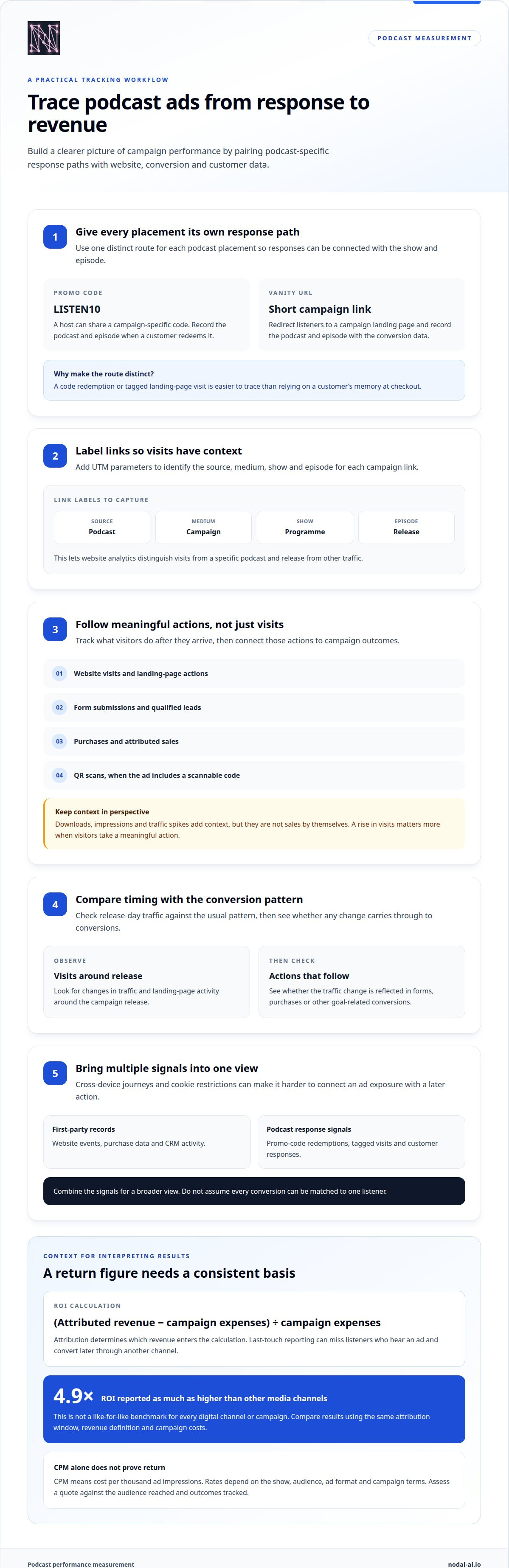
How do podcast ad ROI and performance compare with other digital advertising channels? Podcast advertisers have seen ROI as much as 4.9 times higher than in other media channels. That figure is not a like-for-like benchmark for every digital channel or campaign. Compare podcast results with other channels using the same attribution window, revenue definition and campaign costs.
There is no single average US podcast advertising cost or CPM that applies across shows and placements. CPM means cost per thousand ad impressions, and rates depend on factors such as the show, audience, ad format and campaign terms. Assess a quote against the audience reached and outcomes tracked, rather than treating CPM alone as proof of return.
Use UTM parameters to label campaign links by source, medium, show and episode. For example, specialized platforms like StoriedTails can use dedicated landing pages with tagged links to identify a podcast and a specific release, allowing website analytics to distinguish its visits from other traffic. Track visits, landing-page actions, form submissions and purchases. Compare release-day traffic with the usual pattern, then see whether the change carries through to conversions.
Cross-device journeys complicate attribution: a listener may hear an ad on one device and later visit from another. Cookie restrictions can also reduce visibility into individual journeys. Combine first-party website and CRM records with promo-code redemptions, tagged visits and customer responses. These signals provide a broader view without assuming every conversion can be matched to one listener.
Prioritise metrics tied to the campaign goal: attributed sales, qualified leads, conversion rate, branded search activity and relevant site engagement. Track QR scans when an ad includes a scannable code. Treat downloads, impressions and traffic spikes as context, not sales in themselves. A rise in visits matters more when visitors complete a meaningful action, such as requesting information or buying.
Attribution, conversions, lift, and ROI
Podcast attribution connects listener exposure with later consumer actions. Use multiple models to understand the campaign’s contribution.
ROI Formula and Attribution Challenges
Calculate ROI by subtracting campaign expenses from attributed revenue, then dividing the result by expenses. This provides a consistent financial measure, but attribution determines which revenue enters the calculation. Last-touch reporting can miss listeners who hear an ad, research later, then convert through another channel. Compare last-touch with first-click and multi-touch attribution to see how the model changes the result.
For example, a listener may hear a host-read ad, search for the brand, and later buy through a bookmarked page. Last-touch may credit the final visit, while first-click may credit the earliest recorded interaction. Multi-touch attribution distributes credit across recorded touchpoints. Comparing these views helps reveal whether podcast exposure assists conversions, even when it does not close the sale.
First-Party and Pixel-Based Attribution
First-party attribution uses a business’s own interaction records, such as website events, purchase data and CRM activity. It can connect known actions when a listener uses a tagged link, submits a form or identifies a podcast during a sales conversation. Pixel-based attribution can associate an ad exposure with a later website visit or purchase, but offers directional insight rather than precise click-level proof.
Use both methods carefully. A pixel may indicate that exposed listeners later visited, while first-party records show completed forms or purchases. Neither method alone establishes that the ad caused every conversion. Compare the pattern with campaign timing and other available customer signals, then treat differences between systems as a prompt to investigate attribution coverage.
Podcast Campaign Attribution Tools
Podcast campaign attribution combines web analytics, CRM records, surveys and multi-touch models. Web analytics captures tagged visits and conversion events; CRM attribution follows leads from first contact through opportunity and sale. Customer surveys can ask how consumers first heard about a brand, adding a response that digital tracking may miss.
For guest-led podcasts, record each guest relationship in the CRM and track subsequent referrals, partnerships and qualified opportunities. Keep the guest source attached as the relationship moves through the pipeline. Brand-lift studies can use pre- and post-campaign surveys, or compare exposed and control groups, to assess awareness, consideration and trust. Together, these tools connect immediate conversions with longer-term campaign influence.
Financial returns and marketing-funnel outcomes
Evaluate podcast campaigns through revenue and the actions that lead to it. Separate direct purchases from pipeline progress to see where financial value emerges.
Financial Returns From Leads and Sales
Financial return from leads and direct sales measures revenue linked to campaign-driven customers. To calculate ROI, subtract campaign expenses from attributed revenue, then divide by campaign expenses. A direct purchase can enter the calculation once its source is connected to the podcast. For leads, follow each record through the CRM to a qualified opportunity and closed sale.
For example, trace a podcast response from an enquiry to a CRM opportunity, then associate the resulting revenue with the campaign. Keep lead volume separate from sales: a form submission signals interest, while a closed deal generates revenue. This distinction helps brands see whether a host’s message attracts prospects who progress, rather than counting every response as financial return.
Campaign Financial Returns
Campaign financial returns combine podcast-attributed sales with relevant campaign expenses. Include the spend used to run the campaign in the expense figure, and apply the same revenue definition across channels. Then compare the resulting ROI with other campaigns using consistent attribution rules. This makes channel comparisons more useful than judging performance by clicks, reach or a vanity metric alone.
Separate host-read placements from standard audio ads in campaign reporting. Their formats differ, so combining results can obscure which placement influenced sales or lead quality. For each placement, connect the campaign record to CRM outcomes, direct sales and qualified opportunities. Report revenue and expenses alongside conversion stages, so decision-makers can see both realised returns and developing pipeline.
Map outcomes to funnel stages. A campaign may first increase branded searches, then bring visitors who view product pages, submit enquiries or purchase. Treat each action as a distinct metric, not interchangeable proof of revenue. For example, a rise in qualified CRM opportunities indicates pipeline contribution, while completed purchases show realised sales. This view reveals where the campaign supports growth and where follow-up may help.
Use the same reporting window and attribution approach when comparing podcast campaigns. Separate direct sales from assisted conversions, then review lead progression and revenue together. If exposure appears to influence consideration but sales have not closed, record that funnel movement without counting it as completed revenue. This keeps financial reporting clear while preserving the campaign’s contribution to future results.
Incrementality testing and net-new conversions
Incrementality testing asks whether podcast exposure generated actions beyond the results expected without the campaign. Compare outcomes across exposed and unexposed audiences to identify additional conversions.
Testing for Incrementality
Incrementality testing estimates the conversions that would not have happened without a podcast campaign. Compare a group exposed to an episode with a similar group that was not exposed, then review differences in qualified leads, purchases or other target actions. This helps distinguish net-new outcomes from conversions that attribution tools might otherwise credit to the podcast.
Keep the comparison focused on the same time period and outcome. For example, compare purchase activity among exposed and unexposed audiences while accounting for other campaign activity. A rise in conversions among listeners alone does not prove incrementality, since those consumers may already have been likely to buy.
Guest relationships can create another measurable route to new business. Track podcast guests in the CRM, then record whether they become clients, partners or referral sources within 6 months. One framework example follows 50 podcast guests and finds 8 qualified opportunities. That links relationship-building activity to pipeline movement, rather than treating guest participation as a result by itself.
For well-targeted B2B podcasts, 15-30% of guests may convert into opportunities. Treat that range as a possible outcome, not a guaranteed benchmark. Record each guest’s starting relationship, subsequent actions and opportunity status so the business can distinguish new pipeline from existing conversations.
Downloads, Actions, and Conversions
Downloads show distribution, while actions and conversions show what audiences do after an episode reaches them. Hosting platforms can provide listening data that may help assess audience reach and engagement. These figures help assess reach and engagement, but a download alone does not establish a new lead or sale.
Connect episode activity to defined actions, such as visiting a landing page, booking a meeting or submitting an enquiry. Compare those actions with the campaign’s target outcome, then follow leads through the CRM to opportunity and sale. For example, a download followed by a qualified enquiry and a closed deal provides stronger evidence of business impact than downloads alone.
Keep the outcome sequence visible: episode exposure, listener action, qualified conversion and final business result. Review each stage separately, and compare exposed audiences with a suitable unexposed group. This shows where interest becomes measurable demand and whether the campaign adds conversions beyond the baseline.
Podcast ROI measurement timelines
Set the review window around the campaign goal, because awareness, engagement and sales develop at different speeds. An early report can miss results that appear later.
For awareness, review brand signals after 30 days, including branded search, site engagement and survey responses. These measures show whether listeners recognise or consider the brand, rather than whether they have purchased. Compare results with the pre-campaign baseline. For example, an increase in branded searches after an episode release can be an early signal, not final proof of financial return.
Engagement can also appear quickly. Track episode interaction, social media shares and listener responses during or immediately after a campaign. Brand-lift measures often emerge during or soon after exposure, while performance outcomes typically follow over time. Keep these timelines separate in reporting, so early awareness is not mistaken for completed revenue.
Relationship outcomes need a longer view. For a B2B podcast, record when a guest or listener first engages, then follow whether that contact becomes a client, partner or referral source within 6 months. Link those milestones to CRM records. This helps connect podcast participation with pipeline development, even when a sales conversation begins after the episode.
How do you account for delayed conversions and listener lifetime value? Keep campaign-attributed leads and customers in a cohort, then record later conversions and revenue against their original podcast touchpoint. Assess customer value over the same defined period across campaigns, so a listener who buys later is not excluded from the return calculation.
Podcast ROI may take 3-6 months to materialise, depending on the goal and sales cycle. Review leading indicators during that period, then update revenue and conversion reporting as outcomes arrive. A review after only a quarter can miss delayed results, especially when listeners need time to research, discuss or approve a purchase.
Extend the view to 12 months to see whether outcomes compound. Compare production and campaign activity with awareness, engagement, qualified leads and closed sales at each review. This longer window can reveal whether an early lift in social media attention develops into measurable demand, rather than judging the entire campaign from its first response.
Establish structured review phases to track how podcast performance evolves from initial listener engagement through to long-term revenue generation for Nodal AI.
Nodal AI
Nodal AI is a natural next step when podcast results are spread across analytics, campaign records and customer data. Its AI-powered analytics platform helps organisations turn fragmented data into actionable intelligence. This can support a clearer view of how podcast activity relates to visits, leads, conversions and revenue, without treating one tracking signal as the whole story.
Use the Nodal Platform when performance information needs to come together in a more useful view for decision-making. For podcast measurement, the central task is connecting campaign activity with outcomes across the customer journey. Customer Journey Mapping and Multi-Touch Attribution can help show how different interactions contribute, particularly when a listener converts after several steps.
Performance Marketing Analytics is relevant when the question is how podcast activity performs within the broader marketing mix. It gives businesses a way to examine performance signals alongside other marketing outcomes. This context matters when a podcast drives discovery or consideration, but another channel receives the final conversion credit.
Turn to Growth Recommendations when measurement needs to inform what to do next. Results can highlight areas for closer analysis, such as which campaign signals align with qualified leads or progressing opportunities. Recommendations help connect observed performance with decisions, rather than leaving teams with reports that describe activity but do not guide action.
Automated Reporting is useful when teams need a consistent view of campaign results over time. A repeatable reporting process makes it easier to review sales, conversions and funnel movement together. It also keeps the measurement approach visible, so stakeholders can interpret outcomes against the same campaign goals and definitions.
These offerings support different parts of the measurement challenge. The Nodal Platform provides an analytics foundation; Performance Marketing Analytics, Growth Recommendations and Automated Reporting help turn performance information into clearer analysis and decisions. The right starting point depends on whether the main obstacle is fragmented data, attribution across touchpoints, interpreting results or producing consistent reports.
If podcast measurement needs a more connected view, contact Nodal AI to discuss your analytics needs.
Make measurement part of the next campaign
The next step in deciding how to measure podcast advertising ROI is to build measurement into campaign planning. Set a clear business outcome, agree how it will be recorded, and decide when results will be reviewed. This gives marketing and sales teams a shared basis for interpreting performance and deciding what to adjust.
Use what each campaign reveals to refine the next one. If listener activity appears but qualified opportunities do not, examine the hand-off from response to sales follow-up. If the pipeline progresses but revenue arrives later, preserve that connection in reporting. These decisions turn measurement from a retrospective score into an input for smarter investment.
Nodal AI can support this work through the Nodal Platform, Performance Marketing Analytics and Growth Recommendations, helping teams connect performance data with decisions. A consistent view makes it easier to understand where podcast activity fits within the wider customer journey.
Start with a measurement plan that reflects your goals, then let each campaign inform the next. Clearer evidence supports more confident decisions and a stronger path from audience attention to business growth.
Frequently Asked Questions
What Metrics Actually Matter for Podcast Advertising?
The right metrics depend on what the campaign is meant to achieve. For direct response, monitor purchases, qualified enquiries and revenue. For brand building, measure awareness, ad recall, consideration and branded search activity. Engagement metrics, such as episode retention and social shares, add useful context. Keep these outcomes separate: a download can indicate reach, but it does not prove a sale or a change in brand perception.
What is Return on Investment (ROI)?
Return on investment, or ROI, compares net income with the investment required to generate it. It helps teams judge financial return against campaign expenses rather than viewing sales alone. Podcast ROI depends on which revenue is attributed to the campaign and which expenses are included. Make those assumptions clear in reports so decision-makers can interpret results consistently and compare performance across campaigns.
How do you calculate podcast advertising ROI?
Subtract campaign expenses from attributed revenue, then divide the result by campaign expenses. A practical approach to how to measure podcast advertising ROI is to define eligible revenue and expenses before calculating. For example, decide whether the revenue figure includes only completed purchases or also recognised sales from campaign-generated leads. Apply the same definitions across campaigns, and update results as delayed conversions arrive.
What metrics should you track to measure podcast ad performance?
Track metrics across the listener journey, from exposure to business outcome. Listening activity describes reach; site engagement, enquiries and qualified opportunities show response. For sales-focused campaigns, follow purchases and attributed revenue. For brand goals, monitor awareness, recall and consideration. Teams learning how to measure podcast advertising ROI should separate early indicators from completed outcomes, so attention is not mistaken for revenue.
How do you use promo codes and vanity URLs to attribute podcast conversions?
Give each show or placement a distinct response route. For example, assign one host a unique promo code and another a dedicated vanity URL. Record code redemptions, visits and resulting orders against the relevant campaign. This helps identify direct responses and compare placements. Keep each code or URL specific to its source, then assess whether recorded visits lead to purchases or qualified enquiries.
How do podcast attribution tools measure downloads, visits, and sales?
Audio hosting platforms report listening activity and duration, while web analytics records tagged visits and on-site actions. CRM records can follow enquiries through opportunities and sales. Some attribution partners use pixels to associate ad exposure with later visits or purchases, providing directional rather than click-level evidence. Combining these sources helps teams connect episode reach with downstream outcomes and understand which signals support their campaign assessment.
How do you measure brand awareness and lift from podcast advertising?
Use consistent surveys before and after a campaign, or compare exposed listeners with a control group. Ask about recognition, ad recall, consideration and trust. Also monitor branded search and site engagement during the campaign. Together, these measures can indicate changes in interest and perception. Keep survey questions consistent between measurement points so differences are easier to interpret alongside other campaign signals.
How long should you run a podcast ad campaign before evaluating ROI?
Set the evaluation window according to the campaign goal and sales cycle. Awareness signals can be assessed after 30 days, while podcast ROI may take 3-6 months to materialise. Relationship-led results may take longer to progress into pipeline. Review early indicators alongside later conversions, and preserve campaign source information as leads mature. This gives delayed outcomes room to appear in performance reporting.


