

A channel can look successful on its own, while the full customer journey tells a different story. Customer journey analytics connects signals across touchpoints so you can see which experiences and channels contribute to commercial outcomes, not just activity.
When customer and campaign data sit in separate systems, it is hard to understand how a guest moves from an advert or search to a booking, or what prompts a return visit. Channel reports offer useful snapshots, but rarely reveal the whole picture. The answer is not simply to collect more data. It is to connect the right signals to the questions your team needs to answer.
In this article, you will learn what customer journey analytics includes, how it differs from journey mapping, and how to link behaviour across channels to measures such as direct booking value and promotion performance. You will also find practical steps for turning insights into clear priorities. For hospitality businesses, a modular platform such as Nodal Platform can bring relevant guest, marketing and commercial data into one view, helping teams move from fragmented reporting to more informed decisions.
Key Takeaways
- Use customer journey analytics to connect real interactions with outcomes across acquisition, booking, retention and repeat activity.
- Start with a commercial question, agree on outcome definitions, then bring together the data needed to investigate it.
- Choose the right approach for the decision: analytics reveals behaviour at scale, mapping visualises a typical experience, and attribution assesses channel contribution.
- Turn findings into hospitality decisions about channel investment, guest segments, promotions and retention, while considering demand signals such as local events and weather.
- Connect operational, demand, commercial and guest data to build a clearer view of performance and identify practical opportunities for growth.
What Is Customer Journey Analytics, and What Can It Reveal?
Customer journey analytics examines how people move between interactions with a business and connects those behaviours to outcomes. It goes beyond listing touchpoints such as an advert, website visit or booking page. By joining relevant signals, teams can see which interactions help attract customers, prompt a booking or purchase, encourage a return visit, or contribute to retention.
Customer journey analytics connects observed customer interactions across channels to measurable business outcomes, revealing where experiences create value and where they create friction. The User journey concept offers a useful foundation for thinking about the stages people pass through. Analytics adds evidence about what customers did and what followed, helping teams replace assumptions with a clearer view of performance.
Which customer journey signals are worth analysing?
Start with the decision you need to make, then select signals that can help answer it. Useful categories include:
- Acquisition: the source or campaign that introduced a potential customer.
- Engagement: meaningful actions, such as viewing an offer, browsing rooms or interacting with a membership message.
- Conversion and transaction: bookings, covers, visits, purchases, member activity and guest spend.
- Repeat activity: return visits, repeat bookings or continued membership engagement.
The right combination depends on the business model and question. A hotel might investigate which channels contribute to direct bookings. A restaurant could examine whether a promotion leads to covers and follow-up visits. Collecting every available signal can add noise, so prioritise information that connects a customer action to an outcome your team can influence.
How is journey analytics different from journey mapping?
Journey mapping represents the stages, needs and touchpoints a customer may experience. It helps teams build a shared picture of the intended or typical journey. Analytics measures observed behaviour and outcomes across those stages, showing where real customers progress, pause or drop away.
The approaches work best together. A map helps frame what to investigate; analytics tests that picture against evidence and highlights where attention may be needed. For a deeper look at creating a journey map, see The Definitive Guide to the Customer Journey: Mapping for Profitable Growth in 2026. Use journey analysis to move from a visual account of the experience to a measurable understanding of its commercial contribution.
How to Build a Customer Journey Analytics Workflow
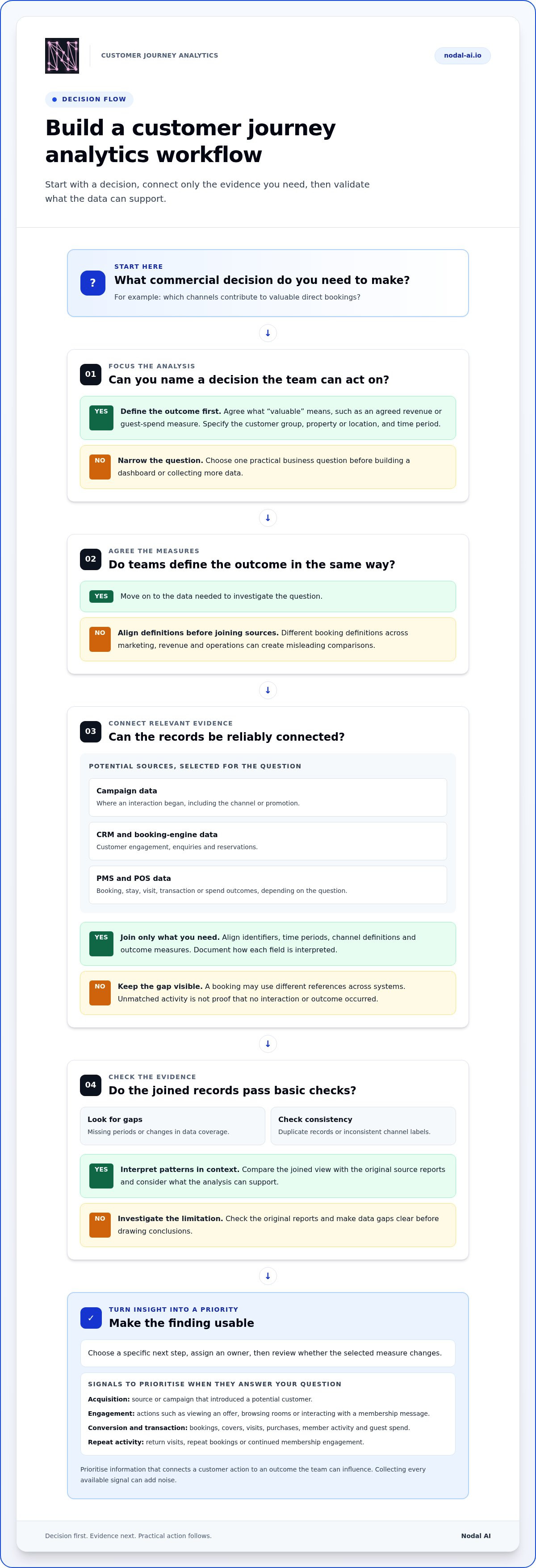
A useful workflow starts with a decision, not a dashboard. Move from a focused business question to joined evidence, then use what you learn to guide an action. This keeps customer journey analytics anchored to commercial value rather than a growing collection of disconnected reports.
Start with a decision, not a dashboard
Choose one question your team can act on, such as: which channels contribute to valuable direct bookings? Define “valuable” before looking at the data. It might mean bookings that meet an agreed revenue or guest-spend measure. Specify the customer group, property or location, and time period you want to examine.
Agree on the outcome and its definition across teams before joining sources. If marketing counts a booking differently from revenue or operations, the analysis may produce misleading comparisons. Select measures that can inform a practical choice, such as changing how channel contribution is evaluated, rather than tracking activity without a decision attached.
Connect data sources and make the journey measurable
Hospitality analysis may draw on different systems for different parts of the journey:
- Campaign data shows where an interaction began and which channel or promotion was involved.
- CRM and booking-engine data can help connect customer engagement to enquiries and reservations.
- PMS and POS data can add booking, stay, visit, transaction or spend outcomes, depending on the question.
Join only the sources needed to answer the question. Align identifiers, time periods, channel definitions and outcome measures, and document how each field is interpreted. A booking may appear in one system under a reservation reference and in another under a customer or transaction record. If records cannot be reliably connected, keep that gap visible rather than treating unmatched activity as proof that no interaction or outcome occurred.
Validate, interpret and act
Before drawing conclusions, check for missing periods, duplicate records, inconsistent channel labels and unusual changes in data coverage. Compare the joined view with the original source reports. Treat gaps as limitations: they affect what the analysis can support, but do not justify certainty about what customers did.
Interpret patterns in context. Customer journeys do not always follow one neat sequence; Harvard Business Review’s What You're Getting Wrong About Customer Journeys describes different journey types, a useful reminder to test assumptions about how people move towards an outcome. Turn a finding into a specific next step, assign an owner, then review whether the chosen measure changes.
Workflow in one sentence: Start with a business question, join the signals that can answer it, validate the evidence, and turn the finding into a measurable action.
Nodal Platform connects fragmented hospitality systems to support this kind of analysis. Explore the Nodal Platform features to see how connected data can support clearer commercial decisions.
Customer Journey Analytics vs Mapping and Attribution: What Each Explains
These approaches answer different questions. A map helps teams describe an experience, attribution assigns credit across marketing touchpoints, and customer journey analytics examines observed behaviour and outcomes across the journey. Use them together to build context, measure performance and decide where to investigate further.
| Approach | Main question | Evidence used | Typical decision |
|---|---|---|---|
| Customer journey analytics | What do customers actually do, and how does it relate to outcomes? | Joined behavioural, transaction and outcome data across relevant touchpoints | Where to investigate friction, segment differences or changes in performance |
| Journey mapping | What stages, needs and touchpoints shape the experience? | Research, workshops, customer feedback and team knowledge | How to design or improve the intended experience |
| Marketing attribution | How should credit for a conversion be assigned across marketing touchpoints? | Campaign and conversion data interpreted through a chosen attribution model | How to assess channel contribution or guide marketing investment |
What does customer journey analytics answer that mapping cannot?
A map captures a shared view of customer stages, but it does not establish how often people follow that path or what results they achieve. Analytics can reveal observed patterns, differences between segments, journey outcomes and changes over time. For example, a hotel map might show that guests compare room options before booking. Analysis can test whether visitors who view several options complete direct bookings, abandon the process or return later. That evidence helps the team assess whether the mapped stage reflects actual behaviour.
Analytics can sharpen understanding the customer journey by connecting touchpoints with outcomes. Still, a pattern is not proof that one interaction caused a booking. Other factors may influence the result. If a team needs to establish whether a change produced an effect, it may need further testing, such as a controlled experiment where practical.
Where does marketing attribution fit into journey analysis?
Attribution assigns conversion credit to marketing touchpoints according to a chosen model. It can help compare the role of channels in a booking journey, but it does not necessarily capture every operational or guest interaction, such as an on-site visit or service experience. Treat attribution as one source of channel evidence within the broader journey, not a complete account of customer behaviour.
Use mapping to frame the experience, attribution to examine marketing credit, and analytics to connect observed interactions with outcomes across stages. For a deeper look at channel-credit approaches, see Mastering Marketing Attribution: The Definitive Guide for 2026. Together, these methods can guide better questions, while testing helps assess whether a proposed change truly drives an outcome.
How to Turn Journey Insights into Better Hospitality Decisions
Journey analysis earns its value when it changes a decision. For hospitality teams, that might mean adjusting channel investment, tailoring a promotion or responding to a shift in demand. The right action depends on what the connected signals show, how reliable the evidence is and whether the team can influence the outcome.
Which hospitality questions can journey analytics help answer?
Use customer journey analytics to investigate questions that connect guest behaviour with commercial priorities:
- Channel investment: Which sources contribute to direct bookings, and how does booking value differ by channel, property or guest segment?
- Guest segments: Which groups return, spend across different services or respond to particular offers? A hotel might compare booking and stay patterns, while a club could examine membership activity and visits.
- Promotion performance: Does an offer lead to bookings, restaurant covers or attraction visits, and does the response vary across locations?
- Demand and retention: Are changes in enquiries, bookings or repeat visits associated with seasonal patterns or particular guest groups?
Choose metrics that fit the setting. A restaurant may focus on covers and spend, while a hotel may examine direct booking contribution. External context can help explain changes: weather may affect visits, FX shifts may influence international demand, and flight demand, tourism trends or local events may shape booking patterns. Treat these as context to investigate, not automatic explanations for a result.
How can teams move from insight to action?
Prioritise findings by commercial relevance, confidence in the evidence and ability to act. A potentially valuable pattern deserves less immediate attention if data coverage is weak or the team cannot influence the factors behind it. Start with the clearest actionable opportunity, and make the proposed change specific.
For example, a hotel asks whether a campaign is contributing to valuable direct bookings. The team connects campaign interactions with booking and guest-value signals, then compares results across relevant locations and periods. If one segment shows stronger booking value, the next decision could be to test a more tailored promotion for that audience. This is a hypothesis to validate, not proof that the campaign alone caused the difference.
Assign an owner, define the action and choose an outcome measure before implementation. Review results after the change, note what shifted and record what the evidence can and cannot establish. This creates a learning loop rather than a one-off report. For a broader view of connected marketing data and growth decisions, see AI Marketing Analytics in 2026: From Fragmented Data to Profitable Growth.
Explore hospitality analytics with Nodal AI to see how customer journey analytics can transform your decision-making process.
How Nodal AI Connects Customer Journey Data to Commercial Intelligence
Once the right business questions and measures are clear, the next challenge is connecting the evidence. Hospitality data often sits across separate marketing, guest, operational and commercial systems. Nodal Platform brings relevant signals together to help teams investigate customer journeys and make more informed decisions about bookings, guest segments, promotions and demand.
A modular view of hospitality performance
A shared view can draw on PMS, booking-engine, CRM, advertising, analytics and revenue tools, connecting the parts of performance that matter to a specific question. For example, a team examining direct booking contribution could consider campaign activity alongside booking outcomes and relevant guest or commercial information. Nodal Platform’s modular architecture helps teams focus analysis on useful sources rather than treating every available data point as essential.
External context can add perspective. Teams may interpret performance alongside weather, foreign exchange movements, flight demand, tourism trends or local events. These signals can help frame a change in bookings or visits, but they are context for analysis, not guaranteed predictors of what guests will do. Explore Nodal Platform features to see how connected data can support a clearer view of hospitality performance.
From connected signals to measurable growth priorities
Joined data is useful when it clarifies what to examine next. A team might compare promotion response across locations, identify guest segments associated with valuable bookings, or investigate how channel activity relates to commercial outcomes. The aim is to give teams a stronger basis for setting priorities, then measuring what changes after they act.
Ovolo Hotels results include a 15.3% reduction in acquisition costs and a 24.5% increase in return on ad spend. The reported results also include a 20% increase in paid search revenue and a 13.8% increase in bookings. These figures provide case-study context for the commercial outcomes associated with connected analytics. They are not a guarantee of results for other businesses.
For your own analysis, begin with one decision, select the data that can inform it, and agree how you will measure the outcome. Then use the findings to set a practical priority and review the result. That is how customer journey analytics can move from fragmented signals to commercial intelligence.
See how Nodal Platform can support your hospitality analytics. Book a demo.
Turn Connected Journey Data into Your Next Growth Move
Customer journey analytics helps hospitality teams move beyond isolated channel reports. Connect relevant signals, focus on a commercial question and use observed behaviour to guide a practical decision. Mapping can frame the experience, while analytics and attribution add evidence about outcomes and marketing contribution.
Nodal Platform offers a modular way to connect fragmented hospitality data, bringing relevant guest, operational, commercial and marketing signals into a clearer view. In a case study, Ovolo Hotels reported a 15.3% reduction in acquisition costs and a 24.5% increase in return on ad spend. These results provide context for what connected analysis can support, not a guarantee of future performance.
Start with one decision your team wants to improve. Build the evidence around it, agree how success will be measured, then review what changes after you act. Clearer connections can help turn scattered signals into confident priorities and lasting progress.
Your next growth opportunity may already be in your data. Bring the signals together and take the next step with confidence.
Frequently Asked Questions
What is customer journey analytics?
Customer journey analytics measures how people interact with a business across relevant touchpoints and connects those interactions to outcomes. It can help teams understand how acquisition, engagement, booking, purchase and repeat activity relate to commercial performance. Rather than simply listing channels or stages, it looks for patterns in observed behaviour, such as where guests progress, pause or return, so teams can identify useful areas for action.
How does customer journey analytics work?
It starts with a business question, such as which channels contribute to valuable bookings. Teams agree on the outcome and its definition, then connect relevant data from sources such as campaign platforms, booking engines, CRM and operational systems. They check the joined data for missing or inconsistent records, interpret patterns in context, and use findings to guide a decision. Results should be reviewed after action, not treated as automatic proof of cause.
What is the difference between customer journey analytics and customer journey mapping?
Customer journey mapping represents the stages, needs and touchpoints that shape an intended or typical experience. It often draws on customer research, feedback and team knowledge. Analytics measures what customers actually do across those stages and how behaviour relates to outcomes. For example, a map may show room comparison before booking; analysis can test whether guests who compare options book, abandon or return later.
How is customer journey analytics different from marketing attribution?
Marketing attribution assigns conversion credit to marketing touchpoints according to a chosen model. It can help teams assess channel contribution, but its focus is marketing interactions linked to conversions. Customer journey analytics can examine a broader set of observed behaviours and outcomes, including relevant guest or operational interactions. Neither approach alone proves causation. Use attribution as one source of evidence within a wider analysis of the customer journey.
Which data do businesses need for customer journey analytics?
Businesses need data that can answer a defined question, not every signal they can collect. Depending on the analysis, this may include acquisition source, campaign engagement, CRM records, booking or transaction data, and repeat activity. Hospitality teams might connect PMS, POS, booking-engine, marketing and guest data. Align identifiers, time periods, channel definitions and outcome measures, then document gaps so incomplete records are not mistaken for certainty.
Can customer journey analytics help increase direct bookings?
It can help teams understand which channels and guest interactions are associated with direct bookings, and where booking value differs across segments or locations. By connecting campaign activity with booking outcomes, a hotel can identify patterns to investigate, such as whether a promotion is reaching guests who book directly. Teams can then test a relevant change and track the agreed outcome. Analytics informs decisions, but does not guarantee more bookings.
How can hotels use customer journey analytics to improve marketing decisions?
Hotels can use journey analysis to compare channel contribution, examine guest segments, assess promotion performance and identify where the path to booking may be losing momentum. Start with one decision, such as how to evaluate direct booking value by source. Connect the relevant campaign, booking and guest signals, validate the evidence, then assign an owner and measure the result of any change. Demand context can inform interpretation, but should not be treated as a guaranteed predictor.


