

What if the platform tracking the most touchpoints still gives you the wrong commercial story? Choosing b2b attribution software UK teams can rely on means looking beyond channel dashboards. Marketing reports and CRM records often disagree, while visible interactions can take too much credit for a decision shaped by a much longer journey.
That makes the buying decision more than a feature comparison. You need to know whether a platform can connect with your real systems, bring relevant data together and make its attribution model useful for commercial decisions. More touchpoints don’t automatically mean more clarity.
This guide gives you a practical framework for comparing platforms against your data, modelling and workflow requirements. You’ll see how to assess integrations, evaluate attribution approaches and connect reporting to pipeline, revenue and marketing investment decisions. For hospitality businesses, we’ll also look at how booking, operational and external demand data can add context to campaign performance.
Key Takeaways
- Choose attribution software by how well it supports commercial decisions, not by how many touchpoints it tracks.
- Assess whether your data sources can connect into a useful view of customer journeys, channels and revenue.
- Use a practical scorecard to compare data fit, model flexibility, reporting, actionability and implementation against real business needs.
- Prepare for selection by defining key decisions, mapping your data, testing platform fit and involving the right teams.
- See how Nodal Platform connects fragmented hospitality data to support attribution, customer journey analysis and commercial insight.
Why B2B attribution software matters when UK teams cannot connect marketing to revenue
A channel report can show clicks and enquiries. A CRM can show qualified pipeline and closed revenue. But if those records don’t connect, teams are left with separate snapshots rather than a reliable view of how marketing activity relates to commercial outcomes. It becomes harder to compare channels fairly, understand which journeys lead to valuable outcomes or decide where investment could make the most difference.
For teams assessing b2b attribution software uk, the goal is to connect relevant journey data with accounts, opportunities and outcomes. A platform should bring together interactions recorded across marketing and sales systems, then show how touchpoints receive credit under a stated attribution model. This creates a more coherent basis for discussion, not an automatic verdict on what caused a sale.
Attribution is a way of assigning value to interactions along a customer journey. The marketing attribution overview offers a neutral introduction to the concept. In practice, distinguish between observed interactions, modelled credit and incremental impact. An interaction may be recorded; a model may assign it a share of credit; neither, on its own, proves that the interaction caused the outcome. Treat attribution as decision support and test important assumptions against other evidence.
What B2B attribution software should help a team understand
Useful reporting connects marketing interactions with account progression, opportunity creation and closed outcomes, while making gaps in the underlying data visible. It should show how campaigns and channels contribute according to the selected model, and explain why credit is assigned as it is. Look for patterns worth investigating, not a single “true” score: results are shaped by tracking coverage, identity matching and the assumptions used.
Why hospitality businesses need a wider view of performance
For hospitality businesses, a customer journey can span advertising platforms, booking engines, customer relationship management (CRM) systems and property management systems (PMS). When each holds only part of the picture, it’s difficult to connect campaign activity with bookings and wider commercial performance. Bringing these sources together can help teams explore how direct bookings relate to acquisition activity, without assuming every booking can be credited to one channel. It also gives customer journey analysis more commercial context. For a deeper foundation, read this guide to marketing attribution.
How B2B attribution platforms connect customer journeys, channels and revenue
An attribution platform turns disconnected records into a usable sequence. It draws on data from relevant systems, aligns interactions to accounts or customers, applies reporting rules, then presents results for teams to interpret. Each step affects the next. Inconsistent campaign names, incomplete booking records or unclear revenue definitions can weaken the final view, even when the dashboard looks polished.
A simple attribution flow
Inputs: CRM, advertising, analytics, booking and revenue records
Processing: standardise fields, match identities and organise interactions by journey
Outputs: channel and campaign reports, account journeys and revenue views
Decision points: investigate performance, compare investment options and refine measurement
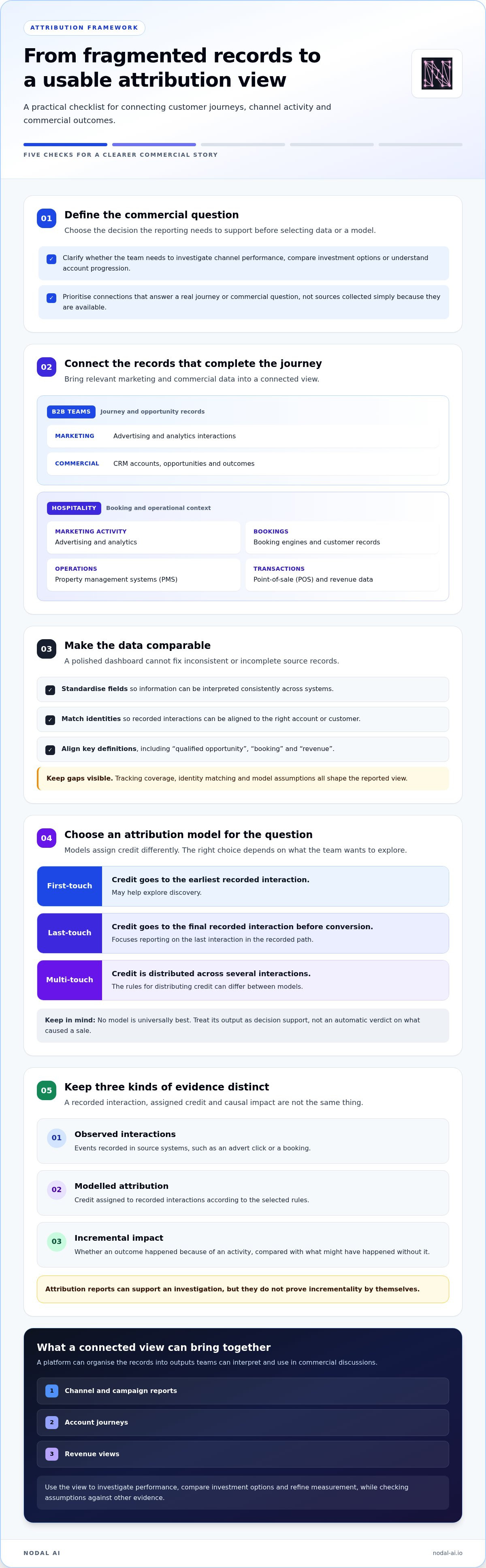
Keep three kinds of evidence distinct. Observed interactions are events recorded in source systems, such as an advert click or a booking. Modelled attribution assigns some or all of the credit for an outcome to those recorded interactions, according to chosen rules. Incremental impact asks whether an outcome happened because of an activity, compared with what might have happened without it. Attribution reports can support that investigation, but shouldn’t be treated as proof of incrementality by themselves.
Which data connections matter for a useful attribution view?
Start with the decisions the team needs to make, then identify the records needed to support them. A B2B team might connect CRM opportunities with advertising and analytics interactions. Hospitality teams may also need to bring together property management systems (PMS), point-of-sale (POS), booking engines, customer records and revenue data. For a hotel, that could mean examining campaign interactions alongside booking and property data to understand how channels relate to direct bookings. Prioritise connections that clarify a real journey or commercial question, rather than collecting sources simply because they’re available.
How attribution models assign credit across touchpoints
First-touch gives credit to the earliest recorded interaction; last-touch gives it to the final one before conversion. Multi-touch approaches distribute credit across several interactions, using rules that can differ between models. None is universally best. Choose according to the decision: first-touch may help explore discovery, while a broader model can show more of the journey. The customer journey mapping guide offers a useful companion for understanding those paths. An empirical study of user-paths also explores how journey data can inform attribution model design.
Before trusting a report, align definitions such as “qualified opportunity”, “booking” and “revenue”, and check how records are matched across systems. Nodal Platform brings fragmented hospitality data together to support customer journey analysis and commercial insight.
How to compare B2B attribution software: a practical buyer scorecard
Compare platforms against the decisions your team needs to make, not the length of their feature lists. A useful b2b attribution software uk scorecard tests whether each option can work with your data, explain its outputs and support action. Use the same business questions for every platform, then score each area from 0 to 2: 0 means it can’t support the need, 1 means it requires a workaround, and 2 means it supports the need clearly.
| Capability | Business question | What a strong fit looks like |
|---|---|---|
| Data fit | Can it connect the sources needed to follow our customer journey? | Relevant data can be brought together, with source records and gaps visible. |
| Model flexibility | Can we compare attribution approaches for different decisions? | Users can understand model rules and how they change credit. |
| Reporting | Can leaders and channel teams answer their key performance questions? | Reports use clear definitions and traceable data. |
| Actionability | Can the findings guide a marketing, audience or commercial decision? | Insights connect to a clear next step, not just another dashboard. |
| Implementation | Can the organisation adopt it within its systems and workflows? | Data ownership, team responsibilities and ongoing use are understood. |
Which attribution features deserve priority?
Prioritise connections that reflect your actual journey and reporting needs. A hospitality business may need booking and property data alongside advertising and customer records; another organisation may focus on CRM opportunities and campaign activity. Check whether users can compare models, adjust reporting to business logic and follow an insight through to a decision. For hospitality teams, useful questions might include which channels are associated with valuable direct bookings, or how guest segments perform by property. A capability earns its place when it answers a real question.
How to assess reporting quality and decision usefulness
Test reports with real questions: which channels are associated with qualified opportunities, and how does channel value vary by property? Can the team inspect the definitions, source data and assumptions behind an answer? If a result can’t be traced or explained, it’s hard to use confidently. Ask users from marketing, sales and operations to interpret the same report. Differences can reveal unclear terms or missing context before they affect planning.
Finally, compare platforms by the workflows they support, not by broad claims of complete visibility. A focused system that answers priority questions may be more useful than a larger feature set that doesn’t fit your data or decisions.
What UK buyers should plan for before choosing attribution software
A good platform fit starts before a product demonstration. Agree what decisions attribution needs to support, then map the people, systems and definitions involved. This gives teams a grounded way to compare b2b attribution software uk options and plan the work around the technology.
Prepare your data and requirements before evaluation
Use four steps to turn a broad software search into a focused evaluation:
- Define decisions. Set out what you want to understand, such as which activity is associated with qualified pipeline, bookings or another commercial outcome.
- Map data. List source systems, data owners, key identifiers and known gaps. Note where account, customer, campaign or revenue definitions differ between teams.
- Test fit. Bring representative questions and examples to each demonstration. Ask to see how the platform handles your data and explains its outputs, rather than relying on a generic walkthrough.
- Plan adoption. Decide who will use the reports, how findings will inform decisions and how performance will be reviewed over time.
Include marketing, revenue or sales, operations and data colleagues in this work. Each team can surface different requirements: marketing may need campaign comparisons, revenue teams may care about opportunity progression, and hospitality operations may need to understand performance across properties. Agree measures that reflect the outcome you want to improve, and document how each measure is defined.
Set expectations early. Historical records may be incomplete or use inconsistent identifiers, while connecting systems can require data preparation and coordination between owners. A platform can organise available information, but it can’t recreate events that were never captured. Record known gaps and decide which ones need addressing before treating reports as a baseline.
Plan implementation around the team’s operating model
Assign clear ownership for data definitions, platform use and ongoing performance reviews. Decide who resolves inconsistent campaign names, who interprets model outputs and where teams will discuss resulting actions. Fit reporting into existing marketing and commercial routines so insights can shape decisions, rather than sit unused in a dashboard.
Use Nodal AI platform capabilities as a reference when assessing how connected data and attribution could support your use cases. Keep the evaluation anchored to your systems, measures and team responsibilities.
How Nodal AI supports hospitality attribution and commercial decision-making
For hospitality groups, marketing performance is only part of the commercial picture. Booking, guest, operational and revenue data can sit across separate systems, making it difficult to understand how marketing activity connects with customer journeys and business outcomes. Nodal Platform is a modular intelligence engine that connects disparate data sources to generate tailored commercial, customer and operational insights.
This industry focus gives buyers comparing b2b attribution software uk options a relevant question to consider: can the platform connect marketing signals with the operational and commercial context that shapes a booking? Nodal Platform supports multi-touch attribution and customer journey mapping, helping teams examine patterns across campaigns, guests and business performance. These insights can inform decisions while leaving room to consider the assumptions behind modelled results.
Where Nodal AI’s hospitality focus fits the buying framework
Nodal Platform can be configured with modules for operational, demand, commercial and guest data, according to the hospitality use case. It can bring together fragmented sources such as PMS, POS, CRM and booking engines. External signals, including weather, exchange rates, flight demand, tourism trends and local events, can add context to performance analysis. For example, teams can investigate whether changes in booking patterns align with shifts in demand, rather than interpreting campaign results in isolation.
AI-driven audience segmentation and journey insight can help teams explore practical questions: which guest groups are more likely to respond to particular campaigns, where journeys differ, and how those patterns relate to booking or commercial outcomes. The aim is to make connected information more useful to marketing and commercial teams, not to treat an attribution score as the whole story.
Turn platform evaluation into a clear next step
Make a demonstration specific to your operation. Bring a map of the systems and data you want to connect, the decisions you need to support, and the measures that matter, such as bookings, acquisition costs or return on ad spend. Use those examples to explore how the platform could support your priorities. For more on turning disconnected sources into usable insight, read about fragmented marketing data insights.
Ovolo Hotels’ case study reports a 15.3% reduction in acquisition costs and a 24.5% increase in return on ad spend. These are reported case-study outcomes, not promised results, and shouldn’t be treated as a forecast for another organisation. They show how connected performance analysis can be considered alongside commercial measures.
Choose attribution that turns connected data into clearer decisions
The strongest attribution platform isn’t simply the one that tracks the most interactions. It’s the one that connects data your teams can use, makes its assumptions clear and helps answer meaningful questions about pipeline, bookings and revenue. Define those questions first, then compare platforms against your systems, reporting needs and working practices.
For hospitality businesses, that means looking beyond advertising and CRM data to the operational and booking context that shapes commercial performance. Nodal Platform connects fragmented hospitality data through a modular intelligence engine, supporting attribution, customer journey analysis and commercial insight.
The Ovolo Hotels case study reports a 15.3% reduction in acquisition costs and a 24.5% increase in return on ad spend. These are reported case-study outcomes, not guaranteed results. Use your own priorities and success measures to evaluate the fit of b2b attribution software uk.
With clear questions and the right data in view, you can move from conflicting reports towards more confident, commercially grounded decisions.
Book a tailored platform demonstration
Frequently Asked Questions
What does B2B attribution software do?
B2B attribution software connects marketing interactions with customer journeys and business outcomes, such as opportunities or revenue. It applies attribution rules to help teams understand how different channels and campaigns receive credit. The results depend on the data connected and the model selected. Review the definitions and assumptions behind each report, and treat attributed credit as decision support rather than definitive proof that marketing activity caused a sale.
How do I choose B2B attribution software in the UK?
Start by defining the decisions the software needs to support, then map the systems and data needed to answer them. Compare integration fit, model flexibility, reporting clarity, implementation needs and how insights reach the teams using them. When assessing b2b attribution software uk options, consider your organisation’s operating requirements and data governance processes. Choose for practical fit, not feature volume alone.
Can B2B attribution software connect marketing activity to revenue?
Yes. It can connect recorded marketing interactions with CRM and other business data to show how campaigns relate to pipeline or revenue. The usefulness of that view depends on data quality, identity matching, attribution rules and the completeness of connected sources. Use the reports to inform budget discussions, but don’t interpret attributed credit as proof that a campaign caused a sale. Consider the model’s assumptions alongside the results.
What is the difference between multi-touch attribution and last-touch attribution?
Last-touch attribution assigns credit to the final measured interaction before a conversion. Multi-touch attribution distributes credit across more than one recorded interaction according to a selected model. Each approach answers different questions and depends on the available data. Compare models against the business decision you need to make, and explain their assumptions when sharing results. No single approach is right for every organisation or customer journey.
Does attribution software work for hospitality businesses?
Yes. Attribution software can help hospitality organisations explore how marketing relates to bookings, revenue and guest journeys. A useful view may draw on advertising and CRM data alongside booking engines and operational systems such as property management systems (PMS) or point-of-sale (POS) platforms. The right data setup depends on the business model, available records and questions teams need to answer, such as how channel activity relates to direct bookings.
What data do I need for B2B attribution software?
The data you need depends on the questions you want to answer. Common sources include marketing platforms, web analytics, CRM records and commercial outcomes. Hospitality organisations may also need booking, property, customer or operational data. Before evaluating software, map the source systems, data owners, identifiers, definitions and known gaps. This helps you assess whether the platform can produce reports that are useful, traceable and interpretable.
Can attribution software show which marketing channel performs best?
Attribution software can compare channel contribution under a defined model, using the data connected to the platform. Rankings may change when model assumptions or data coverage change, so a single report shouldn’t be treated as a universal measure of channel value. Review the customer journey behind the result and consider complementary evidence, such as incrementality analysis where appropriate, before using channel comparisons to guide investment decisions.


