

What if the forecast isn’t the problem, but the disconnected data behind it? Hospitality teams often hold booking, marketing, customer and commercial information in separate systems. Even a useful prediction is difficult to act on if it doesn’t show what decision it can inform. Choosing predictive analytics software uk hospitality businesses can use starts with looking beyond AI claims to the data, forecasts and decisions the platform supports.
You need more than another dashboard. You need to understand how information is brought together, which integrations support the analysis, and whether forecasts can inform decisions such as demand planning, audience segmentation and direct booking growth. The right fit depends on your business requirements, data and team workflows.
This guide covers practical criteria for assessing predictive analytics software for UK hospitality. You’ll learn what forecasts depend on, how to evaluate integrations and workflows, and how to connect predictive insights to commercial outcomes. The aim is to help you move from fragmented data to decisions your team can act on.
Key Takeaways
- Start with a business decision you want to improve, then identify the forecast and outcome that would make it useful.
- Trace how data moves from connected sources through aligned definitions and analysis to forecasts your team can act on.
- Use predictive analytics software uk comparison criteria such as data fit, integrations, explainability and measurement to prioritise what matters for your business.
- Separate essential capabilities from optional features, and evaluate fit through a focused pilot tied to a measurable outcome.
- See how a modular platform can bring hospitality data together and support decisions around demand planning, audience segmentation and direct bookings.
Why UK businesses consider predictive analytics software
Hotels collect valuable signals across property management systems (PMS), booking platforms, customer records, advertising accounts and revenue reports. Those signals may sit in separate systems, belong to different teams or update on different reporting cycles. The result is a fragmented view of demand, making it harder to assess what may happen next month or which commercial action deserves attention now.
Predictive analytics software uses historical and current data to estimate future outcomes; reporting describes performance that has already happened. For UK hospitality teams comparing predictive analytics software UK options, forecasts can help prioritise decisions, but they can’t guarantee results or replace commercial judgement. A prediction is an estimate. Teams still need to interpret it in context and decide how to respond.
What predictive analytics can help hospitality teams anticipate
A hotel might use past booking patterns and current reservations to estimate future demand, expected booking value or the likelihood of a low-occupancy period. A report shows how many rooms were booked last week. A forecast estimates what future occupancy might look like, giving the team time to consider a response.
These estimates can inform marketing allocation, commercial planning and operational priorities. A projected soft period, for example, could prompt a review of campaign timing, audience segments or booking trends. A likely rise in demand may influence planning. Predictive analytics offers a structured view of possible outcomes, not a substitute for local knowledge or experience. For a broader overview of the field, see What is Predictive Analytics?
Why fragmented UK hospitality data makes evaluation harder
Useful analysis depends on bringing together information that can be difficult to reconcile. PMS and booking data may describe stays differently from CRM records, advertising reports or revenue data. If systems don’t connect, teams may compare incomplete views. If key terms, such as a booking or conversion, mean different things across reports, a forecast can appear precise while relying on inconsistent inputs.
Look beyond the forecast itself. Check which data feeds it, how records and definitions are aligned, and whether the result relates to a real business decision. Nodal AI explores this challenge in Predictive Modelling: Transforming Fragmented Data into Future Growth, including how connected data can support more useful commercial insight. Consistent inputs give teams a clearer basis for evaluating forecasts and deciding what to do next.
How predictive analytics software turns data into useful forecasts
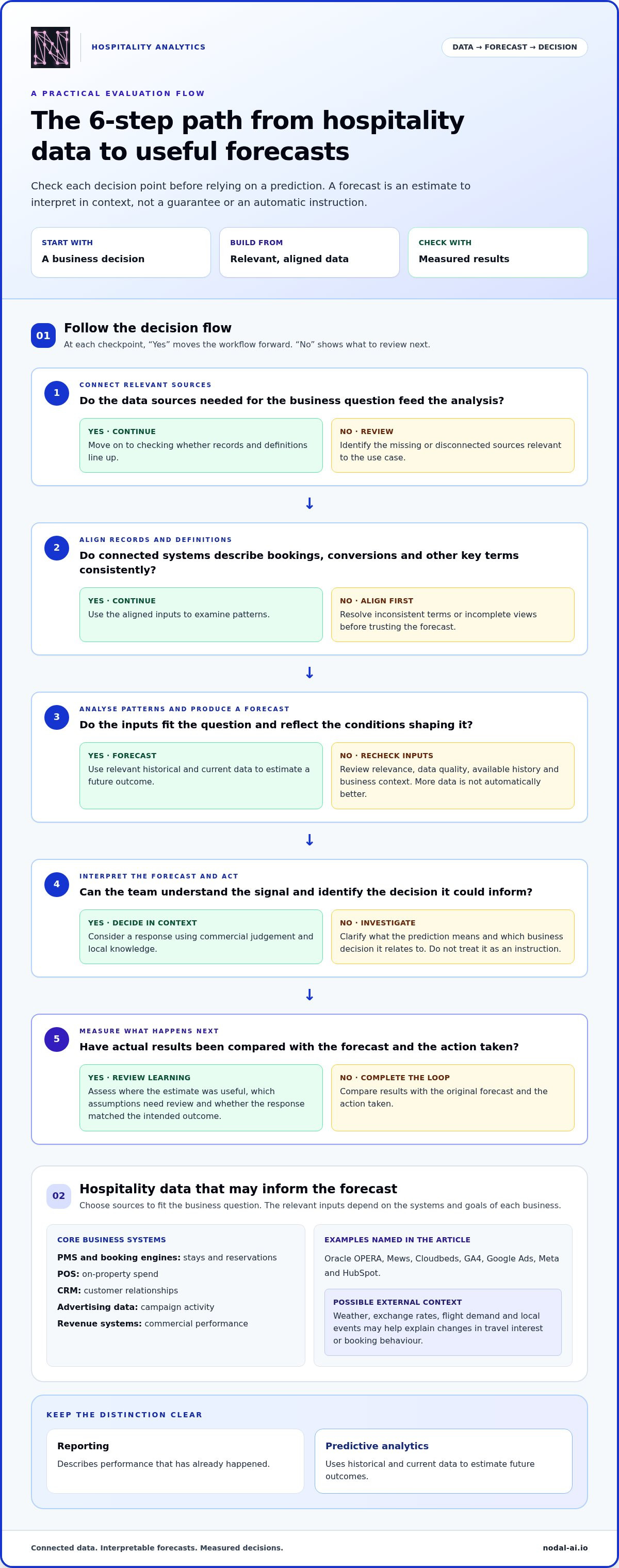
A forecast is useful when a team can understand how it was produced and which decision it can inform. A practical workflow moves through six steps: connect relevant sources, align definitions, analyse patterns, produce a forecast, act on the insight and measure what happens next.
Forecast quality depends on relevant, connected data that reflects the business question and the conditions shaping it. A hotel forecasting occupancy needs inputs suited to that task. Data quality, available history and business context all affect what can reasonably be predicted. More data isn’t automatically better if it’s incomplete or describes different things across systems.
Which data sources can support hospitality predictions?
Depending on the use case, inputs might include PMS and booking engine records for stays and reservations, POS data for on-property spend, CRM information for customer relationships, advertising data for campaign activity, and revenue systems for commercial performance. Nodal Platform connects systems including Oracle OPERA, Mews, Cloudbeds, GA4, Google Ads, Meta and HubSpot. The relevant sources depend on each business’s systems and goals.
External signals can add context. Weather, exchange rates, flight demand and local events may help explain changes in travel interest or booking behaviour. These are signals, not decisions in themselves. If a forecast suggests demand may soften, teams can review the potential need period and decide whether to adjust campaign priorities or commercial plans.
From forecast to action: what the workflow should show
Look for a clear line from prediction to response. If a forecast indicates a possible low-occupancy period, the team should be able to understand the signal, identify the decision it informs and agree how to assess the result. It might prompt a review of audience segments or booking trends, but it shouldn’t be mistaken for an instruction to spend more or change plans automatically.
After making a decision, compare actual results with the original forecast and the action taken. This helps teams see where the estimate was useful, which assumptions need review and whether the response aligned with the intended outcome. Marketing attribution can add context when assessing how channels contributed to results. For a deeper look at that measurement, read Mastering Marketing Attribution: The Definitive Guide for 2026.
When comparing predictive analytics software uk options, assess whether the workflow makes the journey from source data to measurable decision visible. Explore Nodal Platform’s analytics features to see how connected data can support that process.
How to compare predictive analytics software in the UK
Compare platforms against the decisions your team needs to make, not the number of features on a product page. A dashboard can display data without helping you decide whether to adjust a demand plan, investigate booking value or focus on a particular audience. For predictive analytics software uk buyers, the key test is whether relevant data can produce an understandable forecast that informs an action and can be measured afterwards.
Check data fit, integrations, use-case relevance, explainability, workflow fit and measurement before weighing optional features. Treat those as core requirements, then prioritise additional capabilities only when they support a defined business need.
| Evaluation area | Core requirement | Optional capability |
|---|---|---|
| Data fit | Can the platform use the data needed for your chosen question? | Can it incorporate relevant external signals? |
| Integrations | Can priority PMS, CRM, booking, advertising and revenue sources connect? | Can it support further sources as needs change? |
| Use cases | Does it address a defined hospitality decision? | Can teams apply it to additional questions? |
| Explainability | Can business users understand the forecast and its context? | Can users explore different views of the result? |
| Workflow | Can the output inform a decision in an existing team process? | Can it support additional workflows? |
| Measurement | Can teams compare forecasts with observed outcomes? | Can reporting support broader analysis? |
Assess integrations, data fit and implementation needs
Start by mapping one priority decision to the information needed to support it. A demand-planning use case may rely on PMS, booking and revenue data, while a marketing question may also need CRM and advertising inputs. Check whether the platform can bring together the relevant sources. Include technical setup, dashboard configuration and historical data ingestion in your evaluation. The aim is to connect the data needed for the use case, not to add integrations for their own sake.
Test forecast usability, transparency and measurement
Ask business users to interpret a forecast in practical terms: what does it suggest, what decision could follow, and what context might change the response? Then agree how the team will compare predicted outcomes with observed results over time. Forecasts are estimates, not certainties. Assess them alongside commercial conditions and judgement, rather than treating a model output as an instruction.
Keep the comparison grounded in a specific business question. If a capability doesn’t improve the forecast, clarify its meaning or help measure a resulting decision, it may be a lower priority than reliable data connections and a workflow the team will use.
A practical buying framework for predictive analytics software
Anchor your evaluation to a decision, not a feature list. Before comparing predictive analytics software UK options, define what your team wants to decide, what outcome would indicate progress and who will act on the insight. This makes it easier to judge whether a platform fits your operation and avoid being distracted by broad claims about AI.
Start with a business question and a measurable outcome
Choose a question with a clear commercial purpose. You might want to understand which bookings are most valuable, how guest segment value differs, or what demand could look like over the coming weeks. Set an outcome you can observe, such as a change in direct booking performance or improved planning against expected demand.
Assign ownership early. The commercial or revenue team might act on a demand forecast, while marketing may use segment insight to inform campaign priorities. Agree who records the decision and its result so the evaluation connects a prediction to what the business actually did. Nodal AI explores the role of connected information in Nodal Platform: Transform Fragmented Marketing Data into Profitable Decisions.
Plan a focused evaluation and adoption process
Use a simple sequence to keep the process practical:
- Define the question: Select one priority decision and the business outcome you want to assess.
- Audit the data: Identify the sources, definitions and history needed for the use case. Note any gaps that could affect interpretation.
- Evaluate fit: Check whether the platform can use the relevant data and present an output the accountable team can understand and apply.
- Run a focused pilot: Test the chosen use case with the people who will use the insight, and agree how decisions and results will be recorded.
- Measure and review: Compare the forecast with observed outcomes, consider the actions taken, and decide whether the approach is useful enough to extend.
Keep the initial scope proportionate to the available data and the team responsible for acting. A tightly defined question is easier to evaluate than a broad ambition to predict everything. Agree in advance how you’ll review usefulness and business impact after implementation, recognising that results depend on data quality, context and the decisions made.
Explore Nodal Platform features as part of your evaluation, and use your defined use case to guide the discussion.
Where Nodal Platform fits in a UK predictive analytics evaluation
For hospitality teams comparing predictive analytics software uk, Nodal Platform is a modular intelligence engine that brings fragmented business data into a clearer commercial picture. It connects data fit, relevant insight and action, rather than treating prediction as a standalone feature. Teams can focus on operational, demand, commercial and guest insights that relate to their business questions.
How Nodal Platform addresses hospitality data fragmentation
Hospitality information can sit across property, booking, marketing and customer systems. Nodal Platform connects sources including Oracle OPERA and Mews, alongside GA4 and Google Ads. Bringing relevant data together helps teams build analysis around a use case, such as understanding booking patterns or connecting marketing activity with commercial performance. Its modular design lets businesses focus on relevant insights without adding complexity for its own sake.
This joined-up approach can give teams a shared view for commercial discussion, while business context remains essential when interpreting insight. For more on connecting marketing data to growth, read AI Marketing Analytics in 2026: From Fragmented Data to Profitable Growth.
Connect predictive insight to measurable commercial performance
Ovolo Hotels provides a specific case study of Nodal AI’s work. Reported results included a 15.3% reduction in acquisition costs and a 24.5% increase in ROAS. Paid search revenue increased by 20%, bookings by 13.8%, and average booking value by 5.5%. These figures describe Ovolo Hotels’ results, not a guarantee of what another hospitality business will achieve.
For buyers, the practical lesson is to connect analytics to outcomes the commercial team can assess. Consider which decision an insight supports, who owns that decision and how results will be reviewed. This keeps evaluation grounded in your priorities, whether you’re exploring direct booking growth, audience segmentation or demand planning.
Bring a defined business question to a conversation about how Nodal Platform could support your evaluation.
Turn better forecasts into clearer commercial decisions
Choose predictive analytics software uk teams can assess by more than its forecasts. Start with a defined business question, check whether the relevant data can be connected, and make sure the output supports a decision your team can measure. A forecast is most useful when it guides action while leaving room for commercial judgement.
Nodal Platform brings fragmented hospitality data together to support tailored insights and predictive modelling. In the Ovolo Hotels case study, results included a 15.3% reduction in acquisition costs and a 24.5% increase in ROAS. Bookings increased by 13.8%, while average booking value rose by 5.5%. These are specific case study results, not a guarantee of future performance.
Bring your priority question and intended outcome into a conversation about how analytics could support your business. A focused starting point can help turn disconnected signals into a clearer path forward.
With relevant data, useful forecasts and clear ownership, your team can move from uncertainty to more confident decisions.
Frequently Asked Questions
What does predictive analytics software do?
Predictive analytics software uses historical and current data to estimate likely future outcomes. For a hotel, it might help forecast demand, identify a potential low-occupancy period or estimate booking value. These forecasts differ from standard reports, which show what has already happened. Use predictions as decision support, not certainty: teams need to interpret them alongside business conditions and apply their commercial judgement.
How do I choose predictive analytics software for a UK hospitality business?
Start with a business decision you want to improve, then identify the data and workflow needed to support it. The right predictive analytics software uk option should connect relevant sources, produce outputs business users can understand and help teams measure what happens after they act. Prioritise essential capabilities for your chosen use case before considering optional features. A focused evaluation is more useful than comparing platforms by feature count alone.
Can predictive analytics software work with data from different systems?
Yes. Predictive analytics platforms can combine data from different hospitality systems when the relevant sources connect and their information can be aligned. A use case might draw on property management and booking data alongside CRM or advertising activity. Nodal Platform connects systems including Oracle OPERA, Mews, GA4, Google Ads and HubSpot. The useful sources depend on the business question and the systems a team uses.
What data does predictive analytics software need?
The required data depends on the outcome you want to estimate. A hotel demand forecast may use historical and current reservations, occupancy or revenue information, while a marketing analysis may also need campaign and customer data. External signals, such as weather, flight demand or local events, can add context where relevant. Useful inputs should be connected, consistently defined and suited to the question, rather than collected simply because they’re available.
How can I tell whether predictive analytics forecasts are useful?
Check whether users can understand what a forecast indicates, connect it to a specific decision and review the result afterwards. Compare predicted outcomes with what actually happened, taking account of the action taken and relevant business context. A forecast is useful when it helps a team make or assess a decision, not just populate a dashboard. Treat it as an estimate to test over time, rather than a guaranteed outcome.
Is predictive analytics software the same as marketing attribution software?
No. Predictive analytics estimates likely future outcomes from available data, while marketing attribution analyses how credit for observed outcomes is assigned across marketing touchpoints. For example, a hotel could use attribution to understand how channels contributed to completed bookings, then use predictive modelling to inform future planning. The capabilities can complement each other, but they answer different questions. Both are most useful when teams connect analysis to clear commercial decisions.
How does Nodal Platform support predictive analytics for hospitality businesses?
Nodal Platform brings fragmented operational, booking, marketing, customer and commercial data together to support tailored insights, predictive modelling and growth recommendations. Its modular approach helps hospitality teams focus on relevant needs, such as demand planning, guest segments or direct booking growth. It connects property, booking, analytics and advertising systems. The aim is to link data and forecasts to commercial action, with outcomes assessed in each business’s context.
Book a Nodal AI demo to discuss your priority hospitality business question.


