

What if the channel with the most attributed conversions isn’t the one creating the most growth? Marketing incrementality testing helps answer the question attribution alone can’t: did the campaign cause additional bookings or revenue, or would those results have happened anyway? For hospitality businesses, seasonality, promotions and local demand can make the answer harder to see.
Attribution reports are useful, but they assign credit rather than prove causation. When channel data sits across separate platforms, comparing results can feel like fitting together pieces from different puzzles. A clear test gives you stronger evidence, provided its design and limitations are understood.
This guide shows you how to choose a practical test for your business question, interpret incremental lift without overstating certainty, and use the findings to make more informed channel and budget decisions. You’ll explore common testing approaches, ways to account for factors that can distort results, and how connected marketing and operational data can put test outcomes in commercial context. The goal is to move from reported conversions to clearer evidence of what’s driving growth.
Key Takeaways
- Use marketing incrementality testing to estimate the additional outcome linked to a specific marketing intervention, rather than counting every observed conversion.
- Start with the budget or channel decision you need to make, then choose one primary outcome and a test design suited to the question.
- Compare audience holdouts, geographic tests and time-based comparisons, weighing each method’s practical fit against its limitations.
- Read estimated lift alongside uncertainty, test conditions and outcome quality before deciding how much confidence to place in the result.
- Bring campaign, booking and operational data together to connect test findings with commercial performance and make more informed decisions.
What Marketing Incrementality Testing Reveals That Attribution Cannot
Would the outcome have happened without the marketing activity? That’s the question behind marketing incrementality testing. Rather than counting every conversion recorded after a campaign, it estimates how much difference the tested activity made compared with what would likely have happened without it.
Observed conversions are all conversions recorded during a period, while genuinely incremental outcomes are the additional conversions or other results attributable to the tested marketing intervention. The distinction matters: a campaign can coincide with strong sales without causing them. Customers may already have intended to book, or demand may have risen for other reasons.
Incrementality testing versus marketing attribution
Attribution assigns credit to marketing touchpoints along a customer journey. If a traveller sees a social advert, searches for the hotel later and books through its website, an attribution model may give some credit to one or more of those interactions. That helps teams understand how journeys unfold, but the credit itself doesn’t prove the advert caused the booking. The traveller might have booked anyway.
An experiment approaches the question differently. It compares outcomes for a group exposed to a marketing intervention with outcomes for a suitable control group that wasn’t exposed. The gap between them is the estimated lift, subject to the quality of the design and the conditions during the test. This controlled comparison draws on A/B testing as a foundational concept, although incrementality tests can use different methods and scales.
The two approaches are complementary, not interchangeable. Attribution helps describe which touchpoints receive credit; experiments estimate whether an intervention generated additional outcomes. For a broader view of how credit is assigned across customer journeys, see this marketing attribution guide.
Why hospitality teams need a commercial outcome
Choose an outcome that reflects the decision you need to make. For a hotel assessing a paid campaign, clicks may show that the advert attracted attention, but the business question could be whether it generated additional direct bookings. A lift in clicks alone doesn’t establish a commercial gain.
Bookings aren’t always the right measure. A hotel might examine occupancy if the goal is to fill available rooms, average booking value if it wants to understand booking quality, or repeat visits if the campaign is intended to encourage return stays. These outcomes tell different stories, so define the primary measure before the test begins. If the aim is direct revenue growth, distinguish direct bookings from bookings through other channels in the outcome data.
The best choice depends on the business question and the data available to assess it. Check that the outcome is recorded consistently for both groups and that the measurement period gives customers time to complete the action. A well-defined outcome gives the comparison a clear purpose and makes the result more useful for commercial decisions. The next step is to shape a test around that question.
How to Design a Marketing Incrementality Test That Answers One Clear Question
A useful test starts with a decision, not a dashboard. Are you deciding whether to continue a campaign, expand it to more markets or shift budget elsewhere? Define that choice first. Then choose one intervention to test and one primary outcome to measure. Changing several campaign elements at once can make it difficult to tell what drove any difference.
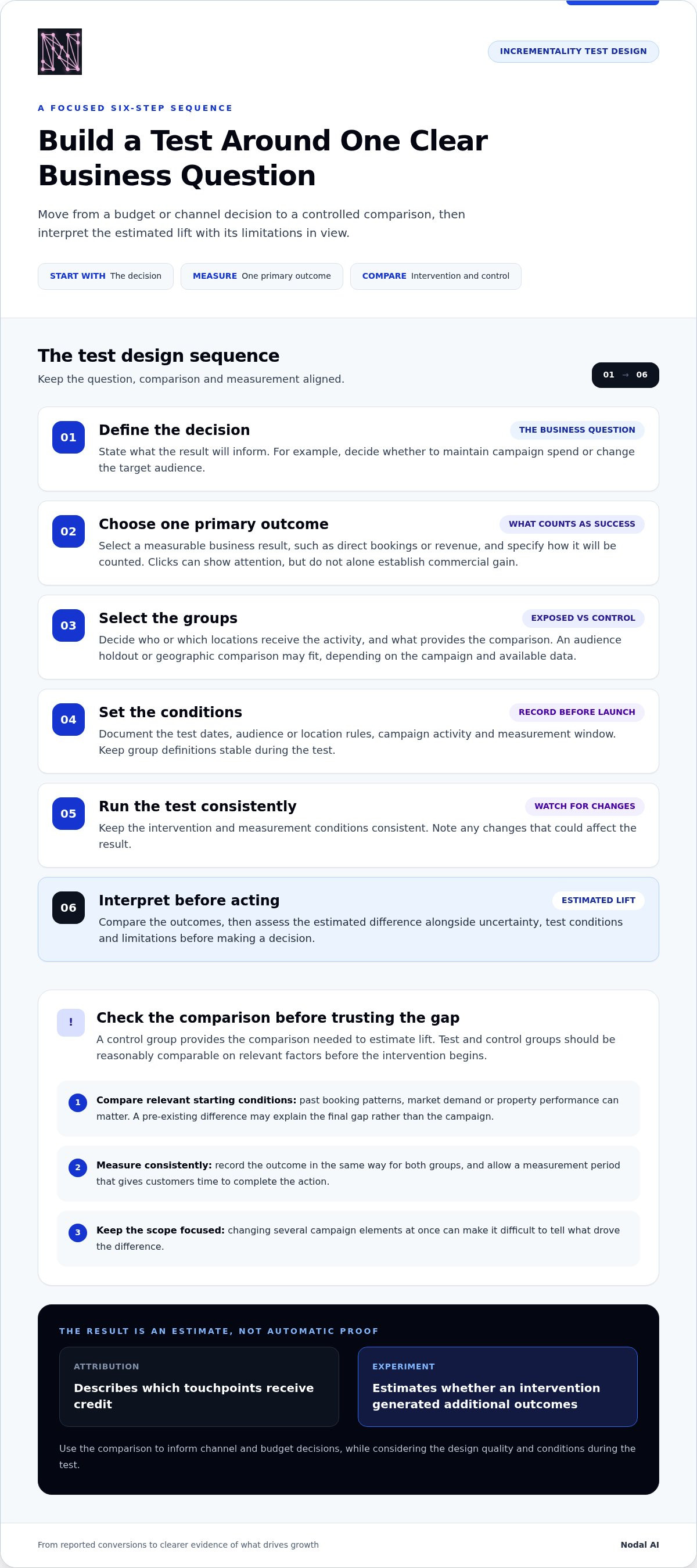
Use this sequence to build a focused design:
- Define the decision: State what action the result will inform, such as maintaining spend or changing the target audience.
- Choose the outcome: Pick a measurable business result, such as direct bookings or revenue, and specify how it will be counted.
- Select the groups: Decide who or which locations receive the activity and what provides the comparison.
- Set the conditions: Record the test dates, audience or location rules, campaign activity and measurement window before launch.
- Run the test: Keep the intervention and measurement conditions consistent, and note any changes that could affect the result.
- Interpret the result: Assess the difference alongside uncertainty and test limitations before acting.
A control group provides the comparison needed to estimate lift. Before the intervention starts, check that test and control groups are reasonably comparable on relevant factors, such as past booking patterns, market demand or property performance. If one group already behaves differently, the final gap may reflect that starting difference rather than the campaign. Record the selection rules and avoid changing group definitions mid-test.
Choose an audience holdout or a geographic test
An audience holdout can suit a campaign where eligible users can be divided into exposed and unexposed groups. A geographic comparison may fit activity targeted by location, provided markets can be matched on relevant characteristics. Neither design is automatically reliable: ad spillover can contaminate a holdout, uneven local demand can skew a market comparison, and small samples can make patterns harder to interpret. Before choosing, consider whether exposure can be separated, whether the groups are comparable and whether the outcome can be measured consistently. These are design risks to assess, not automatic reasons to abandon a test.
Set the outcome, window and comparison conditions
Choose the outcome before launch: direct bookings, revenue, visits or transactions, depending on the business question and available data. Then set the measurement window and sample requirements for the context. A test needs enough relevant observations to support a useful comparison, but there’s no universal duration or sample threshold that fits every campaign. Consider how long it takes for a customer to book or visit, and allow time for that outcome to be recorded. Forrester’s insights on incrementality testing can inform how teams approach a testing strategy.
Plan for conditions that could affect the same outcome. In hospitality, a promotion, seasonal shift, local event or change in room availability may influence bookings alongside the campaign. Note these factors in advance and keep other marketing activity as consistent as practical across groups. If conditions change during the test, document what happened so the final interpretation reflects the context, not just the headline lift.
Clear design makes the result easier to use, but commercial interpretation also depends on seeing campaign outcomes alongside booking and operational context. Connected marketing and booking data can help teams bring those signals into a clearer performance view.
Which Marketing Incrementality Test Fits Your Channel and Business Question?
There’s no universally best design. The right choice depends on the decision you need to make, whether you can build a fair comparison, and whether the data captures the outcome reliably. Test design should follow the decision, not the channel label. A paid campaign doesn’t automatically call for one particular method.
Audience holdout
Question: Did exposure to this campaign change the outcome for eligible users?
Useful context: A defined audience can be split into exposed and unexposed groups, such as for a Google Ads or Meta campaign.
Limitation: Users may encounter the campaign through another route, or the groups may differ in ways that affect results.
Geographic test
Question: Did marketing in selected locations lead to better results than in comparable locations?
Useful context: Property or venue campaigns can be assessed across markets with similar demand and operating conditions.
Limitation: Local events, audience movement or uneven market demand can weaken the comparison.
Time-based comparison
Question: Did the outcome change during a campaign period compared with a suitable earlier or later period?
Useful context: It may help when audience or location holdouts aren’t practical and the business has consistent historical data.
Limitation: Seasonal patterns, promotions or other changes over time can explain some or all of the difference.
Match the test design to the marketing activity
Start with the comparison you can defend. For paid search or social, an audience holdout may be suitable if exposed and unexposed users can be identified and kept distinct enough for a useful analysis. Google Ads and Meta reporting can show activity within their platforms, but a reported conversion or lift alone doesn’t establish what caused the business outcome. The design and comparison matter.
For a hotel or attraction campaign, geographic testing may seem natural, but locations need to be operationally comparable. Markets with different booking patterns, room capacity or visitor profiles may not provide a fair contrast. Google’s guide to incrementality testing offers further context on selecting and applying tests. Consider feasibility and data quality alongside the method’s apparent simplicity.
Account for demand, seasonality and hospitality operations
Hospitality results can shift for reasons beyond advertising. A local event, weather change, travel demand or promotion may influence bookings or transactions during the test. Record these conditions and check whether they affected test and comparison groups differently. A time-based comparison, for example, can be especially difficult to interpret if one period includes a major event and the other doesn’t.
Link the chosen outcome to the system that records it. Hotel bookings may sit in a property-management system such as Oracle OPERA, while restaurant transactions may be recorded in OpenTable. If campaign data and commercial outcomes are fragmented, it becomes harder to compare signals consistently. A connected view of marketing and operational data can give teams useful context for assessing test results, without replacing the experiment or turning correlation into causal proof.
How to Interpret Incrementality Test Results Without Overclaiming
A test result is an estimate, not a universal verdict. Read the size and direction of the estimated lift alongside how reliably the test measured it. A positive difference may be encouraging, but a small sample, uneven groups or changes in demand can leave substantial uncertainty. Avoid turning a directional result into definitive proof.
A test result applies to the intervention, audience, period and conditions that were tested. It doesn’t automatically predict what will happen with a different campaign, season or market. Sample size affects how clearly a test can distinguish a real difference from ordinary variation. Test conditions matter too: if a promotion or local demand shift affects one group more than another, it can cloud the comparison. Outcome quality is just as important. Incomplete or inconsistent booking data weakens confidence in any estimated lift.
Keep incremental outcomes separate from platform-attributed results. Incremental revenue or bookings are the estimated additional outcomes associated with the tested intervention, based on its comparison. Attributed revenue is the amount a platform assigns to its ads under its reporting rules. These figures answer different questions, so they may not match. Neither should be presented as the other.
What to do when results are clear, mixed or inconclusive
For a credible positive result, consider scaling cautiously. Monitor whether the conditions that supported the result remain comparable, and check that the commercial outcome holds as activity expands. A different audience or market may respond differently.
If the findings are mixed, investigate before choosing a story. Review group balance, tracking and outcome definitions, then check whether external demand factors could have influenced the comparison. If the result is inconclusive, state what the test couldn’t establish. It may not show that the activity had no effect; it may simply lack enough reliable evidence to identify one. Don’t force a yes-or-no conclusion.
Turn a test result into a budget decision
Start with the commercial objective. If the goal is additional direct bookings, clicks and platform-reported conversions are supporting signals, not substitutes for the booking outcome. Consider the estimated lift, its uncertainty, the test’s limitations and the value of the outcome together. Then decide whether to maintain spend, adjust the activity or gather stronger evidence before reallocating budget.
Use the result alongside other measurement approaches, not in isolation. Attribution can help describe customer journeys and how credit is distributed across touchpoints. Marketing mix modelling can add a broader view of channel contribution using aggregate performance data. Agreement between methods can strengthen the overall picture; disagreement is a reason to investigate differences in scope, data and assumptions. This predictive modelling guide explores how connected data can support forward-looking analysis.
Clear commercial context helps teams turn results into better-informed decisions. Explore connected performance insights
Connect Marketing Test Results to Commercial Decisions with Nodal AI
A test can estimate whether a campaign made a difference, but acting on the result also means understanding how it fits the business. That can be difficult when campaign reports, booking records and operational data sit in separate systems. Teams may see ad engagement in one place, reservations in another and property performance elsewhere, making it harder to connect the evidence with the commercial outcome.
For hospitality businesses, the useful question might be whether marketing contributes to direct bookings, how performance varies between properties, or whether a restaurant campaign coincides with more transactions. Connected data gives teams a clearer view of these relationships and helps them interpret performance in context. It doesn’t, by itself, prove that a campaign caused an outcome. That conclusion depends on suitable test design and a careful reading of the comparison.
Bring marketing signals and commercial outcomes into one view
Nodal AI’s platform consolidates marketing, customer, booking and operational data to support connected performance insight. Relevant sources can include GA4, Google Ads, Meta, booking engines and property-management systems. When channel activity can be considered alongside booking or transaction records, teams can examine how campaign performance relates to the outcomes that matter to the business.
For example, a hotel team could look beyond ad interactions to understand direct booking contribution in the context of property performance. A restaurant could view campaign activity alongside transaction data. This joined-up perspective can help reveal where results differ and which questions deserve closer analysis. It’s a clearer starting point for commercial interpretation, not a causal testing engine: data consolidation alone can’t establish that marketing generated the observed bookings or transactions.
Explore Nodal Platform features to see how connected data can support a more complete view of performance across hospitality operations.
Move from test evidence to a more informed next step
Use test findings as one input into a broader decision. Bring them together with attribution, which helps describe customer journeys, and wider commercial analysis, which can show how performance varies across channels, properties or periods. If these views point in different directions, investigate the differences in their data, definitions and scope before changing budget. The aim isn’t to make every measure agree, but to understand what each can reliably tell you.
That combination of suitable test design and connected commercial data helps teams make decisions with greater context. Marketing incrementality testing can estimate the effect of a defined intervention; Nodal AI helps bring related performance signals together so teams can interpret that evidence alongside business outcomes. Use the result to guide a measured next step, then continue to monitor how performance develops.
Make Your Next Budget Decision More Evidence-Led
The next step is to turn measurement into a learning habit. Treat each test as a focused question, record the conditions that shaped its result, and use what you learn to sharpen the next decision. Over time, marketing incrementality testing can help your team build a more grounded view of where marketing may be adding value, without mistaking a promising signal for certainty.
Nodal AI supports hospitality teams with connected commercial insight. The Ovolo Hotels case reports a 24.5% increase in ROAS and a 13.8% increase in bookings. These are case-study results, not findings from an incrementality test, and they shouldn’t be interpreted as proof that a specific intervention caused the increases.
Bring clearer context to your hospitality performance decisions. Arrange a Nodal AI demonstration.
Frequently Asked Questions
What is marketing incrementality testing?
Marketing incrementality testing estimates whether a marketing activity generated outcomes beyond what would have happened without it. For example, a restaurant might compare transactions among customers eligible for a campaign with a suitable comparison group. The result can help inform whether the activity contributed additional business, but it applies to the tested audience, campaign and conditions. It isn’t a guarantee that the same effect will occur elsewhere.
How is incrementality testing different from marketing attribution?
Attribution distributes conversion credit among marketing touchpoints, while incrementality testing estimates whether an intervention changed outcomes compared with a control. The distinction is useful when a customer sees an advert, later searches for a venue and books directly. Attribution can describe the journey; a test can help assess whether the advertising added bookings. Use the methods together, while keeping their different purposes clear in reports and budget discussions.
How do you calculate incremental lift in a marketing test?
Compare the outcome rate in the exposed group with the rate in the control group, then calculate the difference. For instance, if 8% of the exposed group books and 6% of the control group books, the estimated absolute lift is 2 percentage points. That simple comparison assumes the groups and measurement are suitable. For uneven groups or complex designs, use an analysis method appropriate to the test rather than relying on raw totals.
How long should a marketing incrementality test run?
Set the duration according to the expected booking or purchase cycle, the volume of outcomes and how quickly enough evidence can accumulate. A hotel campaign measured on completed stays may need a different observation window from one measured on restaurant transactions. Include time for outcomes to be recorded after exposure, and avoid ending the test simply because early results look favourable. Decide the window and stopping approach before launch.
Can small businesses run incrementality tests?
Yes. A smaller business can test a focused activity if it can create a meaningful comparison and measure the chosen outcome consistently. A venue might compare eligible customer groups or suitable locations rather than testing every campaign at once. Lower outcome volume can make estimates uncertain, so start with a question that matters commercially and be prepared to treat the result as directional if the evidence is limited.
Can incrementality testing measure paid search and social campaigns?
Yes, provided the design can distinguish an exposed group from a suitable comparison group and capture outcomes beyond ad interactions. Paid search can be difficult to isolate if people encounter the brand through other channels, while social campaigns may reach audiences outside the intended group. Platform reports can supply useful activity data, but campaign attribution within a platform isn’t, by itself, evidence of incremental bookings or sales.
What should I do if an incrementality test is inconclusive?
Report that the test didn’t provide enough evidence to establish a clear effect, then identify why. Check whether the outcome data was complete, whether the groups were comparable and whether unusual demand or operational changes affected results. If the question remains important, refine the design, measurement or sample plan before testing again. Don’t label an inconclusive result as proof that the campaign worked or had no impact.


