

What if your busiest campaign isn’t the one bringing in the most valuable bookings? Marketing performance tracking software should help answer that question, but disconnected data can obscure the answer. Campaign dashboards may show clicks and conversions while booking, customer and revenue information sits elsewhere. The result is plenty of activity to report, but little clarity about what is driving commercial performance.
If you’re weighing up tracking options, look beyond channel metrics. Hospitality teams need a consistent view of how campaigns contribute to bookings, revenue and guest value, without losing time to manual reporting. The right approach can turn separate signals into meaningful comparisons and more confident decisions.
This article explains how to evaluate marketing performance tracking software for hospitality, connect campaign activity with commercial outcomes, and choose measures that support practical action. We’ll explore data integration, attribution, property-level performance and reporting, so you can see which channels and campaigns are contributing value, where opportunities may lie, and what to improve next.
Key Takeaways
- Choose marketing performance tracking software that links campaign activity to bookings, revenue and guest value, not just channel metrics.
- Understand how data collection, reporting, attribution and predictive insight support different decisions.
- Compare tools by their source coverage, data consistency and ability to show performance by property.
- Build a practical measurement workflow, starting with a business question and ending with a clear action.
- See how a modular intelligence platform can adapt hospitality insights to different sectors and commercial priorities.
Why marketing performance tracking software must connect campaigns to hospitality revenue
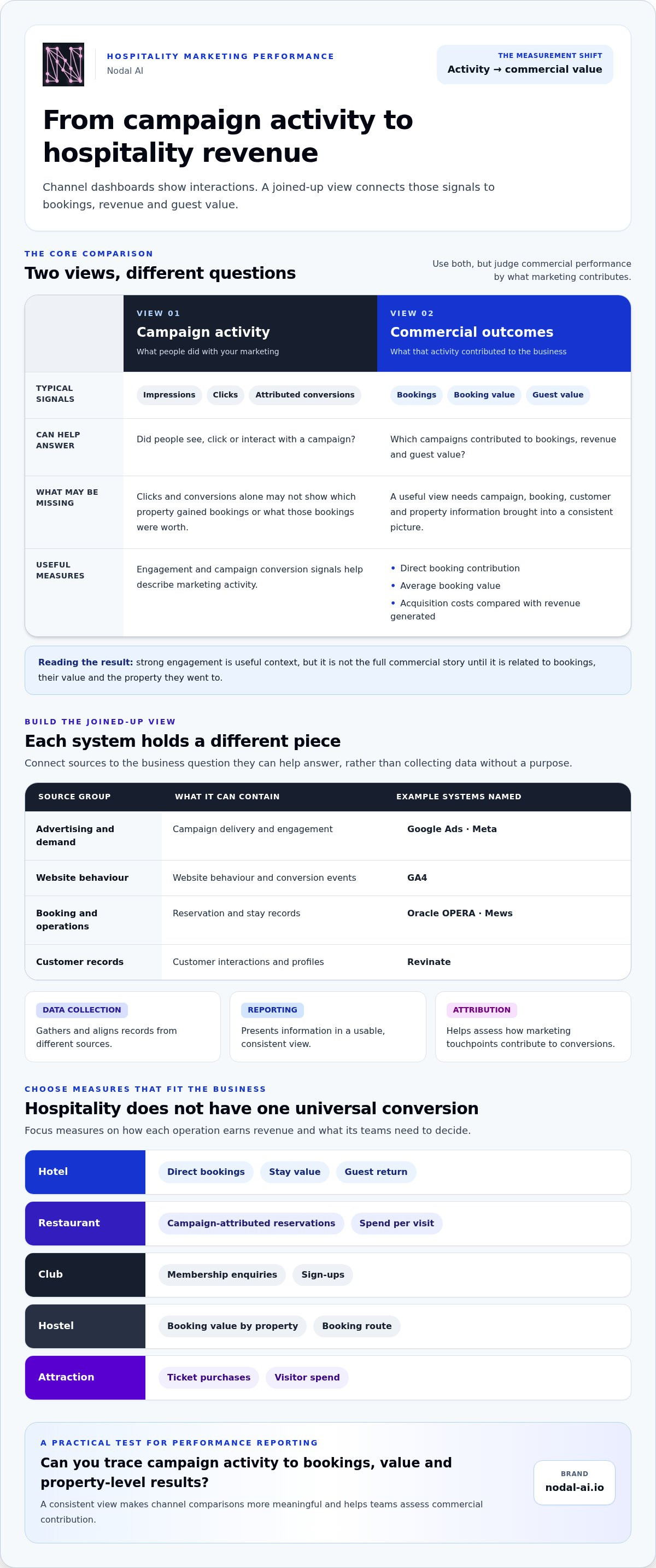
Marketing performance tracking software should connect campaign activity to measurable commercial outcomes. For hospitality teams, that means following the path from an advert, email or search visit to a booking or transaction, then understanding the value it brought to the business. Clicks and conversions show whether people interacted with a campaign. On their own, they don’t show which properties gained bookings, what those bookings were worth or whether the guests returned.
Campaign activity metrics show what people did with your marketing; commercial outcome metrics show what that activity contributed to bookings, revenue and guest value. This reflects the broader idea of marketing effectiveness: assess marketing by the outcomes it supports, not just the activity it generates.
Why channel dashboards cannot tell the whole hospitality story
Each system holds a piece of the picture. An advertising platform may record impressions, clicks and attributed conversions. A booking engine holds reservation details and booking value. A property management system (PMS) records stay information, while customer records may sit in a separate CRM. Without connecting those sources, teams can’t easily trace campaign performance through to property-level results.
Comparisons can also mislead when platforms define a conversion differently or use different reporting windows. One dashboard might credit a booking to a recent click, while another assigns the same journey to a different channel. A hotel could see strong engagement from paid search but still be unable to tell how many people completed a booking, which property received it or what it was worth. The ad result is useful, but it isn’t the full commercial story.
What hospitality teams need to see beyond conversions
Start with questions that connect performance to decisions. How much direct booking contribution came from a campaign? What was the average booking value? How did acquisition costs compare with the revenue generated? Answering these consistently helps teams assess booking quality and commercial contribution across properties, not just booking volume.
The useful measure depends on the hospitality business. A hotel may focus on direct bookings, stay value and guest return. A restaurant may be more interested in campaign-attributed reservations or spend per visit. A club could examine membership enquiries and sign-ups, while a hostel may compare booking value by property or booking route. An attraction might track ticket purchases and visitor spend. Choose measures that reflect how each business earns revenue, rather than forcing every operation into one generic conversion metric.
That clarity depends on bringing disconnected sources into a consistent view. Connecting fragmented marketing data with booking, customer and property information can help reveal which campaigns contribute to commercial outcomes and where performance differs by location. With the right connections, dashboards become a clearer basis for decisions, not just a collection of channel reports.
What marketing performance tracking software connects, measures, and reveals
A useful performance view follows the customer journey from first exposure to commercial outcome. It may begin with an advert impression or a visit to a hotel website, continue through searches and booking-engine activity, and end with a completed reservation, transaction and customer record. Marketing performance tracking software brings these signals into a structure that helps teams understand how activity relates to business results.
Connected source data turns separate system records into a fuller view of how campaigns influence customer journeys and commercial outcomes. Each source has a different role. Data collection gathers and aligns records; reporting presents them in a usable format; attribution helps assess how marketing touchpoints contribute to conversions; predictive insight uses patterns in available data to inform what may happen next. These capabilities work together, but they aren’t interchangeable.
Which systems contribute to a joined-up performance view?
Think in source groups, then connect each to a business question. Advertising and demand sources, such as Google Ads and Meta, show campaign delivery and engagement. GA4 can provide website behaviour and conversion events. Booking and operational systems, such as Oracle OPERA or Mews, can hold reservation and stay records. A CRM such as Revinate can contain customer interactions and profiles. These examples show the roles different systems can play in a hospitality data landscape.
For instance, if the question is whether paid search contributes to completed bookings at a particular property, campaign data alone won’t answer it. The analysis needs a consistent way to relate advertising activity to booking records and property information. If the question is which customer groups return, customer records and transaction history become important too. Choose integrations for the decisions they support, not simply to accumulate more data.
From reporting dashboards to actionable commercial intelligence
Automated reporting can bring recurring measures into a regular, consistent view, reducing the need to rebuild reports manually. It can show changes in campaign activity, bookings or revenue, but it doesn’t explain why a result changed or what action to take. Teams still need to interpret the evidence, check how measures are defined and decide what response makes commercial sense.
Customer journey mapping and multi-touch attribution answer different questions. Journey mapping helps teams see the sequence of interactions a customer has across channels and systems. Attribution assesses how credit for a conversion is assigned across marketing touchpoints. One gives context about the path; the other provides a way to evaluate contribution. Together, they help teams move beyond a single conversion count without treating every interaction as equally influential.
Keep the setup focused: define the decision, identify the records needed to answer it, then align the measures and reporting view. Nodal Platform brings hospitality data together for commercial, customer and operational insight, with capabilities including connected analytics and attribution. This gives teams a clearer foundation for turning routine reporting into a useful view of performance.
How to compare marketing performance tracking software for your business
Compare marketing performance tracking software by the decisions it helps you make, not by the length of its feature list. Start with the basics: can it connect campaign sources with booking, customer and revenue information, and present results consistently across properties? Then assess advanced options, such as predictive modelling or external signals, against the questions your team needs to answer.
Which evaluation criteria matter most to hospitality teams?
Prioritise source coverage, consistent definitions and reporting that reflects your business structure. You may need to compare performance by property, brand, channel or guest segment. The key test is decision relevance: can the view help your team assess acquisition, direct booking contribution or changes in demand, rather than simply display more metrics?
| Software approach | Strengths | Limitations | Suitable use |
|---|---|---|---|
| Channel-native analytics | Detailed views of activity within an advertising or web channel. | Usually focused on that channel, so cross-source commercial comparisons may require additional work. | Reviewing campaign delivery and engagement within a specific platform. |
| General reporting tools | Can bring selected data into shared dashboards and recurring reports. | Useful views depend on reliable inputs, aligned definitions and ongoing interpretation. | Consolidating established measures for regular team reviews. |
| Connected commercial intelligence platforms | Designed to relate marketing signals to bookings, customers and revenue data. | Value depends on relevant source connections and clear business questions. | Understanding contribution across properties, channels and guest groups. |
Use the comparison to separate essentials from enhancements. Reliable connections and consistent property-level views may be foundational; predictive modelling is an advanced option, not a substitute for sound historical data. Explore platform features to see how connected hospitality insights can support different commercial questions.
Match platform capabilities to the question you need answered
Make each capability earn its place. A hotel might want to know which campaigns bring valuable direct bookings, not simply the highest booking count. That requires campaign activity to be viewed alongside booking value and property context. A restaurant might compare delivery and dine-in activity, asking how marketing relates to each transaction type and the revenue it brings.
Historical reporting describes what has happened; predictive insight uses available patterns and relevant signals to help explore what may happen next. For example, a team could use historical demand alongside relevant external inputs, such as local events, to inform planning for a future demand period. A prediction is a guide for consideration, not a guaranteed outcome. Choose advanced capabilities when they address a defined decision, and make sure the underlying measures are clear first.
How to put marketing performance tracking software into a reliable workflow
Good software creates a clearer view, but a reliable workflow turns that view into decisions. Start with a commercial question, check that the underlying data can answer it, then agree how the team will review findings and act. This keeps marketing performance tracking software connected to business priorities instead of letting dashboards dictate what matters.
Build measurement around a clear commercial question
Choose a decision first. For example, a hotel may want to reduce acquisition costs or increase direct booking contribution. Define the outcome measure that will show progress, then select supporting indicators that help explain movement. For a direct booking question, those indicators might include campaign engagement and booking-engine activity. Set out how results should be compared across properties, channels and audiences, so a difference in mix or scale isn’t mistaken for a change in performance.
Use a simple KPI hierarchy to keep the measures in order:
- Activity: campaign reach, clicks or website visits show what marketing generated.
- Conversion: enquiries, booking-engine completions or transactions show the response.
- Commercial outcomes: booking contribution, revenue or acquisition costs connect that response to business value.
Next, map the sources behind each measure. Confirm that campaign records, booking information and revenue data use compatible dates, property identifiers and channel definitions. Check for missing records, duplicates or inconsistent naming before drawing conclusions. If a booking is counted differently in two systems, a polished report won’t resolve the mismatch. Document how each KPI is calculated and which source takes precedence when figures differ, so teams can use consistent definitions.
Turn connected reporting into a repeatable decision cycle
Once the measures are aligned, make review a clear sequence rather than a tour of every dashboard:
- Review: compare outcomes with the relevant previous period or agreed reference point.
- Investigate: identify which property, channel or audience contributed to a notable change.
- Add context: consider whether relevant external signals help explain the pattern.
- Act and record: agree a response, assign ownership and note what the team expects to learn.
External context can sharpen interpretation. Weather may affect local demand, while flight demand or local events could help explain changes in interest for a destination or period. Treat these as context to investigate, not automatic explanations. Record the signal considered and the reasoning behind the decision. At the next review, the team can assess whether the action was useful and refine its approach.
Discuss your hospitality measurement workflow with Nodal AI, using connected data and commercial insight to focus on the decisions that matter.
How Nodal Platform turns hospitality marketing performance data into action
Nodal Platform is a modular intelligence engine that connects hospitality data to commercial, customer and operational insight. Rather than treating marketing performance tracking software as a campaign dashboard alone, it brings relevant information into a view shaped around the decisions a business needs to make. Teams can investigate which activity supports valuable bookings, how customer behaviour differs between properties, or where performance may need attention.
Connect fragmented hospitality systems around business questions
Marketing activity is only one part of the picture. Nodal Platform connects data across property management systems (PMS), booking engines, advertising platforms, CRM and revenue tools. Bringing these sources together supports analysis of campaign performance alongside bookings, customer records and property-level outcomes. The value comes from joining the information that answers a defined commercial question, not from connecting systems for their own sake.
Configuration can reflect the needs of different hospitality businesses. A hotel group might focus on direct booking contribution and performance by property. A serviced apartment operator may want a view that reflects its booking and customer patterns. Clubs and food businesses can centre analysis on the customer and transaction questions most relevant to their operations. The platform’s modular approach lets the focus follow the business, rather than forcing every sector into an identical set of measures.
External signals can add context to analysis where they are relevant. Weather, flight demand, tourism trends, foreign exchange rates and local events may help teams interpret changes in demand alongside their own data. These signals inform analysis, but they shouldn’t be treated as guaranteed forecasts or explanations without supporting evidence.
Use case evidence to assess fit, not promise identical results
The Ovolo Hotels case provides a specific example of reported outcomes. Results included a 15.3% reduction in acquisition costs and a 24.5% increase in ROAS. The case also reported a 20% increase in paid search revenue and a 13.8% increase in bookings. These are outcomes from that case, not typical results or a promise of future performance. Use them as evidence of the commercial measures that can matter, then assess whether the questions, data and outcomes align with your own business.
The practical test is whether connected analysis can help your teams move from scattered records to clearer decisions, with a view of performance that fits your properties and priorities. Nodal Platform brings together data and analytical capabilities to support that work.
Make your next marketing decision clearer
Your next step doesn’t need to be a sweeping technology project. Start with one commercial uncertainty that’s slowing a decision, then consider what evidence would give your team greater confidence. That focus helps you judge whether marketing performance tracking software can support the way your hospitality business operates, rather than adding another layer of reporting to manage.
As priorities change, your measurement approach can evolve too. The aim is to give teams a shared, dependable basis for deciding where to investigate, what to test and which opportunities deserve attention. With clearer evidence behind each choice, marketing data becomes more useful across the business, not just easier to present.
Book a tailored demo of Nodal Platform to see how connected performance data can support your next marketing decision.
Frequently Asked Questions
Does marketing performance tracking software replace Google Analytics 4?
No, it usually complements GA4 rather than replacing it. Keep GA4 for detailed website analysis, then use a connected platform for broader business questions. Before linking data, review your GA4 key events and check that booking confirmations aren’t counted more than once. Clear event names and a shared definition of a completed booking make comparisons more dependable and help teams investigate differences between web analytics and downstream business records.
Can marketing performance tracking software support multi-property hospitality businesses?
Yes. For a reliable roll-up, establish a consistent property code and map it to each system’s location names. This is especially useful if a property changes name or a booking engine serves several sites. Also agree how to handle central campaigns and bookings involving more than one property. These rules help teams interpret group-level results without losing the local detail needed to understand what’s happening at an individual site.
How much does marketing performance tracking software cost?
Pricing depends on the platform’s scope and configuration. Nodal Platform subscription fees are tiered according to factors such as data volume, number of integrations and advanced predictive features. Professional implementation and onboarding fees may also apply for technical setup, data integration and dashboard configuration. When assessing the total investment, consider both recurring access and the work needed to prepare and maintain the data your analysis depends on.
What integrations should marketing performance tracking software support?
Prioritise reliable data transfer and clear field mapping, not just the number of available connections. Check how the platform handles renamed fields, missing records and updates to source systems. Decide who owns each connection and how your team will identify a failed or delayed data feed. A small reconciliation check, such as comparing booking totals with the source system, can catch issues before they shape a performance decision.
Can marketing performance tracking software use AI to recommend actions?
Yes, AI can help identify patterns or guest segments that may merit attention. For businesses exploring broader intelligent automation, providers like Online Star s.r.o. provide AI-powered tools for online marketing to help surface key audience trends. Still, treat each recommendation as a hypothesis to assess, not an instruction to follow automatically. For example, teams can review whether a suggested audience fits their commercial priorities, then test a measured change and observe the result. Recommendations are most useful when staff can understand the evidence behind them and apply operational context before acting.
Are reported improvements in ROAS or bookings guaranteed when using tracking software?
No. Software can improve visibility, but it can’t guarantee a particular change in commercial performance. Results also depend on factors such as campaign decisions, pricing, room availability, market demand and how consistently outcomes are measured. Before evaluating a reported improvement, define the comparison period and confirm that the measurement method stayed consistent. This helps separate a meaningful change from differences in conditions or reporting.


