

A campaign can light up every dashboard and still leave one question unanswered: are the right accounts moving towards a valuable outcome? Account-based marketing analytics should connect engagement across channels to account progression, pipeline and revenue, not just count clicks or leads.
If account activity is scattered across your CRM, ad platforms and web analytics, it’s hard to see what’s working. Campaign metrics may show attention without revealing whether buying groups are engaging, opportunities are advancing or existing customers are more likely to stay. Manual reporting adds delay when teams need a shared, timely view.
This article shows how to build a practical account-level measurement framework, choose useful signals and compare analytics approaches. You’ll learn how to connect campaign activity with commercial outcomes, assess initiatives across longer buying journeys and make more confident decisions about where to focus. We’ll also explore how unified metrics, conversational analytics and impact analysis can help turn fragmented data into clearer questions and more actionable insight, without confusing correlation with proof of cause.
Key Takeaways
- Separate account progress from lead volume and isolated campaign activity by defining the commercial outcomes that matter.
- Map CRM, advertising, web analytics and transaction data to specific account questions, with consistent account identities as a practical foundation.
- Use channel reporting, engagement views, attribution and impact analysis for different decisions, and be clear about what each approach can and cannot show.
- Build your account-based marketing analytics framework by choosing target accounts, defining outcomes, mapping data, selecting measures and reviewing decisions.
- Bring marketing and revenue metrics into one view with Unified Metrics to support clearer account-level analysis.
Why Account-Based Marketing Analytics Must Measure Account Progress
A campaign can generate clicks, impressions and form fills without showing whether a priority business is moving towards a decision. Account-based marketing analytics measures the signals and commercial outcomes associated with target accounts, rather than treating each lead or interaction as a result in isolation. That shift gives marketing and sales a clearer basis for deciding where to focus next.
This account-centred view reflects the focus of Account-Based Marketing (ABM) Overview: concentrate activity on selected organisations rather than relying only on broad audience reach. Measurement needs to go beyond naming accounts in a campaign report. It should show whether engagement is changing and whether that movement aligns with meaningful business outcomes.
What makes ABM analytics different from campaign reporting?
Channel reporting answers questions such as how many people saw an advert or clicked an email. Account-level reporting asks which organisations those people belong to, how activity is developing across each organisation and whether the account is progressing. A high impression count may indicate reach, but it doesn’t show that a target account is ready to buy.
Several known contacts can represent one buying group, each with a different role and set of concerns. If one person downloads a guide, that is a useful signal, not proof of purchase intent. If contacts from finance, operations and leadership engage with relevant material over time, the pattern may give sales a stronger reason to coordinate follow-up. It still doesn’t prove that marketing caused a deal to advance.
Which business questions should account analytics answer?
Useful measurement begins with questions that can guide action. For each target account, teams can look for meaningful changes in engagement, such as more contacts participating, repeat visits to important pages or responses to a sales conversation. For teams orchestrating multi-channel social touchpoints and automated deal qualification through SocialPosterr, tracking these early conversational signals helps indicate which accounts are actively engaging. The value lies not in collecting every possible signal, but in deciding which changes warrant attention.
Connect those signals to outcomes that matter to the business. For a hospitality group, for example, a team might ask whether activity associated with a corporate account coincides with direct bookings at relevant properties. In another B2B context, the outcome might be a qualified opportunity progressing through the pipeline or an existing customer renewing. Similarly, for high-growth firms coordinating stakeholder engagement or capital outreach through platforms like Pre-IPO Hype, tracking account progression helps gauge genuine investor interest. These are questions to investigate, not results to assume.
A practical review can ask:
- Which target accounts show a notable change in engagement, and which people or channels contributed to that pattern?
- Is the account progressing towards a defined commercial outcome, or is the evidence limited to campaign interaction?
- Does the observed activity suggest that teams should prioritise, maintain or reconsider future engagement?
Use the answers to focus attention and shape the next decision. Treat patterns as evidence to examine, not automatic proof of cause. That distinction keeps reporting credible and makes account-based marketing analytics more useful than a tally of disconnected campaign results.
How Account-Based Marketing Analytics Connects Data to Account Signals
Useful account insight depends on more than collecting data from more platforms. Teams need to understand what each source records, how it relates to a target account and what kind of conclusion it can support. Account-based marketing analytics becomes more reliable when observed activity, inferred interest and commercial outcomes are kept distinct.
Which data sources support a useful account view?
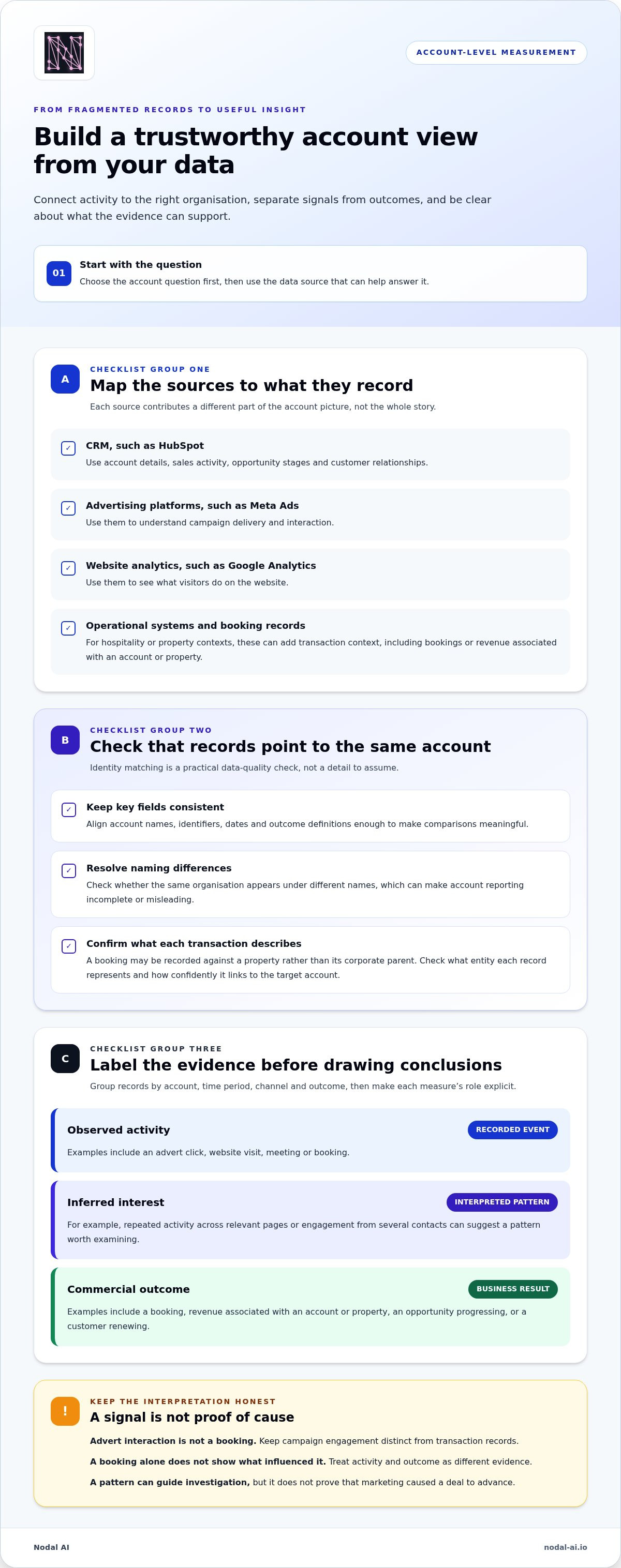
Start with the question, then identify the data that can help answer it. A CRM such as HubSpot can show account details, sales activity, opportunity stages and customer relationships. Advertising platforms such as Meta Ads record campaign delivery and interaction. Google Analytics can help show what visitors do on a website. Each source provides a different part of the picture, not a complete account story on its own.
For hospitality, property or operational systems and booking records can add transaction context. They answer questions about bookings or revenue associated with an account or property. Advertising data, by contrast, shows campaign exposure and engagement. Keep the two separate: an advert interaction is not a booking, and a booking alone doesn’t reveal which activity influenced it.
To connect these inputs usefully, account names, identifiers, dates and outcome definitions need to be consistent enough for comparison. If the same organisation appears under different names, or a booking is recorded against a property rather than its corporate parent, account-level reporting may be incomplete or misleading. Treat identity matching as a practical data-quality question: what entity does each record describe, and how confidently can it be associated with the target account?
How do signals become useful account insight?
Give every measure a clear place in the reporting model. Group relevant records by account, time period, channel and outcome, then label what each measure represents:
- Observed activity: recorded events such as an advert click, website visit, meeting or booking.
- Inferred interest: an interpretation of patterns, such as repeated activity across relevant pages or several contacts engaging. This is a useful hypothesis, not confirmed intent.
- Commercial outcome: a recorded event such as an opportunity progressing, a completed booking or a renewal.
This separation helps prevent an engagement score or prediction from being presented as a confirmed business result. It also gives teams a disciplined way to explore relationships between activity and outcomes without claiming that one caused the other.
External market comparisons can add context. If an account’s performance differs from a relevant benchmark, that may prompt a closer look at timing, audience or channel mix. A benchmark describes a comparison, not the reason behind the difference, so use it to shape questions rather than claim attribution.
Conversational analytics can make that exploration more direct. Teams can ask focused questions of available data, such as which target accounts show increased website activity alongside open opportunities, then examine the underlying measures before acting. Explore analytics features that support a more connected view of marketing and business data.
Compare Account-Based Marketing Analytics Approaches and Their Trade-offs
No single method answers every measurement question. Channel reports describe delivery, account engagement views show patterns across target organisations, and attribution or impact analysis can help connect activity with outcomes. Use each for the decision it supports, and be clear about the limits of its evidence. Strong account-based marketing analytics combines perspectives rather than treating one score as the full story.
Account engagement metrics versus commercial outcomes
Engagement metrics describe observed interactions, such as visits, responses or participation from contacts associated with an account. They can help teams spot changes and decide where to investigate, but they don’t guarantee buying readiness. Pair them with account progression and relevant revenue or retention measures to see whether activity coincides with outcomes that matter.
Aggregate channel success can hide uneven performance. A campaign may attract substantial engagement overall while priority accounts remain quiet, or a small number of target accounts may show meaningful activity that disappears in a broad total. Account-level views reveal this variation, while commercial measures help put it in context.
Attribution, benchmarking and impact analysis compared
Attribution allocates credit across touchpoints according to a selected model. Benchmarking places performance beside market data for context. Impact analysis helps identify initiatives associated with longer-term outcomes, such as revenue or retention. Each offers a different lens. None should be treated as automatic proof that marketing caused a result.
Use the comparison below to match a method to the question at hand:
| Method | Useful question | Strength | Limitation |
|---|---|---|---|
| Channel reporting | What did a channel deliver? | Shows delivery and interaction within that channel. | May not reveal which target accounts progressed. |
| Account engagement view | Which accounts show activity, and how is it changing? | Groups engagement signals at the account level. | Activity alone doesn’t establish intent or commercial value. |
| Attribution | Which touchpoints receive credit under this model? | Offers a structured view of contribution across recorded interactions. | Credit depends on the chosen model and available data, not definitive causation. |
| Benchmarking | How does performance compare with a market reference? | Adds context to account or campaign results. | A difference from the benchmark doesn’t explain why it occurred. |
| Impact analysis | Which initiatives are associated with longer-term outcomes? | Connects activity patterns with commercial measures over time. | Association alone doesn’t prove an initiative caused the outcome. |
For example, if an account’s engagement rises while an opportunity advances, the pattern is worth reviewing. Attribution may show how recorded touchpoints receive credit, while impact analysis can help explore whether similar initiatives align with longer-term outcomes. Sales conversations, timing and market conditions may also shape progress.
Choose the method based on the decision: adjust a channel, prioritise an account, review credit allocation or investigate longer-term contribution. Keeping the question and limitation visible makes the evidence more useful and the next action more grounded.
Build an Account-Based Marketing Analytics Framework in Five Steps
A useful framework doesn’t need a universal score or a complex dashboard. It needs shared definitions, measures tied to decisions and a review process that turns evidence into action. Use these five steps to build account-based marketing analytics around your programme, whether it focuses on individual organisations or broader groups.
- Choose the accounts. Set clear inclusion criteria with sales, such as strategic fit, current relationship or opportunity status. Agree how parent organisations, subsidiaries and properties should be treated so teams measure the same account. The level of personalisation can vary across one-to-one, one-to-few and one-to-many programmes, while the account definition remains clear.
- Define the outcomes. Choose outcomes that fit the business model and account lifecycle. These might include opportunity progression, a completed transaction, renewal or retention. Write down what counts as each outcome and the period in which it will be reviewed. Marketing and sales should agree who owns the definitions and who validates the records.
- Map the data. Identify where account, activity and outcome information lives, then note which fields or records connect them. Record gaps and inconsistencies rather than masking them with assumptions. Give each source and measure an owner, so teams know who can explain or resolve data-quality questions.
- Select the measures. Keep engagement and progression as separate indicator groups. Engagement describes recorded interactions; progression describes movement towards an agreed outcome. Choose only measures that can inform a decision, such as whether to prioritise an account, adjust future activity or review an opportunity. Don’t import generic benchmarks or target values without a credible comparison that fits your accounts and context.
- Review and learn. Set a consistent review cadence that suits the sales cycle and programme. At each review, note the account pattern, changing conditions, decision made and outcome observed later. This record helps the team learn over time without assuming that a change followed by an outcome proves marketing caused it.
Turn reporting into a repeatable review cycle
Keep the review focused: What changed? Which accounts need attention? What action will the team take? Who will follow up, and when will the result be reviewed? This gives marketing and sales a shared operating rhythm instead of separate reports. For more on assigning credit across touchpoints, see Mastering Marketing Attribution: The Definitive Guide for 2026.
Use this short checklist to keep the framework practical:
- Account definitions and reporting ownership are agreed.
- Outcomes reflect the account lifecycle and business model.
- Engagement is reported separately from commercial progression.
- Each measure supports a clear decision and has an owner.
- Reviews record actions, context and observed outcomes.
Once the process is clear, connected analytics can make recurring reviews easier. Explore a Nodal AI demo
Use Unified Account Insight to Make Better ABM Decisions
A measurement framework is useful when teams can turn its signals into clearer decisions. Nodal Platform brings marketing and revenue information together for analysis. Teams can use that shared view to examine account-level questions, then decide which accounts to prioritise and what action to take.
How Nodal Platform supports account-level questions
Unified Metrics brings marketing and revenue metrics into a single view, helping teams examine activity alongside commercial measures. Conversational Analytics lets users ask AI agents focused questions about available data, such as which accounts show changing engagement alongside opportunity progression. AI Growth Insights can surface actionable suggestions for further consideration, while Real-Time Insights provides market-data comparisons and benchmarking to help interpret performance in context.
These capabilities support analysis, not certainty. A benchmark can provide context, and a pattern may help a team decide what to investigate next. Neither proves that marketing caused a change or guarantees an ABM outcome. Impact Analysis can help identify initiatives associated with longer-term revenue and retention, while teams assess other influences and the evidence behind each conclusion.
Connect the framework to broader customer and marketing analysis
Account signals sit within a wider customer journey. Connecting them with relevant journey stages can help teams understand where an account’s interactions fit across marketing and revenue activity. For a broader perspective, explore The Definitive Guide to the Customer Journey: Mapping for Profitable Growth in 2026. To see how connected analytics can support decisions across fragmented marketing data, read Nodal Platform: Transform Fragmented Marketing Data into Profitable Decisions.
Automated Media Planning uses over 20 data sources. This complements the platform’s analytics capabilities, but the core measurement principle remains the same: use data to inform choices, then review what happens without treating association as proof of cause.
For a practical evaluation, take a few questions from your framework into the platform discussion. Which account-level measures can be viewed alongside revenue metrics? What comparisons would add market context? How could teams investigate initiatives associated with longer-term outcomes? Clear questions make it easier to assess whether the analytics fit your reporting needs.
Explore how Nodal Platform can support your account-level analytics questions:
Put Your Account Insights to Work
Turn measurement into a team habit. Choose a current account decision, agree what evidence would inform it, and use the result to sharpen your next review. This keeps account-based marketing analytics connected to practical choices, rather than letting reporting become an end in itself.
As your approach develops, look for ways to reduce the distance between a question and a useful answer. A shared view of marketing and commercial performance, tools for exploring data through questions, and planning informed by broad data inputs can all support that work. The goal is not more dashboards. It’s greater confidence about where to focus and what to learn next.
Start with the account questions your team needs to answer, then explore how Nodal Platform could support your measurement approach.
Use a Nodal Platform demo to explore how unified metrics and AI-powered analytics can support your account-based marketing decisions.
Frequently Asked Questions
What is account-based marketing analytics?
Account-based marketing analytics examines signals and outcomes for a defined group of target organisations. It can help teams spot changes in activity, understand how engagement develops and compare those patterns with business goals. For example, a team might review whether more relevant contacts are interacting with an account’s campaign over time. Such a pattern can guide follow-up, but it doesn’t establish that marketing caused a purchase or other result.
Which metrics should you track in account-based marketing?
Choose measures that answer a decision your team needs to make. A practical set might include buying-group coverage, movement in opportunity stage and an outcome such as renewal or completed revenue. Keep the definitions consistent across the accounts being compared. If the team is deciding where sales should focus, a contact-level activity count alone won’t show whether the account’s commercial position has changed.
How do you measure ABM campaign effectiveness?
Begin with a defined account group and a clear intended outcome, such as creating a qualified opportunity or supporting an existing customer relationship. Then compare campaign activity with account and commercial records over a consistent period. Note what action the analysis informed and what happened afterwards. Attribution can help organise credit among recorded interactions, but other touchpoints and business conditions mean it shouldn’t be treated as proof that a campaign caused the result.
Can account-based marketing analytics work without a CRM?
Yes, teams can start with available marketing and commercial records, although gaps in account and contact information may limit the view. For example, a team might compare a campaign list with opportunity data maintained elsewhere, provided both use a consistent account name or identifier. Document unmatched records and missing fields rather than treating them as complete. A CRM can help organise relationships, but data quality and clear account definitions remain important.
How is account-based marketing analytics different from marketing attribution?
Account-based marketing analytics examines an organisation’s wider performance, including activity across its contacts and commercial context. Attribution is one method within that analysis: it assigns credit to interactions according to a selected model. For example, a model may distribute credit across recorded email, advert and website interactions. That allocation is useful for comparing touchpoints under the model, but it doesn’t replace the account picture or prove that any interaction caused a sale.
What data do you need for account-based marketing analytics?
The right inputs depend on the question. A team studying opportunity progression might need account records, sales-stage history and campaign interactions; one examining customer retention may also need renewal or service outcomes. Before adding another source, check whether its records can be associated consistently with the accounts under review. A smaller set of clearly defined, relevant data can support a more interpretable analysis than a larger collection of mismatched records.
How can AI support account-based marketing analytics?
AI can help teams explore available data and surface suggestions to investigate, while people assess whether those suggestions fit the business context. Nodal Platform includes Conversational Analytics, which lets users ask AI agents questions about their data, alongside AI Growth Insights and Impact Analysis. For example, a suggested relationship between an initiative and retention can prompt further review. Treat it as a lead for analysis, not a guaranteed result or proof of cause.


