

A rise in online conversions after a TV campaign may reflect timing rather than impact. Connecting tv ads to digital conversions starts with a credible evidence chain: record exposure, define a measurable action, then assess whether the campaign changed outcomes. This distinction matters when TV reports and digital analytics sit in separate systems. A visit after an advert may look like proof, but it does not show what caused the visit.
To assess more than a view-through count, set a practical measurement plan before committing budget. Define the action that matters, choose tracking that fits the campaign, and compare attribution methods while accounting for their limits. This guide covers exposure signals, digital conversion data, multi-touch attribution, marketing mix modelling and incrementality testing, so you can decide which evidence best suits your objective.
Then bring campaign results into the wider marketing and revenue picture. Unified metrics and conversational analytics can help teams examine available data and make more informed decisions, without treating correlation as causation. The result is a clearer way to assess TV’s contribution and decide what to test next.
Key Takeaways
- Build a practical path for connecting tv ads to digital conversions by defining the desired outcome before choosing tracking methods.
- Separate ad delivery, response signals, digital conversions and business outcomes to see what each metric can, and cannot, tell you.
- Compare platform-reported attribution, response signals and incrementality testing against the question your campaign needs to answer.
- Before launch, document campaign dates, audience, creative, conversion event and reporting window so results can be interpreted consistently.
- Bring available marketing and revenue metrics together to identify patterns and make clearer decisions about what to test next.
Why connecting TV ads to digital conversions requires a clear evidence chain
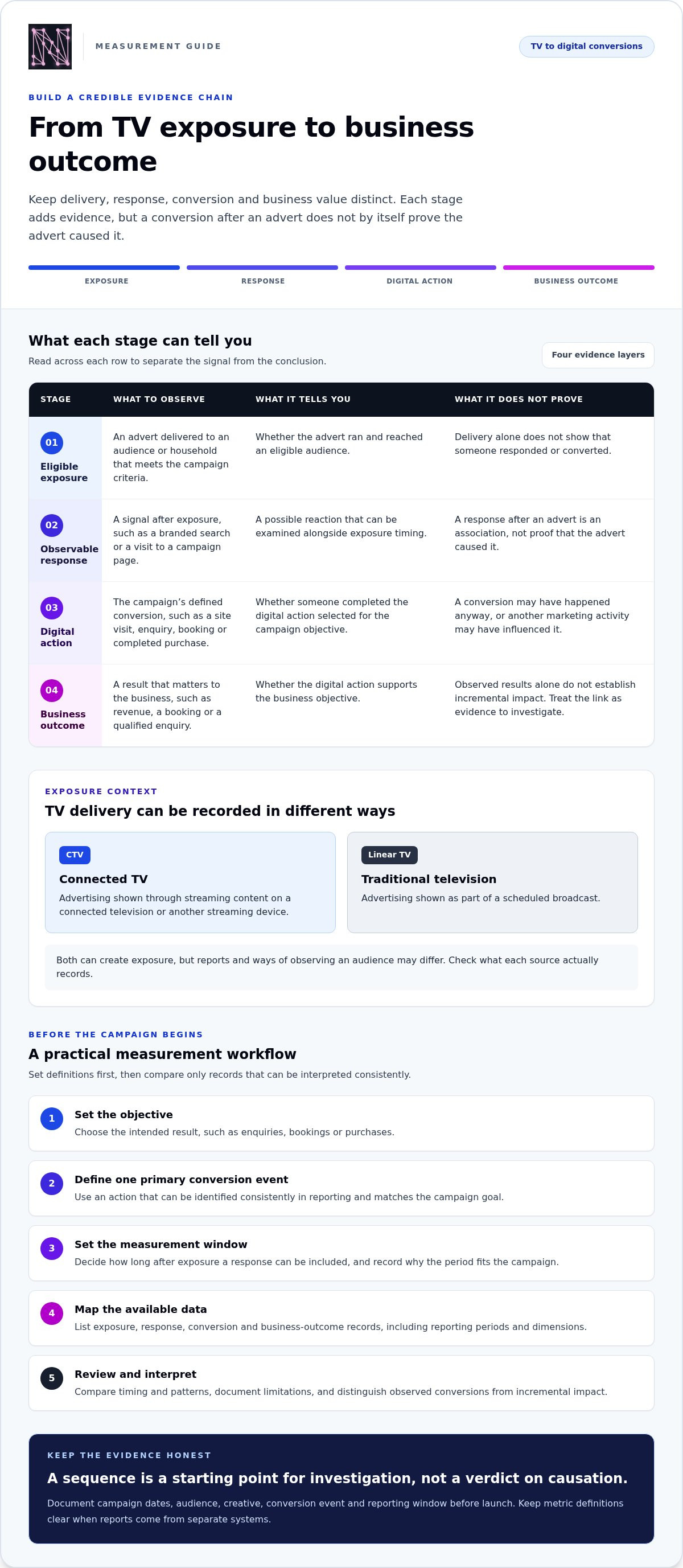
A television advert may be shown to a household, and someone in that household may later visit a website or make a purchase. The events may be related, but their sequence does not prove that the advert caused the action. Connecting tv ads to digital conversions means building a credible trail from recorded exposure to a defined digital response, then assessing whether that response represents real business impact.
First, distinguish how the advert was delivered. Connected TV (CTV) advertising appears through streaming content on a connected television or another streaming device. Traditional linear television follows a scheduled broadcast. Both can create exposure, but the reports and ways of observing an audience may differ. Be clear about what each source actually records.
The evidence chain has four parts:
- Eligible exposure: An advert was delivered to an audience or household that meets the campaign’s criteria.
- Observable response: A measurable signal follows, such as a branded search or a visit to a campaign page.
- Digital action: Someone completes the conversion defined for the campaign.
- Business outcome: The action contributes to an outcome that matters, such as revenue, a booking or a qualified enquiry.
Keep these stages distinct. Delivery metrics show whether the advert ran; response signals suggest a possible reaction; conversion data records a digital action; business measures show whether that action had value. Combining them too early can make weak evidence look conclusive.
What does connecting TV advertising to a digital conversion mean?
It means assessing whether an eligible TV exposure is associated with a later, observable digital action, and whether that action supports the business objective. The conversion might be a site visit, enquiry, booking or completed purchase. Choose the event to match the campaign goal: a booking campaign and an awareness campaign should not be judged by the same action.
Why is the TV-to-digital link difficult to read?
Someone may watch an advert on a television, then act later on a phone or computer. They may return through search, another advert or a saved link. The time gap and device change make the sequence harder to interpret, while separate platform reports may capture only part of the journey.
This fragmentation creates a practical challenge. A TV report might describe delivery, website analytics might record sessions, and another system might report purchases. Differences in definitions, time windows and available data can mean the totals do not line up. Before interpreting a result, establish which records can be compared and what each leaves out.
Most importantly, a reported association is not automatically proof of incremental impact. A conversion after exposure may have happened anyway, or another marketing activity may have influenced it. Treat the observed link as evidence to investigate, not a verdict. The sections that follow show how to shape that evidence into a measurement plan and compare methods for evaluating TV’s contribution.
Build a measurement chain from TV exposure to digital conversion
Turn the evidence chain into a repeatable workflow before the campaign begins. The aim is not to force every dataset into one attribution story. Define what success means, establish which records can be compared, and report only what the evidence supports. This makes connecting tv ads to digital conversions more disciplined, even when exposure and outcome data come from separate systems.
Use this sequence to keep each stage distinct:
- Set the objective. Decide whether the campaign is intended to drive enquiries, bookings, purchases or another business result.
- Define the conversion event. Choose one primary digital action that can be identified consistently in reporting.
- Set the measurement window. Decide how long after exposure a response can be included, and record why that period fits the campaign.
- Map available data. List exposure, response, conversion and business-outcome records, including their reporting periods and dimensions.
- Review and interpret. Compare timing and patterns, document limitations, and distinguish observed conversions from incremental impact.
Step one: define the conversion and its timeframe
Write one clear event definition before launch: “A conversion is a completed booking recorded on the website during the agreed measurement window.” Replace the example with the action that reflects your objective. A site visit may suit an early-stage response goal, while a completed purchase may better represent a sales objective. Select one primary event to keep the evaluation focused.
Set the reporting window in advance rather than extending it after seeing the results. Document the rationale and separate immediate responses from actions that follow after a delay. Use the same event name and time period across reporting wherever possible. Consistency lets teams compare like with like, and clear definitions prevent small differences in labels from being mistaken for changes in performance.
Step two: connect exposure, response and outcome data
Inventory the data the campaign team can use: TV delivery reports, response signals such as branded search or landing-page activity, digital conversion records, and relevant business outcomes. Record the source, date range, audience or campaign dimensions, and definitions for each dataset. Map shared identifiers or dimensions only when they are legitimately available and comparable. Do not infer a connection that the data does not provide.
Mark gaps plainly. If a report uses different dates, event names or audience definitions, flag the mismatch instead of adjusting figures by assumption. A missing link is useful information: it shows where measurement is limited and helps set realistic expectations for interpretation.
Step three: review the evidence consistently
Compare campaign timing with response and conversion patterns using the agreed reporting window. Then state the method, data limitations and attribution window alongside the findings. Keep the conclusion precise: “The report recorded conversions during the attribution window after TV exposure; this tracking does not establish how many were incremental.” For teams bringing available campaign and revenue metrics into clearer analysis, Nodal AI’s analytics features can help provide wider context for reviewing results.
Compare attribution, response signals, and incrementality for TV campaigns
No single method answers every question. Attribution describes how credit is assigned across a customer journey. Response signals show activity that may follow a campaign. Incrementality testing asks whether outcomes changed because of the campaign. Comparing all three gives a more balanced view of connecting tv ads to digital conversions, without treating any one type of evidence as a complete verdict.
| Method | Question answered | Strengths | Limitations | Suitable use |
|---|---|---|---|---|
| Platform-reported attribution | Which conversions does the platform credit to TV exposure? | Can provide campaign-level reporting within the platform’s measurement setup. | Results depend on platform definitions, available data and attribution windows. Credited conversions do not prove that the campaign created additional demand. | Monitoring reported performance and comparing campaigns within consistent platform settings. |
| Response signals | Did measurable activity change around the campaign? | Signals such as QR scans, branded searches or direct visits can help show audience response and inform further analysis. | They do not capture every response, identify every cause or show the full business impact. | Tracking immediate engagement and spotting patterns to investigate alongside conversion data. |
| Incrementality testing | Did the campaign produce additional outcomes compared with what might otherwise have happened? | A holdout or comparison design can offer stronger evidence of causal lift than observed activity alone. | Test design, data quality and other influences on results affect interpretation. Results may not apply beyond the tested conditions. | Evaluating whether a campaign changed outcomes when a suitable comparison can be designed. |
What attribution can show, and what it cannot
Attribution assigns credit according to a chosen model and the data available. A last-touch model, for example, gives credit to the final recorded interaction, while other models may distribute credit across several interactions. Each answers a different accounting question. None automatically establishes causation. View-through reporting also depends on how the platform defines a view, links it to an outcome and sets its measurement window. For background on attribution approaches, explore a dedicated guide to marketing attribution.
Read platform-reported results as modelled credit, not proof that a TV impression created a conversion. A person may have converted without seeing the advert, or another activity may have contributed. State the model and reporting window alongside the result so stakeholders understand what the figure represents.
When response signals and incrementality add context
A QR scan is a direct response to an on-screen prompt. Branded search changes or increased direct traffic may also coincide with exposure. These are useful clues, but they do not reveal how many people were persuaded or whether extra demand was created. Treat them as supporting evidence, not a complete measure of impact.
A holdout or comparison design can add context by comparing outcomes between groups or areas with different exposure. Account for other influences, such as concurrent promotions, seasonality or changes in other marketing activity. The best method depends on the campaign question, available data and strength of the comparison. Report the evidence together, while keeping observed association distinct from demonstrated incremental change.
Set up a TV-to-digital conversion measurement plan before launch
A reliable report starts before the first advert runs. Decide what the campaign is meant to change, which records will help assess it, and how the team will interpret the result. This preparation gives everyone the same reference point and makes connecting tv ads to digital conversions more consistent across TV, digital and business reporting.
Use this pre-launch checklist:
- Objective: State the business goal and choose one primary digital action that represents progress towards it.
- Event definition: Write the conversion event in plain language, including how it is recorded and which event name appears in reporting.
- Data readiness: List the exposure, response, conversion and business-outcome data available, along with the system and team responsible for each source.
- Baseline: Choose a pre-campaign period for comparison and confirm that its metrics use the same definitions as the campaign-period report.
- Review: Set the reporting window, review date and approach for recording limitations or other activity that could affect results.
Also document the campaign dates, audience, creative, conversion event and reporting window in one shared record. This gives analysts and stakeholders a common reference when results arrive. A customer journey map can help teams clarify the stages between exposure, response and action. Keep the map grounded in the touchpoints and data actually available.
Prepare campaign data and reporting definitions
Agree a shared naming convention for campaigns, audiences and conversion events before reporting begins. For example, use one consistent campaign label in planning documents and performance reports rather than informal variations that make matching records harder. Note which team owns each source and how often it is updated. Check that baseline and campaign-period reporting use consistent event definitions, audience groupings and date boundaries.
Keep TV and digital reporting comparable without pretending their metrics are interchangeable. TV delivery measures and digital actions describe different things, so preserve each in its original unit. Compare them by agreed dimensions, such as campaign dates or audience, only where those dimensions align. If periods, definitions or coverage differ, flag the mismatch and report the figures separately instead of combining them into a misleading total.
Read results without overstating what changed
Separate the observed result from the explanation. “Website enquiries increased during the campaign period” describes a pattern. “The TV campaign caused the increase” makes a causal claim that requires stronger evidence. Before drawing conclusions, review the timing, other campaign activity and known business context, including promotions or operational changes that may have influenced demand.
Close the review with a concise stakeholder summary: what changed, how confidently the team can interpret it, what data or design limits that confidence, and what should be tested or improved next. Clear reporting turns uncertainty into a useful decision rather than hiding it behind a single attribution figure. Explore customer journey mapping to see how journey context can support a broader view of marketing and revenue metrics.
Use these steps to bring your campaign and business metrics into a clearer measurement plan.
Use unified analytics to turn TV and digital signals into clearer decisions
Unified analytics can help teams interpret available campaign, marketing and revenue metrics together. It does not replace good campaign design, define the right conversion event or prove that TV caused a change. Instead, it puts the evidence you have in a wider business context, helping teams assess patterns and make informed decisions about what to investigate or test next.
Bring marketing and business performance into one view
With separate reports, a TV delivery figure, a change in website activity and a revenue result can each tell part of the story. Nodal’s Unified Metrics brings revenue and marketing data into one view, helping teams review available measures in relation to the wider performance picture. The Nodal Platform for fragmented marketing data supports clearer analysis while keeping each metric’s definition and limits visible.
Conversational Analytics lets teams ask AI agents questions about their data, making it easier to explore available information and investigate patterns without relying only on static reports. For example, a team could examine whether a change in digital activity coincided with a campaign period, then review the context in its marketing and revenue metrics. That observation can guide further analysis, but timing alone does not establish that TV caused the change.
Confirmed integrations include Meta Ads, Google Marketing Platform and Google Analytics, alongside other favourite tools. These integrations can inform analysis of available business metrics. They do not imply direct TV or connected TV integrations, TV ad buying, or TV-specific attribution capabilities.
Turn analysis into the next measurement decision
AI Growth Insights can help surface growth insights from available data. Impact Analysis identifies initiatives that drive long-term revenue and retention. Together, these capabilities can help teams ask more useful follow-up questions: which patterns merit closer review, what context might explain a change, and what should the next measurement test examine? They support interpretation, but do not replace a defined objective, suitable comparison or sound measurement design.
Keep conclusions proportionate to the evidence. If a report shows a change during a TV campaign, use that finding to inform the next decision, not to claim an effect the measurement has not demonstrated. A broader view of performance can help teams prioritise follow-up analysis and connect campaign discussions with business outcomes.
Ovolo Hotel Group’s testimonial describes results amid media costs rising by 60%. This provides broader marketing context, not evidence of a TV campaign result. Explore the platform’s analytics and impact analysis features to understand how available metrics can support clearer decisions.
Make your next campaign a smarter test
Let each campaign sharpen the questions you ask next. Connecting tv ads to digital conversions is not just about assigning credit after the fact. It can help your team identify what remains uncertain, decide which evidence would make the next evaluation stronger, and build a more confident basis for future investment.
Bring the learning into wider planning, too. Nodal’s Automated Media Planning uses over 20 data sources, adding broader context to marketing decisions without replacing campaign-specific measurement. Keep the focus on the business question: which outcomes matter, what evidence can inform them, and what would justify changing course?
This approach turns measurement from a one-off report into a more useful decision process. Start with the available evidence, be clear about its limits, and use each review to guide the next test. Better decisions begin with better questions.
Take the next step with a clearer view of your marketing data. Book a Nodal AI demo to explore how unified metrics and AI-powered insights can support better-informed decisions.
Frequently Asked Questions
What counts as a digital conversion after a TV ad?
A digital conversion is an online action selected to match the campaign objective. For connecting tv ads to digital conversions, define the event before launch: if the goal is enquiries, is a conversion a submitted form or a qualified enquiry recorded later? Document the exact action and how it appears in reporting. A recorded event confirms that an action occurred; it does not, by itself, show that TV caused it.
Can TV advertising lead to a conversion on a different device?
Yes. Someone might see an advert on television, then visit a website on a phone or complete a purchase on a computer. Whether the journey can be linked depends on the data and measurement methods available to the campaign. Record the attribution window and any gaps in cross-device visibility. If reports show exposure and a later action without a reliable connection, describe it as an association, not definitive proof of causation.
Do QR codes prove that a TV ad generated sales?
No. A QR scan can show that someone responded to a particular creative or campaign, but it does not establish that they completed a purchase or that the advert generated additional demand. For example, a scan may lead to a product page without an order. Define a downstream event, such as a completed checkout, and interpret scan activity alongside conversion records and wider business results.
How long after a TV ad should conversions be measured?
There is no single measurement window that fits every campaign. A quick sign-up journey may call for a different period from a considered booking or purchase. Choose the window before launch based on the objective and expected decision process, then use it consistently in analysis. Disclose it in reports. If you change the window for a later review, explain why so stakeholders can judge whether the results remain comparable.
Which metrics should a team include when evaluating TV ads and digital conversions?
Include metrics that cover delivery, response, the chosen digital conversion and relevant business outcomes. For example, impressions describe advert delivery, branded searches may indicate a response, and completed orders record an action. Revenue can show the commercial context. Keep the measures separate rather than combining them into one score, and record each definition and source. This helps stakeholders understand what the data demonstrates and where interpretation begins.
How can marketers tell whether a TV campaign caused additional conversions?
Attribution can allocate credit, but additional conversions require evidence that outcomes changed because of the campaign. Where practical, use a holdout or comparison design, then compare outcomes across groups while accounting for differences in timing, audience and other marketing activity. The design should fit the campaign and available data. Report its assumptions and limitations clearly, and describe the result as estimated incremental change rather than certainty when the evidence cannot support a stronger claim.


