

What if your channels look successful on their own, but together they can’t explain what’s driving revenue? A cross-channel marketing analytics platform should connect the whole picture, not leave your team comparing reports with different definitions or stitching data together by hand.
It’s frustrating when engagement looks strong but its commercial impact stays unclear. You need to understand how channel activity relates to revenue and retention, then use that view to decide what to do next. This article explains how to evaluate a platform’s ability to unify performance measures, connect marketing activity with business outcomes and turn analysis into practical growth decisions.
We’ll explore the data connections, measurement capabilities and actionable insights that matter most. For hospitality teams, we’ll also consider questions such as how marketing relates to direct bookings, which guest segments respond and how results vary by property. The goal is a clearer view of what’s working and a more confident way to act on it.
Key Takeaways
- Choose a cross-channel marketing analytics platform that makes channel data comparable and connects it to commercial outcomes.
- Map the data sources and business questions you need answered before comparing platform features.
- Assess whether insights can guide practical decisions about revenue, retention and campaign priorities.
- Use a consistent evaluation plan to compare integration fit, commercial context, benchmarking and security.
- See how Nodal AI’s analytics capabilities can help connect marketing performance with growth decisions.
What a Cross-Channel Marketing Analytics Platform Actually Connects
Channel dashboards can show clicks, bookings, engagement and spend, yet those figures may use different definitions, time periods and attribution rules. A team can see activity in every channel and still struggle to compare performance or decide where to focus. A cross-channel marketing analytics platform brings relevant channel data into a coherent analytical view, so marketers can assess activity alongside shared business measures.
Cross-channel analytics compares connected marketing channels using consistent measures to understand their relative contribution to business outcomes. The aim isn’t to put every metric on one screen. It’s to make information comparable and useful for decisions, while being clear about what the data can and can’t establish.
Cross-channel analytics, multichannel and omnichannel are not interchangeable
Multichannel marketing describes using different channels to reach customers. A business might use a website, email campaigns and social media without connecting their performance in a single analysis. Cross-channel analysis compares those channels and their results. It doesn’t automatically mean customers receive a coordinated or identical experience across them.
Omnichannel is broader: it concerns how channels and customer experiences are coordinated. Analytics can help teams assess performance across connected channels, but it isn’t the activity of planning messages or delivering campaigns. Keeping the distinction clear helps set realistic expectations about what an analytics platform does.
Why separate channel dashboards leave decision gaps
Each channel’s reporting view can describe its own activity, but separate views may use different attribution approaches or count outcomes differently. Adding their reported conversions together can therefore create a misleading picture of combined performance. A platform’s reported results are useful evidence, but they don’t independently prove that a campaign caused a sale or show how much business would have occurred without it.
Analytics supports measurement and decision-making; campaign activation is a separate function. Use the combined view to investigate patterns, compare results and inform choices about future activity. Don’t confuse a platform that analyses campaign data with a tool that launches or manages campaigns—for example, while analytics highlights the revenue impact of organic search, dedicated execution tools like AutoSEO handle the day-to-day automation of search engine optimization.
Consider a hotel group running marketing across several channels and managing more than one property. A channel dashboard might show clicks or attributed bookings, while the business needs to understand how activity relates to direct bookings and property-level revenue. Connecting marketing measures with booking and revenue context can help teams compare performance more meaningfully. It can also prompt useful questions: are the results concentrated at one property, and do they align with changes in bookings? Those questions support investigation, not automatic proof of cause.
The practical test is simple: can the platform help your team move from “What happened in each channel?” to “What does the combined evidence suggest we should do next?” That shift turns reporting into a clearer basis for commercial decisions.
How a Cross-Channel Marketing Analytics Platform Turns Data into Insight
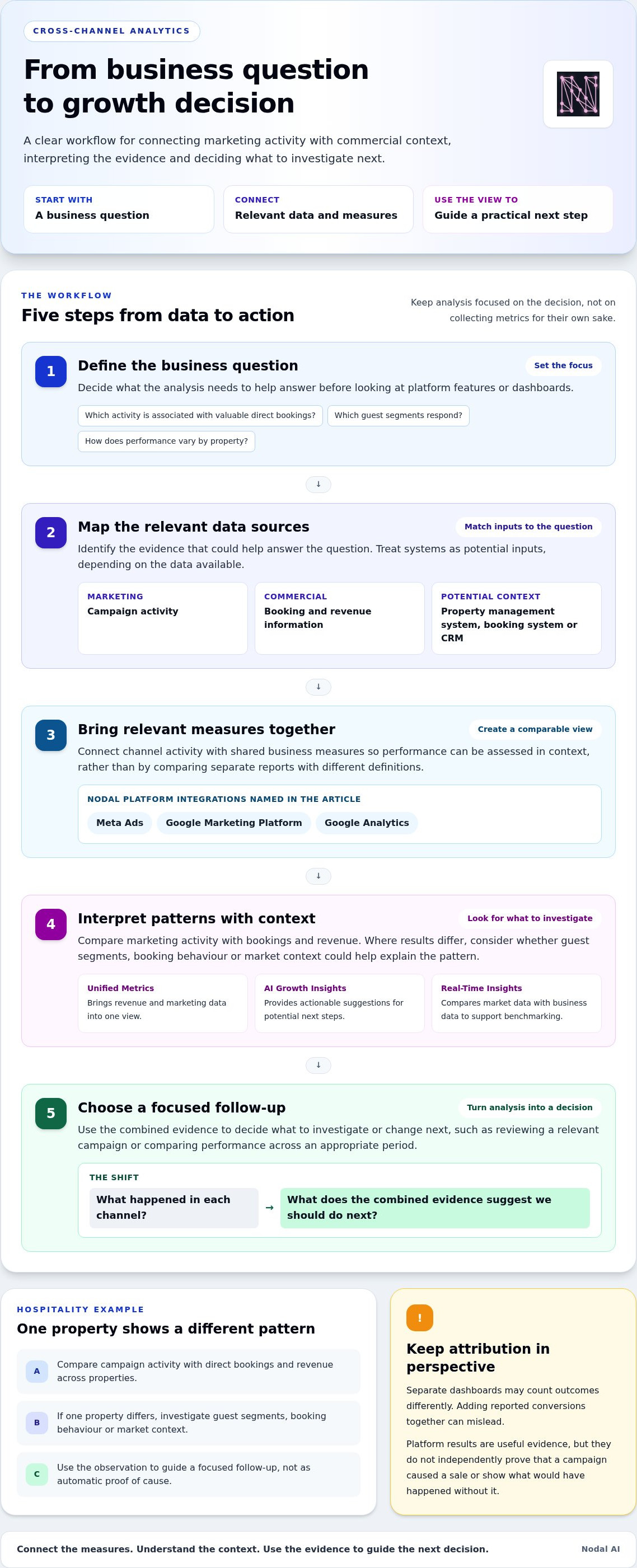
Useful analysis starts before the dashboard. First, define the business question. Then identify the data that could help answer it, bring relevant measures together, interpret the pattern and decide what action to take. This workflow keeps reporting focused on decisions, not on collecting metrics for their own sake.
Start with business questions and relevant data sources
For a hospitality business, useful questions might include: which marketing activity is associated with valuable direct bookings, which guest segments respond, or how does performance vary between properties? Each question points to different evidence. Marketing data can describe campaign activity; booking and revenue information can add commercial context; operational records may help explain differences between properties or guest groups.
Map the sources before assessing results. A property management system, booking system and CRM could each contribute relevant context, depending on the question and the data available. Treat them as potential inputs, not automatic proof of a complete customer journey. Nodal Platform integrates with Meta Ads, Google Marketing Platform and Google Analytics, alongside other favourite tools. Bringing relevant marketing information together can help teams analyse it in context, while keeping the question and available data in view.
Move from unified metrics to practical insight
Once the question and relevant inputs are clear, use a cross-channel marketing analytics platform to turn separate measures into a structured view. Nodal Platform’s Unified Metrics brings revenue and marketing data into one view. AI Growth Insights provides actionable suggestions, helping teams identify potential next steps without manually digging through spreadsheets. Real-Time Insights compares market data with business data to support benchmarking.
Connected metrics help teams move from reporting what happened to deciding what to investigate or change next.
For example, a hotel group could compare campaign activity with direct bookings and revenue across properties. If one property shows a different pattern, the team can investigate whether the difference relates to guest segments, booking behaviour or market context. That observation can guide a focused follow-up, such as reviewing the relevant campaign or comparing performance across an appropriate period. Treat it as a lead for investigation, not automatic evidence that one channel caused the result.
Use this ordered workflow to keep the analysis grounded:
- Frame the question. Name the decision the team needs to make, such as where to investigate booking performance.
- Select relevant sources. Match marketing, booking, revenue and operational data to the question, rather than connecting data simply because it exists.
- Align the measures. Check that time periods, property groupings and metric definitions are comparable before drawing conclusions.
- Interpret the pattern. Look for differences across channels, guest segments or properties, and note what the data cannot establish on its own.
- Choose a next step. Use the insight to guide a practical action, then assess what the resulting data shows.
Explore Nodal Platform’s analytics features to see how unified metrics and insights can support this decision-making process.
How to Evaluate Cross-Channel Marketing Analytics Platforms
Choose a platform by the decisions it can help your team make, not by the length of its feature list or the polish of its dashboards. A cross-channel marketing analytics platform should bring relevant measures together and make them useful in a commercial context. The questions below help reveal whether its capabilities fit your priorities. Remember that outputs depend on the quality, consistency and relevance of the data you use.
| Criterion | Evaluation question | Business decision it supports |
|---|---|---|
| Data unification | Can marketing and revenue measures be viewed together using consistent definitions and time periods? | Which channel or initiative merits further investment or investigation? |
| Integration fit | Can the platform work with the relevant marketing, booking and operational data sources for your use case? | Which data is needed to answer your priority business questions? |
| Commercial context | Can you examine marketing activity alongside revenue, bookings or retention measures? | Which initiatives are associated with outcomes the business values? |
| Insight usability | Can users understand the analysis and translate it into a practical next step? | What should the team investigate, adjust or test next? |
| Benchmarking | Can market comparisons provide context that’s relevant to your business? | Is performance distinctive, or does it reflect wider market movement? |
| Security | What protections are described for handling business data? | Does the platform’s stated security approach fit your organisation’s requirements? |
Check whether the platform connects metrics to commercial outcomes
Look for a way to view revenue and marketing data together, then assess whether impact analysis can help identify initiatives associated with revenue or retention. For hospitality teams, test the framework against practical questions: can it help explore direct bookings, guest value or differences between properties? The platform can surface patterns, but interpreting them depends on suitable data and business context. Association is useful evidence, not automatic proof that marketing caused an outcome.
Assess usability, benchmarking and data protection
Test whether users can ask questions through a conversational analytics interface and understand the resulting insight. Check whether real-time market comparisons provide a meaningful benchmark for your business, rather than adding context for its own sake. Nodal Platform’s Secure Data includes advanced security and enterprise-level encryption. Assess stated capabilities separately from the results your team hopes to achieve.
Prioritise fit over feature volume. A capability matters when it helps answer a real question and supports a clear next decision. Assess the data foundation and how people will use the insight, then judge whether the platform can strengthen decision-making in your organisation.
A Practical Evaluation Plan for Your Marketing Analytics Platform
Move from feature lists to a practical test. A cross-channel marketing analytics platform should help answer recurring business questions for the people who make decisions, using data that reflects how your organisation operates. Evaluate it with realistic scenarios, not a generic demonstration.
Build a shortlist from business questions
Start with a small set of decisions your team regularly faces. For a hotel group, one might be: which channels are associated with direct bookings during specific demand periods, and does the pattern vary by property or guest value? Record who needs the answer, which data could inform it and what output would be useful, such as a comparison, report or growth recommendation.
- Choose the decisions. Write down a few recurring questions linked to revenue, retention or property performance. Keep each question specific enough to guide analysis.
- Map the people and data. Identify the teams that own, interpret or act on the information. Note the relevant marketing, booking, revenue and operational sources, along with any gaps in availability or consistency.
- Define a useful output. Decide what would help the team act: a property comparison, a market benchmark, an explanation of a performance change or a recommended area to investigate.
- Use the same test across platforms. Give each shortlisted platform the same business question and representative data. This makes it easier to compare clarity, relevance and effort without relying on prepared demonstrations.
- Agree what counts as useful. Set expectations for what the output should show, what assumptions need explaining and which follow-up decision it should support.
This approach also exposes fragmented marketing data early. If teams use different definitions or cannot connect campaign measures with bookings, the evaluation can show whether the platform helps clarify the picture or simply presents existing inputs differently. The Nodal Platform features provide an example of bringing performance information into a more unified analytical view.
Test whether insights are clear and actionable
Put a real question to the platform, such as, “Which channels were associated with direct bookings during this demand period, and how did the pattern differ by property?” Assess whether the answer is understandable, identifies the relevant commercial measure and makes its limits clear. Conversational analytics is useful when it helps users explore data, not merely when it accepts a question in plain language.
Consider whether the output leads to a sensible next step: investigate a property-level difference, review a guest segment or compare results with a relevant benchmark. For a deeper look at attribution approaches, pair this evaluation with your existing marketing attribution guide. Keep its model explanations separate from this broader assessment of commercial fit.
Use your chosen scenarios to assess how Nodal Platform supports marketing analytics decisions, from asking questions about your data to reviewing relevant market benchmarks.
How Nodal Platform Connects Cross-Channel Analytics to Growth Decisions
Once you’ve defined the decisions, data and users that matter, assess how a platform supports them in practice. Nodal Platform brings revenue and marketing metrics together, helping hospitality businesses examine performance in its commercial context and identify areas for action. It’s an example of how a cross-channel marketing analytics platform can link measurement with growth decisions.
Connect marketing performance with revenue context
Unified Metrics brings revenue and marketing data into a single view. For a hotel group, that view can help frame questions about how marketing activity relates to direct bookings, which guest segments contribute value and how results differ across properties. The value lies in seeing relevant measures together, rather than interpreting campaign activity in isolation. The analysis still depends on the quality and context of the underlying data.
Nodal Platform’s Impact Analysis helps identify initiatives that drive long-term revenue and retention. It gives teams a way to examine which activity appears connected to commercial outcomes and decide where to investigate further. That distinction matters: an analytical finding can inform a decision, but it doesn’t automatically prove that an initiative caused a particular result.
The Ovolo Hotels case study reports a 15.3% reduction in acquisition costs and a 24.5% increase in ROAS. These figures describe reported performance in a specific case study, not a promise of the same results for every business.
Turn analysis into a next step
AI Growth Insights provides actionable suggestions, while Conversational Analytics lets users ask AI agents questions about their data. For example, a hospitality team could ask how booking performance varies by property or which guest segments are associated with stronger results. The aim is to help users move from a question to an insight they can consider, without making manual spreadsheet analysis the only route to understanding.
Real-Time Insights compares market data with business data to support benchmarking. This can add context when teams assess whether a change in performance is specific to their business or should be considered alongside market conditions. Nodal Platform’s Automated Media Planning uses over 20 data sources, bringing additional information into marketing analysis and planning.
Together, these capabilities connect measurement with questions about revenue, retention and performance. Explore Nodal Platform features to see how they align with your evaluation priorities.
Make Better Measurement Part of Your Next Decision
Your next step is to make measurement a shared habit, not a one-off platform project. Agree which commercial questions matter, who needs to answer them and how the organisation will use the findings. That gives teams a common reference point as priorities, campaigns and market conditions change.
A cross-channel marketing analytics platform can support that work, but its value comes from the decisions people make with the information. Keep asking whether the analysis is clear enough to guide action, whether its limits are understood and whether the next step can be assessed. Consistent questions and thoughtful interpretation help turn reporting into a stronger basis for growth.
Choose an evaluation approach that fits your business, then let your team see how it works in practice. A clearer view can help everyone move forward with greater confidence.
Start with the questions that matter most to your organisation, and build from there.
Frequently Asked Questions
What does a cross-channel marketing analytics platform do?
A cross-channel marketing analytics platform helps teams analyse marketing performance alongside relevant business measures. For example, a hotel marketer could compare campaign engagement with booking trends for the same reporting period, then investigate where the figures move together or diverge. This supports more informed planning than reviewing channel activity alone. The quality of the analysis depends on having relevant, consistently defined data available.
How is cross-channel marketing analytics different from attribution?
Attribution focuses on how conversion credit is assigned to marketing touchpoints. Cross-channel analytics has a wider scope: it can bring channel performance, spend and engagement into a broader view of business results. Attribution can be one part of that analysis, but it doesn’t answer every commercial question. A team may also want to compare campaign activity with revenue trends or customer retention.
Can a marketing analytics platform combine marketing and revenue data?
Yes. Nodal Platform’s Unified Metrics brings revenue and marketing data into a single view. This can help a team examine campaign measures alongside business performance, rather than relying only on channel-specific results. For instance, marketers could consider how activity relates to booking revenue over a selected period. The usefulness of the comparison depends on having appropriate data and consistent definitions across the sources being analysed.
What data sources can Nodal Platform use?
Nodal Platform integrates with Meta Ads, Google Marketing Platform and Google Analytics, as well as other favourite tools. These connections help teams bring relevant marketing data together for analysis. When planning an evaluation, identify the information needed to answer your priority questions, such as campaign activity, bookings or guest relationships, and assess the resulting view in that context.
How can hospitality businesses use cross-channel analytics?
Hospitality teams can use cross-channel analytics to explore commercial questions across properties, guest groups and trading periods. A hotel might examine which channels are associated with valuable direct bookings, while a hostel could investigate how stay extensions relate to bed yield. Restaurants may compare delivery and dine-in activity with location performance. These analyses can help teams spot patterns and decide what to investigate, without treating correlation as proof of cause.
Is data protected when using Nodal Platform?
Nodal Platform’s Secure Data includes advanced security and enterprise-level encryption. These are product protections, not a claim that every security requirement is automatically met for every organisation. As part of an evaluation, consider the types of information your team plans to analyse and how your organisation handles access and data governance. This helps align platform use with internal security expectations.
What does Nodal Platform’s Impact Analysis show?
Impact Analysis helps identify initiatives that drive long-term revenue and retention. A hospitality team could use it to examine which marketing initiatives are associated with repeat bookings or ongoing guest value, then decide where further analysis may be useful. The result can inform planning, but it should be interpreted alongside the data and business context. An observed relationship alone doesn’t establish that an initiative caused the outcome.


