

A churn score is only useful when it points to an action your team can take. Churn prediction using machine learning can help hospitality businesses identify customers at risk of disengaging, but disconnected PMS, POS and CRM data can obscure the signals that matter. A high accuracy score can also be misleading when relatively few customers churn.
If your team is juggling fragmented records or struggling to turn model outputs into relevant outreach, the answer isn’t simply a more complex algorithm. Start with a clear definition of churn, bring customer behaviour into view and choose evaluation methods that reflect your retention priorities.
This guide covers the core workflow: preparing hospitality data, comparing suitable models and assessing risk beyond headline accuracy. It also explains how to connect predictions to practical, measurable actions, from responding to changes in guest behaviour to supporting membership retention. The goal is to make predictive modelling part of a clear decision process, so risk signals help your team decide what to do next.
Key Takeaways
- Start churn prediction using machine learning with a clear, operational definition of churn that fits your hospitality business.
- Build a reliable workflow from customer records, using only information available at the point each prediction is made.
- Compare interpretable models with more complex approaches, and look beyond accuracy when churn cases are less common.
- Use risk scores to prioritise thoughtful retention actions, not as proof that a guest or member will leave.
- Bring PMS, POS, CRM and booking data into a more connected view to support customer analysis and predictive modelling.
What churn prediction using machine learning means for hospitality businesses
Churn prediction estimates how likely a customer, member or account is to stop engaging with a business within a defined future period. Churn prediction using machine learning analyses past and current customer data to estimate the likelihood of a defined churn event. The result is a risk signal, not a confirmed departure. A guest who hasn’t returned yet may still book again, and a member flagged as at risk may renew.
This distinction matters because a model learns from the examples it is given. If teams label ordinary gaps between stays as churn, the model may raise false alarms. If they define churn only after a relationship has clearly ended, it may identify risk too late to support a useful response. Start by agreeing what the business needs to protect and what evidence marks the end of that relationship. The general concept of churn rate provides useful background, but a prediction project needs a definition tailored to its customer relationship.
Define churn for the customer relationship you want to protect
Customer, member, booking and account churn describe different outcomes. A hotel might define guest churn as no return within a period that reflects its normal booking pattern. A members’ club could define it as a membership ending without renewal. A booking cancellation is not automatically customer churn: the guest might rebook, while a completed stay doesn’t guarantee they’ll return.
Set the observation window around the usual purchase or visit cycle, rather than choosing a period simply because it is easy to calculate. Then agree on the evidence for the churn label. For example, a membership retention model might classify a member as churned only after their membership has ended under the business’s agreed criteria. A shared definition gives analysts and retention teams the same meaning to work with and keeps model results aligned with real decisions.
Why hospitality churn signals can be hard to interpret
A long gap between visits doesn’t always mean a guest has left. Travel patterns change, demand varies by season, and some customers book only for particular events or times of year. In addition, frequent flyers and hotel rewards members often shift itineraries or connect on community platforms like Nomadipity.com to share travel experiences before booking again. A quiet period may be normal for one guest and unusual for another. Treating every lapse in activity as churn can confuse these different behaviours and obscure which relationships need attention.
Separate reduced activity from confirmed churn using evidence defined for the business. Fewer bookings or visits may indicate a change worth investigating, but they don’t prove that a customer has gone. Choose measures that fit the hospitality model: visit frequency or renewal status may help assess a membership, while completed stays and repeat bookings may be relevant to a hotel guest relationship. The value measure also depends on the business. Booking count, membership status and customer contribution answer different questions. Clear definitions help teams interpret risk in context, rather than treating every customer relationship as if it followed the same pattern.
How to build a churn prediction workflow from customer data
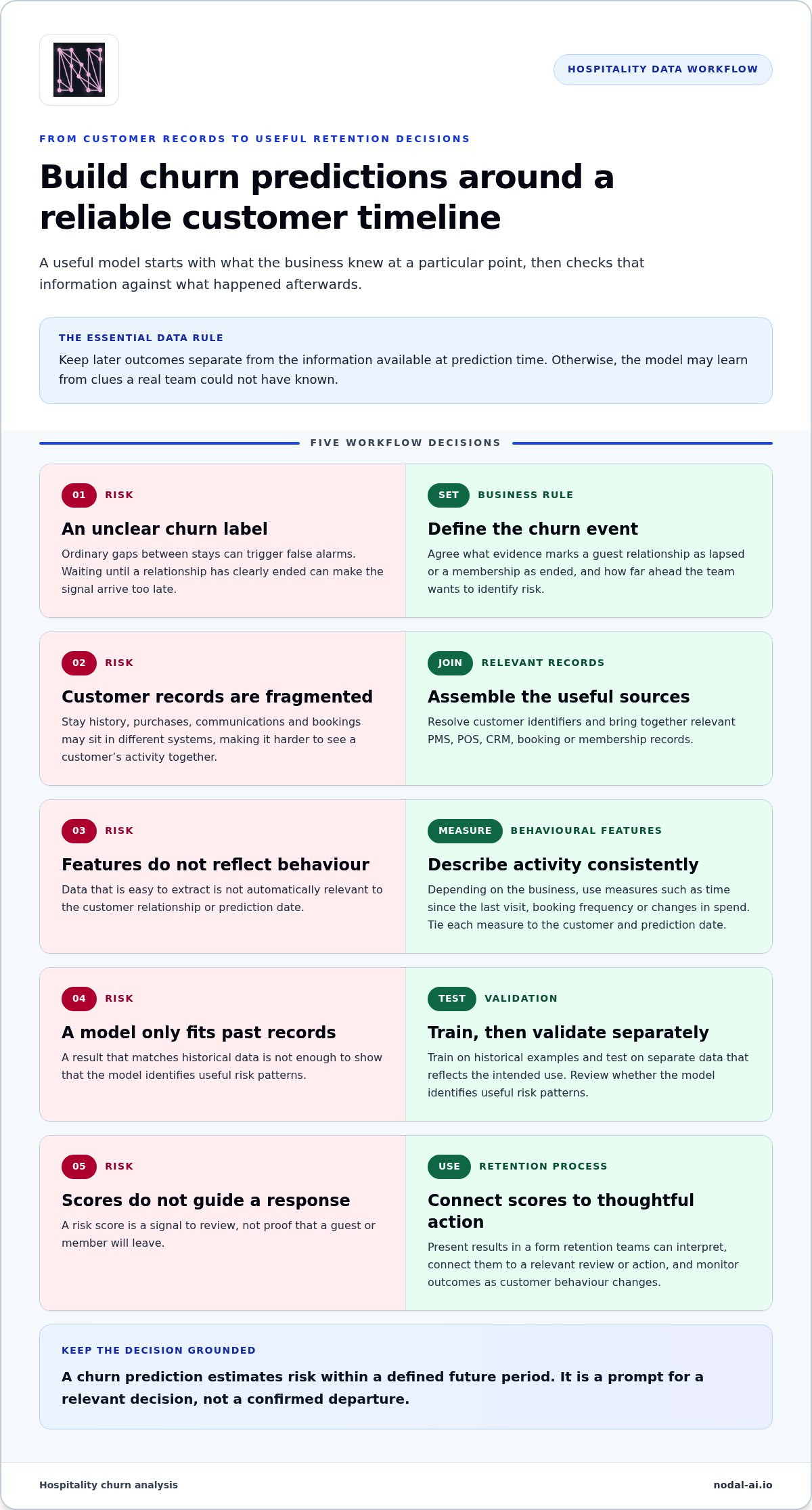
A useful model starts with a reliable timeline, not a complicated algorithm. For churn prediction using machine learning, build a dataset that shows what the business knew about each customer at a particular point, then compare that information with what happened afterwards. This makes predictions easier to test and more relevant to retention decisions.
- Define the churn event. Set the business rule and prediction horizon. For example, decide what evidence marks a membership as ended or a guest relationship as lapsed, and how far ahead the team wants to identify risk.
- Assemble relevant records. Bring together customer identifiers and interactions from the systems that hold useful information. Depending on the business, these might include PMS, POS, CRM, booking or membership records.
- Prepare behavioural features. Create consistent measures from the data, such as time since the last visit, booking frequency or changes in spend. Keep the measures tied to the customer and prediction date.
- Train and validate the model. Train on historical examples, then test on separate data that reflects the intended use. Review whether the model identifies useful risk patterns, not just whether it fits past records.
- Operationalise the results. Make risk scores available in a form retention teams can interpret, then connect them to a relevant review or action. Monitor outcomes and revisit the workflow as customer behaviour changes.
Prepare customer records and define a prediction window
First, resolve customer identifiers so interactions belonging to the same person or account can be analysed together. A PMS may hold stay history, while a CRM contains communications and a POS records purchases. Use only sources relevant to the question. Label historical outcomes using the agreed churn definition, and set a consistent prediction point for each record. Keep later outcomes separate from the information available at that point. Otherwise, the model may learn from clues a real team could not have known when making a prediction.
Select signals that reflect customer behaviour
Choose features for their connection to the prediction question, not simply because they are easy to extract. Recency, visit or booking frequency, spend and engagement can help describe behaviour where the business captures them. Add context where it changes the meaning: a quiet period at one property may reflect a different pattern from the same gap at another, while membership activity has its own rhythm. Research into AI adoption in hospitality provides broader context for applying these methods in the sector.
Time-aware validation matters because a churn model must predict future behaviour from past information, not learn from events that occurred later. Use earlier periods to train and later periods to test, preserving the order in which data would become available. This can show whether patterns hold as seasons and customer behaviour shift. A connected view of relevant hospitality data supports this preparation. See Nodal AI’s analytics capabilities as part of a wider workflow.
Which churn models and evaluation measures should you compare?
The right model isn’t automatically the most complex one. In churn prediction using machine learning, compare approaches against the decision your retention team needs to make: which customers should it review, and how many can it act on? A useful comparison considers model performance alongside transparency, data readiness and the practical consequences of incorrect predictions.
Match model complexity to the decision the team needs to make
Begin with logistic regression as an interpretable baseline. It can show how input features relate to estimated churn risk, although its usefulness depends on the data and how the relationships are represented. A decision tree offers a rule-based view of how the model separates cases, but a large tree can become difficult to follow. Gradient-boosted trees combine multiple trees and can capture more complex patterns, with added demands for explanation and maintenance.
Evaluate risk rankings, not accuracy in isolation
Accuracy measures the share of predictions that are correct overall. It can look strong even when a model misses customers who churn, particularly if retained customers outnumber churned customers. Examine the errors directly. A confusion matrix groups predictions into correctly flagged churn risks, correctly identified retained customers, missed churn cases and customers flagged as at risk who don’t churn.
Precision asks: among the customers flagged as at risk, how many actually churn? Higher precision can help a team avoid spending limited time on unnecessary interventions. Recall asks: of all customers who churn, how many did the model identify? Higher recall can reduce missed risks, but may create more follow-up work. The right balance depends on the team’s capacity and the purpose of the intervention.
Also assess whether the model ranks customers meaningfully. Ranking quality asks whether those who churn tend to appear higher on the risk list than those who stay. Probability calibration asks a different question: when the model assigns a particular risk probability, does that estimate correspond to outcomes at a similar rate across comparable cases? A useful ranking may support prioritisation even if probability estimates need calibration before they guide decisions.
The best risk threshold depends on the cost of acting, the impact of missed churn and the team’s capacity to follow up, so set it around the retention decision rather than choosing a default cut-off. Compare results at thresholds the team could realistically use, then review how many customers would be flagged and what kinds of errors each choice creates.
How to turn churn predictions into a practical retention process
A risk score becomes useful when it helps a team decide what to review and what to do next. Treat predictions from churn prediction using machine learning as prioritisation signals, not proof that a particular guest or member will leave. Add customer context, choose an appropriate response, then measure what follows.
- Rank and review risk. Use scores to create a manageable list, then check whether the data and customer context support follow-up.
- Group customers by need and value. Consider risk alongside relationship stage, value and recent behaviour rather than applying one rule to everyone.
- Choose a suitable action. Match the response to a plausible reason for disengagement, using the customer’s history to make outreach relevant.
- Measure the outcome. Track whether customers return, renew or otherwise meet the business’s chosen retention measure, and compare results with a reasonable baseline.
Translate scores into useful customer segments
Risk alone doesn’t tell a team where to focus. Combining it with customer context can distinguish high-risk, high-value relationships from cases where an intervention may have lower business value. For example, a membership team might prioritise a long-standing member with declining engagement for a personal check-in, while reviewing a newer member’s activity before choosing an offer. These are prompts for thoughtful review, not automatic decisions about individuals.
Design the response around the likely need. A member who appears less engaged may benefit from a relevant reminder or conversation, while a guest whose travel pattern has changed may not need an incentive at all. For hospitality venues seeking practical retention tools, digital loyalty platforms like stmpr.io replace paper stamp cards with digital passes for Apple and Google Wallet to encourage repeat visits. Consider the practical guidance in your customer retention strategies article when shaping these interventions. Keep actions appropriate to the relationship, and record which segment received which response so the team can interpret results later.
Monitor model quality and commercial relevance over time
Customer behaviour and business conditions shift. Review whether source data, churn definitions or activity patterns have changed, and check that scores still help teams identify useful cases. Gather feedback from staff who review the segments: they may spot missing context, confusing labels or repeated false alarms. Use that feedback to refine the definitions and future analysis, rather than treating the initial model as final.
Measure both prediction quality and business outcomes. Track indicators that fit the model, such as whether higher-risk customers are identified usefully, alongside retention measures such as renewal or return activity and customer value. Compare customers who received an intervention with a suitable baseline or comparison group where possible. A difference in outcomes alone doesn’t prove the intervention caused it, since customers may differ in other ways. Use the comparison to guide learning, then refine the segment, action or measurement approach.
Make the process repeatable: review the risk list, document the action, capture the outcome and feed what the team learns into the next cycle. That turns prediction into a disciplined retention workflow, with clear signals and decisions that can be assessed over time.
How Nodal AI can support hospitality churn analysis
Churn analysis depends on seeing enough of the customer relationship to ask useful questions. For hospitality teams, that information may sit across operational, booking and customer systems, making it difficult to connect activity into a coherent view. Nodal AI’s modular analytics platform consolidates fragmented hospitality data to support commercial, customer and operational analysis.
This shared view can help teams investigate patterns such as changes in guest behaviour, membership engagement or customer value. It doesn’t confirm that a person will leave or guarantee a retention outcome. Instead, it gives teams a clearer foundation for exploring where risk may be emerging and what further analysis could inform a decision.
Connect fragmented systems to a clearer customer view
Relevant records can come from property management systems (PMS), point-of-sale (POS) platforms, customer relationship management (CRM) tools and booking systems. Nodal AI connects data from systems including Mews, Oracle OPERA, Revinate and HubSpot. Which sources matter depends on the question: a team investigating membership engagement may focus on member interactions, while guest lifecycle analysis may draw on booking and stay activity.
Bringing relevant records together helps teams interpret signals in context, rather than treating each system’s view as the whole relationship. This is the practical value of the Nodal Platform’s data consolidation: it supports a connected foundation for customer and commercial analysis, while helping teams examine how activity across touchpoints relates to their business question.
Use commercial context to guide the next decision
A consolidated view is a starting point, not an intervention by itself. Customer journey mapping can help teams examine how interactions unfold, while AI-driven audience segmentation and predictive modelling support analysis of relevant customer groups and emerging patterns. The work can be shaped around hospitality questions, such as which member groups show changing engagement or how guest activity relates to customer value. These capabilities inform investigation and prioritisation, not guaranteed churn reduction.
Keep the analysis tied to a decision. If a membership team wants to understand emerging risk, it can review relevant engagement and value patterns, then decide whether a segment merits further attention. For guest relationships, teams can explore how booking and stay behaviour differs across customer groups. This commercial context helps prevent a score or segment from becoming a decision on its own. Predictive modelling sits within the wider analytics workflow, alongside the definitions, customer context and follow-up process that give its outputs meaning.
Consolidated data can help your team move from scattered records to clearer questions about retention, guest value and member behaviour. Explore Nodal AI’s hospitality analytics platform.
Make your next retention decision a more informed one
Choose one customer relationship question your team wants to investigate, then agree what a useful answer would help you decide. A focused starting point can reveal where definitions, data or team processes need attention before analysis expands. Give the work a clear owner, and set a review point to assess whether the findings are useful in practice.
Over time, churn prediction using machine learning can become part of a wider habit of learning from customer behaviour, provided teams keep their assumptions visible and revisit them as business priorities change. The aim isn’t to let a score make the decision. It’s to give people a clearer basis for asking better questions and choosing where to focus their judgement.
Start with a question that matters to your business, and build from there. Each thoughtful step can bring greater clarity to the decisions that support lasting customer relationships.
Frequently Asked Questions
What is churn prediction using machine learning?
Churn prediction using machine learning estimates how likely a customer is to stop engaging with a hospitality business, based on patterns in historical data. It indicates risk, not certainty: a high-risk guest may still return. For example, a spa could use a customer’s treatment history and booking interval to flag a possible lapse in visits, then review whether a timely, relevant invitation makes sense.
Which machine learning model is best for churn prediction?
There isn’t one best model for every churn project. Logistic regression can provide a useful, relatively transparent starting point, while decision trees offer rule-based splits and more complex methods can capture less straightforward patterns. Compare models using the same data and business objective. Consider whether staff can interpret the output, whether the data supports the method and whether the organisation can maintain it as systems and customer behaviour evolve.
How do you measure the accuracy of a churn prediction model?
Don’t rely on accuracy alone, especially if the evaluation data contains far more retained customers than churned ones. Check precision, which shows how many flagged customers actually churn, and recall, which shows how many churned customers were identified. Review a confusion matrix to see both missed risks and unnecessary alerts. Validate on data from a later period than the training data to test how the model handles future cases.
Can machine learning predict when a customer will churn?
Most churn models estimate risk over a defined future period or rank customers by relative likelihood; they don’t reliably identify an exact departure date. A model might flag a restaurant loyalty member whose visits are becoming less frequent, but it can’t know whether that person has decided to stop visiting. Use the result to guide timely review, and set the prediction period to match the business’s customer cycle and intended action.
What data is needed for customer churn prediction?
Start with a clear definition of which customer relationship and outcome count as churn. Then assemble historical interactions that help describe behaviour, such as bookings, visits, renewals or relevant communications, alongside transaction records where available. Include dates and consistent customer identifiers so events can be placed in sequence and linked to the right person or account. Use data that relates to the prediction question, rather than collecting fields simply because they exist.
How often should a churn prediction model be updated?
Set the review cadence according to how quickly the business’s data and customer behaviour change. A model used in a fast-moving booking environment may need closer monitoring than one supporting relationships with longer visit cycles. Watch for missing or delayed data, shifts in the kinds of customers being scored, and changes in prediction quality. Reassess the model when these signals or the business’s churn definition change, rather than relying on a fixed schedule alone.
Can churn prediction work with fragmented hospitality data?
Yes, provided relevant records can be connected and interpreted consistently. A hotel might align a guest identifier across its booking and property systems, while a CRM holds separate communication history. Resolve duplicates and account for cases where one person uses more than one identifier. If records can’t be matched reliably, the model may treat one customer as several, weakening the behavioural picture and making its risk estimates harder to use.


