

A single confident number can make a marketing forecast look precise while hiding the assumptions behind it. Learning how to forecast marketing performance means building a decision model, not simply extending last month’s results into the future.
Historical reports show what happened, but they cannot tell you what is likely to happen next. When campaign, booking and customer data sit in separate systems, it is harder to connect marketing activity with commercial outcomes. A useful forecast makes its inputs clear, tests more than one possibility and changes when new evidence comes in.
This guide explains how to build a forecast from business goals, connected data and explicit assumptions. You’ll learn how to choose useful metrics, estimate future performance, compare plausible scenarios and update your plan when results or conditions shift. Connecting marketing outcomes with bookings and revenue signals adds commercial context. Nodal AI’s platform brings fragmented data together to support analysis and predictive modelling. The aim is to replace guesswork with a transparent view that helps you make better budget decisions.
Key Takeaways
- Start with the business decision your forecast needs to support, then choose outcomes that make its impact measurable.
- Learn how to forecast marketing performance by matching your method to the quality and depth of your data.
- Separate forecasts from targets, budgets and past reports so each plays a clear role in planning.
- Compare actual results with projections using consistent definitions, then investigate gaps before changing course.
- Bring marketing, booking and customer signals into a more joined-up view to strengthen commercial analysis.
What Does It Mean to Forecast Marketing Performance?
A marketing performance forecast estimates future marketing and business outcomes using historical evidence and explicit assumptions. It helps teams consider what may happen under defined conditions, such as a change in spend, demand or conversion rates. It is a planning tool, not a promise of a particular result.
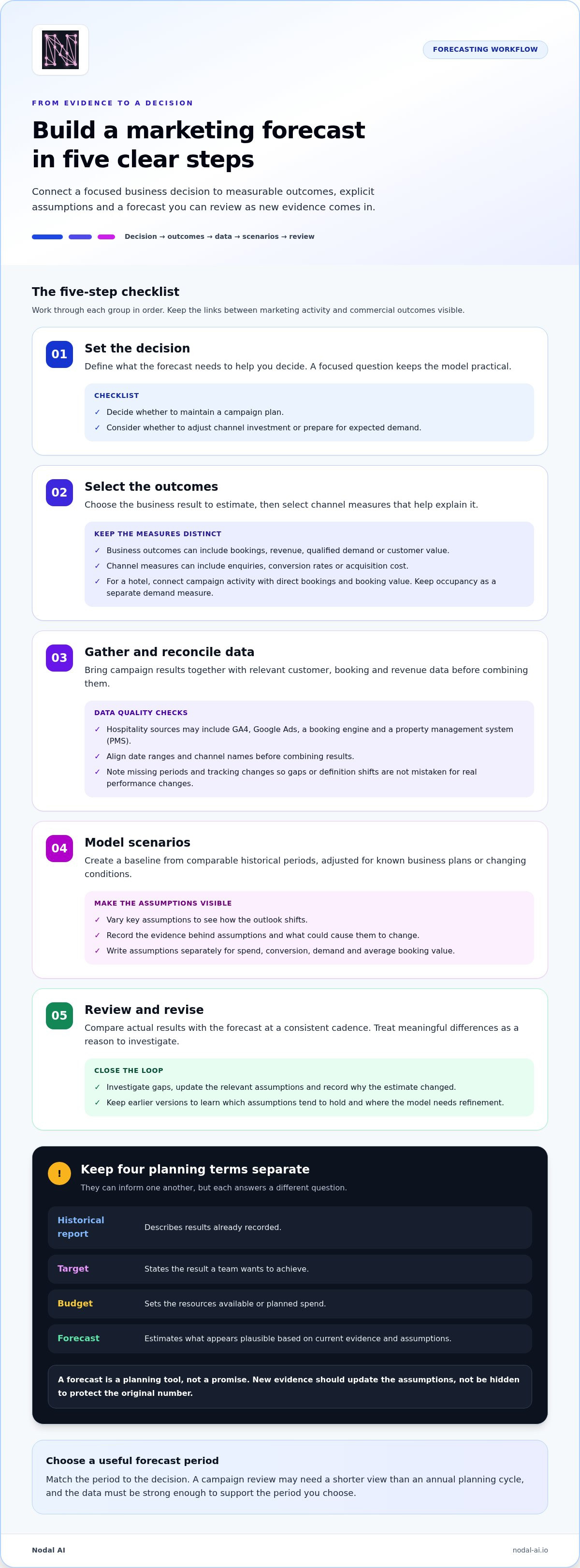
Four planning terms can easily blur together. A historical report describes results already recorded. A target states the result a team wants to achieve. A budget sets the resources available or planned spend. A forecast estimates what appears plausible based on the evidence and assumptions available now. These figures may inform one another, but they answer different questions.
Forecasting also depends on measurement. Teams need to understand how activity relates to outcomes, rather than treating clicks or impressions as commercial results. A foundational overview of Analytics in Marketing can help clarify how analysis supports optimisation and predictive modelling. For a practical forecast, connect the measures being modelled to a specific business decision.
For example, a forecast might estimate how campaign activity could contribute to qualified demand, then show how that demand may translate into bookings or revenue. Acquisition efficiency adds another perspective: are the expected outcomes proportionate to the resources used to generate them? This joined-up view helps teams decide where to focus, rather than simply report channel activity.
Which outcomes should a marketing forecast include?
Start with the business outcome the forecast needs to inform. That might be bookings, revenue, qualified demand or customer value. Then choose campaign and channel measures with a credible relationship to that outcome, such as enquiries, conversion rates or acquisition cost. Keep the relationship visible so that a change in a channel metric has a clear interpretation.
In hospitality, keep occupancy, direct bookings and average booking value separate. They describe different commercial outcomes. A forecast could estimate direct bookings alongside their expected value, while treating occupancy as a wider demand measure. Combining them into one figure can hide whether the plan depends on more bookings, higher-value bookings or a change in overall demand.
Why a forecast is not a promise
A forecast rests on assumptions about demand, spend, conversion and data quality. Record those assumptions beside the estimate, including the evidence behind them and what could cause them to change. A central estimate is one view of a plausible outcome. Targets express ambition, while scenario ranges show how results could differ when assumptions change.
New evidence should update the forecast, not be hidden to protect the original number. If demand shifts, campaign delivery changes or data quality weakens, revise the assumptions and show how the estimate responds. This transparency makes forecasting a practical decision process: teams can see what they believe, what could change and which choices remain sensible under different conditions.
How to Forecast Marketing Performance in Five Clear Steps
To understand how to forecast marketing performance, start with a decision you need to make, then build a clear path from evidence to action. Match the forecast period to that decision. A campaign review may need a shorter view than an annual planning cycle, and the data must be strong enough to support the period you choose.
- Set the decision. Define what the forecast will help you decide, such as whether to maintain a campaign plan, adjust channel investment or prepare for expected demand. A focused question keeps the model practical.
- Select the outcomes. Choose the business result you need to estimate, then identify the channel measures that can help explain it. For a hotel, that could mean connecting campaign activity with direct bookings and booking value, while keeping occupancy as a separate demand measure.
- Gather and reconcile data. Bring campaign spend and performance together with relevant customer, booking and revenue data. For hospitality, sources may include GA4, Google Ads, a booking engine and a property management system (PMS). Align date ranges and channel names before combining results. Note missing periods and tracking changes so that gaps or definition shifts do not look like real performance changes.
- Model scenarios. Establish a baseline from comparable historical periods, adjusted for known business plans or changes in conditions. Then vary key assumptions to see how the outlook shifts. This shows decision-makers what the result depends on, rather than hiding uncertainty inside a single figure.
- Review and revise. Compare actual results with the forecast at a consistent cadence. Investigate meaningful differences, update the relevant assumptions and record why the estimate changed. Keep earlier versions so the team can learn which assumptions tend to hold and where the model needs refinement.
Turn assumptions into a forecast you can explain
Write assumptions separately for spend, conversion, demand and average booking value. This makes it easier to adjust one input without quietly changing the others. Transparent assumptions make a forecast easier to challenge and update. For the baseline, use historical periods that are genuinely comparable, and account for known plans such as changes to campaign timing or available inventory.
Illustrative example, not a benchmark: suppose a hotel uses an assumed 1,000 relevant website visits, a 2% booking conversion rate and an average booking value of £200. The simple calculation gives 20 bookings and £4,000 in booking value. These figures are examples only. A real forecast should use the business’s own evidence, explain whether booking value is gross or net, and account for the time between marketing activity and booking.
If reconciling separate sources is slowing the process, connected data can provide a clearer base for analysis. The Nodal Platform’s connected data capabilities bring relevant marketing, booking and commercial signals into a more joined-up view.
Which Forecasting Method Fits Your Marketing Data?
The right way to forecast marketing performance depends on the decision you need to make, the evidence available and how far ahead you’re looking. A simple method can be more useful than a complex model when data is limited or the forecast needs to be easy to explain. Use this comparison to find a sensible starting point.
| Method | Best suited to | Strength | Limitation | Practical use |
|---|---|---|---|---|
| Historical trend extrapolation | Consistent data and relatively stable patterns | Quick to build and easy to explain | Can carry past conditions forward even when they’ve changed | Estimate near-term bookings from comparable periods |
| Driver-based forecasting | Reliable data on factors linked to outcomes | Makes relationships and assumptions visible | Depends on selecting relevant drivers and estimating their effects | Model how spend, demand and conversion could shape revenue |
| Predictive modelling | Connected data with multiple signals or complex patterns | Can analyse interactions across a broader set of inputs | Can be harder to interpret and relies on sound data | Explore how customer, booking and external demand signals relate to future outcomes |
When is a simple trend forecast enough?
Trend extrapolation is a useful starting point when the pattern is stable, periods are comparable and definitions have stayed consistent. It offers a clear baseline without requiring a complex model. But past performance alone can miss changes in demand, channel mix or business conditions. For example, a hotel comparing bookings with the same period last year may find that the event calendar has changed, making the earlier period an imperfect guide to current demand.
Before using a trend, check whether the historical period reflects the conditions you expect ahead. If it does not, treat it as a reference point rather than a complete forecast, and adjust your approach to account for the difference.
When should you use driver-based or predictive models?
Driver-based forecasting is useful when you can define plausible links between inputs and outcomes, such as how spend and demand may influence visits, bookings and average booking value. Predictive modelling can help analyse multiple signals and less obvious patterns, provided the underlying data is suitable. For more on model approaches, see predictive modelling methods.
Keep forecasting distinct from attribution. A forecast estimates future outcomes; attribution analyses how credit for observed outcomes is assigned across marketing touchpoints. The guide to marketing attribution explores that measurement question. The two can inform planning, but they answer different questions.
How to Test, Update and Use a Marketing Forecast
A forecast becomes useful when you compare it with what actually happened and use the difference to make a better decision. Review results by period, channel and business outcome, keeping metric definitions consistent. If one report counts bookings by booking date and another by campaign interaction date, their totals may differ because of timing, not performance.
Forecast accuracy improves through measured review, not certainty at the outset. Set a regular review point that suits the planning cycle, then record the forecast version, actual result and explanation for any meaningful gap. This creates a clear record of what changed and why.
How can you assess forecast accuracy?
Choose an error measure that makes sense for the outcome. Mean absolute error (MAE), for example, is the average size of the difference between forecast and actual results, expressed in the same units. If a forecast estimates bookings, MAE shows the typical number of bookings by which it missed. Assess bookings and revenue separately rather than combining unlike measures into one score.
Look at direction as well as size. If actual bookings repeatedly exceed the forecast, the model may be underestimating demand; if results regularly fall short, assumptions may be too optimistic. One successful period does not prove a model is reliable. Compare performance across multiple periods and relevant channels, and check whether a strong overall score hides larger errors in a commercially important area.
Investigate the gap before changing the plan
Trace a material variance to its likely source. Check whether assumptions about demand, conversion or spend still hold. Then review data quality, tracking changes and campaign delivery. A result can miss the forecast because the model was off, but it can also reflect a real shift in conditions or incomplete data. Separate these causes before changing inputs, so a temporary reporting issue does not trigger an unnecessary budget move.
Keep a short record of the variance, the evidence reviewed and the resulting change. Clear ownership of metrics and dependable definitions support this process. A practical data governance framework can help teams manage shared inputs and reduce confusion between systems.
Turn forecast changes into budget decisions
Use scenarios to compare choices, not to treat one estimate as an instruction. If demand is softer than expected, model how different allocation options could affect bookings and revenue before committing to a change. If a channel is performing differently, test whether the gap is likely to persist and whether the business outcome moves with it. Then make the next decision using the latest evidence, while preserving earlier forecast versions for comparison.
Connected reporting can bring marketing measures and commercial outcomes into the same review. Explore how connected marketing data supports performance analysis when forecast inputs span separate systems.
How Connected Marketing Intelligence Supports Better Forecasts
Forecasts lose commercial context when campaign results, customer behaviour, bookings and revenue sit in separate systems. A marketing platform may show clicks or conversions, while a booking system records reservations and a property management system (PMS) holds stay information. Without a consistent way to connect these views, it is difficult to trace how marketing activity relates to business outcomes or tell whether a change reflects campaign performance, demand or gaps in the data.
That connection is central to how to forecast marketing performance with more useful business context. The Nodal Platform connects fragmented marketing, customer, booking and commercial data, then brings relevant analytics modules together to support customer journey analysis, predictive modelling and automated reporting. Explore the Nodal Platform features to see how connected data and analytics support a joined-up view.
Connect marketing signals to hospitality outcomes
For a hospitality forecast, relevant inputs might include GA4 website activity, Google Ads campaign results, booking engine reservations and PMS data. Together, these sources can help link marketing interactions with bookings and commercial outcomes. External signals, such as weather, flight demand, tourism trends and local events, can add context to changes in demand. They do not determine what will happen, but they can help explain why a forecast may need to account for conditions beyond campaign performance.
The value comes from assessing the evidence together. For example, a rise in website visits may not translate into more bookings if demand patterns have shifted or the booking journey has changed. Combining sources gives teams more context for testing assumptions and comparing plausible outcomes. It also helps distinguish what the data shows from what the forecast still assumes.
From forecast insight to a clearer next step
Connected data gives teams a stronger foundation for reviewing forecast performance. Automated reporting can bring relevant measures together, while growth recommendations can help surface areas for further analysis. These capabilities support decision-making, but they do not make future results certain. Teams still need to interpret the evidence, review assumptions and decide how to respond.
Ovolo Hotels provides a specific example of reported outcomes: acquisition costs fell by 15.3% and ROAS increased by 24.5%. The same case also reported a 20% increase in paid search revenue, a 13.8% increase in bookings, a 5.5% increase in average booking value and a 3.6% reduction in overall spend. These figures describe Ovolo Hotels’ reported results, not a forecast or a guaranteed outcome for other businesses. They show why connecting marketing measures with booking and revenue signals is useful when evaluating commercial performance.
A clearer view of connected evidence can help your team assess assumptions, compare scenarios and decide what to review next.
Make Your Next Forecast a Better Decision Tool
Your next forecast does not need to answer every marketing question. Start with one commercial decision that matters, and make the information behind it clear enough for your team to act on. That focus can turn how to forecast marketing performance from a reporting exercise into a practical planning habit.
Choose a decision you’ll face soon, then note which business outcome would inform it and what evidence you’d need to assess the options. Make ownership clear: who maintains the inputs, who reviews changes and when the forecast should be revisited. A defined next step keeps analysis connected to action.
As your data and questions evolve, connected marketing intelligence can help bring the right signals into view. Build from a focused decision, learn from each review and give your team a clearer basis for its next move. Explore how the Nodal Platform can connect marketing performance data and support your forecasting work.
Frequently Asked Questions
How do you forecast marketing performance?
To forecast marketing performance, connect a business outcome to the marketing activity that may influence it, then estimate the outcome using relevant evidence. For example, a hotel could track campaign visits through to confirmed bookings, separating completed reservations from cancellations. This makes the forecast more commercially meaningful than projecting traffic alone. Record how each measure is calculated so later comparisons use the same basis.
What data do you need to forecast marketing performance?
You need data relevant to the outcome you’re forecasting, along with enough context to interpret it. For bookings, useful details can include booking date, stay date, booking status, source and value. Campaign data should use consistent channel names and dates. Check whether revenue is recorded gross or net, and whether cancellations or duplicate transactions appear in the totals. These details can materially change what a forecast represents.
How far ahead should a marketing performance forecast look?
Choose a forecast horizon that matches the decision and the evidence available. A short-term operational decision may rely on recent booking pace, while longer-range planning may need broader demand patterns and business plans. As the horizon extends, uncertainty usually increases, so avoid presenting distant estimates with the same detail as near-term ones. Refresh the outlook as new information arrives, especially when booking behaviour or market conditions change.
What is the difference between a marketing forecast and a marketing target?
A forecast estimates what may happen based on current evidence, while a target describes the result a team intends to achieve. Comparing them shows the distance between expected performance and ambition. For example, if the forecast falls below the target, the gap can prompt a review of assumptions, resources or plans. Do not close it by changing the forecast number without new evidence.
Can AI predict marketing campaign performance accurately?
AI can analyse patterns across marketing and commercial data, but its estimates are only as useful as the inputs and assumptions behind them. A model trained on outdated tracking or unusual past conditions may produce misleading projections. Test it against periods it was not built on, check whether its predictions remain relevant as conditions change, and use human judgement to interpret unusual events that the data may not explain.
How do you measure whether a marketing forecast is accurate?
Compare forecast values with actual results for the same outcome and period, then assess the size and direction of the differences. For a deeper check, back-test the method: build a forecast using earlier data and compare it with a later period that was not used to create it. Repeat this across different periods and outcomes. A close match once is encouraging, but it is not enough to establish consistent performance.
What should you do when actual marketing results differ from the forecast?
First identify whether the difference comes from a reporting issue, a changed assumption or a genuine shift in performance. For instance, a booking feed arriving late may make current results look weaker than they are. Once you’ve checked the data, update the relevant input, note the reason and consider whether the change affects a live decision. Keep a record so the same cause is easier to recognise next time.


