

What if your marketing data could do more than explain last month’s results? The right ai marketing analytics platform can bring booking, guest, channel and revenue signals into a clearer commercial view. If you’re weighing up how to connect your data and make better decisions, start with what the platform can help you understand, not just what it can report.
Hospitality teams often work across disconnected systems and spend valuable time stitching reports together. Even when the numbers are available, it can be difficult to see what changed, which channels are driving valuable direct bookings or where to focus next. A useful view connects performance across channels, properties and guest segments without creating more manual work.
This guide explains how to evaluate an AI marketing analytics platform against those practical needs. You’ll learn what to look for in data connections, attribution, customer journey mapping, automated reporting and growth recommendations. You’ll also see how to assess whether analytics can turn fragmented information into actionable opportunities, helping your team move from reviewing results to making clearer commercial decisions.
Key Takeaways
- Choose an ai marketing analytics platform for the commercial questions it can help answer, not just the reports it can produce.
- Trace how data moves from hospitality systems through analysis to a decision your team can act on.
- Compare platforms on hospitality relevance, analytical depth, integration fit and how well they support your reporting workflow.
- Set a focused first use case, assign clear ownership and define the outcome before connecting more data.
- See how Nodal Platform brings marketing performance, customer journeys and commercial insight together to help assess direct booking contribution.
Why an AI marketing analytics platform matters when hospitality data is fragmented
Hospitality performance depends on connected decisions, but the evidence often sits in separate systems. Campaign reports show clicks and spend. Booking records show reservations. Guest and revenue data add context, but rarely appear together in a ready-to-use view. Teams can spend hours reconciling spreadsheets and still struggle to explain what changed or where to act.
An ai marketing analytics platform brings relevant sources together and analyses them in relation to commercial questions. Its value isn’t simply putting more charts on a screen. It helps teams understand how marketing activity relates to bookings and business outcomes, spot patterns and decide what to investigate next.
What does an AI marketing analytics platform do?
An AI marketing analytics platform combines marketing and business data, applies analytical methods to identify patterns, and presents findings that support better decisions. In practice, this means consolidating relevant data, analysing it in context and helping people decide what to do with the results.
Consolidation creates a more joined-up view of information from sources such as campaign, booking, guest and revenue systems. Analysis can compare performance, trace customer journeys or examine how channels contribute to bookings. Decision support turns those findings into clearer reporting or recommendations for the team to consider. The platform informs action, while people interpret the results in the context of the business.
Why hospitality teams need a commercial view
Bookings, occupancy, guest behaviour and marketing activity influence one another. A hotel campaign may generate website visits, but visits alone don’t show whether people booked directly, chose a particular property or generated valuable stays. Looking only at bookings leaves a different gap: the team sees the outcome without understanding which campaign or guest journey may have contributed.
The same principle applies across hospitality, although the questions vary. A restaurant might compare promotion activity with reservations and spending patterns. A serviced apartment operator could examine how channel activity relates to bookings across properties. A spa might want to understand which guest groups respond to an offer. In each case, channel results become more useful when viewed alongside relevant business outcomes.
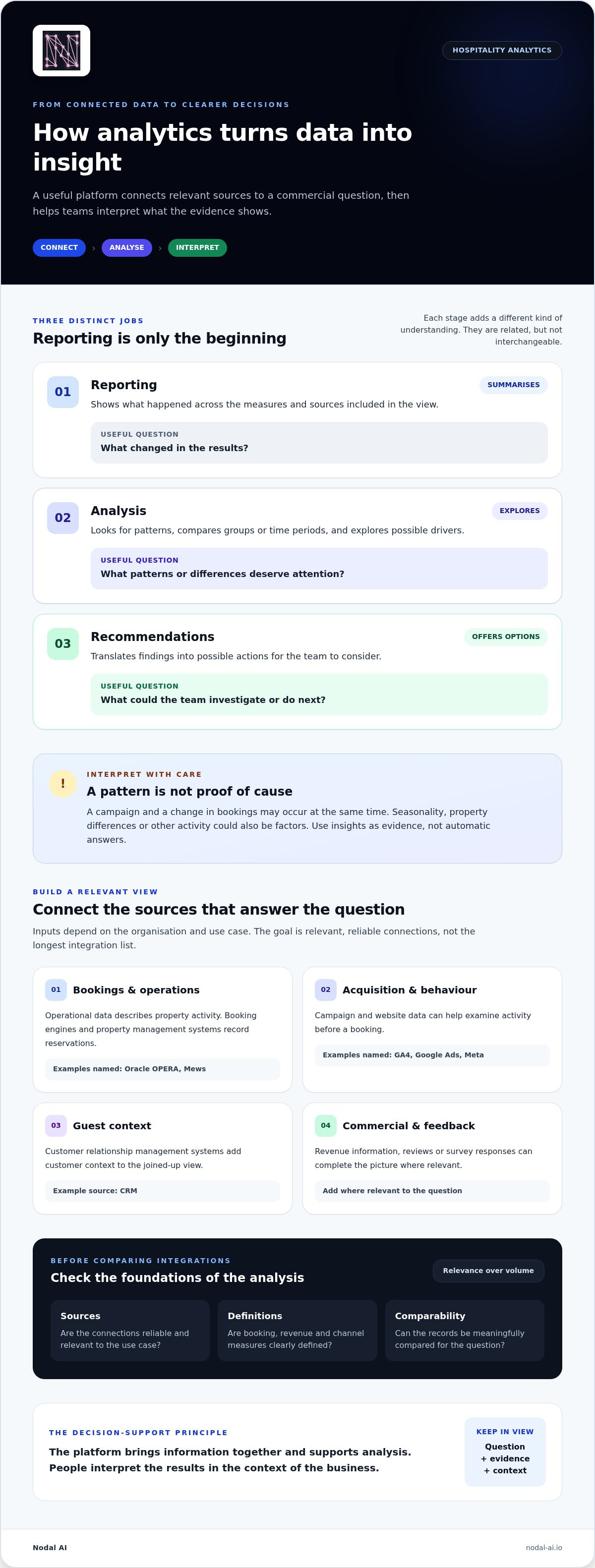
Use insights as evidence, not automatic answers. Bookings may change at the same time as a campaign, but seasonality, property differences or other activity could also be factors. Reliable interpretation depends on relevant data, a clearly framed question and a sound understanding of how the measures are defined. This helps teams move beyond reporting activity to assessing commercial contribution.
How an AI marketing analytics platform turns connected data into insight
Connected data is the starting point, not the answer. An ai marketing analytics platform can help hospitality teams move from separate records to a clearer view of commercial performance. The value comes from linking useful sources to a business question, then interpreting the results with care.
Which hospitality data sources can contribute?
Relevant inputs depend on the organisation and use case. Operational data can describe property activity—such as physical footfall and visitor traffic tracked with Smart Urban Sensing—while booking engines and property management systems (PMS) record reservations. Acquisition sources include GA4 and advertising platforms; customer relationship management (CRM) systems add customer context. Commercial records and feedback, including revenue information, reviews or survey responses, can complete the picture where relevant.
Hospitality systems include Oracle OPERA, Mews, GA4, Google Ads, and Meta. Their relevance depends on the organisation’s setup and the question being investigated. Assess integrations against the data you need, how it is defined and whether it can support the intended analysis. A long integration list is less useful than reliable connections to the sources that matter for your use case.
From reporting to analysis and recommendations
Reporting summarises what happened. Analysis looks for patterns, compares groups or time periods, and explores possible drivers. Recommendations translate those findings into options for action. These steps are related, but they aren’t interchangeable: a pattern can point to a useful question without proving what caused the result.
Data consolidation brings relevant information from separate sources into a shared view for commercial analysis.
A practical workflow moves through these stages:
- Connect relevant sources. Bring together campaign activity, website behaviour and booking records for a hotel, for example, so the team can examine more than clicks alone.
- Prepare the measures. Align definitions such as booking, revenue and channel, then check that records can be meaningfully compared.
- Analyse the question. Segmentation groups results by attributes such as property, channel or guest type. Journey analysis examines the sequence of interactions before a booking. Attribution estimates how credit for that outcome is assigned across touchpoints. Each method answers a different question. For a deeper explanation, see marketing attribution methods.
- Consider what may come next. Predictive modelling uses available patterns to inform planning, such as assessing expected demand. It can support decisions, but it can’t guarantee future outcomes.
- Choose an action to test. A team might investigate a channel with rising visits but weaker booking contribution, then decide whether to adjust its measurement or marketing priorities.
For a restaurant, the relevant combination might be promotion activity, reservations and commercial results. For a hotel group, it could be guest journeys and booking performance across properties. Explore connected analytics features to see how a joined-up view can support clearer hospitality decisions.
How to compare AI marketing analytics platforms without buying into the hype
A platform should reduce the effort between a commercial question and a useful answer. If it adds another login, more disconnected reports and manual reconciliation, AI features won’t solve the underlying problem. Compare how each option fits your data, hospitality operation and decision-making workflow rather than judging it by the length of its feature list.
Which evaluation criteria reveal real platform fit?
Use the same questions to assess each platform. Focus on whether it supports the decisions your team needs to make and simplifies work rather than adding another layer.
Data fit: Can it connect the operational, booking, marketing and customer sources relevant to your use case? Consider how it handles the data you rely on, not just the number of integrations named in a product overview.
Hospitality context: Can teams examine performance by channel, property and guest segment? A group managing several hotels may need to distinguish property-level patterns, while a restaurant group may prioritise comparisons across venues.
Analytical depth: Look for support for the analysis your questions require, such as journey mapping, multi-touch attribution or predictive modelling. Check that each method is explained clearly and suits the decision at hand.
Decision usefulness: Do reports and recommendations address defined commercial questions, or simply add more dashboards? Outputs should help teams see what merits attention and why.
Modularity and workflow: Can the platform support a focused use case without requiring teams to adopt every capability at once? Consider whether reporting fits existing routines and reduces repeated manual preparation.
During a Nodal Platform walkthrough, bring a real question, such as how to compare booking contribution across properties. Follow the process from source data to analysis and final output. This makes unclear definitions, gaps and extra manual steps easier to identify before the platform becomes part of your team’s workflow.
How to assess AI recommendations responsibly
Recommendations are useful only when their context is visible. Look for the evidence behind a suggestion, the measures used and the assumptions that may affect its interpretation. If the platform flags a change in channel performance, your team should be able to see which data informed the finding and what it does not establish.
Keep human judgement in the process. A model may surface a pattern, but hotel teams understand local demand, property differences and operational realities that can change how a result should be read. Treat AI as support for investigation and planning, not as a guarantee of future outcomes.
Separate product claims from demonstrated results. Establish whether an example describes a measured outcome in a specific business context or a general capability. Then consider whether the measurement approach fits your own commercial question. Judge a marketing analytics platform’s features by how clearly they support that process, not by AI claims alone.
How to prepare your hospitality team for an analytics platform
A successful analytics project starts with a business question, not a long list of systems to connect. Before choosing an ai marketing analytics platform, agree what your team needs to understand, who will use the insight and which decision it should inform. This focus helps prevent a new platform from becoming another place to check reports.
Define the commercial questions before connecting data
Start with questions that matter to your operation. Are some booking channels contributing more valuable stays? How does demand differ by period or property? Which guest segments respond to a promotion? Which part of the booking journey needs closer attention? Make the first question specific enough to guide the data and analysis required.
Next, identify who will interpret and act on the findings. Marketing may own campaign performance, while revenue teams consider booking value and demand. Property or venue teams can add operational context. If the question concerns the steps guests take before booking, customer journey mapping can help define which interactions the team wants to examine. Shared ownership keeps insight connected to action.
Map data sources, ownership, and first use cases
Make a simple inventory of the systems that could answer the chosen question. Depending on the organisation, this might include a property management system (PMS), point-of-sale (POS) system, customer relationship management (CRM) platform, booking engine, advertising accounts and revenue-management tools. Record who owns each source, what information it contains and which decision it is meant to support. This makes missing context and unclear responsibility easier to spot early.
Then agree what a useful output looks like. A hotel team might compare campaign contribution with bookings for a particular property. A restaurant group could focus on how promotion activity relates to reservations across venues. Define the measures and who will review them before adding more sources.
- Choose one priority question. Select a decision with a clear business owner and a practical reason to investigate it.
- Identify the minimum relevant sources. Include only the data needed to explore that question, and note who is responsible for each source.
- Agree the output and review process. Decide what the team needs to see, how often it will review the insight and who can act on it.
- Refine before expanding. Use the first use case to identify useful additions, then widen the scope as team needs become clearer.
Keep the scope realistic. Let the available systems, the question and the selected modules shape the work, rather than trying to connect everything at once. A modular approach lets hospitality teams prioritise relevant commercial, customer or operational insight. Explore Nodal Platform features to see how modular capabilities can support different analytics needs.
With the question, owners and initial scope defined, your team can plan a focused evaluation of Nodal Platform.
How Nodal Platform connects hospitality marketing data to commercial decisions
Hospitality teams need more than a channel report to understand what marketing contributes. Nodal Platform is a modular intelligence engine that connects fragmented hospitality data to commercial, customer and operational insights. It helps teams relate marketing activity to booking performance, explore direct booking contribution and bring evidence into decisions across properties and guest groups.
A modular platform for hospitality performance questions
Different questions call for different perspectives. Nodal Platform’s modular approach brings together commercial, demand, guest and operational insights, allowing a team to focus on its priorities rather than treating every data source as equally important.
- Commercial insight can help teams examine marketing performance alongside revenue and booking outcomes.
- Demand insight can put performance in context, including external signals such as weather, flight demand, currency movements and local events where relevant data is available.
- Guest insight can help teams understand journeys and use AI-driven audience segmentation to identify guest groups with a stronger likelihood of responding to an offer.
- Operational insight can add property or venue context when teams interpret results and consider next steps.
For example, a hotel group could investigate whether campaign activity is contributing to direct bookings at particular properties while considering demand patterns that may also influence results. A restaurant or spa might focus on which guest segments respond to promotions. The right view depends on the organisation’s question and the data that can inform it. AI can help surface patterns, while teams bring the commercial and local knowledge needed to interpret them.
Evidence and next steps for evaluating Nodal Platform
Evidence matters more than broad promises. In results attributed to Ovolo Hotels, Nodal AI reports a 15.3% reduction in acquisition costs and a 24.5% increase in return on advertising spend (ROAS). The reported results also included a 20% increase in paid search revenue and a 13.8% increase in bookings.
These figures describe a specific client context, not a forecast or guarantee of future performance. Results depend on the organisation, its data, marketing activity and measurement approach. Use the example to examine how performance is assessed, then consider which outcomes matter for your properties and how you would define success.
Bring a practical question to a Nodal Platform demo, such as how to understand direct booking contribution across channels or compare performance by property. Use it to explore how the platform connects relevant data and supports a decision your team needs to make. Keep the conversation grounded in your systems, priorities and intended outputs.
Turn clearer insight into a stronger decision habit
Make commercial insight part of how your hospitality team makes decisions, rather than another report to review. Choose an upcoming decision and agree what evidence would make the choice clearer. That gives an ai marketing analytics platform a practical role: helping people move from uncertainty to a reasoned next step.
As your needs evolve, revisit the questions behind your analytics. A useful view today may prompt a better question tomorrow, perhaps about a different guest group, property or part of the booking journey. Focus on learning and informed decisions, rather than expecting technology to remove the need for judgement.
Nodal Platform brings fragmented data together to support the commercial questions that matter to your hospitality business.
Explore Nodal Platform to connect your data with clearer commercial decisions.
Frequently Asked Questions
Is an AI marketing analytics platform the same as a business intelligence tool?
Not exactly. Business intelligence tools typically help organisations organise and explore data across business functions. An AI marketing analytics platform focuses more specifically on marketing measurement, customer journeys and related commercial questions, with AI-supported analysis where appropriate. There can be overlap, so compare the capabilities you need: a hospitality team may prioritise broad financial reporting, detailed campaign attribution, or both. The right fit depends on the decisions the tool needs to support.
Can an AI marketing analytics platform replace marketing analysts?
No. It can reduce repetitive work, surface patterns and make reporting easier to access, but analysts provide essential interpretation. They can spot when a result reflects a tracking change, a property-specific event or a shift in campaign activity rather than a broader trend. For example, an analyst can investigate why bookings changed before recommending a budget or measurement adjustment. The platform supports expertise; it doesn’t replace commercial judgement or accountability.
What data should a hospitality business prepare before adopting an analytics platform?
Prepare the sources that relate to your first business question, such as booking records, campaign results and customer data. Check that key fields, including booking date, property and channel, are recorded consistently enough to compare. Note how your team defines measures such as a direct booking or a completed stay. Clear definitions help prevent teams from drawing different conclusions from the same report, even when they use the same underlying data.
How should a team judge whether an AI-generated marketing recommendation is useful?
Check whether the recommendation explains its supporting evidence and relates to a decision your team can influence. If it suggests changing a promotion, look for the relevant audience, time period and performance measure, then compare the suggestion with operational context. A practical next step could be testing the idea on a defined campaign and reviewing the result. Treat recommendations as hypotheses to assess, not instructions to follow automatically.
Can an analytics platform help hotels understand direct booking performance?
Yes, if it connects relevant marketing and booking information and makes the measurement approach clear. A hotel could examine how paid search, email or other campaign activity relates to direct reservations, then compare patterns by property or booking period. This gives the team more context than website traffic alone. An ai marketing analytics platform can support that analysis, but teams should still account for how attribution rules assign credit across the guest journey.
Does predictive modelling tell hospitality teams exactly what demand will be?
No. Predictive modelling estimates possible future patterns from available data; it does not provide certainty. A hotel might use it to inform planning for a period when demand could change, then consider the estimate alongside booking pace, local events and operational knowledge. The model’s output is only as useful as its inputs and assumptions. Treat it as one planning signal, revisit it as conditions change and retain human oversight.
How can hospitality teams reduce the manual work involved in marketing reports?
Standardise recurring measures and reporting periods, then automate the steps used to gather and present them where the platform supports it. For example, a marketing team could replace repeated spreadsheet assembly with a shared report covering campaign activity and booking outcomes. Assign an owner to check data quality and decide which reports still inform action. Removing duplicated reports and focusing on decision-ready views can save effort without sacrificing useful scrutiny.


