

Last-touch can give you a clear answer to the wrong question. A lead may discover your brand through search, return via a paid ad and convert after a sales conversation, while each platform credits the journey differently. A lead generation attribution model sets the rules for assigning credit. The model you choose can change what your reports say about marketing performance.
Attribution becomes difficult when lead data is spread across channels and systems. Last-touch reporting is easy to read, but it can hide the interactions that built awareness or moved a prospect closer to becoming a lead. Even a more detailed model shows which touchpoints were recorded, not necessarily which one caused the conversion.
Choose a model based on the decision it needs to support, not its label. This guide compares common approaches, explains their trade-offs and shows how to choose a framework that fits your lead-generation goals and available data. You’ll also learn how to connect marketing activity with lead and revenue outcomes, interpret attribution carefully and use clearer measurement to make informed decisions.
Key Takeaways
- Separate lead creation from qualification, opportunity creation and revenue so each outcome stays clear.
- Choose a lead generation attribution model based on the marketing decision it needs to inform.
- Check for missing, cross-device and offline interactions before treating recorded journeys as complete.
- Set consistent rules for touchpoints, data inputs and review frequency to make comparisons more useful.
- Use attribution alongside lead-stage and revenue metrics to assess channel contribution, not as a standalone budget verdict.
What a Lead Generation Attribution Model Can Tell You
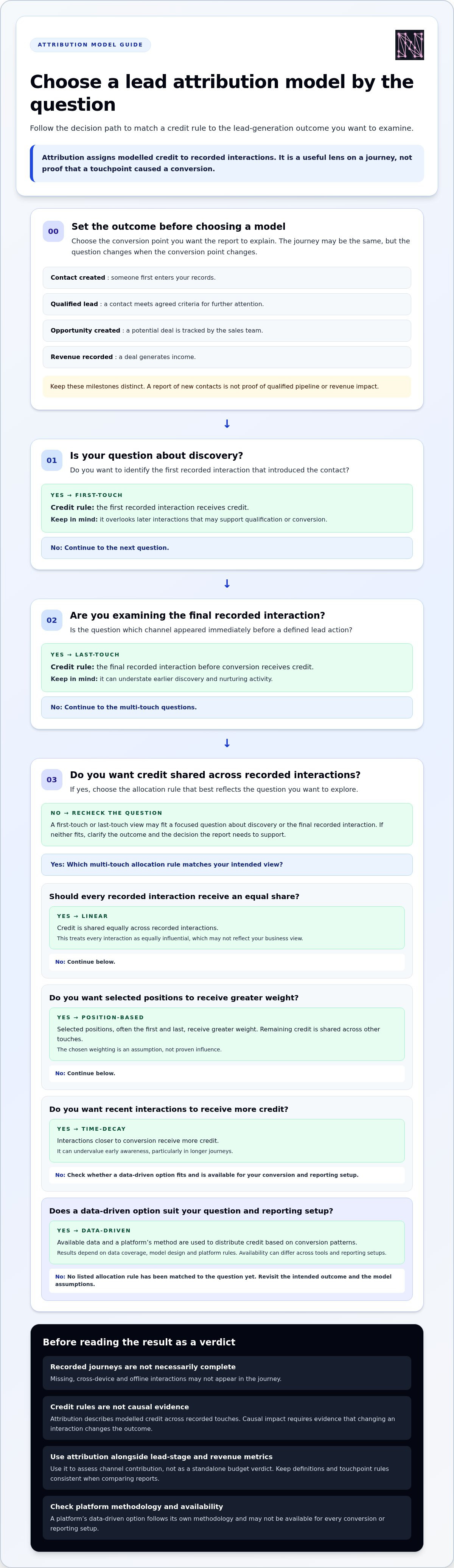
A lead generation attribution model assigns or distributes conversion credit across recorded marketing interactions. It gives teams a consistent way to describe which channels appeared in a journey, but the result depends on what counts as a conversion and how credit is allocated. Define those rules clearly and attribution can help connect marketing activity to outcomes. Leave them vague, and different reports may tell different stories.
Lead generation includes several distinct milestones. A contact is created when someone first enters your records—whether through inbound marketing campaigns or outbound sales platforms like Seasely. A qualified lead meets agreed criteria for further attention. An opportunity represents a potential deal tracked by the sales team, while revenue is recorded when a deal generates income. Each outcome answers a different question. A report of new contacts, for example, is not proof of qualified pipeline or revenue impact.
Example journey, for illustration only: A prospect reads a search article, attends a webinar, clicks a follow-up email and then fills in a contact form. If the conversion is the form submission, the model distributes credit among the recorded interactions before that event. If you are measuring later qualification or opportunity creation, the conversion point changes. The journey is the same, but the question is different.
What does lead attribution measure?
Start by defining the conversion event, then decide which interactions belong in the journey. Is the report about creating a contact, progressing a lead to qualified status, creating a sales opportunity or recording revenue? Agree on what each stage means across marketing and sales, including the criteria for moving between stages. Shared definitions make reports easier to interpret and help teams compare like with like.
Why the model changes the story
Different credit rules can tell different stories about the example journey. A first-touch view highlights the search article as the discovery interaction. A last-touch view gives the follow-up email credit for the form submission. Neither view captures every influence on the prospect, and neither is a complete record of buyer behaviour. Interactions outside the tracked journey may not appear at all.
Attribution assigns modelled credit to recorded interactions; causal impact requires evidence that changing an interaction changes the outcome. Treat a report as a useful lens, not a verdict on what made someone convert. Attribution can help teams ask sharper questions about channel contribution. Keeping lead stages distinct also makes it easier to see whether marketing activity is associated with contact creation, progression, opportunities or revenue.
Compare Lead Generation Attribution Models by the Question They Answer
Each model applies a different rule to recorded interactions. The useful question is not which model sounds most complete, but which view helps you assess a specific lead-generation outcome. Match the model’s assumptions to the decision you need to make.
Model | Credit rule | Useful question | Main limitation
First-touch: Credits the first recorded interaction. | Which channel introduced the contact? | Overlooks later interactions that may support qualification or conversion.
Last-touch: Credits the final recorded interaction before conversion. | Which channel was present immediately before the lead action? | Can understate earlier discovery and nurturing activity.
Linear: Shares credit equally across recorded interactions. | Which touchpoints appeared across the journey? | Treats every interaction as equally influential, whether or not that reflects your business view.
Position-based: Gives greater weight to selected positions, often the first and last, with remaining credit shared across other touches. | How do discovery and conversion interactions compare with the middle of the journey? | The chosen weighting reflects an assumption, not proven influence.
Time-decay: Assigns more credit to interactions closer to conversion. | Which recent touches were associated with a lead action? | Can undervalue early awareness, particularly in longer journeys.
Data-driven: Uses available data and a platform’s method to distribute credit. | Which interactions are associated with conversion patterns in the data? | Results depend on data coverage, model design and platform rules.
When does single-touch attribution help?
First-touch and last-touch are focused views, not full journey summaries. First-touch can help you examine discovery, while last-touch can show the final recorded interaction before a defined conversion. Both are straightforward to explain. Use them to answer those specific questions, but do not treat either as a complete account of the interactions linked to lead qualification, opportunity creation or revenue.
What do multi-touch models reveal?
Linear, position-based and time-decay models distribute credit across multiple interactions, but each does so differently. Linear applies an equal share, position-based prioritises selected points, and time-decay favours more recent touches. These are allocation rules, not causal measurements. A platform’s data-driven option follows its own methodology and may not be available for every conversion or reporting setup. Check the platform’s current documentation before assuming a model is supported. For example, Google Analytics 4 attribution reports offer data-driven attribution and last-click options, while model availability can differ across tools.
No lead generation attribution model is automatically best for every journey or objective. A discovery question may suit first-touch; a question about the final recorded step may suit last-touch. For a broader view, compare a multi-touch model with those focused views and note where the conclusions differ. Keep the conversion event and journey scope consistent, or comparisons may reflect changed settings rather than changed performance.
Teams considering multi-touch approaches can review Nodal AI’s attribution and analytics features as part of a broader measurement approach.
Do Attribution Models Prove Which Marketing Touchpoint Caused a Lead?
No. A lead generation attribution model assigns credit according to its rules or patterns in the data. It can show which recorded interactions were associated with a lead outcome, but it cannot establish that any one interaction caused that outcome. A prospect might have converted because of a recommendation, a sales conversation or a need that arose outside the channels your systems track.
This distinction matters when reports inform investment decisions. If a channel receives credit, that is evidence to investigate its contribution, not proof that removing or increasing it would change lead volume. Causal impact requires a different kind of evidence, such as a well-designed experiment comparing outcomes when marketing exposure changes.
Why can lead attribution data be incomplete?
A journey may cross advertising platforms, analytics tools and a CRM, each recording different details. Someone might research on one device and submit a form on another, speak with sales offline or encounter a campaign without clicking it. Consent choices and platform reporting methods can also affect which interactions are recorded. The resulting gaps can distort the observed journey, though their effect depends on the data and context.
Even recorded data can be difficult to compare if campaign tags are inconsistent, conversion windows differ or teams use different definitions for a qualified lead. A report may then appear to show a performance change when the underlying measurement rules have changed. Keep these issues visible rather than assuming the tracked path is complete.
How should teams interpret modelled credit?
Treat model output as one piece of decision evidence. Document the model, conversion event, journey scope and time window, then keep those settings consistent when comparing periods or channels. If a setting changes, record when and why. This gives colleagues a clear basis for interpreting shifts instead of mistaking a change in methodology for a change in marketing contribution.
Attribution describes how credit is assigned to recorded interactions; it does not prove that those interactions caused the conversion. Reflect that distinction in reporting. Say a channel was associated with lead creation under a stated model, rather than claiming it generated every credited lead on its own.
- Check the data trail: Identify disconnected platforms, missing campaign tags and gaps between marketing records and CRM outcomes.
- Keep definitions stable: Align teams on lead stages and conversion windows before comparing results.
- Seek complementary evidence: Use experiments or other measurement approaches where suitable to test whether changing activity affects outcomes.
Clear assumptions make attribution more useful. Unified marketing and revenue metrics can add context across fragmented data, while analysis of initiatives associated with longer-term revenue and retention can help teams look beyond the initial lead event. Together, these views support better-informed decisions without treating modelled credit as certainty.
How to Choose and Set Up a Lead Generation Attribution Model
Start with the decision you need to make, then build the measurement around it. A lead generation attribution model is useful when its conversion, data and reporting rules support a clear question. Follow this sequence to create a consistent framework from scattered tracking.
Start with the lead outcome and decision
Decide whether you need to understand contact creation, lead qualification, opportunity progression or revenue. These stages have no universal definition, so agree on what each means in your organisation. Then connect the question to an action. For example, identifying which campaigns are associated with qualified leads is more useful when the team knows how it will use that insight.
- Define the decision. Specify what the report should inform, such as comparing channels for lead creation or reviewing activity associated with opportunities.
- Choose the conversion outcome. Name the event being measured, such as a new contact, a qualified lead, an opportunity or recorded revenue. Keep these outcomes separate in reporting.
- Set the journey scope. Decide which interactions count, which channels are included and what time window the report covers. Apply the same scope when comparing results.
- Check your data inputs. Identify the advertising, analytics and CRM records needed to connect interactions with the selected outcome. Note any gaps that could limit interpretation.
- Set a review cadence. Choose regular points to review data quality, assumptions and reporting patterns. Record changes so comparisons remain understandable.
Prepare tracking and review the model
Before comparing channels, align campaign naming, UTM practices, interaction definitions and CRM stages. Use consistent labels so the same campaign is not split across different names, and make sure teams interpret lifecycle stages in the same way. Then check whether your data supports the model you plan to use. A complex approach will not fix missing fields or inconsistent records.
Choose the simplest model that answers the stated question. Document its credit rule, conversion event, time window and known limitations. For example, a first-touch view may suit a discovery question, while a multi-touch approach may offer a broader account of recorded interactions. Treat either as a reporting lens, not proof that a channel caused the outcome.
Review the evidence before changing channel strategy. A shift in reported contribution could reflect new tagging, a different conversion window, changes to CRM definitions or an actual change in marketing activity. Compare like with like and investigate the explanation rather than acting on a single report in isolation. Where possible, bring lead-stage reporting together with revenue and marketing metrics for a clearer view of performance.
For teams working across fragmented marketing data, Nodal AI brings marketing and revenue metrics together to support clearer analysis of performance and initiatives associated with longer-term revenue and retention.
See how Nodal AI approaches measurement
Turn Lead Attribution Insights into Clearer Marketing Decisions
Attribution is valuable when it improves the questions you ask, not when it produces a definitive channel ranking. Use modelled credit as one input alongside lead-stage results, revenue and other relevant marketing metrics. A channel receiving credit for contact creation may look different when you review which leads qualify or progress into opportunities. That difference is a prompt to investigate, not an automatic instruction to move budget.
Build a repeatable attribution review
Make each review a consistent loop. Compare the interactions credited by your model with outcomes at each lead stage, then check the assumptions behind the report. If a channel’s credited contribution and its qualified-lead or revenue results appear misaligned, investigate before drawing conclusions. Look for changes in tracking, campaign activity, lead definitions or the period being compared.
- Review the same outcomes: Keep contact creation, qualification, opportunity creation and revenue distinct, and compare like with like.
- Investigate discrepancies: Check the underlying records and reporting rules before treating a change in credited activity as a performance conclusion.
- Record decisions: Note what the team changed, why it changed and what result it expects to observe.
- Revisit the question: As goals or data change, assess whether the model still supports the decision it was chosen to inform.
This creates a practical feedback loop: review the evidence, investigate the gaps, make a considered decision and return to the same measures. It also helps distinguish a genuine shift in outcomes from a change in reporting assumptions.
Bring fragmented marketing metrics into one view
When channel reports and revenue records sit in separate systems, teams can struggle to compare activity using consistent definitions. Nodal AI’s Unified Metrics brings revenue and marketing metrics into a single view, giving teams shared context for reviewing performance. The Nodal Platform integrates with Meta Ads, Google Marketing Platform and Google Analytics, as well as other tools.
Attribution is one part of that wider picture. Impact Analysis helps teams examine initiatives associated with longer-term revenue and retention, extending review beyond the initial lead event. It does not turn association into causal proof, but it adds another perspective when teams assess how marketing activity relates to business outcomes. See the platform features for marketing measurement to understand how these capabilities fit together.
Use a lead generation attribution model to guide investigation, then weigh its findings against lead quality, progression and revenue data where available. The aim is not to crown a single channel. It is to make decisions with clearer context, documented assumptions and a repeatable way to learn from results.
Explore the Nodal Platform in a demo
Make Your Next Measurement Decision with Confidence
Make your next step practical: choose a marketing decision you need to improve, then make sure the evidence you review speaks to it. A lead generation attribution model can help organise the signals, but progress comes from using them thoughtfully and learning as measurement develops. Keep your assumptions visible, invite marketing and sales to interpret the same outcomes, and use each review to sharpen the next question.
Nodal AI brings Unified Metrics and Impact Analysis together to help teams examine marketing and revenue measures alongside initiatives associated with longer-term revenue and retention. Its Automated Media Planning uses over 20 data sources. An Ovolo Hotel Group testimonial describes results despite media costs rising by 60%, a reminder to assess performance in context rather than rely on one metric alone.
Take the next step towards a clearer view of your marketing data and the decisions it can support.
With a consistent framework, your team can move from competing reports to more confident, informed decisions.
Frequently Asked Questions
What is a lead generation attribution model?
A lead generation attribution model is a reporting framework for assigning credit to marketing interactions recorded before a defined lead outcome. For example, a team could assess the interactions associated with a first enquiry separately from those linked to a later sales opportunity. The model organises evidence around a business question. Its usefulness depends on clear event definitions and reliable records, not on its label alone.
Which attribution model is best for lead generation?
There is no single best model for every team. Choose according to the outcome you need to understand and the quality of your tracking. If you are assessing how people first discover your organisation, first-touch may offer a useful focused view. If your priority is understanding how interactions relate to qualified pipeline, compare options that include more of the recorded journey, then check their findings against lead-stage data.
Is last-touch attribution enough to measure lead generation?
Last-touch can be useful if you are asking which recorded interaction immediately preceded a form submission, but it is rarely a complete view of lead generation. A prospect might have encountered several campaigns before responding to a final email or search ad. To understand whether earlier activity appears across qualified leads or opportunities, compare last-touch results with another view and review downstream stages rather than relying on the final interaction alone.
How do I choose between single-touch and multi-touch attribution?
Choose single-touch when you need a narrow, easy-to-interpret view, such as the first recorded discovery channel. Consider multi-touch when your decision involves several interactions and your tracking captures enough of the journey for a meaningful comparison. You can examine both views against the same conversion event. If they point to different channels, use that contrast to identify what each rule highlights, rather than selecting whichever result supports a preferred conclusion.
Can attribution models track offline lead-generation activity?
They can include offline interactions only when those activities are recorded and can be associated with a lead in the available data. For instance, a team might enter event attendance or a sales referral into its customer records using consistent source details. Unrecorded conversations will not appear in the observed journey. Treat offline coverage as partial unless the relevant interactions are captured and linked consistently.
What happens if different attribution models give different results?
Different results usually show how each model’s credit rules emphasise different parts of the recorded journey. Do not average them automatically or assume one must be wrong. Check that each uses the same conversion event, reporting period and channel data, then identify which interactions gain or lose credit. The difference can reveal where a decision is sensitive to model assumptions and where additional evidence would help.
How often should a lead attribution model be reviewed?
Review it on a regular schedule that fits your reporting cycle, and whenever a material change could affect interpretation. Examples include a new CRM stage, revised campaign tagging, a changed conversion event or a new channel entering the mix. Record what changed and when. This helps your team distinguish shifts in marketing results from shifts in measurement, and assess whether the model still supports its intended decision.


