

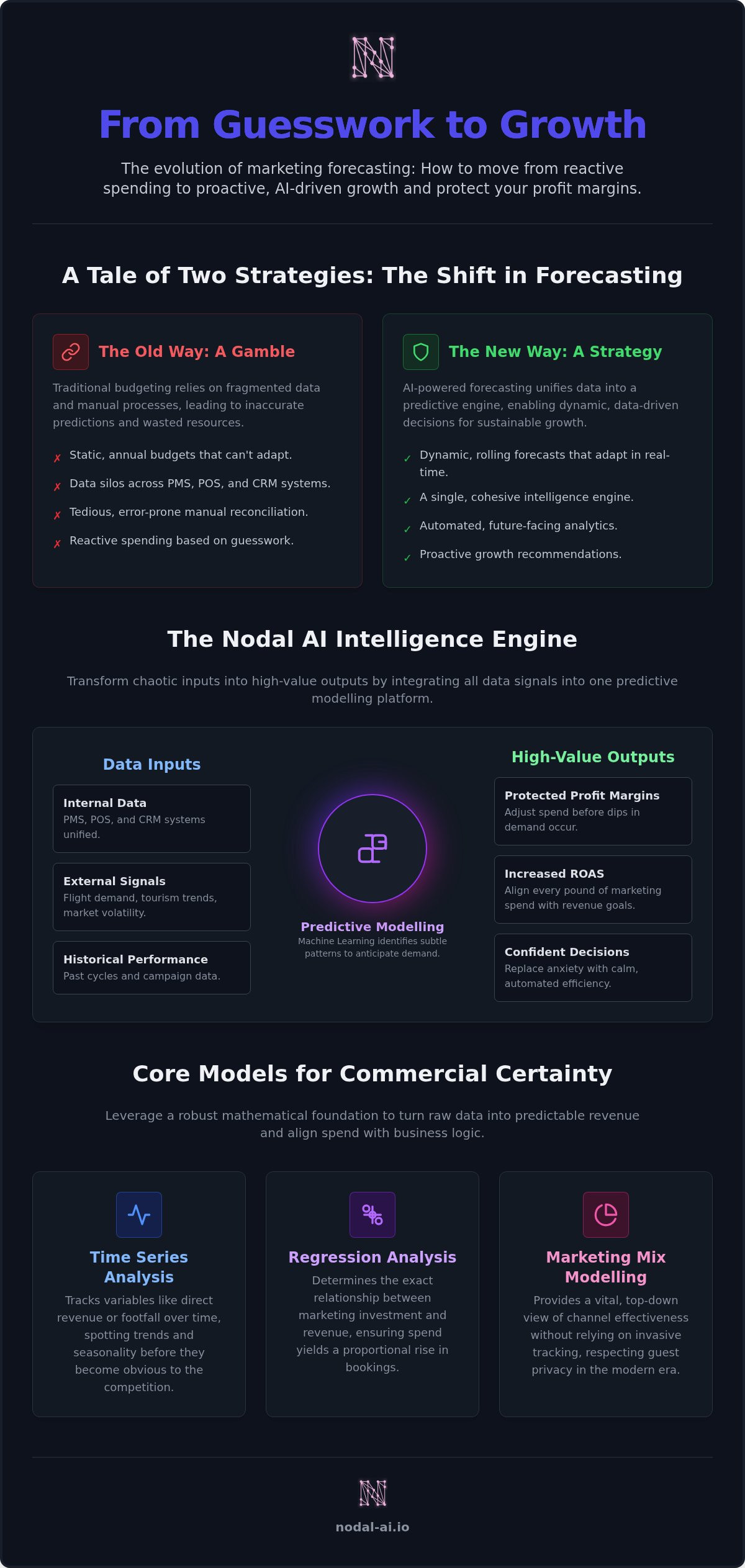
Traditional budgeting is no longer a strategy; it's a gamble that your bottom line can no longer afford to lose. You likely recognise the exhaustion of reconciling fragmented data across your PMS, POS, and CRM systems, only to find your budget allocation misses the mark. It's a common struggle to predict demand when market volatility feels like the only constant. This guide demonstrates how modern marketing forecasting models move you beyond guesswork by integrating external signals and internal data into a single, cohesive engine.
You'll learn how to leverage the Nodal Platform and its predictive modelling capabilities to transform these chaotic inputs into high-value outputs, protecting your profit margins while driving direct bookings. We will outline a strategic framework for predicting future revenue, ensuring your marketing spend aligns perfectly with occupancy and footfall to deliver a measurable increase in ROAS. By the end of this guide, you'll understand how to replace the anxiety of manual reporting with the calm efficiency of automated, future-facing analytics. Prepare to move from reactive spending to proactive growth.
Key Takeaways
- Transition from static annual budgets to dynamic, rolling forecasts that adapt instantly to shifting market conditions and guest behaviours.
- Discover how to implement advanced marketing forecasting models that leverage AI to bridge the gap between fragmented PMS, POS, and CRM data.
- Learn to integrate external signals such as flight demand and tourism trends to refine your commercial accuracy beyond internal historical data.
- Establish a clear framework for predicting future revenue, ensuring every pound of marketing spend is aligned with specific occupancy or footfall targets.
- Understand how the Nodal Platform serves as a central intelligence engine to automate predictive modelling and protect your profit margins.
The Evolution of Marketing Forecasting Models for 2026
Marketing forecasting is the strategic process of predicting future performance using historical data and AI-driven intelligence. For 2026, this discipline has transitioned from static annual budgets to dynamic, rolling forecasts that adapt to market changes in real-time. In high-stakes industries like hospitality, where margins are notoriously thin, the cost of guesswork is a liability you can no longer afford. This evolution marks the rise of commercial intelligence, which acts as the next logical step beyond simple marketing analytics. It turns passive data points into active participants in your business strategy.
While foundations like Marketing mix modelling have provided a statistical basis for estimating the impact of tactics on sales, modern marketing forecasting models must integrate a wider array of signals. By using the Nodal Platform, organisations can move beyond fragmented views to achieve total clarity. This ensures that every pound of spend is an investment in future revenue rather than a shot in the dark. This shift replaces the anxiety of manual, tedious tasks with the confidence of streamlined, high-level perspectives.
Why Static Spreadsheets Fail in a Multi-Channel World
Spreadsheets are where good data goes to die. They rely on manual entry, which invites human error, and they struggle to reconcile the fragmented silos of PMS, POS, and CRM systems. In a multi-channel world, the sheer volume of modern customer journey data makes traditional models obsolete. You cannot capture a complex guest journey in a single cell; instead, you need a system that breathes with the market. Data fragmentation creates blind spots that lead to wasted spend and missed opportunities, especially when your team is forced to spend hours on manual reconciliation rather than strategic growth.
The Rise of AI-Driven Predictive Intelligence
Machine learning identifies subtle patterns that the human eye misses. This technology shifts your team from reactive reporting to proactive growth recommendations, allowing you to anticipate shifts in demand before they occur. Accurate 2026 predictions require real-time processing to turn chaotic inputs into high-value outputs. This proactive approach allows you to protect profit margins by adjusting spend before a dip in demand occurs. It replaces the anxiety of manual tasks with the confidence of streamlined, high-level perspectives. By adopting these advanced marketing forecasting models, you empower your organisation to make more and waste less, ensuring long-term stability in a volatile market.
Core Quantitative Models for Modern Performance Marketing
Precision in 2026 requires more than just a glance at last month's performance. It demands a robust mathematical foundation to turn raw data into commercial certainty. These architectures align your spend with actual business logic, ensuring you don't just chase clicks, but capture sustainable revenue. To train these engines effectively, you need high-quality historical performance data. By analysing past cycles, predictive modelling techniques identify the specific drivers of growth that human intuition might overlook. This rigorous approach ensures you aren't just chasing immediate bookings at any cost, but are balancing short-term occupancy goals with the long-term health of your brand.
Time Series Analysis and Regression
Time series analysis acts as a chronological map, tracking variables like direct revenue or footfall over precise daily or weekly intervals. It allows you to spot trends before they become obvious to the competition. Regression analysis then determines the exact relationship between your marketing investment and the resulting revenue. It answers the critical question of whether a specific increase in ad spend will yield a proportional rise in bookings. These models account for seasonality in hospitality by correlating historical dates with recurring events, school holidays, or local festivals, ensuring your budget is active exactly when your guests are ready to book.
Marketing Mix Modelling (MMM) in the Privacy Era
In a landscape defined by tracking restrictions and the end of the third-party cookie, Marketing Mix Modelling (MMM) has returned as a vital tool. This top-down framework provides a high-level view of channel effectiveness across your entire mix without relying on invasive individual tracking. It respects guest privacy while delivering the granular insights needed to optimise your strategy. The Nodal Platform integrates these MMM insights to solve the "walled garden" problem, where platforms like Google or Meta often hide the full picture of your customer journey. By connecting these dots, you can see how offline signals and digital spend work together to drive direct bookings.
Choosing the right marketing forecasting models is not a one-size-fits-all decision; it must match your specific business logic. Whether you manage a boutique hostel or a multi-national hotel group, your framework must be modular to adapt to market volatility. When you move beyond fragmented reporting and adopt these core quantitative models, you replace the anxiety of guesswork with the confidence of data-driven intelligence. You can explore how predictive modelling can streamline your growth strategy and remove the ambiguity from your channel mix.
Beyond Internal Data: Integrating External Signals for Commercial Accuracy
Internal data tells only half the story. If you rely solely on your PMS or CRM, you are blind to the external forces that dictate whether a guest actually walks through your door. For location-based businesses, marketing forecasting models must evolve into modular systems capable of ingesting diverse data streams. This approach moves you from reactive reporting to predictive intelligence. By integrating external signals, the Nodal Platform turns chaotic market shifts into high-value outputs, ensuring your budget is always where the demand is. This is the only way to protect your profit margins in a volatile environment.
A truly strategic model recognises that your business does not exist in a vacuum. 2026 forecasting requires a modular approach to data ingestion, where the Nodal Platform acts as the central engine connecting internal performance with the outside world. This connectivity allows you to make more and waste less by identifying opportunities that your competitors, stuck in their internal spreadsheets, will inevitably miss. It transforms passive data into an active commercial advantage.
The Impact of Macro-Economic and Environmental Signals
Global shifts such as FX rates and inflation directly influence international travel and booking patterns. A weaker pound might attract more overseas visitors, while high inflation could shift domestic guests toward lower-cost options. Similarly, weather patterns are a primary driver of footfall for QSR and local attractions; a sudden heatwave or a rainy weekend can swing revenue by significant margins. Flight demand data serves as a powerful leading indicator, allowing you to predict hotel occupancy surges weeks before the first booking is even made. By capturing these signals, you replace the anxiety of unpredictable dips with the confidence of a streamlined, high-level perspective.
Mapping Local Events and Demand Surges
Localised demand is often driven by specific cultural or sporting moments. A major concert, a sporting event, or a local festival can transform a quiet Tuesday into a peak revenue day. To capitalise on this, your marketing forecasting models must recognise these surges in advance. Instead of manually adjusting campaigns, you can use automated systems to scale marketing spend the moment a local demand spike is detected. This ensures your brand is visible when intent is highest, reducing reliance on OTAs and protecting your margins. Explore the Nodal Platform features to see how these operational insights can be integrated into your daily workflow to drive direct bookings and reduce leakage.
Implementing a Data-Driven Forecasting Framework
Moving from raw data to actionable forecasts requires more than just software; it requires a strategic roadmap. You must first establish a clean data foundation before applying advanced marketing forecasting models. Without this, your predictions are merely high-tech guesses. Success depends on total alignment between your Marketing, Sales, and Finance departments. When these teams synchronise their goals, the transition from chaotic spreadsheets to streamlined growth becomes inevitable. Multi-touch attribution then acts as the refining lens. It allows you to see which interactions truly drive value over time, ensuring your model evolves alongside your customers.
Consolidating Fragmented Data Sources
Your first step is to break down the silos. You must integrate your PMS, POS, CRM, and digital ad platforms into a unified ecosystem. This process of connecting the dots creates a single source of truth, transforming passive assets into active participants in your commercial strategy. By consolidating these sources, you remove the ambiguity that plagues traditional reporting. This integration is not just a technical task; it is a cognitive upgrade for your entire organisation. For a deeper look at how this data maps to the guest experience, consult our Definitive Guide to the Customer Journey. This clarity is the bedrock of profitable growth.
Validating and Adjusting Your Predictions
Accuracy is built through constant refinement. You should implement a process of back-testing, where you run your models against historical reality to see how well they would have predicted past events. This creates a feedback loop that improves model precision every month. It replaces the anxiety of manual, tedious tasks with the confidence of high-level perspectives. While the Nodal Platform provides the heavy lifting through AI-driven growth recommendations, a human-in-the-loop remains essential. Your team's expertise is needed to interpret these insights and apply them to the unique nuances of your market. This partnership between human intuition and machine intelligence ensures your marketing forecasting models remain both sharp and relevant.
Book a demo to see our forecasting framework in action
Scaling Growth with the Nodal AI Intelligence Engine
Nodal AI provides the definitive solution for organisations struggling with the dual pressures of data scale and margin erosion. While traditional systems often buckle under the weight of fragmented inputs, our modular architecture transforms chaotic data into tailored commercial and guest insights. By leveraging advanced marketing forecasting models, the Nodal Platform acts as a cognitive upgrade for your entire organisation. It identifies hidden efficiencies that reduce acquisition costs while simultaneously increasing the lifetime value of every booking, often resulting in a 24.5% increase in ROAS for our hospitality clients. Our modular architecture is built specifically for complex customer journeys, allowing you to scale operations without losing the granularity of individual guest behaviours. This is the ultimate path to our mission: "Make more, waste less" through the power of predictive modelling.
Turning Insights into Automated Growth Recommendations
The platform moves beyond passive observation by identifying high-propensity guest segments for precisely targeted spend. It doesn't just show you what happened; it provides automated growth recommendations that tell you exactly where to invest next. For marketing teams in fast-paced hubs like London, automated reporting eliminates the tedious labour of manual data reconciliation. This saves hours of high-value time that can be redirected toward creative strategy and guest experience. The impact is concrete and measurable. Case studies, including our specialised work with Ovolo Hotels, demonstrate a 15.3% reduction in acquisition costs when these automated insights are put into action.
Protecting Profit Margins in Hospitality
Protecting your bottom line requires a proactive approach to driving direct bookings and reducing OTA leakage. Accurate forecasting allows you to capture guests before they wander toward third-party platforms that eat into your margins. The Nodal Platform gives you the unique ability to identify "need periods" (critical windows of low occupancy) up to six weeks in advance. This lead time is vital for commercial stability. It allows you to activate targeted campaigns to fill rooms without resorting to last-minute discounting that erodes your brand value. You replace the stress of reactive management with the calm efficiency of a forward-thinking strategy. This approach transforms your marketing forecasting models from passive reports into active engines of growth.
Book a demo to see how Nodal AI transforms your forecasting.
Master the Future of Commercial Intelligence
The transition from manual reporting to predictive intelligence is the most significant cognitive upgrade your organisation can undertake. You now have the strategic framework to move beyond siloed data and embrace a modular approach that accounts for real-world market volatility. By leveraging AI-driven marketing forecasting models, you replace the anxiety of wasted spend with the confidence of measurable returns. This shift ensures your budget is always aligned with actual demand, protecting your margins against the friction of fragmented systems.
Our hospitality clients have already realised a 24.5% increase in ROAS by using the Nodal Platform to connect the dots across their commercial data. Our modular intelligence engine provides tailored insights that turn chaotic inputs into high-value growth recommendations. Whether you require specialised support for mapping complex customer journeys or need to identify low-occupancy periods six weeks in advance, we provide the tools to make more and waste less. It is time to transform your passive assets into active participants in your commercial success.
Book a Nodal AI demo to transform your data into growth
Take the first step toward a more efficient, data-driven future and secure your competitive advantage for 2026.
Frequently Asked Questions
What is the most accurate marketing forecasting model for 2026?
The most accurate marketing forecasting models for 2026 are those that utilise an integrated, modular approach. These systems combine internal historical data with real-time external signals such as flight demand and weather patterns. Unlike static models, these dynamic frameworks adapt to market volatility. By using the Nodal Platform to bridge these data points, hospitality brands achieve a higher degree of commercial certainty and protect their profit margins against unpredictable shifts.
How does predictive modelling differ from traditional marketing reporting?
Traditional reporting is reactive, focusing on what has already happened to your budget. Predictive modelling is proactive, using existing data to project future outcomes and growth opportunities. While reports tell you how much you spent, predictive intelligence tells you where to invest next to maximise returns. This transition replaces the anxiety of manual data reconciliation with the confidence of streamlined, future-facing perspectives that drive immediate commercial value.
Can marketing forecasting models work with fragmented data from different systems?
Yes, modern marketing forecasting models are specifically designed to resolve data fragmentation. The Nodal Platform acts as a central engine that integrates disparate sources like your PMS, POS, and CRM systems. By connecting these silos, you create a single source of truth that turns chaotic inputs into high-value outputs. This integration removes the ambiguity of manual spreadsheets and ensures your forecasts are based on a complete view of the guest journey.
How often should a marketing forecast be updated to remain accurate?
You should update your marketing forecasts on a rolling basis, ideally in real-time or at least weekly. In volatile markets like hospitality, a static monthly forecast becomes obsolete the moment a new demand surge or economic shift occurs. Regular updates allow you to adjust your spend dynamically, ensuring your marketing efforts always align with current occupancy targets. This frequent refinement helps you make more and waste less by catching opportunities early.
What external data signals should be included in a hospitality marketing forecast?
A robust hospitality forecast must include external signals like flight demand, tourism trends, and local event schedules. Environmental factors such as weather patterns also play a critical role in predicting footfall for restaurants and attractions. Additionally, monitoring macro-economic indicators like FX rates helps you anticipate shifts in international booking behaviour. Integrating these signals ensures your commercial strategy is grounded in the reality of the external market, not just your internal history.
What is the role of AI in modern marketing forecasting models?
AI serves as the cognitive engine of modern forecasting, identifying subtle patterns in customer behaviour that human analysts often miss. It automates the processing of massive datasets across multiple channels, providing real-time growth recommendations. By using machine learning, the Nodal Platform replaces tedious manual tasks with high-level intelligence. This allows your team to focus on creative strategy while the algorithm handles the complex mathematical frameworks required for accurate demand prediction.
How can I measure the ROI of my forecasting efforts?
Measure the ROI of your forecasting by tracking improvements in ROAS and reductions in your cost per acquisition. Compare your forecasted revenue against actual performance to determine model accuracy over time. Successful forecasting should lead to a measurable increase in direct bookings and a decrease in OTA leakage. By quantifying these commercial outcomes, you can demonstrate how predictive intelligence directly contributes to the long-term stability and profitability of your organisation.
Does Nodal AI integrate with my existing PMS and CRM systems?
Nodal AI is built to integrate seamlessly with your existing PMS and CRM systems. Our modular architecture allows for frictionless data ingestion, ensuring you don't have to overhaul your current technology stack to benefit from predictive modelling. This connectivity turns your passive data assets into active participants in your business process. By synchronising these systems, the platform provides a unified view of your guest journey, enabling more precise targeting and better commercial results.


