

What if the twenty hours your team spends every month stitching spreadsheets together isn't just a productivity drain, but a direct threat to your profit margins? You've likely accepted manual data fragmentation as a necessary evil of managing diverse platforms like Meta, Google, and your PMS. It's exhausting to watch inaccurate attribution lead to wasted ad spend while your direct revenue targets remain out of reach. You deserve the relief that comes from turning chaotic inputs into high-value outputs.
This guide shows you how to deploy automated performance marketing reports to eliminate these silos and transform your data into a high-velocity engine for growth. Learn to unify your commercial signals into a single, authoritative view of performance that drives bottom-line results. We'll explore the specific steps to increase direct booking revenue and use real-time insights to reallocate budgets with total confidence. Stop reporting on the past and start engineering a future of frictionless, measurable growth. It's time to replace the anxiety of manual tasks with the clarity of a streamlined, enterprise-ready perspective.
Key Takeaways
- Transform static spreadsheets into real-time commercial intelligence that turns fragmented data into a strategic engine for direct revenue growth.
- Reclaim over 20 hours each month by automating data extraction and closing the attribution gap that often leads to wasted ad spend.
- Establish a scalable workflow for automated performance marketing reports that prioritizes high-value commercial outcomes over vanity metrics.
- Shift from looking at past performance to using predictive modeling for identifying high-propensity guest segments before they book.
- Unify your PMS, POS, and ad platforms to gain a single view of performance that reduces OTA leakage and increases your ROAS.
What are Automated Performance Marketing Reports?
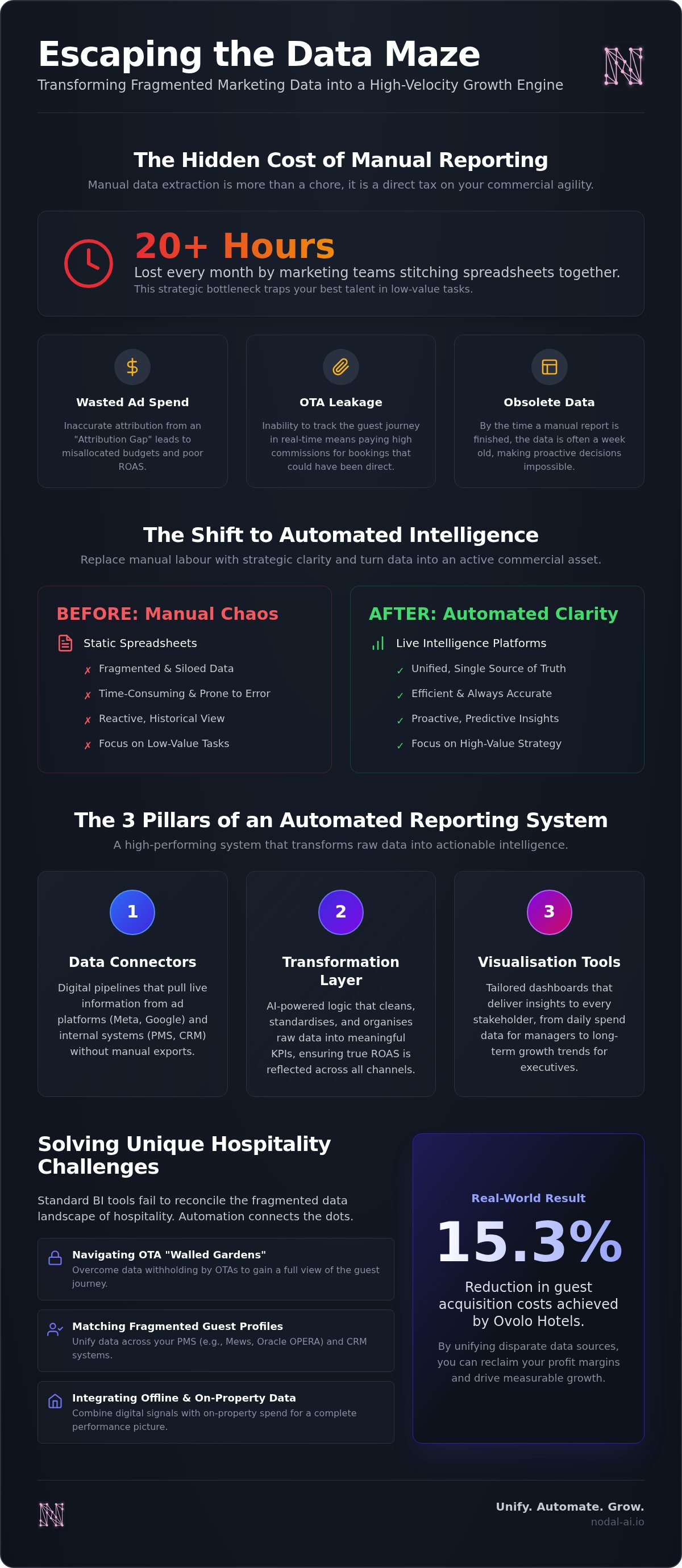
Automated performance marketing reports are integrated systems that automatically extract, transform, and visualize commercial data from multiple sources. This technology represents a fundamental shift from static, historical spreadsheets to real-time intelligence platforms. In the past, teams spent days manually stitching together data from Meta, Google, and internal systems. Today, that process happens in seconds, providing a live pulse on your marketing health and financial stability.
Performance marketing requires a level of granularity that traditional brand reporting simply cannot provide. While brand reports might look at monthly sentiment, automated performance marketing reports track every dollar spent against every booking made. This precision allows for immediate budget reallocation. AI plays a vital role here by standardizing disparate data schemas from various platforms into a unified view. It’s a sophisticated application of marketing automation that replaces manual labor with strategic clarity. Deploying these reports turns your data from a passive archive into an active commercial asset.
The Core Components of an Automated Reporting System
A high-performing system relies on three pillars. First, data connectors act as digital pipelines, pulling live information from external ad platforms and your internal databases. They ensure data flows freely without manual export. Second, the transformation layer organizes raw data into meaningful KPIs. It applies specific business logic to ensure that automated performance marketing reports accurately reflect your true ROAS across all channels. Finally, visualization tools deliver these insights through tailored dashboards. This provides the right level of detail for every stakeholder, from tactical managers needing daily spend data to executive leaders focused on long-term growth.
Why Hospitality Teams Face Unique Reporting Challenges
The hospitality sector deals with fragmented data that standard BI tools often fail to reconcile. You’re constantly navigating "walled gardens" where OTAs withhold guest information to protect their own margins. Matching guest profiles across a PMS like Mews or Oracle OPERA and your CRM is a persistent hurdle. Digital signals are only half the story. You must also integrate offline data like on-property spend and restaurant footfall to see the full picture.
Solving these challenges is how brands like Ovolo Hotels achieved a 15.3% reduction in acquisition costs. It requires specialized tools like the Nodal Platform, which is designed to connect these dots and reclaim your profit margins. By unifying these disparate sources, you move from the anxiety of manual tasks to the confidence of a streamlined, high-level perspective.
The Hidden Cost of Manual Data Fragmentation
Manual data extraction is more than a tedious chore. It's a direct tax on your commercial agility. London marketing teams currently lose over 20 hours every month to the manual labor of stitching spreadsheets together. This isn't just a loss of productivity; it's a strategic bottleneck that keeps your best talent trapped in low-value tasks. While your team fights with VLOOKUPs, your competitors are already pivoting their budgets based on live performance signals.
The most dangerous consequence of this fragmentation is the "Attribution Gap." When you rely on manual entry, it's nearly impossible to track the complex, multi-touch journey of a modern guest. This leads to over-crediting high-cost third-party channels while your direct booking efforts appear undervalued. Without automated performance marketing reports, you're essentially flying blind. You can't identify OTA leakage in real-time, which means you're paying high commissions for guests who might have booked directly. By the time a manual report is finished, the data is often a week old. In a market that moves in minutes, stale data is obsolete data.
The Impact of Poor Data on Decision Making
Inaccurate data leads to wasted ad spend. If your ROAS calculations are off by even a small margin, you might be pouring money into keywords that don't convert or platforms that don't drive revenue. Relying on last-click attribution is a gamble you can't afford to take. It ignores the early touchpoints that build intent. Fragmented data also hides the early warning signs of low-occupancy periods. By the time you spot the dip in a manual report, it's often too late to launch a recovery campaign. Deploying automated performance marketing reports ensures you see these signals early enough to act.
Financial Risks of Non-Compliant Data Handling
Moving guest data between unsecure spreadsheets creates significant GDPR risks. Enterprise security requires a robust data governance framework that manual processes simply cannot provide. You need a single source of truth for financial auditing and long-term stability. Managing data through integrated systems replaces the anxiety of potential breaches with the confidence of high-level protection. To see how your team can reclaim these lost hours and secure your data, you might want to explore how our intelligence engine unifies fragmented sources. This shift transforms your data from a liability into a high-value commercial asset.
How to Build a Scalable Automated Reporting Workflow
Building a scalable workflow requires a transition from manual data collection to strategic oversight. You must begin with a comprehensive audit of your current data ecosystem. Identify every ad platform, booking engine, and operational source currently in use. This audit reveals the gaps where data often disappears. Once identified, define your north star metrics. Move beyond vanity metrics like clicks or impressions. Focus instead on commercial outcomes that drive the bottom line, such as direct booking revenue and net profit margins.
Selecting a modular intelligence engine is the next critical step. Your system must be flexible enough to scale with your organization as you add new properties or channels. Automating the transformation process is where the real value lies. It ensures that raw data from disparate sources is converted into consistent, accurate KPIs without human intervention. The final goal is to establish a feedback loop. Your automated performance marketing reports should do more than just display history. They should trigger automated growth recommendations that allow you to pivot strategies in real-time.
Step 1: Connecting Disparate Data Sources
Start by integrating your primary ad platforms, such as Google Ads and Meta, with GA4. This creates a foundational layer of digital performance. For hospitality teams, the real power comes from connecting industry-specific systems like Mews, Cloudbeds, or Oracle OPERA. This connection allows you to see the actual revenue resulting from your digital spend. Don't stop at internal data. Incorporating external signals like local weather patterns, FX rates, and flight demand into your automated performance marketing reports provides a competitive edge. It helps you understand why performance fluctuates beyond your ad creative.
Step 2: Implementing Multi-Touch Attribution
Generic reporting often relies on simplistic first-click or last-click models. These models fail to capture the complex journey of a modern guest who may interact with your brand five times before booking. Implementing multi-touch attribution (MTA) allows you to see the true value of every touchpoint. Use AI to weight these interactions based on their actual contribution to revenue. This shift provides the clarity needed to stop wasting spend on underperforming channels. To dive deeper into this process, read our guide on Mastering Marketing Attribution. Moving to an MTA model replaces guesswork with a high-level, enterprise-ready perspective on your marketing ROI.
Beyond Metrics: Using AI for Predictive Growth
Most marketing teams are stuck in the past. They use descriptive reporting to see what happened last month or diagnostic tools to understand why a campaign failed. While useful, these methods are fundamentally reactive. The true competitive shift occurs when you move into predictive growth. This level of intelligence allows you to anticipate market shifts rather than just reacting to them. By using automated performance marketing reports, you can transform historical data into a forward-looking strategy that identifies opportunities before they vanish.
Predictive modeling is the engine behind this transformation. It analyzes patterns across your PMS and ad platforms to identify high-propensity guest segments. These are the individuals most likely to book during specific windows. Instead of broad-spectrum advertising, you can focus your budget where the return is most certain. This approach is detailed extensively in our Predictive Modelling Guide. It allows you to forecast "need periods", those upcoming gaps in occupancy, and adjust your ad spend weeks in advance. You stop chasing demand and start engineering it.
Growth Recommendations: The Next Level of Automation
The most advanced automated performance marketing reports don't just present data; they offer solutions. AI-driven growth recommendations identify underperforming campaigns in real-time and suggest precise budget reallocations. This isn't about human intuition. It's about algorithmic speed. By automating audience segmentation, you create personalized customer journeys that feel effortless to the guest but are highly optimized for conversion. This level of precision has helped partners achieve a 24.5% increase in ROAS by reducing acquisition costs through intelligent bidding adjustments. It turns your reporting suite into a conversational partner that guides your commercial strategy.
Measuring Incrementality for True ROI
Understanding which revenue is truly "extra" is the hallmark of a sophisticated marketing organization. Incrementality testing moves beyond simple attribution to prove that a specific ad actually caused a booking that wouldn't have happened otherwise. Automated lift tests allow you to validate channel performance without the need for manual experimentation. This data changes your long-term brand planning. It reveals which platforms are driving genuine growth and which are simply claiming credit for guests who were already going to stay with you. This clarity replaces the anxiety of wasted spend with the confidence of measurable returns.
Book a demo to see predictive growth in action
Nodal Platform: Connecting the Dots for Hospitality Performance
The Nodal Platform is the modular intelligence engine designed to bridge the gap between fragmented hospitality systems and strategic commercial growth. Most reporting tools offer a generic view that fails to account for the specific complexities of hotel data. Nodal is different. It acts as the central brain for your organization, unifying signals from Oracle OPERA, Mews, and your digital ad platforms into a single source of truth. By transforming automated performance marketing reports from simple charts into a high-velocity revenue engine, we empower you to stop reporting on the past and start engineering the future.
Hospitality leaders often struggle with data that lives in disconnected silos, leading to inaccurate attribution and missed opportunities. Nodal solves this by standardizing disparate data schemas, allowing you to see the true journey of every guest. This clarity has a measurable impact on the bottom line. Consider the results achieved by Ovolo Hotels. By deploying Nodal’s integrated insights, they realized a 24.5% increase in ROAS and a 15.3% reduction in acquisition costs. This is the relief that comes from replacing manual labor with streamlined, enterprise-ready perspectives.
Key Features of the Nodal Platform
Nodal’s modular architecture allows you to customize your intelligence suite based on your specific operational needs. The Operational, Demand, and Guest modules work in harmony to provide a 360-degree view of your performance. This technology is built with a relentless focus on direct bookings. It identifies where OTA leakage occurs and provides the recommendations needed to steer guests toward your own channels. You can explore our full list of features to see how we empower hospitality leaders to move beyond manual data entry and reclaim their profit margins.
Transform Your Performance Today
Moving from manual labor to strategic commercial intelligence requires a partner who understands the unique landscape of UK hospitality. As a London-based partner, we provide professional implementation and onboarding tailored to your team's specific workflow. We don't just deliver software; we deliver a cognitive upgrade for your entire organization. It's time to replace the anxiety of disconnected data with the confidence of unified performance. You deserve a system that turns chaotic inputs into high-value outputs. Book a demo to see your data unified in a single, authoritative view and start your journey toward frictionless growth today.
Engineer Your Future with Commercial Intelligence
The shift from manual data entry to strategic commercial intelligence is a competitive necessity. By deploying automated performance marketing reports, you eliminate the attribution gaps that erode profit margins and stifle growth. You've seen how industry leaders achieved a 24.5% increase in ROAS and a 15.3% reduction in acquisition costs by unifying their fragmented data. These aren't just numbers; they represent the tangible relief that comes from replacing manual labor with high-level, enterprise-ready perspectives.
Replace the anxiety of disconnected spreadsheets with the confidence of live, actionable insights. With custom hospitality integrations for systems like Mews and Oracle OPERA, your passive data becomes an active participant in your revenue strategy. It's time to turn chaotic inputs into high-value commercial outcomes and reclaim the twenty hours your team loses every month. The path to direct revenue growth is now clear, structured, and entirely within your reach.
Book a Nodal AI Demo to Automate Your Commercial Intelligence
Take the first step toward a future of frictionless progress and measurable success today.
Frequently Asked Questions
What is the difference between automated reporting and business intelligence?
Automated reporting is a focused application of business intelligence designed for real-time tactical action. While BI provides a broad view of historical company data, automated performance marketing reports deliver live commercial signals from your ad platforms and booking engines. This technology replaces manual data extraction with direct pipelines. It allows for immediate budget reallocations that general BI tools often miss.
Can automated marketing reports integrate with my PMS like Oracle OPERA?
Yes, seamless integration with hospitality-specific systems like Oracle OPERA, Mews, and Cloudbeds is a core feature of advanced platforms. These connections allow you to link digital ad spend directly to guest check-ins and on-property revenue. By unifying your PMS and marketing data, you eliminate the attribution gap. You gain total clarity on your true return on investment across every channel.
How much time can my team really save by automating performance reports?
Marketing teams in competitive hubs like London frequently reclaim over 20 hours every month. Automation removes the tedious labor of manual data stitching and spreadsheet management. This shift transforms your staff from data entry clerks into strategic growth engineers. By using automated performance marketing reports, you replace the anxiety of manual errors with the confidence of live, accurate data.
Is multi-touch attribution included in automated marketing reports?
Enterprise-ready platforms include multi-touch attribution to provide a 360-degree view of the guest journey. You move beyond simplistic last-click models to understand how every digital touchpoint contributes to a final booking. This clarity helps you stop wasting budget on channels that don't drive incremental revenue. It allows you to focus your spend on the interactions that actually grow your bottom line.
How does automated reporting help reduce OTA leakage for hotels?
It identifies the specific campaigns and keywords that lead to third-party bookings instead of direct ones. By highlighting these leakage points in real-time, you can refine your audience targeting and bidding strategies immediately. This ensures your marketing budget works to reclaim profit margins from OTAs. You turn your data into an active participant in driving higher direct booking revenue.
What are the common pitfalls when implementing report automation?
The primary pitfall is ignoring data hygiene before you begin the implementation process. If your ad platforms and PMS use conflicting naming conventions, the automation might produce fragmented results. You must audit your data sources and define clear north star metrics first. This preparation ensures your automated workflow stays focused on meaningful commercial outcomes rather than distracting vanity metrics.
Do I need a data scientist to manage an automated reporting platform?
You don't need a data scientist to operate a modern, modular intelligence engine. These platforms are built for empowering accessibility, providing clear growth recommendations that any marketing professional can act upon. The underlying technology handles the complex algorithmic processing. You simply focus on the high-level perspective and strategic decisions needed to drive your organization forward.
Is automated reporting compliant with GDPR for guest data?
Centralized reporting is significantly more secure and compliant than using manual, unsecure spreadsheets. It establishes a secure, single source of truth that adheres to strict GDPR standards for guest data protection. This replaces the security risks of manual file sharing with a robust data governance framework. You gain the peace of mind that comes from enterprise-ready security protocols.


