

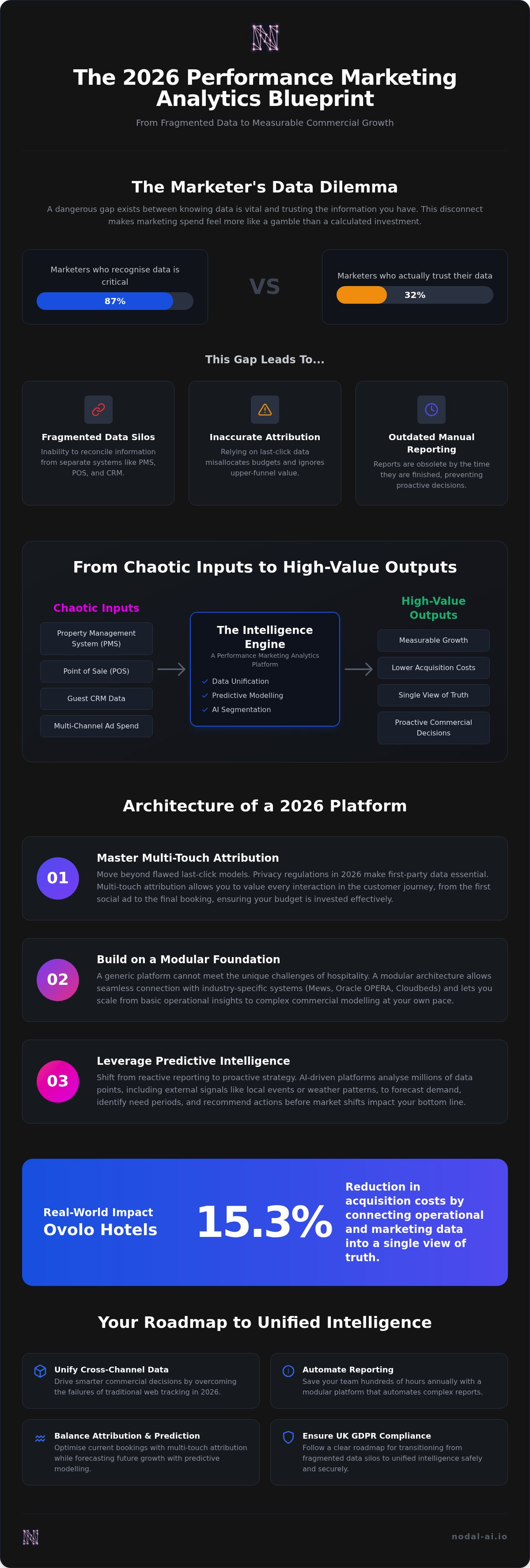
While 87% of marketers recognise that data-driven strategies are critical for survival, only 32% actually trust the quality of the information they see. This disconnect creates a dangerous gap where marketing spend feels more like a gamble than a calculated investment. If you are struggling to reconcile fragmented data across siloed systems, you are likely losing revenue to inaccurate attribution and manual reporting that is already outdated by the time it is finished. Implementing a sophisticated performance marketing analytics platform is no longer just a technical upgrade; it is a fundamental requirement for commercial intelligence in 2026.
We understand the frustration of seeing high acquisition costs without a clear path to reduction. This guide will show you how to unify your disparate data streams and transform every pound of marketing spend into measurable commercial growth using advanced analytics and predictive modelling. We will explore how to achieve a single view of truth, utilise predictive insights to identify need periods before they arrive, and leverage better audience segmentation to lower your costs. From navigating the 2026 privacy landscape to mastering multi-touch attribution, you are about to discover how to turn chaotic inputs into high-value outputs.
Key Takeaways
- Learn why traditional web tracking fails in 2026 and how to unify cross-channel data to drive smarter commercial decisions.
- Discover the modular architecture required to build a performance marketing analytics platform that automates reporting and saves your team hundreds of hours annually.
- Master the balance between multi-touch attribution to optimise current bookings and predictive modelling to forecast future growth periods.
- Follow a clear roadmap for transitioning from fragmented data silos to unified intelligence while ensuring strict UK GDPR compliance.
- See how hospitality leaders like Ovolo Hotels achieved a 15.3% reduction in acquisition costs by connecting their operational and marketing data.
Beyond the Dashboard: The Evolution of Performance Marketing Analytics
Performance marketing is no longer about simple click-through rates or basic traffic logs. A modern performance marketing analytics platform acts as a modular intelligence engine. It unifies fragmented data from every touchpoint to drive high-level commercial decisions. Traditional web analytics often stop at the website boundary. They fail to account for the complex, multi-channel customer journeys that define the modern era. Commercial intelligence goes deeper. It connects your marketing spend to actual profit margins and real-time operational capacity. You aren't just seeing what happened; you are seeing what should happen next. This shift from reactive reporting to proactive, AI-driven growth recommendations transforms marketing from a cost centre into a predictable revenue driver.
The Death of Last-Click Attribution
Relying on the final click is a recipe for misallocated budgets. It ignores the vital upper-funnel interactions that introduce your brand to the guest. By the time 2026 arrived, privacy regulations in states like Indiana and Kentucky, alongside CCPA updates regarding neural data, made first-party data the only reliable source of truth. Multi-touch attribution allows you to value every interaction. You can finally see which social ads or email campaigns actually started the conversation, not just which one ended it. This clarity is essential for anyone engaged in performance-based advertising where every penny must be justified by a measurable result. Stop guessing which half of your budget is working and start investing in the channels that build long-term value.
Why Hospitality Brands Face Unique Data Challenges
Hospitality operates in a state of constant fragmentation. You have a Property Management System (PMS) for rooms, a Point of Sale (POS) for the restaurant, and a CRM for guest loyalty. Connecting these is a crisis for most brands. Measuring the gap between a digital impression and a physical check-in is notoriously difficult. The Nodal Platform solves this by prioritising direct booking data. It addresses the "OTA leakage" problem by showing you exactly where you can win back customers from high-commission third parties. By integrating systems like Mews or Oracle OPERA, you gain a single view of truth that traditional tools simply cannot provide. This level of performance marketing analytics platform integration ensures that your digital strategy reflects your physical reality. Explore our modular features to see how we bridge this gap for high-growth hospitality brands.
The Architecture of Actionable Intelligence: Key Components of a 2026 Platform
A robust performance marketing analytics platform in 2026 is built on modularity. It must process millions of data points without overwhelming the user. As industry experts suggest, All Marketing Is Performance Marketing Now, which requires a shift from vanity metrics to hard commercial value. This architecture treats your data as a living asset. It uses AI to identify high-propensity targets while incorporating external signals, such as local weather patterns or major city events, into your commercial analysis. This creates a cognitive upgrade for your entire organisation, allowing you to react to market shifts before they impact your bottom line.
Modular Data Engines and Custom Integrations
Generic platforms often fail because they don't speak the language of hospitality. A modular approach allows you to scale at your own pace. You might start with basic operational insights and later add complex demand or commercial modelling. The platform must connect seamlessly with industry-specific systems like Mews, Cloudbeds, or OpenTable to be effective. Our "Total Connect" feature acts as a bridge, mapping years of complex historical data from these disparate sources into a single, clean stream. This ensures you aren't just collecting data; you are building a foundation for actionable intelligence that reflects the reality of your property's performance.
AI-driven segmentation is the silent engine of the modern stack. It moves beyond basic demographics to understand guest intent. By analysing external signals, such as a sudden forecast for sunshine or a local festival announcement, the platform can automatically adjust your growth recommendations. This level of granularity ensures your acquisition costs remain low while your conversion rates stay high. It is about being in the right place at the precise moment a guest decides to book, transforming passive data into an active participant in your business growth.
Real-Time Automated Reporting
Manual reporting is a productivity killer. Marketing teams often spend hundreds of hours every year manually updating spreadsheets that are obsolete before they are even finished. Moving to live, interactive dashboards eliminates this waste entirely. Automated reporting ensures data consistency across global teams and removes the risk of human error in complex calculations. You can explore Nodal Platform features to see how we transform static numbers into dynamic growth engines. This real-time visibility allows you to pivot strategies instantly, ensuring your budget always follows the highest-performing opportunities. It replaces the anxiety of manual tasks with the confidence of streamlined, high-level perspectives.
Multi-Touch Attribution vs. Predictive Modelling: Choosing Your Growth Engine
Most marketers spend their time looking in the rear-view mirror. While tracking past performance is necessary, it is only half of the equation. A comprehensive performance marketing analytics platform must bridge the gap between historical truth and future opportunity. By combining multi-touch attribution with advanced predictive modelling, you move from simply reporting on what happened to influencing what will happen next. This synergy is the hallmark of modern marketing analytics, where data stops being a static record and becomes a proactive commercial tool.
Mastering Marketing Attribution in 2026
Multi-touch attribution (MTA) is your primary tool for identifying which channels currently drive the most valuable direct bookings. In a world where customer journeys are non-linear, relying on basic models leads to wasted spend. You need to understand the weight of every interaction, whether it is an initial social media discovery or a final search ad. You can explore these nuances in our guide on Mastering Marketing Attribution: The Definitive Guide for 2026. By moving from linear or time-decay models to data-driven ones, you gain the transparency needed to justify every pound of marketing spend to the board. It replaces ambiguity with concrete evidence of performance.
Predictive Modelling for Scalable Growth
While attribution tells you where you have been, predictive modelling shows you where you are going. This technology uses AI to forecast guest demand by analysing historical patterns and external market trends. For hospitality leaders, the most significant advantage is the ability to identify "need periods" (low occupancy windows) up to six weeks in advance. This foresight allows you to deploy targeted campaigns before the slump occurs, rather than reacting once rooms are already empty. It transforms your performance marketing analytics platform into a radar system for revenue.
Implementing these forward-looking insights has a measurable impact on the bottom line. Hospitality brands using the Nodal Platform have documented a 24.5% increase in ROAS by aligning their spend with predicted demand. To understand how to leverage these forecasts, read our deep dive into Predictive Modelling: Transforming Fragmented Data into Future Growth. When you combine the historical accuracy of attribution with the foresight of predictive modelling, you create a growth engine that is both stable and highly scalable. It is the difference between surviving the market and mastering it.
Bridging the Gap: How to Implement a Performance Marketing Analytics Platform
Transitioning from fragmented data silos to a unified intelligence engine requires a structured, multi-step approach. It isn't just about plugging in software; it's about re-engineering how your organisation perceives and acts on commercial information. A successful performance marketing analytics platform implementation replaces guesswork with a robust framework for growth. You must move through a logical sequence of integration, validation, and cultural adoption to ensure the technology delivers its full commercial potential. This journey turns chaotic inputs into high-value outputs, providing the relief that comes from resolving deep-seated complexity.
The Onboarding and Integration Phase
The first step is identifying your core data sources. In hospitality, this typically includes your Property Management System (PMS) such as Cloudbeds or Oracle OPERA, your CRM, and your digital advertising platforms. Mapping the customer journey across these fragmented touchpoints is essential. You need to see the direct line from a social media impression to a physical check-in. During this phase, data hygiene is non-negotiable. Ingesting inaccurate historical data only serves to scale existing errors. Clean your datasets before migration to ensure your initial insights are trustworthy and actionable from day one.
Compliance and Data Governance in the UK
The UK data landscape in 2026 demands a privacy-first approach to measurement. With the end of third-party cookies and the evolution of the UK GDPR, first-party data collection is the only sustainable foundation for a modern analytics strategy. The Nodal Platform prioritises this, ensuring high-level protection of assets while maintaining guest privacy. This isn't just about legal safety; it's about building a transparent relationship with your guests. By using privacy-preserving attribution methods, you can still gain deep insights without compromising individual security.
Finally, the implementation process must address the human element. Technology is only as effective as the people who operate it. Training your teams to move away from intuition-based decisions is a critical final step. Encourage your marketing and revenue managers to interrogate the platform for specific Growth Recommendations. This shift in mindset transforms the service from a functional tool into a cognitive upgrade for the entire organisation. It replaces the anxiety of manual, tedious reporting with the confidence of streamlined, high-level perspectives.
Book a demo to start your implementation journey
Nodal AI: The Commercial Intelligence Engine for High-Growth Hospitality
The Nodal Platform acts as the definitive bridge between chaotic data inputs and high-value commercial outputs. It is specifically engineered to unify the fragmented reality of hospitality performance, transforming your data from a passive record into an active participant in your business growth. By deploying our performance marketing analytics platform, you replace the confusion of siloed systems with a single, clear view of the truth. This is more than a reporting tool; it is a cognitive upgrade that empowers your entire organisation to make smarter, faster decisions with total confidence.
Consider the documented success of Ovolo Hotels as a prime example of this transformation. By integrating their revenue and marketing data through our modular engine, they realised a 15.3% reduction in acquisition costs alongside a 13.8% increase in total bookings. This shift was driven by our "Make More, Waste Less" philosophy, which utilises AI-driven audience segmentation to identify and eliminate wasted ad spend. We don't just track what happened; we provide the Growth Recommendations needed to ensure your future spend is always directed toward the highest-performing opportunities.
Tailored Insights for Every Hospitality Sector
Our modular intelligence engine provides specific benefits across the diverse hospitality landscape, ensuring that your data reflects your operational reality. For hotels, it identifies high-propensity guest segments to drive direct bookings and reduce OTA reliance. For QSRs and Private Members' Clubs, it unifies POS and CRM data to map the complete customer journey with absolute transparency. Being a London-based partner allows us to offer enterprise-grade support tailored to the UK and global markets. We understand the unique pressures of the sector, from seasonal demand shifts to the constant need for better margin protection. Our performance marketing analytics platform ensures your strategy is always aligned with your physical capacity and commercial goals.
Ready to Transform Your Marketing Data?
The transition from manual reporting to automated intelligence represents a fundamental shift in team productivity. Our partners typically save over 20 hours per week by eliminating tedious spreadsheet work and manual data reconciliation. This reclaimed time allows your marketing and revenue teams to focus on visionary strategy rather than repetitive data entry. We invite you to see the Nodal Platform in action and discover how a unified perspective can accelerate your commercial growth. Replace the overwhelm of complexity with the calm efficiency of streamlined, high-level analytics.
Mastering the Future of Hospitality Intelligence
The shift toward unified commercial intelligence is no longer optional for high-growth brands. By integrating fragmented data sources and adopting advanced predictive modelling, you replace the anxiety of manual reporting with the clarity of automated, actionable insights. This evolution ensures that every marketing decision is tethered to real-world financial performance. You aren't just tracking spend; you are engineering growth.
Leading luxury hospitality brands already use the Nodal Platform to bridge the gap between digital impressions and physical covers. Our methodology has delivered a 15.3% reduction in acquisition costs for Ovolo Hotels and earned Gold in the Performance Marketing Awards. Implementing a dedicated performance marketing analytics platform is the cognitive upgrade your organisation needs to maintain a competitive edge in 2026.
Book a Nodal AI Demo to unify your marketing data
Take the first step toward total commercial clarity today. Your data is ready to work for you.
Frequently Asked Questions
What is a performance marketing analytics platform?
A performance marketing analytics platform is a modular intelligence engine that consolidates revenue and marketing data into a single view of truth. It replaces fragmented silos by connecting digital ad spend directly to physical covers or room bookings. This allows hospitality brands to move beyond surface-level traffic metrics and focus on high-value commercial outcomes and long-term growth.
How does Nodal AI differ from Google Analytics 4?
Nodal AI provides a deeper commercial perspective by integrating operational systems like your PMS and POS, which GA4 cannot access directly. While GA4 tracks website behaviour, our platform connects that activity to actual revenue and profit margins. It personifies your passive data assets, transforming them into active participants in your business strategy through hospitality-specific growth recommendations and predictive insights.
Can Nodal AI integrate with our existing PMS and POS systems?
Yes, the Nodal Platform is designed for seamless integration with industry-leading systems such as Mews, Cloudbeds, Oracle OPERA, and OpenTable. Our "Total Connect" architecture maps complex historical data from these disparate sources into a clean, unified stream. This ensures your marketing intelligence is always grounded in your property's operational reality, allowing for precise measurement from digital impression to guest check-in.
Is multi-touch attribution better than last-click for hospitality?
Multi-touch attribution is significantly more effective because it recognises every interaction in the guest's non-linear journey. Last-click models often lead to misallocated budgets by ignoring the upper-funnel touchpoints that first introduced your brand. By valuing every step, you gain the transparency needed to justify spend to the board. It replaces the anxiety of guessing with the confidence of data-driven evidence.
How long does it take to implement a marketing analytics platform?
Implementation typically follows a structured multi-step journey that can be completed within a few weeks, depending on the complexity of your data sources. We prioritise a frictionless onboarding process that focuses on data hygiene and accurate historical ingestion. This ensures your team can transition from manual reporting to live, interactive dashboards quickly, reclaiming over 20 hours of productivity per week almost immediately.
How does predictive modelling help reduce marketing waste?
Predictive modelling identifies "need periods" or low occupancy windows up to six weeks in advance, allowing you to deploy targeted campaigns before slumps occur. By analysing historical patterns and external signals like local events, the platform ensures your budget follows high-performing opportunities. This proactive approach prevents the waste associated with reactive, last-minute discounting and keeps your acquisition costs consistently low.
Is Nodal AI compliant with UK GDPR and privacy regulations?
Nodal AI is strictly compliant with the latest UK GDPR updates and 2026 privacy-first tracking standards. We prioritise first-party data collection as the foundation of a sustainable analytics strategy, ensuring high-level protection of your guest assets. Our platform uses privacy-preserving measurement techniques that provide deep commercial insights without compromising individual security or navigating the risks of third-party cookie deprecation.
What kind of ROI can we expect from using a performance analytics platform?
Hospitality leaders using the Nodal Platform have documented a 24.5% increase in ROAS and a 15.3% reduction in acquisition costs. These results stem from better audience segmentation and the removal of manual reporting errors. By turning chaotic inputs into high-value outputs, the platform delivers a cognitive upgrade that translates directly into higher profit margins and more direct bookings for your organisation.


