

What if your most fragmented data sources weren't obstacles, but the very engine driving your next 24.5% increase in ROAS? You're likely exhausted from toggling between legacy PMS reports and disconnected marketing dashboards while OTAs quietly erode your profit margins. It's a common frustration in hospitality, but the introduction of nodalrank offers a way to turn this chaotic information into a clear, high-performance growth engine.
We understand the weight of manual reporting and the anxiety of missing targets because of blind spots in your commercial data. This methodology transforms chaotic inputs into high-value outputs. Discover how to unify your hospitality data into a single view of commercial performance that prioritizes your bottom line and improves direct booking rates.
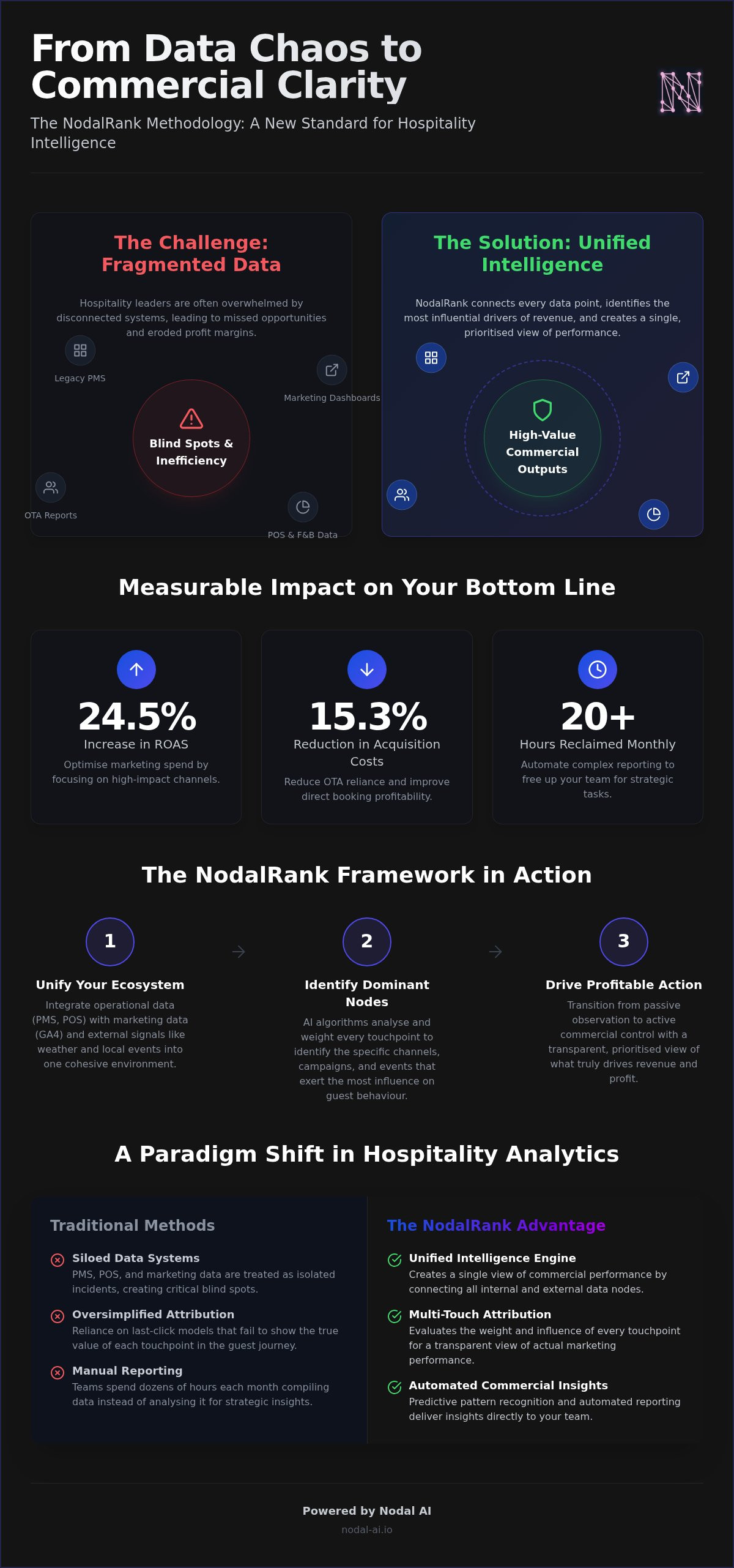
We'll break down the shift from fragmented search journeys to a unified view of commercial performance. You'll learn how this AI-driven intelligence reduces acquisition costs, including the 15.3% reduction seen by industry leaders like Ovolo Hotels. It's time to stop struggling with data silos and start scaling with a clear, data-backed strategy.
Key Takeaways
- Identify and prioritize the most influential data nodes in your business to replace chaotic inputs with high-value commercial outputs.
- Implement the nodalrank methodology to unify fragmented systems like PMS and POS into one streamlined intelligence engine.
- Shift from oversimplified last-click models to multi-touch attribution for a transparent view of your actual marketing performance.
- Reduce OTA reliance and protect profit margins by optimizing direct booking rates through predictive pattern recognition.
- Reclaim over 20 hours of manual labor each month by automating complex reporting through the Nodal Platform.
Understanding NodalRank: A New Standard for Commercial Intelligence
Most hospitality businesses are drowning in data but starving for insight. You likely have dashboards for your marketing, spreadsheets for your rooms, and separate reports for your F&B outlets. NodalRank is the methodology that finally connects these dots. It identifies and prioritizes the most influential data nodes within your business, providing a single, ranked view of what actually drives revenue and profit.
Think of your business as a network of interactions. Every guest booking, every table reservation, and every click on a social ad is a node. While traditional analytics treat these events as isolated incidents, nodalrank evaluates the weight of every touchpoint. It moves beyond simple tracking to determine which nodes are the primary drivers of commercial success. By focusing on these high-impact areas, you can stop chasing vanity metrics and start optimizing for actual growth.
The Evolution from Fragmented Data to Nodal Clarity
Traditional reporting often fails the hospitality industry because it relies on siloed information. Your PMS doesn't talk to your POS, and your marketing spend often feels like a black box. This fragmentation creates blind spots that lead to missed opportunities. NodalRank solves this by identifying "dominant nodes", the specific events or channels that exert the most influence over guest behavior.
This approach draws on established node influence metrics to quantify the value of each interaction. Instead of looking at raw data in a vacuum, you gain access to interconnected intelligence. You begin to see how a specific marketing campaign directly correlates with high-value bookings or increased spend in your restaurant. It's a shift from passive observation to active commercial control.
Why Hospitality Leaders are Prioritising Nodal Analysis
The modern hospitality market is unforgiving. High OTA commissions continue to erode profit margins, making direct booking growth a survival necessity rather than a luxury. Leaders are prioritizing nodal analysis because it highlights exactly where leakage occurs. It allows teams to make faster, more confident decisions in a competitive market by surfacing inefficiencies that human analysis often misses.
Implementing this framework helps your team make more and waste less. You can see which marketing channels are actually delivering a high ROAS and which are simply draining your budget. By understanding the hierarchy of your data, you can redirect resources to the most profitable nodes. Explore how these intelligence features transform chaotic inputs into high-value commercial outcomes.
How the NodalRank Framework Unifies Your Data Ecosystem
Unifying a fragmented hospitality ecosystem requires more than just a simple API connection. The nodalrank framework operates through a modular architecture that bridges the gap between your operational reality and your marketing efforts. By treating every system as a contributing node, the platform creates a cohesive environment where information flows freely. This allows you to stop managing disconnected spreadsheets and start managing unified growth.
Beyond internal data, the framework integrates external signals like local weather patterns, FX fluctuations, and major city events. These aren't just decorative metrics; they are active variables that influence the ranking of your commercial priorities. When local events or FX rates shift, the framework automatically recalibrates your commercial focus. For example, a sudden drop in currency value might trigger a prioritization of international acquisition nodes. The result is a predictive model that forecasts demand with precision, identifying need periods before they become revenue gaps.
Integrating Operational and Marketing Nodes
Connecting your Property Management System (PMS) like Oracle OPERA, Mews, or Cloudbeds with acquisition data from GA4 is the first step toward total clarity. This integration allows you to map the entire customer journey from the first digital touchpoint to the final check-out. By mapping these nodes, you can see exactly which marketing spend resulted in a high-value stay versus a one-time discount seeker. Ensuring strict data governance and compliance across these integrated platforms protects your guest information while providing a transparent audit trail. This removes the ambiguity often found in fragmented legacy systems, giving you the confidence to scale your operations safely.
The Role of AI in Weighting Commercial Impact
The Nodal Platform replaces gut feeling with machine learning. It uses advanced algorithms to establish explainable hierarchies in labeled networks, ensuring every data point is weighted by its true commercial significance. This move away from intuition-based decisions allows for evidence-led growth strategies that prioritize measurable returns. AI weights each data node by analyzing its historical contribution to ROAS and prioritizing the interactions that lead to the highest lifetime value. This level of automation ensures your strategy remains agile without requiring constant manual oversight. To see how this unification could streamline your operations, feel free to book a demo with our team.
NodalRank vs Traditional Marketing Attribution
Traditional attribution is a liability in a multi-channel world. Most hospitality brands still rely on last-click models that oversimplify the guest journey, giving 100% of the credit to the final reservation link while ignoring the weeks of research that preceded it. This flawed logic leads to inaccurate marketing spend, inflated egos for specific channels, and ultimately, eroded profit margins. NodalRank replaces this oversimplification with sophisticated multi-touch attribution, ensuring every interaction receives the credit it actually deserves.
By moving beyond the final click, you gain a transparent view of which channels are driving the most valuable direct bookings right now. This approach accounts for the "halo effect" of brand awareness and integrates external demand signals that traditional models ignore. It treats your marketing ecosystem as a living network rather than a linear path. This methodology aligns with the Ranking Networks model, which suggests that node attributes are themselves rankings within a complex system. When you apply this to your commercial data, you stop guessing and start investing in the nodes that actually move the needle.
Moving Beyond the Last-Click Fallacy
Relying on outdated attribution models carries hidden costs that directly impact your bottom line. If you only see the final touchpoint, you might cut funding for the very social or search campaigns that introduced the guest to your brand in the first place. This creates a cycle of diminishing returns where your top-of-funnel dries up while your acquisition costs skyrocket. NodalRank provides a more accurate picture of marketing ROI by weighing every interaction based on its true influence. You can explore this further in our definitive guide to Mastering Marketing Attribution, which details how to reclaim control over your digital spend.
Measuring Incrementality and True Growth
The real test of any marketing strategy is incrementality. You need to know if a promotion actually increased revenue or simply shifted existing demand from one date to another. NodalRank helps you distinguish between these two states, identifying when you're creating new, incremental value for the business. This level of clarity is vital for London marketing teams who must scale growth effectively in a hyper-competitive market. Predictive modelling allows these teams to forecast need periods with precision, ensuring that marketing budgets are deployed only when they'll generate the highest possible return. It's about working smarter, not just spending more, to secure your market position.
Practical Applications: NodalRank in the Hospitality Sector
Theory only matters when it produces measurable results. In the hospitality sector, applying nodalrank allows operators to move beyond generic data collection and start influencing specific commercial outcomes. Whether you're managing a boutique hotel in London or a national QSR chain, this framework identifies the exact levers that drive profitability across different asset types. It transforms passive data into a cognitive upgrade for your entire organization.
Optimising Direct Bookings for Hotels and Serviced Apartments
Hotels and serviced apartments use this intelligence to balance occupancy rates with direct revenue growth. The primary goal is reducing OTA leakage by identifying high-propensity guest segments who are likely to book direct. By analyzing these segments, the Nodal Platform triggers automated growth recommendations for specific properties, ensuring your team focuses on the most profitable opportunities. For example, Ovolo Hotels achieved a 13.8% increase in bookings by applying these insights to their acquisition strategy, proving that targeted nodal analysis outweighs broad-brush marketing spend.
Improving Performance for F&B and Attractions
The application extends deep into F&B and visitor attractions. Upscale F&B operators use the framework to analyze the delivery versus dine-in mix, protecting profit margins that are often squeezed by third-party platforms. For major UK attractions, tracking the visitor lifecycle value becomes effortless, allowing for better-targeted marketing spend based on actual footfall and order value. Understanding these touchpoints is essential for long-term stability. You can explore this further in The Definitive Guide to the Customer Journey.
Hostels and private members' clubs also find unique value here. While hostels use the framework to understand full guest value, including ancillary spend and stay extensions, members' clubs apply these insights to improve retention and on-property spend. It transforms passive member data into active strategies for engagement. Every interaction on-property becomes a data node that informs your next growth move, replacing the anxiety of manual tracking with the confidence of streamlined, high-level perspectives.
Book a personalized demo to see these applications in action
Scaling Your Business with the Nodal AI Platform
While the nodalrank methodology provides the strategic framework, the Nodal Platform is the high-performance engine that brings it to life. It transforms your passive data points into active participants in your business growth. Stop the exhausting cycle of manual data extraction and fragmented reporting. UK marketing teams currently reclaim over 20 hours of productivity every month by letting our automated reporting handle the heavy lifting. This shift replaces the anxiety of tedious tasks with the calm efficiency of a high-level perspective.
Complexity shouldn't be a barrier to scale. The platform's modular architecture allows you to build a customized intelligence suite that reflects your unique commercial goals. You aren't just buying software; you're gaining a capable partner that surfaces clear growth recommendations. These aren't vague suggestions. They are data-backed directives that lead to measurable revenue increases and long-term stability. By turning chaotic inputs into high-value outputs, you gain the clarity needed to lead your sector with confidence.
Seamless Integration with Your Tech Stack
Compatibility is never an obstacle to your digital transformation. We support over 50 hospitality integrations across operational and commercial systems, ensuring your data flows without friction. Whether you rely on Oracle OPERA, Mews, or Cloudbeds, our professional onboarding process ensures data accuracy from day one. We don't just connect systems; we harmonize them. This rigorous approach to data integrity removes the ambiguity that often plagues legacy hospitality environments. Explore the full list of Nodal Platform features to see how we can bridge your existing silos and create a single, high-performance growth engine.
Driving Measurable Returns on Ad Spend
The ultimate measure of commercial intelligence is financial performance. Nodal AI clients have achieved a 24.5% increase in ROAS by identifying and prioritizing the high-value nodes that actually drive conversion. This isn't just about looking backward. Our predictive modelling prepares your business for future market trends, allowing you to anticipate demand shifts before your competitors do. You can finally move away from reactive spending and embrace a proactive, evidence-led strategy. Don't leave your commercial future to chance or oversimplified metrics. Book a demo with Nodal AI to see nodalrank in action and secure your organization's growth through superior intelligence.
Elevate Your Commercial Performance through Nodal Intelligence
The era of struggling with siloed hospitality data is over. By adopting the nodalrank methodology, you transform every operational interaction into a strategic asset. You've seen how a unified data ecosystem replaces the anxiety of manual reporting with the confidence of high-level perspectives. Our clients have already achieved a 15.3% reduction in acquisition costs and a 24.5% increase in ROAS by focusing on the nodes that actually drive value.
The modular architecture of the Nodal Platform ensures your intelligence suite is built for your specific needs, providing the transparency required to protect profit margins and scale with precision. It's time to stop reacting to market shifts and start predicting them through predictive modelling and automated insights. You have the tools to turn complex data into a cognitive upgrade for your entire organization.
Book a personalised Nodal AI demo today
Take the first step toward total commercial clarity and secure your competitive edge in the evolving hospitality market. We're ready to help you turn your fragmented data into your most powerful growth engine.
Frequently Asked Questions
What is the primary difference between NodalRank and traditional analytics?
NodalRank prioritizes commercial influence over mere data volume. Traditional analytics often just count clicks or bookings without weighing their strategic impact on your bottom line. This methodology identifies which data nodes actually drive revenue, allowing you to focus on the specific activities that generate the most value. It's a shift from passive tracking to active, ranked intelligence that guides your next move.
How does NodalRank help reduce OTA commissions for hotels?
It reduces OTA reliance by identifying guest segments with the highest propensity for direct booking. By analyzing customer journey mapping data, the framework highlights exactly where potential guests drop off your site to book on a third-party platform. You can then deploy targeted performance marketing analytics to capture those bookings directly, protecting your profit margins from high commission fees and reclaiming your revenue.
Can NodalRank integrate with legacy systems like Oracle OPERA?
Yes, the Nodal Platform seamlessly integrates with Oracle OPERA and other major systems like Mews or Cloudbeds. Our modular architecture is designed to bridge the gap between legacy operational data and modern marketing tools. This ensures your property management data becomes an active participant in your growth strategy rather than remaining trapped in a siloed database, removing the complexity of manual data extraction.
Is NodalRank relevant for small hospitality businesses or only large enterprises?
NodalRank is relevant for any hospitality business that manages multiple data sources, regardless of its size. While large enterprises benefit from scaling across multiple locations, smaller boutique hotels or independent restaurants use the framework to eliminate waste in their limited marketing budgets. It provides the same high-level clarity and cognitive upgrade, ensuring every pound spent on acquisition is backed by evidence-led intelligence and measurable returns.
How does the Nodal Platform handle data privacy and GDPR compliance?
We prioritize high-level protection of your assets through strict data governance and compliance protocols. The Nodal Platform is built with GDPR requirements at its core, ensuring all guest data is handled securely and transparently. Our professional onboarding process includes a thorough audit of your current data handling to ensure compliance from day one, replacing security anxiety with the confidence of streamlined, professional protection.
What kind of growth recommendations does the NodalRank framework provide?
The framework provides actionable growth recommendations such as identifying untapped guest segments or suggesting budget shifts between acquisition channels. It might recommend increasing spend on a specific social channel that shows a high lifetime value or flagging a need period where predictive modelling suggests a future drop in occupancy. These directives are always tethered to concrete business outcomes and long-term financial stability for your organization.
How long does it take to see results after implementing NodalRank?
Most businesses see actionable insights within the first 30 days of implementing nodalrank. While long-term predictive modelling gains accuracy over time, the initial connection of your PMS and marketing data surfaces immediate inefficiencies. You can often identify and fix leaky acquisition channels or inaccurate attribution models within the first month of full integration, providing an immediate relief from wasted marketing spend.
What are the main data sources required for a successful NodalRank analysis?
A successful nodalrank analysis requires three primary inputs: your Property Management System (PMS), Point of Sale (POS) data, and marketing acquisition sources like GA4. Integrating these disparate sources allows the AI to map the complete customer journey with total transparency. We also incorporate external signals like local events and FX rates to provide a holistic view of your commercial performance across all integrated systems.


