

With technology sectors now allocating up to 15% of their total revenue to marketing, the era of guessing what works has officially ended. You've likely felt the mounting pressure from finance to justify every dollar while battling fragmented data silos and inaccurate last-click attribution. It's time to stop treating your budget as a sunk cost and start connecting marketing spend to revenue with surgical precision.
You deserve a unified view of the customer journey that turns chaotic inputs into high-value outputs. This guide will teach you how to transform your data into a high-yield revenue engine using advanced multi-touch attribution and predictive modeling. We'll show you how to build a defensible ROI report that secures board-level confidence. Discover how to navigate the 20 US states with comprehensive privacy laws while reallocating your spend in real-time to the channels that drive measurable growth.
Key Takeaways
- Move beyond the "black box" by shifting from activity-based metrics to a high-performance revenue marketing model.
- Replace inaccurate last-click models with sophisticated multi-touch attribution to capture the true value of every customer interaction.
- Master a proven 4-step framework for connecting marketing spend to revenue by unifying fragmented platform data into a single source of truth.
- Transition from hindsight to foresight using predictive modeling to simulate future ROI and forecast growth with surgical precision.
- Equip your organization with a cognitive upgrade through automated reporting that transforms chaotic inputs into high-value, board-ready insights.
The End of the Black Box: Why Justifying Marketing Spend with Data is Non-Negotiable
The "Black Box" of marketing is a liability your organization can no longer afford. For decades, marketing operated as a creative silo where budgets vanished into a void of "brand awareness" and "engagement." That model has collapsed. In 2026, marketing has evolved into a complex system of data and capital allocation. It's an operating system designed for one purpose: growth. Stop treating your budget as a mystery and start viewing it as a measurable investment.
CFOs have shifted their perspective. They don't see marketing as a cost center to be trimmed during volatility; they see it as a profit center that requires precise justification. With marketing budgets in technology sectors reaching up to 15% of revenue, the demand for transparency is absolute. You're no longer just running campaigns. You're managing a financial engine. Mastering the art of connecting marketing spend to revenue is the only way to protect your budget and your seat at the table.
For UK enterprises, the ability to clearly demonstrate this link is a primary competitive advantage. While your competitors struggle with fragmented silos, you'll have a clear revenue map. This allows you to reallocate capital to high-performing channels in real-time. By connecting marketing spend to revenue, you transform marketing from a discretionary expense into a predictable growth lever.
The High Cost of Inaccurate Attribution
Inaccurate data is a silent thief. When you rely on outdated models, you're likely overvaluing the final search and ignoring the brand touchpoints that actually built the intent. This leads to massive budget waste. Automated clarity replaces the anxiety of manual spreadsheets with the confidence of real-time insights. By implementing a sophisticated marketing attribution strategy, you turn passive data points into active participants in your business strategy. This marketing attribution framework acts as the bridge between every pound spent and every sale closed.
Meeting 2026 Regulatory and Privacy Standards
The regulatory environment is tightening. As of May 2026, 20 US states have enacted comprehensive privacy laws. The California Delete Act requires data brokers to comply with deletion requests starting August 1, 2026. These aren't just hurdles; they're an opportunity to build trust. Moving toward first-party data ensures your revenue mapping remains accurate without compromising user privacy. Server-side tracking has become the gold standard, replacing fragile cookies to provide a durable source of truth. You can track revenue effectively while remaining fully compliant with GDPR and emerging global standards.
Beyond Last-Click: Implementing Multi-Touch Attribution (MTA)
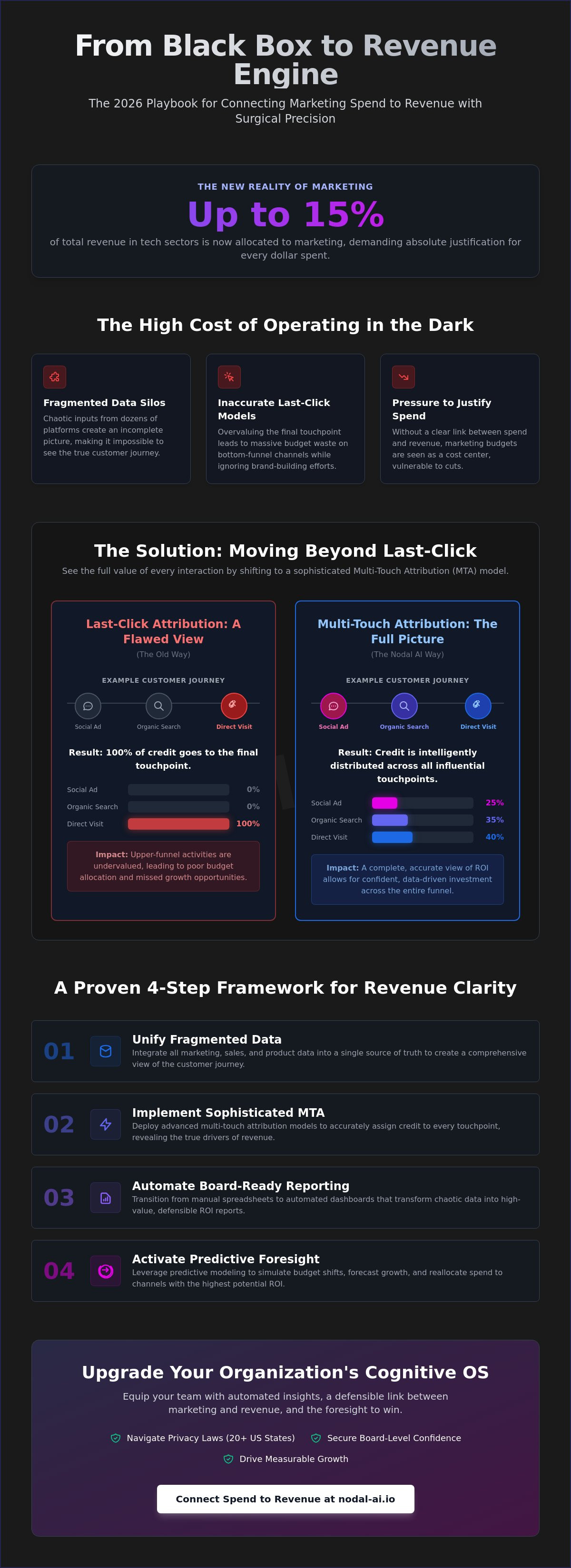
Last-click attribution is a relic. It rewards the final interaction while ignoring the weeks of brand building that made that click possible. This creates a distorted reality where top-of-funnel spend looks like a waste, even when it's your primary growth driver. To achieve total clarity in connecting marketing spend to revenue, you must move beyond this binary view. Multi-touch attribution (MTA) provides the necessary resolution by assigning fractional credit to every touchpoint in the sequence. It's the foundational layer for modern ai marketing analytics, turning fragmented signals into a coherent narrative of value.
While Marketing Mix Modelling (MMM) offers a high-level, top-down view of your ecosystem, MTA provides the granular, bottom-up data needed for tactical optimization. You don't have to choose one over the other. Combining them allows you to see both the forest and the trees, ensuring your capital is always working its hardest. This dual approach replaces the anxiety of guesswork with a professional, enterprise-ready perspective on your entire marketing operation.
Mapping the Complex Customer Journey
The path to purchase is rarely linear. A prospect might discover your brand through a social ad, conduct organic research days later, and finally convert via a direct visit. Without a sophisticated customer journey map, these "assisted conversions" go unrecognized. You risk cutting the very channels that introduce new customers to your brand. By visualizing the entire journey, you can justify upper-funnel awareness spend with hard data, proving its role in the final invoice. This process transforms passive assets into active participants in your revenue engine.
Solving the Walled Garden Attribution Gap
Relying on Meta or Google to report their own ROI is like letting a student mark their own homework. These walled gardens naturally claim credit for every conversion they touch, often leading to inflated results that don't reflect reality. To gain an objective perspective, use an independent third-party platform to verify cross-platform revenue impact. This reveals the "incrementality" of your spend. Incrementality is the true measure of whether an ad spend actually caused a sale or if that customer would have purchased anyway. When you master this, connecting marketing spend to revenue becomes a defensible science. If you're ready to see the truth behind your data, exploring how the Nodal Platform unifies your reporting is the next logical step.
The 4-Step Framework for Connecting Marketing Spend to Revenue
Transforming your marketing data from a chaotic cost center into a high-yield revenue engine requires a structured approach. You don't need more data; you need a system that makes your existing data work for you. By following this 4-step framework, connecting marketing spend to revenue becomes an automated reality rather than a manual chore. This process replaces the anxiety of guesswork with the confidence of streamlined, high-level perspectives.
- Step 1: Centralize. Pull fragmented data from every ad platform and your CRM into a single, unified source.
- Step 2: Normalize. Convert disparate currencies and data formats into a standardized structure for accurate comparison.
- Step 3: Apply AI Attribution. Deploy a model that reflects your specific sales cycle, assigning value where it's truly earned.
- Step 4: Automate. Deliver real-time executive insights that prove your impact on the bottom line.
Data Unification: Breaking Down the Silos
Manual spreadsheets are the enemy of growth. They're prone to error, they're instantly outdated, and they hide the truth about your performance. For London-based enterprises with global reach, automated data ingestion isn't a luxury; it's a necessity for survival. You need to see how a click in Tokyo influences a contract signed in Mayfair. This unification must also bridge the gap between digital touchpoints and "offline" revenue. Whether it's a high-value phone sale or a physical contract, your system must link these outcomes back to the original marketing investment. This creates a total source of truth that powers every decision you make.
Calculating True ROAS and Customer Acquisition Cost (CAC)
Platform ROAS is often a vanity metric. It's a self-reported number that ignores the broader context of your marketing ecosystem. To get a realistic financial picture, you must shift to "Blended ROAS." This looks at your total marketing investment against total revenue, providing a defensible figure for the board. When you factor in customer lifetime value (LTV), you gain the leverage to justify higher initial acquisition costs for high-value segments. This is where connecting marketing spend to revenue yields its highest returns. Utilizing automated reporting keeps your stakeholders aligned and ensures that everyone is looking at the same profitable growth metrics. It replaces the friction of manual labor with the momentum of real-time intelligence.
From Hindsight to Foresight: Using Predictive Modelling to Forecast Growth
Most marketing reports are post-mortems. They tell you where your money went, but they don't tell you where it should go next. In 2026, the most successful leaders have moved beyond reactive dashboards. They use foresight to stay ahead of the competition. By connecting marketing spend to revenue through a forward-looking lens, you gain the power to simulate growth before you commit a single pound of capital. This is the difference between surviving the market and leading it.
predictive modelling transforms your static data into a dynamic simulation engine. It analyzes historical patterns to forecast future ROI with surgical precision. This shift is essential. It replaces the question "What happened?" with "What will happen if we spend more on this channel?" It's a cognitive upgrade for your entire marketing department.
Every channel has a ceiling. AI identifies this "Diminishing Returns" curve. It tells you exactly when an extra pound in Search stops being a profit driver and starts being a waste of resources. Instead of reacting to a bad month, you receive proactive growth recommendations that keep your efficiency high. You're no longer just reporting on the past; you're architecting the future.
Scenario Planning for Budget Allocation
Run "What-If" scenarios to de-risk your strategy. Perhaps you're considering shifting 20% of your budget from Search to Video. Or maybe you're predicting revenue outcomes for a new market entry in Europe. Predictive ROI is the ultimate tool for board-level budget approval. It provides the financial certainty that stakeholders demand. By simulating these shifts, you ensure your capital is always allocated to its highest and best use.
Identifying High-Value Growth Levers
AI identifies hidden profitable segments that human analysts often overlook. It spots the micro-trends in your data that signal a massive opportunity for expansion. Machine learning also refines your attribution models over time, making your insights sharper with every transaction. You can automate the identification of low-performing campaigns, allowing for immediate budget reallocation. Stop wasting time on manual audits. Start focusing on the high-value levers that drive your organization forward. Book a Nodal Platform demo to see how predictive analytics can transform your growth strategy.
Nodal AI: Your Partner in Revenue Attribution and Growth
Nodal AI isn't just another analytics tool; it's a partner in your organization's evolution. Based in London and built with global enterprise-ready infrastructure, the Nodal Platform serves as the cognitive upgrade your marketing team needs to master the complexities of 2026. We understand that modern professionals are overwhelmed by chaotic inputs. Our mission is to turn that chaos into high-value outputs. By unifying your fragmented data streams into a single source of truth, we provide the clarity required to make high-stakes decisions with total confidence.
The gap between CMO ambition and CFO requirements is often filled with friction. Nodal closes this gap. By connecting marketing spend to revenue in real-time, we provide the financial evidence needed to support bold growth strategies. We transform your data from a passive asset into an active participant in your business process. This shift replaces the anxiety of manual reporting with the calm efficiency of streamlined, high-level perspectives.
The Nodal Advantage: Implementation and Insights
Success begins with a professional onboarding process that respects your unique business logic. We don't believe in one-size-fits-all solutions. Our team works with you to map your specific customer journey and integrate historical data, ensuring your revenue map is accurate from day one. You'll move beyond basic metrics to receive automated growth recommendations. Spend smarter, not just more. This intelligent optimization identifies exactly where your next pound of investment will yield the highest return. Security is non-negotiable. We provide enterprise-grade protection for your most valuable data assets, ensuring compliance with the latest global standards while you focus on scaling your results.
Ready to Prove Your Impact?
The era of manual data stitching is over. It's time to reclaim your productivity and focus on high-level strategy. By moving to AI-driven reporting, you eliminate the tedious labor that slows your momentum. You gain the ability to present a defensible, board-ready ROI report at a moment's notice. Stop guessing and start connecting marketing spend to revenue with a platform built for the future of commerce. Experience the relief of total clarity and the confidence of masterfully managed data. Book a Nodal AI Demo to see your revenue map today and take the first step toward frictionless growth.
Secure Your Seat at the Revenue Table
You've moved beyond the limits of last-click attribution and the anxiety of manual reporting. By implementing a framework that prioritizes data unification and predictive modeling, you've turned your marketing budget into a high-performance investment. The shift from gut-feel to revenue marketing isn't just a trend; it's a non-negotiable requirement for the 2026 landscape. You now have the tools to replace complexity with clarity.
Connecting marketing spend to revenue is no longer a luxury; it's your most powerful competitive advantage. You've seen how AI-powered multi-touch attribution and automated, executive-ready reporting transform chaotic inputs into high-value results. Our London-based team is ready to help you implement these future-facing analytics with enterprise-grade precision. This is your opportunity to lead with data and secure board-level confidence.
It's time to stop justifying the past and start architecting your future. Secure the clarity your organization deserves. Request a Personalised Growth Roadmap from Nodal AI today. Your journey from fragmented data to profitable growth starts now.
Frequently Asked Questions
How do I justify marketing spend when the sales cycle is long (6-12 months)?
Use multi-touch attribution to assign fractional value to early-stage interactions that eventually lead to a sale. Long cycles require tracking micro-conversions like whitepaper downloads or webinar attendance. These leading indicators prove that your top-of-funnel spend is effectively nurturing prospects. By connecting marketing spend to revenue across a 12-month horizon, you demonstrate the long-term value of your strategy to stakeholders who only see the final invoice.
What is the difference between ROAS and ROI in marketing spend justification?
ROAS measures gross revenue generated from specific ad spend, while ROI calculates net profit after accounting for all operational costs. Think of ROAS as a tactical efficiency metric for campaign managers. ROI is the strategic financial metric that the board actually cares about. Both are necessary for a complete picture, but only ROI proves that your marketing is a profit center rather than a discretionary expense.
Can I connect marketing spend to revenue without a sophisticated CRM?
You can achieve this by using a centralized platform to unify ad spend with your transaction records or manual sales logs. While a CRM streamlines the process, it isn't a strict requirement for connecting marketing spend to revenue. You simply need a reliable way to map customer identifiers from their first digital touchpoint to the final purchase. This process transforms fragmented spreadsheets into a coherent revenue map.
How does Multi-Touch Attribution handle cookie-less tracking in 2026?
Modern attribution relies on server-side tracking and first-party data to bypass the limitations of traditional cookies. With 20 US states now enforcing comprehensive privacy laws and the California Delete Act in full effect, privacy-first tracking is essential. These methods use secure, consent-based identifiers to maintain a unified view of the customer journey. You get the clarity you need without compromising user trust or regulatory compliance.
How much should I spend on marketing attribution software?
Your investment should align with the complexity of your marketing ecosystem and the total budget you need to justify. Organizations typically evaluate attribution tools based on the potential for waste reduction and the scale of their media spend. You should research current market rates for enterprise-grade analytics platforms to determine a budget that fits your specific needs. Focus on the return you'll gain from high-value growth recommendations.
What are the best KPIs to show the board to justify a budget increase?
Focus on Blended Customer Acquisition Cost (CAC), the LTV:CAC ratio, and Incremental Revenue. These metrics speak the language of the board by focusing on long-term stability and profitability. Showing that your marketing is driving sales that wouldn't have happened otherwise is the most persuasive argument for a budget increase. Use automated reporting to present these insights in a clear, executive-ready format that highlights financial performance.
How do I account for brand awareness spend that doesn't have a direct click-to-sale?
Customer journey mapping identifies the "assist" value of awareness campaigns that don't result in an immediate click. Multi-touch attribution assigns fractional credit to these brand-building touchpoints, proving they are active participants in the eventual conversion. Stop treating brand spend as a sunk cost. When you see the full path to purchase, you can finally justify the top-of-funnel investments that fill your pipeline.
Is it possible to track offline conversions back to digital ad spend?
Yes, you can bridge this gap by ingesting offline sales data like phone orders or physical contracts into your analytics platform. By matching unique identifiers like email addresses or phone numbers, you link digital ad interactions to real-world outcomes. This creates a total source of truth for your organization. It ensures that every pound of digital spend is accurately accounted for, regardless of where the final transaction occurs.


