

59% of CMOs report that their current budgets are insufficient to execute their strategy, yet the demand for efficiency has never been higher. When the CFO looks at the balance sheet, they often see marketing as an optional expense rather than a growth driver. This happens because fragmented data makes it nearly impossible to prove the exact ROI of your top-of-funnel spend. You know your campaigns work, but without a clear link to the bottom line, your resources remain on the chopping block.
Learning how to defend marketing budget cuts requires a shift from defensive reporting to offensive revenue mapping. You shouldn't spend 20 hours every week manually stitching together spreadsheets just to justify your team's headcount. This article demonstrates how to use multi-touch attribution and predictive modelling to turn chaotic data into high-value outputs. We will explore how to leverage the Nodal Platform to gain board-level trust, automate your reporting, and secure the investment you need for a successful 2026.
Key Takeaways
- Shift the board’s perspective from viewing marketing as an expense to seeing it as a revenue engine by closing the visibility gap.
- Replace vulnerable last-click models with Multi-Touch Attribution to prove the specific value of every top-of-funnel touchpoint.
- Master a tactical five-step framework on how to defend marketing budget cuts by presenting "cost of inaction" scenarios backed by predictive data.
- Use the correlation between Share of Voice and Share of Market to quantify the long-term financial decay of slashing brand awareness.
- Deploy the Nodal Platform to automate complex reporting and turn fragmented data into actionable Growth Recommendations.
The Psychology of the Budget Cut: Why Marketing is the First Target
The boardroom in 2026 is a place of hyper-efficiency. With the average marketing budget hovering around 7.7% of revenue, the pressure to justify every penny is immense. Board members often default to risk aversion when economic signals flicker. They look for costs to cut, and marketing often tops the list. This isn't because marketing is useless; it's because it's caught in the "Cost Centre Fallacy." When the board sees a line item without a direct, visible link to the next quarter's profit, they see a liability rather than an asset.
This "Visibility Gap" is the primary reason why marketers struggle with how to defend marketing budget cuts. If the board can't see the complex journey a customer takes, they won't fund the start of that journey. They focus on the harvest but ignore the soil. In 2026, where digital channels account for over 56% of spend, the complexity of these journeys has only increased. To protect your resources, you must bridge this gap with undeniable evidence of value.
The Cost Centre vs. Revenue Engine Debate
Traditional accounting is built for stability, not growth. It prioritises immediate savings because they are easy to measure on a spreadsheet. However, this narrow view ignores the reality of "Dark Social" and untracked touchpoints that influence modern buyers. Without sophisticated marketing attribution models, these critical interactions remain invisible. You must redefine your department's identity. A Revenue Engine is a system where every £1 spent has a mapped trajectory toward a specific financial outcome. It transforms marketing from a mysterious "black box" into a predictable driver of enterprise value.
The Risk of the 'Herd Mentality' in Budgeting
When competitors cut their spend, it's tempting to follow suit to protect short-term margins. This reactionary "herd mentality" is a strategic trap that leads to a rapid loss of competitive share of voice. Data highlights a harsh reality known as the BCG Regain Ratio; it often costs $1.85 to win back the market share that just $1.00 of maintenance spend would have protected. Slashing your budget today creates a massive debt for tomorrow. To stop this cycle, position your team as a Business Intelligence function. Use your data to show the board that your spend isn't just about ads. It's about the deep market insights and customer journey mapping that fuel every other department's success.
Attribution as a Shield: Moving Beyond Last-Click Reporting
Last-click attribution is the single greatest threat to your marketing department. It credits 100% of a conversion to the final touchpoint, effectively rendering your entire top-of-funnel strategy invisible on paper. Research shows that last-click models can misallocate up to 40% of marketing budgets. When a CFO reviews a spreadsheet where your brand awareness campaigns show zero direct conversions, those lines are marked for deletion. They don't see the five touchpoints that warmed the lead; they only see the final click that closed the deal.
To master how to defend marketing budget cuts, you must shift the conversation from "what happened last" to "what caused the growth." You need a data-driven shield that protects every stage of the funnel. This is where Multi-Touch Attribution (MTA) becomes your most powerful asset. It transforms your marketing from a series of disconnected ads into a unified revenue engine. Executives who successfully defend their budgets do so by proving that "low-performing" channels are actually vital entry points that feed the bottom line.
The Multi-Touch Attribution Advantage
Modern buying cycles aren't linear. By mapping the complex customer journey, you can visualize exactly how early-stage awareness impacts late-stage revenue. MTA assigns value to "assist" channels, ensuring that your social spend and content marketing receive the credit they deserve. Instead of guessing which ads to cut, you can use hard data to show that removing a specific TOFU campaign would cause a catastrophic drop in final conversions three months down the line. It turns your reporting from defensive to proactive.
Proving Incrementality to the CFO
Incrementality is the ultimate measure of marketing's true contribution. It answers the one question every board member asks: "What would happen to our revenue if we stopped this spend today?" Using AI-driven predictive modelling, you can run "ghost tests" to simulate these scenarios without actually risking your market share. This moves the discussion away from subjective opinions and toward objective financial reality. You aren't just asking for money; you're presenting a business case for essential growth. If you want to see how these insights look in practice, explore the Nodal Platform to start building your own revenue map.
Quantifying the Cost of Silence: The Long-Term ROI of Brand Spend
Silence isn't just quiet; it's expensive. When brand spend stops, you aren't saving money. You're liquidating your company's future revenue. This reality is the core of how to defend marketing budget cuts when facing a board focused solely on the immediate quarter. You must quantify the "time value" of your brand assets to show that today's savings are tomorrow's losses. Brand equity acts as a buffer against market volatility; once that buffer is gone, your performance marketing has to work twice as hard to achieve the same results.
The correlation between Share of Voice (SOV) and Share of Market (SOM) is a law of marketing physics. If your SOV falls below your current SOM, your market share will eventually contract to match. Understanding the time value of marketing allows you to frame brand spend as a long-term capital investment rather than a disposable expense. Predictive modelling can forecast the exact window when revenue will begin to slide following a cut, turning an abstract fear into a concrete financial warning for the CFO.
The Decay of Brand Equity
Stopping brand marketing creates a "performance cliff" that usually appears 6 to 12 months after the initial cut. While the balance sheet looks healthy today, the decay rate of brand awareness is already accelerating. As your brand fades from the collective consciousness, your future Customer Acquisition Costs (CAC) will inevitably spike because you're forced to buy every single lead from scratch. Silence in the market is an invitation for competitors to steal your audience. Once they capture that mindshare, the cost to win it back often doubles, destroying any short-term "savings" you achieved.
Protecting Customer Lifetime Value (CLV)
Retention marketing is your most budget-efficient defence strategy during lean periods. It's significantly cheaper to keep an existing customer than to acquire a new one, yet retention often suffers during broad budget slashes. By leveraging predictive modelling, you can identify high-value customers who are at risk of churn before they leave. Organizations that implement AI-driven insights report an average 41% increase in revenue by optimizing these existing relationships. Automated reporting provides the board with real-time retention health metrics, proving that your budget isn't just "spending" money; it's actively protecting the company's most valuable recurring assets.
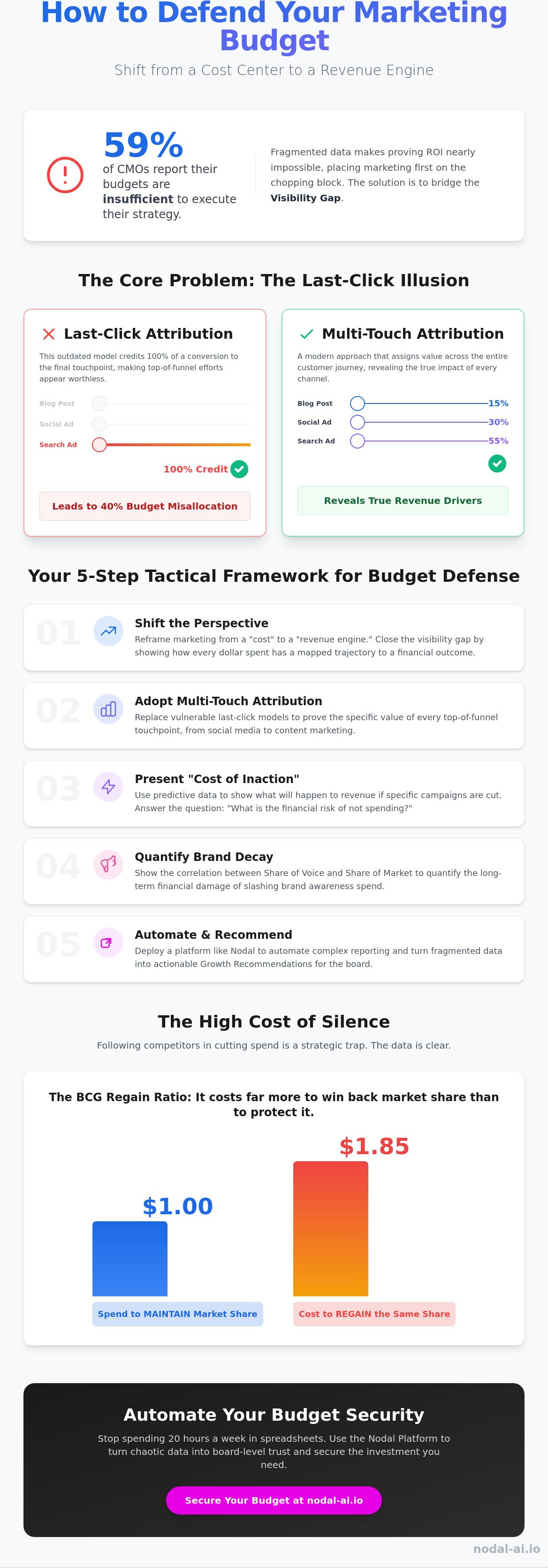
A 5-Step Tactical Framework for the Budget Defence Meeting
Walking into a budget review without a structured framework is a recipe for a reactionary cut. Successfully mastering how to defend marketing budget cuts requires you to speak the language of the CFO. You must pivot from defending "activities" to protecting "assets." Use this five-step tactical framework to transform your next board meeting into a strategic growth session.
- Step 1: Audit and eliminate genuine inefficiencies. Demonstrate fiscal responsibility by cutting the bottom 10% of underperforming tactics first. This builds the board-level trust needed to protect your high-value core.
- Step 2: Present the 'Cost of Inaction' scenarios. Use predictive data to show exactly how much revenue the company will lose over the next 18 months if specific budgets are slashed today.
- Step 3: Pivot to 'Investment Tiers.' Never offer a single budget number. Present three tiers of investment, each with its own mapped revenue outcome, making the board co-authors of the final decision.
- Step 4: Map the ripple effect. Use Multi-Touch Attribution to prove that cutting a "brand" channel will directly cause a drop in "performance" conversions within 90 days.
- Step 5: Propose an 'Efficiency Upgrade.' Instead of accepting a flat cut, offer to trade manual labor for AI-driven automation. This replaces recurring costs with scalable technology.
Scenario Planning: The Good, The Bad, and The Ugly
Board members hate uncertainty. By presenting three distinct budget options, you move the conversation away from "can we save money?" toward "what level of growth do we want to buy?" The 'Middle Path' usually wins because it balances risk with measurable returns. When your scenarios are backed by ai marketing analytics, you replace subjective opinions with objective financial modelling. This "What-If" analysis forces the board to acknowledge the risk of falling behind competitors who maintain their share of voice.
The Efficiency Counter-Offer
If the board insists on savings, offer a trade. Demonstrate that automated reporting can reclaim the 20 hours your team loses every week to manual data entry. This isn't just a convenience; it's a headcount optimization. Frame the Nodal Platform as a cognitive upgrade for the entire organization that identifies Growth Recommendations in real-time. By investing in better intelligence today, you protect the company's growth assets for the long term. Secure your budget and your future by implementing the Nodal Platform before your next review.
Leveraging Nodal AI to Automate Your Budget Security
Manual data entry is the silent killer of marketing departments. When your team spends 20 hours every week stitching together spreadsheets, they aren't just losing time; they're losing the ability to prove their value in real-time. The Nodal Platform replaces this chaotic manual labor with a streamlined, high-level perspective that CFOs trust. By transforming fragmented data into a unified business case, you move away from defensive quarterly meetings and into a continuous state of proven ROI. This is the definitive answer to how to defend marketing budget cuts in a fast-paced 2026 economy.
The platform doesn't just report on what happened; it provides Growth Recommendations for what should happen next. This shifts your role from a spender who asks for permission to a growth architect who offers financial certainty. Instead of presenting static numbers, you provide a dynamic roadmap for profit. Automated reporting ensures that your value is visible every single day, making your budget an untouchable asset in the eyes of the board.
Turning Intelligence into Action
Raw data often overwhelms non-technical stakeholders, leading to confusion and eventual budget slashes. Nodal’s predictive engines solve this by identifying hidden trends and "performance cliffs" before they impact the bottom line. This actionable intelligence allows you to pivot spend toward high-performing channels with surgical precision. For example, a London-based marketing team recently used the platform to reclaim over 20 hours of weekly reporting time. They shifted that energy from manual labor to high-level strategy, ultimately securing a 15% increase in their technology investment by proving the exact revenue trajectory of their campaigns.
Securing the Future of Your Marketing Department
In an era of strict data privacy and shifting regulations, AI-driven marketing attribution acts as your ultimate career insurance. It provides the transparency needed to remove all ambiguity from your reporting. You no longer need to guess how to defend marketing budget cuts because the data does the heavy lifting for you. You become the most informed person in the room, backed by predictive modelling that forecasts growth with high-tech accuracy. Stop playing defence and start leading the conversation. See how Nodal AI secures your budget and your growth by turning your marketing department into a cognitive upgrade for the entire organization.
Transform Your Marketing from a Cost Centre to a Growth Engine
The era of defensive spreadsheets and "black box" marketing is over. By adopting a data-driven framework, you replace boardroom uncertainty with actionable intelligence. You now have the tools to show how multi-touch attribution protects your top-of-funnel spend and how predictive modelling quantifies the long-term financial cost of market silence. Mastering how to defend marketing budget cuts isn't about arguing for more money; it's about providing the board with a transparent, risk-mitigated roadmap for revenue.
The Nodal Platform empowers you to lead these high-stakes conversations with absolute authority. With advanced multi-touch attribution and AI-powered growth recommendations, you turn fragmented data into a unified business case that CFOs can't ignore. Our London-based enterprise support team is ready to help you reclaim your time and protect your growth assets for the long term.
Defend your budget with the Nodal Platform today and transform your department into an untouchable revenue engine. Your growth is too valuable to leave to chance.
Frequently Asked Questions
How do I explain marketing ROI to a CFO who only cares about profit?
Explain ROI by mapping marketing spend to specific financial outcomes rather than vanity metrics. Use predictive modelling to show the CFO a direct trajectory from today's investment to next quarter's profit. This shifts the perception of marketing from an optional expense to a critical business intelligence function. It transforms your department into a revenue engine that powers the entire company's growth through measurable, high-value outputs.
What is the most common mistake when defending a marketing budget?
Relying on last-click attribution is the most dangerous error because it ignores the complex customer journey. When you only credit the final touchpoint, your top-of-funnel strategies look like failures on a spreadsheet. This lack of visible intelligence is often why marketers fail at how to defend marketing budget cuts when the board starts looking for short-term savings. You must prove the value of the assist.
Can AI really help me keep my marketing budget during a recession?
Yes, AI-driven analytics provide the transparency needed to protect your resources during economic downturns. Organizations implementing AI report an average 41% increase in revenue and a 32% reduction in customer acquisition costs according to industry research. By using predictive modelling to identify high-value opportunities, you can prove that your budget is an essential driver of stability rather than a disposable cost that can be easily slashed.
How much should I cut from my marketing budget if I have no choice?
Avoid cuts that drop your Share of Voice below your Share of Market, as this leads to inevitable share loss. Research into the BCG Regain Ratio shows it costs $1.85 to win back the market share that just $1.00 of maintenance spend would have protected. If you must cut, focus on eliminating verified inefficiencies identified through performance marketing analytics rather than slashing the brand awareness campaigns that fuel your future pipeline.
What is the 'Cost of Inaction' and how do I calculate it?
The 'Cost of Inaction' is the quantifiable revenue loss your company will suffer if you stop specific marketing activities today. You calculate this using predictive modelling to forecast the "performance cliff" where organic and paid leads drop off. By presenting these scenarios to the board, you make them co-authors of the risk. It moves the conversation from saving pennies today to losing pounds tomorrow.
How does multi-touch attribution help in budget negotiations?
Multi-touch attribution provides a data-driven shield by assigning value to every interaction in the customer journey. It proves that "low-performing" awareness ads are actually vital entry points that warm up leads for the final conversion. This level of clarity prevents the board from cutting essential top-of-funnel spend that they mistakenly view as unproductive. It turns chaotic inputs into high-value, defensible outputs for the board.
Is it better to cut brand marketing or performance marketing first?
Cutting brand marketing first is a common but fatal mistake that leads to a performance cliff six months later. While performance marketing delivers immediate clicks, brand spend builds the equity that lowers your long-term acquisition costs. Use your analytics to show that brand silence is an invitation for competitors to steal your audience. This mindshare loss eventually makes your performance ads twice as expensive to run.
How can automated reporting protect my marketing team's headcount?
Automated reporting reclaims the 20 hours your team loses every week to manual data entry, allowing them to focus on high-value strategy. By replacing tedious labor with the Nodal Platform, you demonstrate high-level efficiency to the board. This positions your team as a lean, tech-enabled unit that delivers maximum output with optimized resources. It proves that your headcount is focused on growth rather than manual administration.


