

While 87% of marketing leaders view data quality as critical, only 32% actually trust the numbers they see in their reports. You’ve likely felt that sinking feeling when Meta Ads claims 100 conversions, your CRM shows 60, and you’re left explaining the gap to a skeptical board. Learning how to fix marketing data discrepancies is no longer a luxury; it's a necessity for anyone tired of wasting hours on manual spreadsheet reconciliation. You need to replace the anxiety of misallocated ad spend with the confidence of a streamlined, high-level perspective.
This guide provides a strategic roadmap for 2026 to stop the drain on your resources and build a unified source of truth. We'll explore how to integrate first-party data, leverage AI-driven analytics, and automate your reporting. By the end, you'll have the tools to make confident budget allocations and transform chaotic inputs into high-value outputs. It's time to move beyond siloed platform reporting and embrace a cognitive upgrade for your entire organization.
Key Takeaways
- Identify the technical friction points, including privacy-first browsing and mismatched attribution windows, that create conflicting narratives in your marketing reports.
- Master the strategic framework for how to fix marketing data discrepancies by moving beyond "matching numbers" to aligning the underlying logic of your data sources.
- Implement a five-step process to audit your tech stack and unify identity resolution, transforming fragmented data into a clear roadmap for growth.
- Leverage the Nodal Platform to replace manual spreadsheet labor with automated reporting and predictive modeling, ensuring every dollar of ad spend is backed by a single source of truth.
What are Marketing Data Discrepancies and Why Do They Happen?
A marketing data discrepancy is the numerical mismatch between two or more platforms for the exact same metric. It's the frustrating reality where Meta Ads reports 100 conversions, but your internal sales system only confirms 65. This gap isn't just a minor tracking error; it's a fundamental symptom of the "Fragmented Data" problem. When your marketing tools operate in silos, they generate conflicting narratives that make it impossible to see the truth. To understand What are Marketing Data Discrepancies, you have to recognize that every platform uses its own proprietary logic to define a successful conversion.
The impact on your ROI is devastating. A 20% discrepancy in your reporting often leads to 100% uncertainty when it's time to request a budget increase. If you can't verify your numbers, you can't scale your successes with confidence. Your objective shouldn't be to just live with these gaps. Instead, you must shift your focus from managing fragmented inputs to generating actionable intelligence. Mastering how to fix marketing data discrepancies is about transforming your data from a passive list of numbers into an active participant in your business growth.
The Three Levels of Data Mismatch
Most organizations struggle with discrepancies at three distinct levels. First is Platform-to-Platform friction, such as the classic battle between Meta and Google Analytics 4. Each uses different tracking technologies and cookie durations. Second is Platform-to-CRM gaps, where your ad platforms report leads that never actually appear in your primary customer database. Finally, there is the Internal vs. External divide. This happens when your first-party server logs show one story, but your third-party pixels show another. These layers of confusion hide the true path your customers take.
The Hidden Cost of "Acceptable" Discrepancies
Accepting a "standard" margin of error is a strategy for stagnation. It leads to several critical failures that stall your momentum. When your reports don't match, you lose credibility with stakeholders and the boardroom. You also fall into the "Double Counting" trap. Since every platform wants to claim credit for a sale, you might think you have three conversions when you only have one. Finally, consider the wasted human capital. Your team spends hours on manual spreadsheet reconciliation. This is time stolen from high-level strategy and creative optimization. By learning how to fix marketing data discrepancies, you replace the anxiety of dirty data with the clarity of automated, accurate reporting.
The Technical Root Causes of Data Gaps in 2026
Technical friction is the primary driver of reporting chaos. In 2026, the gap between what you see in your dashboard and what actually happens in your bank account is wider than ever. This isn't just about "bad tracking." It's the result of a deliberate shift toward privacy-first browsing. Technologies like Intelligent Tracking Prevention (ITP) and the legacy of iOS 14.5 have effectively blindfolded traditional client-side pixels. If you want to understand how to fix marketing data discrepancies, you must first acknowledge that your data is being filtered through a complex web of "Walled Gardens." These platforms refuse to share granular data, forcing you to rely on their self-reported successes.
The solution requires moving from fragile client-side triggers to robust server-side tracking. While pixels rely on a browser's willingness to share information, server-side connections create a direct link between your business and the platform. This transition is essential for building A Strategic Framework for Data Governance that survives the current regulatory environment. Without this shift, your multi-touch attribution will remain a collection of guesses rather than a map for growth. To gain true clarity, you need performance marketing analytics that can reconcile these conflicting logics into a single narrative.
Attribution Logic: The War of the Windows
Chaos thrives in the mismatch of attribution windows. Meta might claim credit for a sale based on a 30-day view, while Google Analytics 4 defaults to a last-click model. This discrepancy creates a "Double Counting" trap where two different platforms claim 100% of the same revenue. View-through conversions are often the biggest source of this inflation. They credit an ad for a purchase simply because the user saw it, even if they never interacted. This creates historical data drift, making it nearly impossible to compare performance across different quarters accurately. You can't optimize what you can't accurately measure.
The Death of the Cookie and the Rise of Signal Loss
The era of the third-party cookie has ended, and signal loss is the new reality. Research shows that browser-based tracking now blocks up to 40% of marketing signals. Ad blockers and VPNs further degrade JavaScript-based analytics, leaving massive holes in your customer journey maps. By June 2026, twenty US states have enacted comprehensive privacy laws, including Indiana and Kentucky, which grant residents the right to opt out of targeted advertising. This regulatory pressure makes first-party data collection your only viable path forward. Learning how to fix marketing data discrepancies means building your own data ecosystem rather than renting one from a third party.
A Strategic Framework for Data Governance
Fixing the symptoms of data decay is a temporary patch. To achieve long-term stability, you must implement a robust Data governance strategy that addresses the structural flaws in your reporting. Many marketers waste weeks trying to force Meta and Google to show identical numbers. This is a losing battle. Instead, shift your focus from "matching numbers" to "aligning logic." You don't need the platforms to agree with each other; you need them to feed into a platform-agnostic "Source of Truth" that interprets their data objectively. This is where AI acts as the vital bridge, connecting fragmented touchpoints into a single, coherent customer journey.
Adopting a data governance framework transforms your analytics from a source of anxiety into a competitive advantage. It replaces the manual labor of spreadsheet reconciliation with the confidence of automated, high-level perspectives. When you standardize how data enters your ecosystem, you eliminate the ambiguity that leads to misallocated ad spend. Learning how to fix marketing data discrepancies starts with this cognitive upgrade. It’s about building a system that values transparency and measurable returns over the biased metrics of individual ad platforms.
Standardising Your UTM and Naming Conventions
Messy campaign naming is the primary fixable cause of reporting gaps. If your team uses "Facebook_Ads" in one campaign and "FB-Paid-Social" in another, your analytics engine will treat them as different channels. You must create a global taxonomy for every channel, campaign, and creative asset. Use a strict, hierarchical structure that leaves no room for interpretation. Automate your UTM tagging process to remove the risk of human error. When your naming conventions are uniform, your data flows into your reporting engine with perfect clarity, allowing for immediate, accurate analysis.
Implementing Server-Side GTM and API Conversions
The browser-based tracking era is over. To capture 100% of your marketing signals, you must move tracking from the client-side to the server-side. Implementing tools like Meta Conversions API (CAPI) and Google Enhanced Conversions ensures that your data bypasses ad blockers and browser restrictions. This server-side approach provides the data density required for advanced multi-touch attribution while maintaining strict GDPR compliance. It’s a critical step in how to fix marketing data discrepancies, as it provides a direct, unshielded link between your sales and your ad platforms. Stop relying on fragile cookies and start owning your data stream.
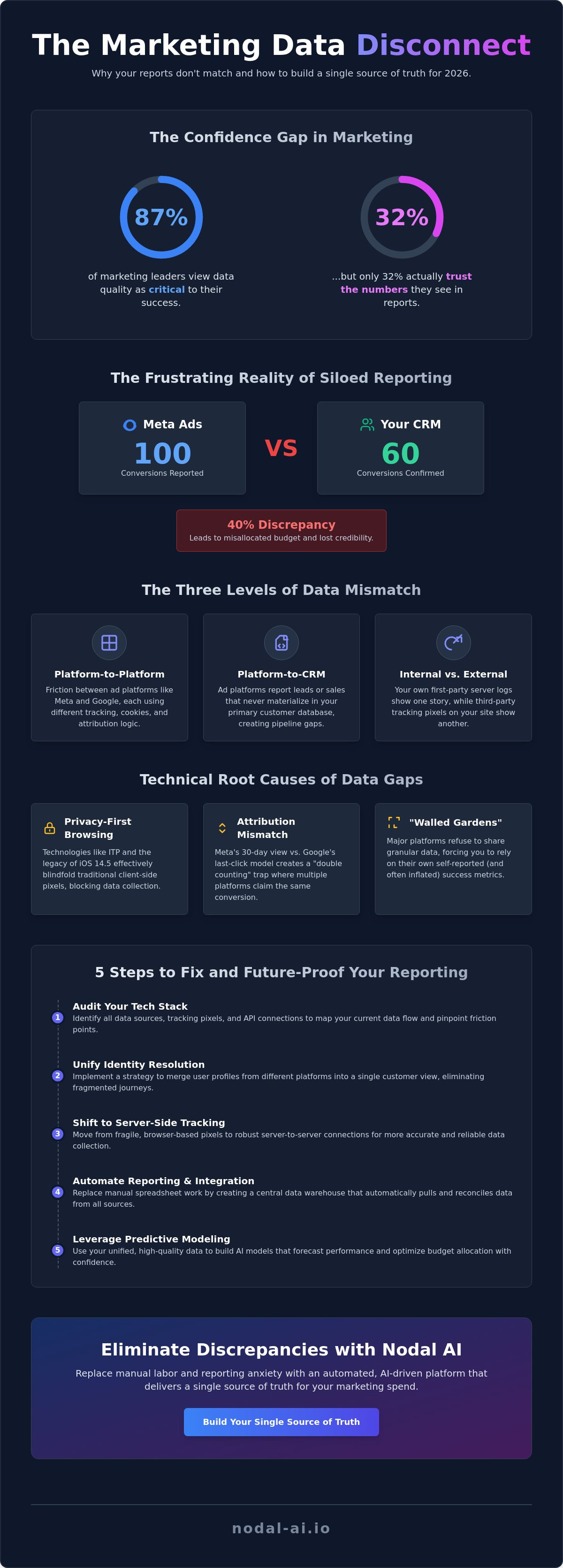
5 Steps to Fix and Future-Proof Your Marketing Reporting
Stop accepting a 10% margin of error as a success. This passive approach drains your budget and erodes stakeholder trust. To master how to fix marketing data discrepancies, you must implement a proactive technical roadmap that future-proofs your reporting. Replace the anxiety of manual reconciliation with the confidence of a unified identity resolution system. By following these five steps, you transform your data from a collection of fragmented touchpoints into a high-value business asset.
Success requires a shift from descriptive reporting to prescriptive intelligence. You need to unify your identity resolution using a first-party ID that survives the death of the cookie. Once your identity layer is solid, you can automate your reporting to eliminate the human errors inherent in manual spreadsheets. To achieve total clarity, deploy performance marketing analytics that bridge the gaps between your ad platforms and your CRM.
Step 1: The Data Audit and Leak Detection
Begin by comparing your raw server logs against your platform dashboards. This audit reveals exactly where your largest leaks occur. Look for "Ghost Conversions," which are sales that appear in your ad platforms but never materialize in your CRM. These are often caused by duplicate firing pixels or bot traffic. Verify your tag firing sequences to ensure that page-load delays aren't cutting off your tracking signals before they reach the server. Identifying these leaks is the first move in how to fix marketing data discrepancies permanently.
Step 2: Transitioning to Multi-Touch Attribution (MTA)
Moving beyond last-click models is essential for modern marketing attribution accuracy. Last-click ignores the complex, cross-device paths customers take before converting. MTA allows you to see the customer journey clearly by assigning fractional credit to every touchpoint. This approach stops the "Double Counting" trap where every platform claims 100% credit for the same sale. By aligning your attribution logic, you ensure that your budget is allocated to the channels that actually drive growth.
Step 3: Leveraging AI for Predictive Insights
Privacy restrictions in 2026 mean that 100% tracking is no longer possible. You must use predictive modelling to fill the gaps left by the "dark funnel." AI-driven engines estimate missing data points by analyzing historical patterns and behavioral signals. This shifts your perspective from merely looking at "what happened" to understanding "what to do next." Predictive insights allow you to scale your ad spend with confidence, even when individual user signals are obscured by privacy laws.
Eliminate Discrepancies with the Nodal Platform
Stop managing chaos. Start managing growth. The Nodal Platform provides the definitive answer to how to fix marketing data discrepancies by unifying your entire marketing ecosystem into a single, high-definition view. While individual platforms provide biased self-reporting, Nodal acts as an objective engine that unifies data from Meta, Google Search, and your CRM. This isn't just a dashboard; it's a cognitive upgrade for your organization. It transforms passive data points into active participants in your business process, ensuring every decision is backed by a single source of truth.
The manual labor of spreadsheet reconciliation is a relic of the past. Our automated reporting saves marketing teams 20+ hours per month, allowing you to reallocate headcount toward high-level strategy and creative optimization. By leveraging AI-driven performance marketing analytics, Nodal identifies profitable trends that siloed platform dashboards often miss. You move from the anxiety of "dirty data" to the confidence of precise, automated reporting that stakeholders can trust implicitly.
From Fragmented Data to Strategic Clarity
Nodal AI ingests data from every silo to eliminate the "Double Counting" trap. It uses advanced multi-touch attribution and customer journey mapping to provide a clear roadmap of how your customers actually convert. This process replaces the guesswork of last-click models with the accuracy of fractional credit. When you present your reports to the boardroom, you do so with 100% confidence. You no longer have to explain why numbers don't match; instead, you focus on the growth recommendations generated by our predictive modelling engine. This transparency is the cornerstone of how to fix marketing data discrepancies at scale.
Why London’s Leading Brands Choose Nodal
Enterprise-ready security and global scalability are built into our core architecture. We understand that complex customer journeys require more than just a generic tool. That’s why we provide dedicated onboarding and technical setup to ensure your server-side tracking and identity resolution are flawless from day one. Our platform is designed for professionals who demand measurable returns and time-conscious efficiency. It's time to replace your fragmented inputs with high-value outputs that drive long-term stability.
- Unified Source of Truth: Eliminate silos and stop the drain on your ad spend.
- AI-Driven Growth: Receive prescriptive recommendations that go beyond simple descriptive data.
- Frictionless Progress: Automate the tedious tasks that stall your team's momentum.
Don't let mismatched data dictate your marketing strategy. Book a demo with Nodal today to see your true performance and unlock the full potential of your marketing analytics.
Take Command of Your Marketing Truth
The era of "good enough" reporting has ended. You’ve seen how technical friction and siloed logic drain your resources and erode stakeholder trust. By standardizing your data governance and moving toward server-side tracking, you reclaim total control over your performance narrative. Mastering how to fix marketing data discrepancies isn't just about cleaning spreadsheets; it's about building a visionary foundation for long-term commercial stability. It is the cognitive upgrade your entire organization needs to thrive in a privacy-first landscape.
Stop wasting time on manual reconciliation and start focusing on high-level growth strategy. Transform your fragmented data into profitable decisions with Nodal AI. Our platform delivers AI-powered multi-touch attribution and predictive modelling that turns missing signals into actionable intelligence. Experience the immediate relief of automated reporting that saves your team 20+ hours every month. You have the tools to replace chaos with clarity. Take the first step toward a unified source of truth and scale your successes with absolute confidence today.
Frequently Asked Questions
Why does Meta Ads Manager show more conversions than Google Analytics?
Meta Ads Manager counts conversions based on its own self-attribution logic, which includes both click-through and view-through actions. Google Analytics 4 typically defaults to a last-click model, ignoring users who saw a Meta ad but eventually converted through a different channel. This fundamental mismatch in how each platform claims credit creates the inflated numbers you see in your social dashboards.
What is an acceptable percentage for marketing data discrepancies?
While many industry professionals report that a 10% to 20% discrepancy is common, you shouldn't treat this as a benchmark for success. High-performance brands leverage advanced architecture to bring this gap below 5%. Learning how to fix marketing data discrepancies means moving beyond "acceptable" errors to achieve a single, platform-agnostic source of truth for your budget allocation.
How does iOS 14 and 17 impact marketing data accuracy?
These updates significantly degrade signal quality by restricting third-party cookies and stripping tracking parameters from URLs in private browsing. iOS 14 introduced the App Tracking Transparency framework, which allows users to opt out of tracking entirely. iOS 17 furthered this with Link Tracking Protection, which removes identifiers like GCLIDs from links, making traditional click-based attribution much less reliable.
Can server-side tracking completely fix data discrepancies?
Server-side tracking is a powerful tool that captures signals blocked by browsers, but it isn't a silver bullet for every reporting gap. It ensures your data reaches your server, yet it won't resolve the logical differences in how platforms define a conversion. You must combine server-side tracking with a unified attribution layer to reconcile conflicting reporting rules across your tech stack.
What is the difference between client-side and server-side tagging?
Client-side tagging executes scripts directly in the user's browser, which makes it fragile and easily blocked by ad blockers or privacy settings. Server-side tagging sends data to your own secure server first before forwarding it to external platforms. This creates a robust and compliant data stream that provides a cognitive upgrade for your entire analytics ecosystem.
How do different attribution models affect data reporting?
Attribution models dictate how credit is distributed across the customer journey, which directly impacts your reported ROI. A last-click model ignores the early touchpoints that drive discovery, while a first-click model misses the final triggers that close the sale. Using mismatched models across different platforms is a primary driver of fragmented reporting and misallocated ad spend.
Is it possible to track the customer journey across multiple devices accurately?
Yes, you can track cross-device journeys accurately by implementing first-party identity resolution. By using hashed identifiers like email addresses or persistent login IDs, you link a mobile interaction to a desktop purchase. This transition from anonymous pixels to known identities provides the streamlined, high-level perspective required for modern performance marketing.
How can AI help in resolving missing marketing data?
AI uses predictive modeling to estimate missing conversions by analyzing historical patterns and behavioral signals. It fills the gaps in the "dark funnel" where technical tracking is impossible due to privacy restrictions. This is a critical component of how to fix marketing data discrepancies, as it transforms incomplete inputs into prescriptive growth recommendations for your business.


