

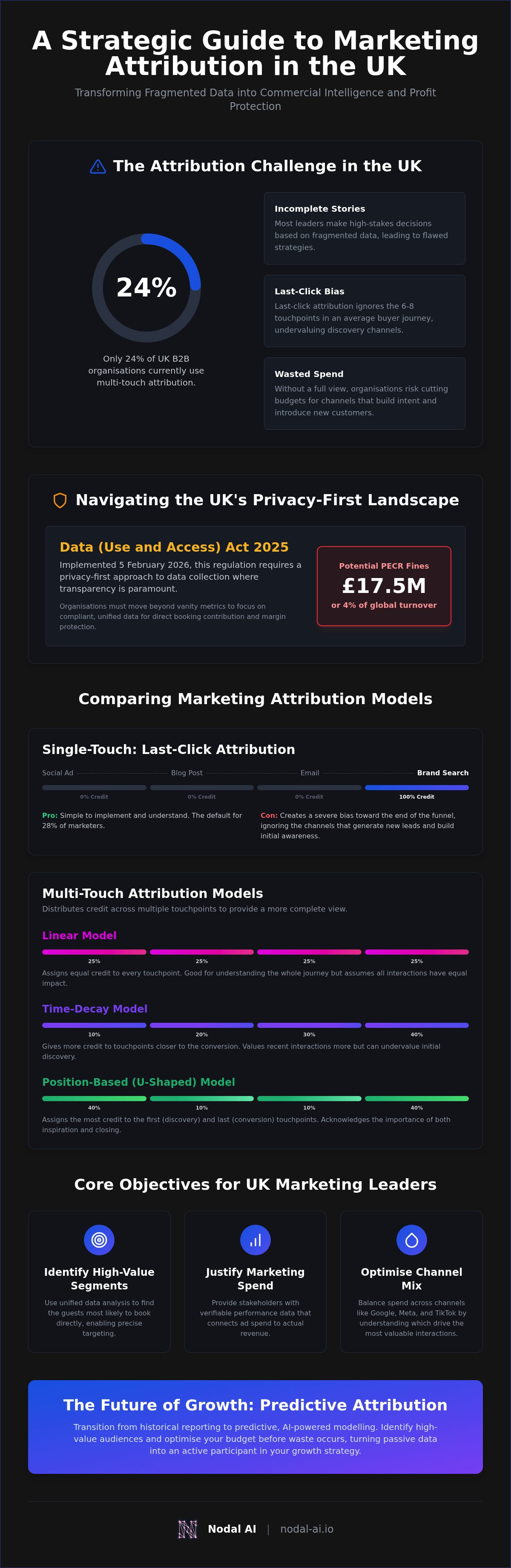
Only 24% of UK B2B organisations currently use multi-touch attribution, which means most leaders are making high-stakes decisions based on incomplete stories. You know the frustration of seeing fragmented data scattered across your PMS, CRM, and ad platforms. It's difficult to justify spend when last-click bias credits the final touchpoint while ignoring the five interactions that actually built the intent. Mastering marketing attribution models UK is no longer a technical luxury. It's a commercial necessity for any brand looking to protect its margins against OTA leakage and rising acquisition costs.
We'll show you how to turn these chaotic inputs into high-value outputs by unifying your tracking into a single, profitable view of the guest journey. You'll learn to navigate the 2026 regulatory landscape, including the Data (Use and Access) Act 2025, while implementing a framework that reduces acquisition costs through precision. This guide provides the cognitive upgrade your organisation needs to move from manual reporting to automated commercial intelligence. Let's transform your passive data into an active participant in your growth strategy and realise the true potential of your marketing spend.
Key Takeaways
- Navigate the shift toward privacy-first tracking under the Data (Use and Access) Act 2025 to maintain compliant and transparent data collection.
- Evaluate the strengths and limitations of various marketing attribution models UK to move beyond the inaccuracies of last-click bias.
- Unify fragmented data from your PMS and CRM systems to eliminate silos and effectively reduce OTA leakage.
- Deploy a strategic framework that focuses on direct booking contribution and reducing customer acquisition costs through better spend allocation.
- Transition from historical reporting to predictive modelling to identify high-value audiences and optimise your budget before waste occurs.
Defining Marketing Attribution in the UK Regulatory Landscape
Marketing attribution is the process of assigning commercial value to every interaction within a guest journey. It's about seeing the invisible threads that connect a social media click to a confirmed hotel booking. In the UK market, this clarity is becoming harder to achieve but more vital to protect. By identifying exactly where value is created, hospitality leaders can adopt a "make more, waste less" philosophy, stripping away inefficient spend to reinvest in high-performing channels. This transition from simple tracking to advanced commercial intelligence is what separates market leaders from those struggling with rising acquisition costs.
Effective marketing attribution models UK allow you to reclaim control over your margins. The landscape shifted significantly on 5 February 2026 with the implementation of the Data (Use and Access) Act 2025. This regulation requires a privacy-first approach to data collection, where transparency is paramount and consumer rights are strictly enforced. To succeed, you must move beyond vanity metrics like impressions and focus on direct booking contribution and long-term margin protection.
The Role of Attribution in Modern Commercial Strategy
Hospitality brands often find themselves trapped in a cycle of high OTA commissions and fragmented reporting. Implementing a sophisticated attribution framework allows you to move beyond bottom-line anxiety and focus on profit protection. By 2026, the regulatory environment has evolved to align PECR fines with UK GDPR levels, reaching up to £17.5 million or 4% of global turnover. This makes compliant, unified data more valuable than ever. When you understand the full customer lifecycle, you can reduce your reliance on third-party platforms and drive guests toward your direct booking engine.
Core Objectives for UK Marketing Leaders
Your primary goal is to turn chaotic data into a streamlined perspective of performance. This involves several critical steps that move your organisation from manual labor to high-level strategy:
- Identify high-propensity segments: Use unified data analysis to find the guests most likely to book directly.
- Justify marketing spend: Provide stakeholders with verifiable performance data that connects ad spend to actual revenue in your PMS.
- Optimise the channel mix: Balance your presence across Google Ads, Meta, and TikTok by understanding which platforms drive the most valuable interactions.
The average buyer journey now involves 6 to 8 touchpoints before a conversion. If you rely on last-click data, you are ignoring the majority of the story and potentially cutting budget from the very channels that introduce guests to your brand. Utilising Performance Marketing Analytics ensures you see the full picture and allocate resources with total confidence.
Comparing Primary Marketing Attribution Models: From Last-Click to Multi-Touch
Selecting the right framework is the first step in transforming chaotic data into a streamlined commercial perspective. While many organisations remain tethered to simplistic methods, the complexity of the modern guest journey requires a more sophisticated lens. Marketing attribution models UK vary from basic single-point tracking to advanced algorithmic systems that personify your data. By assigning weight to actual performance patterns, you can move from defensive reporting to aggressive growth.
Linear and time-decay models offer a broader view by distributing credit across the entire customer lifecycle. Linear models treat every interaction with equal importance, while time-decay models give more weight to touchpoints closer to the conversion. Position-based models, or U-shaped frameworks, value the first discovery and the final booking equally. This acknowledges that while the final click closes the deal, the initial inspiration was the catalyst for the entire journey.
The Limitations of Single-Touch Attribution
Last-click attribution remains the default for 28% of marketers because it's easy to implement. However, this ease comes at a high price. It creates a fundamental bias toward the end of the funnel, often leading brands to over-invest in brand search terms while starving the discovery channels that actually generate new leads. In luxury hospitality, a guest rarely books on their first visit. They might discover your property through a high-impact social media video, browse your amenities on a mobile device, and eventually book via a direct search weeks later. A first-touch model credits the video but ignores the booking intent. A last-click model does the opposite. Both distort your ROI and lead to inefficient budget allocation.
Advanced Multi-Touch Frameworks
To capture the transition from discovery to loyal guest, you must move toward multi-touch frameworks. W-shaped and full-path models provide a granular look at the journey, identifying the key moments that turn a prospect into a confirmed guest. Custom algorithmic models allow you to tailor these rules to your specific business logic and unique guest behaviour. This ensures your budget is allocated based on verifiable performance rather than outdated assumptions.
Transitioning from manual reporting to advanced insights doesn't have to be a technical hurdle. The Nodal Platform automates this process, unifying disparate signals into a single, profitable view of your marketing performance. By adopting a data-driven approach, you can identify high-propensity segments and optimise your channel mix with total confidence. Stop guessing which channels work and start investing where the data proves it leads to direct bookings.
The Fragmented Data Challenge: Why Standard Models Often Fail
Standard models often fail because they assume a linear path that simply doesn't exist in hospitality. Your Property Management System (PMS), CRM, and ad platforms typically operate as isolated islands. When these systems don't communicate, you lose the ability to track the guest journey accurately. Data silos kill margins. This fragmentation is the primary driver of OTA leakage, where marketing spend drives interest, but the final booking happens on a third-party platform because the direct connection was lost in the data gap. By unifying these sources, you can reclaim the guest relationship and stop wasting budget on untracked interactions.
Disconnected systems also degrade the guest experience. If your marketing doesn't realise a guest has already booked through your PMS, you risk sending redundant or irrelevant ads. Solving the walled garden problem requires reconciling data from Meta, Google, and Amazon into a single source of truth. Without this integration, your marketing attribution models UK will always provide a distorted view of reality. You need a framework that bridges these gaps to reveal the true commercial value of every touchpoint.
Unifying Hospitality Tech Stacks
To achieve total clarity, you must bridge the gap between disparate sources. Integrating platforms like Oracle OPERA, Mews, and SevenRooms into a unified intelligence engine transforms passive data into active commercial assets. Historical data ingestion is a critical part of this process. It allows for accurate year-on-year performance tracking, ensuring your growth strategies are based on long-term trends rather than seasonal anomalies. A modular architecture ensures your business can scale its marketing attribution models UK as your portfolio grows, providing a future-proof foundation for commercial intelligence.
Identifying Inefficiency through Data Consolidation
Consolidating your data allows you to spot early signs of need periods by analysing occupancy data alongside real-time marketing demand. This level of insight enables you to shift budget away from high-occupancy dates toward the gaps that actually require support. You can also measure the true value of guest segments by looking beyond room revenue to include ancillary spend from POS systems. This holistic view was instrumental for Ovolo Hotels, which achieved a 15.3% reduction in acquisition costs by using the Nodal Platform to unify its fragmented systems. By turning chaotic inputs into high-value outputs, you can ensure every pound of your marketing budget is working toward direct, profitable results.
Strategic Implementation: Choosing and Deploying Your Framework
Deploying marketing attribution models UK represents a cognitive upgrade for your entire organisation. Implementation is the bridge between chaotic data and commercial clarity. Before you begin, you must assess your current data maturity. Are your systems ready for the transition to multi-touch analysis? Many brands start with a fragmented view, but the goal is to reach a stage where every click is tethered to a specific booking. Setting clear commercial KPIs is essential for this journey. You should focus on metrics that directly impact the bottom line: Return on Ad Spend (ROAS), Customer Acquisition Cost (CAC), and direct booking contribution.
The technical setup requires more than just a tracking pixel. It involves deep API integrations with your core systems, such as your PMS and CRM. This ensures that data flows seamlessly between your marketing efforts and your actual revenue. Aligning your internal teams is the final piece of the puzzle. When marketing, sales, and revenue management use the same data, you eliminate friction and ensure everyone is working toward the same growth targets. This unified perspective turns your passive data into an active participant in your business strategy.
A Roadmap for Successful Onboarding
Professional implementation services play a vital role in configuring custom dashboards that reflect your unique business logic. This process begins by mapping the complex customer journey and identifying every critical guest touchpoint, from the initial social media discovery to the final loyalty sign-up. A well-mapped journey allows you to Discover the features that power accurate attribution and ensure no value is lost in the gaps between systems. By turning complex inputs into streamlined outputs, you create a sense of momentum that drives the entire organisation forward.
Measuring the Impact of Attribution
You cannot manage what you do not measure. Establishing a baseline for your ROAS and acquisition costs is critical before you transition to a new model. This baseline provides the weight needed to quantify the value of your new framework. Once deployed, you can conduct incrementality testing to prove the true value of specific channels, identifying which ads truly drive bookings and which are simply following the guest. Refining your strategy based on automated reporting and growth recommendations ensures your marketing spend is always optimised for maximum profit. This continuous cycle of measurement and refinement is the hallmark of a high-performing commercial organisation.
Book a demo to see how the Nodal Platform unifies your commercial data
The Future of Growth: Transitioning to AI-Powered Predictive Attribution
The final stage of commercial maturity involves moving beyond historical reporting. While standard marketing attribution models UK often focus on what happened yesterday, the real value lies in predicting what will happen tomorrow. Predictive modelling allows you to transition from defensive data collection to offensive growth strategies. By using AI to identify high-propensity audiences, you can optimise your marketing spend before a single pound is wasted on low-value traffic. This proactive approach ensures your budget is always directed toward the interactions most likely to result in direct bookings.
Implementing advanced marketing attribution models UK allows you to integrate external signals that human analysts often miss. By incorporating weather patterns, FX rates, and local event schedules into your attribution framework, you can predict demand shifts with surgical precision. If a sudden currency fluctuation makes the UK a more attractive destination for international guests, your systems should react instantly. This level of commercial intelligence protects your profit margins by ensuring you never over-spend during peaks or under-invest during potential need periods. It turns your data from a passive record into an active participant in your revenue strategy.
Beyond Attribution: Predictive Commercial Intelligence
True commercial intelligence uses AI to forecast demand and adjust marketing spend in real-time. This process moves beyond tracking clicks to seeing the future of your occupancy. When your system identifies a projected dip in bookings for a specific period, it can automatically trigger growth recommendations to fill those gaps. This helps hospitality brands maintain consistent occupancy even during traditional low-demand cycles. To see this technology in action, you can book a demo to see predictive modelling in action and realise the power of forward-facing analytics.
Achieving Long-Term Scalability
Transforming fragmented data into a competitive advantage is the ultimate goal for UK enterprises. The Nodal Platform acts as a cognitive upgrade for your entire commercial organisation, turning passive data points into high-value outputs. By unifying your PMS, CRM, and ad platforms, you create a scalable foundation that grows alongside your portfolio. This shift from manual labour to automated intelligence allows your team to focus on high-level strategy rather than tedious reporting. For a deeper dive into these strategies, explore our sibling guide on Mastering Marketing Attribution: The Definitive Guide for 2026. The future of marketing is not just about knowing where your guests came from; it is about knowing where they will come from next.
Future-Proof Your Growth Strategy
The shift toward advanced marketing attribution models UK represents a fundamental transformation for hospitality leaders. By unifying your PMS, CRM, and ad data, you replace the anxiety of manual reporting with the confidence of high-level commercial intelligence. This framework has already proven its value, delivering a 24.5% increase in ROAS and a 15.3% reduction in acquisition costs for organisations that prioritise transparency. Backed by experience that earned Gold in the Performance Marketing Awards, our approach turns your passive data into an active participant in your business success.
You now have the framework to move beyond the inaccuracies of last-click bias and navigate the 2026 regulatory landscape with ease. Transitioning to predictive modelling allows you to identify high-propensity guests and protect your profit margins before waste occurs. It's time to realise the true potential of your marketing spend and secure your competitive advantage in a fragmented market.
Book a demo of the Nodal Platform to transform your marketing data into profitable decisions
Take the next step toward total clarity and watch your direct bookings thrive.
Frequently Asked Questions
Which marketing attribution model is best for UK hospitality brands?
Data-driven or multi-touch models are superior because they account for the 6 to 8 touchpoints typical in a modern guest journey. While last-click is common, it ignores the early discovery phases that build intent. A position-based or custom algorithmic model provides the most accurate view by valuing both the initial inspiration and the final booking. This allows brands to use marketing attribution models UK to allocate budget based on verifiable performance rather than simplistic assumptions.
How does the Nodal Platform handle data from fragmented systems like PMS and POS?
The Nodal Platform unifies disparate data sources through deep API integrations with systems like Oracle OPERA and Mews. It ingests historical and real-time data to bridge the gap between marketing spend and actual revenue. By consolidating these silos into a single source of truth, the platform transforms passive assets into active commercial intelligence. This eliminates the manual labour of reconciling spreadsheets and provides a streamlined perspective of your total performance.
Can multi-touch attribution help reduce our reliance on OTAs?
Yes, it identifies the specific channels that drive direct bookings, allowing you to bypass high OTA commissions. By understanding the full customer journey, you can reinvest in the high-performing discovery channels that lead guests directly to your website. Multi-touch attribution reveals where OTA leakage occurs, giving you the insights needed to reclaim the guest relationship and protect your profit margins through a more efficient and transparent direct-to-consumer strategy.
What is the typical ROI after implementing a multi-touch attribution model?
Organisations implementing multi-touch attribution report an average budget reallocation of 18% to 22% across channels. This strategic shift often leads to a 12% to 19% reduction in customer acquisition costs. Specifically, users of the Nodal Platform have seen a 24.5% increase in ROAS. These results demonstrate how moving from manual tracking to automated intelligence provides a concrete financial weight to your marketing efforts and secures measurable, long-term returns.
How does UK GDPR compliance affect marketing attribution in 2026?
The implementation of the Data (Use and Access) Act 2025 requires a privacy-first approach to all data collection. Compliance now involves mandatory complaint handling and transparent opt-out options for analytics. Using marketing attribution models UK requires prioritising first-party data and secure integrations to maintain trust. Failure to comply can lead to fines of up to £17.5 million, making it vital to use platforms that treat security and privacy as core features.
Is multi-touch attribution software difficult to integrate with existing CRM systems?
Integration is a streamlined process when using a modular intelligence engine designed for the hospitality sector. The Nodal Platform integrates directly with leading enterprise CRM platforms to ensure a seamless flow of guest data. While the underlying technology is complex, the user experience is effortless. Professional onboarding services map your specific guest touchpoints, turning a potentially chaotic setup into a cognitive upgrade that provides immediate value without deep technical specialisation.
How often should we review our chosen attribution model?
You should review your model quarterly to ensure it aligns with changing guest behaviour and market conditions. However, automated reporting provides real-time insights that allow for continuous refinement. As UK regulations or platform rules, such as GA4 updates, evolve, your framework must remain flexible. Regular reviews help you identify new high-propensity segments and adjust your spend allocation to maintain a competitive advantage in an increasingly complex and fragmented digital landscape.
What is the difference between marketing mix modelling and multi-touch attribution?
Multi-touch attribution tracks individual guest touchpoints at a granular level, while marketing mix modelling (MMM) uses aggregate data to measure high-level channel impact. MMM is excellent for long-term strategic planning and offline channels, whereas multi-touch attribution provides the real-time, actionable data needed to optimise digital ad spend. Combining both methods offers a total view of performance, bridging the gap between historical trends and immediate commercial growth for your organisation.


