

What if you could achieve a 15.3% reduction in acquisition costs simply by connecting the dots your organisation already owns? For most hospitality leaders, guest behaviour remains trapped within legacy systems that refuse to talk to one another. You likely feel the daily friction of manual reporting and the anxiety of seeing profit margins eroded by OTA leakage. It's a common struggle where the lack of unified marketing analytics creates a fog that obscures your true commercial yield, forcing a heavy reliance on expensive external channels.
This article provides a roadmap for the 2026 hospitality strategy, showing you how to consolidate disparate data into a single, modular intelligence layer. You'll learn how to maximise your ROAS and realise a single view of guest behaviour by mastering your guest journey. We will explore how the Nodal Platform acts as a cognitive upgrade for your business, replacing manual labour with automated growth recommendations that drive direct bookings and long-term stability.
Key Takeaways
- Move beyond simple dashboards by implementing unified marketing analytics to create a single intelligence layer for your hospitality data.
- Eliminate manual CSV reporting and data cleaning through automated ingestion across your PMS, POS, and CRM systems.
- Reclaim your profit margins by identifying and plugging OTA leakage to drive more direct booking revenue.
- Follow a structured five step audit to transform fragmented silos into actionable growth recommendations for 2026.
- Achieve a cognitive upgrade for your organisation that delivers measurable improvements in ROAS and guest lifetime value.
What is Unified Marketing Analytics for Hospitality?
Unified marketing analytics represents a fundamental shift from merely observing past performance to actively predicting future growth. For a modern hospitality brand, it serves as a single source of truth that bridges the gap between marketing spend and actual room revenue. It's the difference between seeing a collection of disconnected metrics and understanding a complete commercial narrative. Many organisations mistake simple data visualisation for a true intelligence engine, yet the two are worlds apart.
A standard dashboard might show you that bookings are up; however, a modular intelligence engine tells you exactly which specific touchpoint triggered that booking. It reveals how much profit remained after the OTA took their commission. In 2026, the role of AI is to act as this central nervous system. It ingests raw, chaotic data from every corner of your business and transforms it into precise growth recommendations. This replaces the anxiety of manual data cleaning with the confidence of high-level, actionable perspectives.
Hospitality brands face a unique fragmentation crisis that standard retail does not encounter. While an e-commerce site might use one platform for everything, a hotel must juggle legacy Property Management Systems, Point of Sale tools, and various digital marketing channels. These systems are often silos that refuse to communicate. Mastering unified marketing analytics allows you to break these silos down and reclaim control over your guest data.
The Core Components of a Unified View
To achieve total clarity, your intelligence layer must synthesise three distinct data streams into one cohesive picture. This requires a modular architecture that connects:
- Demand signals: Real-time performance and spend data from Google Ads, Meta, and TikTok.
- Operational data: Live occupancy, guest profiles, and commercial yield from PMS systems like Mews or Opera.
- Reputation metrics: Sentiment analysis and guest feedback from platforms such as TripAdvisor.
Connecting these dots allows you to see the entire guest journey. You can finally track a guest from their first social media interaction to their final checkout at the front desk.
Why 2026 is the Year of Data Consolidation
The industry is currently hitting a critical tipping point. Rising operational costs and labour shortages are squeezing profit margins to the limit, making every booking essential. You can no longer afford to guess which channels drive value and which simply drain your budget. There is a decisive shift away from simplistic last-click models toward complex, multi-touch frameworks. Sophisticated marketing attribution now provides the essential foundation for this unification. This transition ensures that every pound spent on marketing is tethered to a measurable commercial outcome, protecting your yield against market volatility and reducing your reliance on expensive third-party platforms.
The Mechanics of a Unified Intelligence Layer
Building a robust foundation for unified marketing analytics requires moving beyond the "spreadsheet trap" that plagues many hospitality organisations. Manual CSV exports are the enemy of speed; they create a lag between data collection and commercial action. A modern intelligence layer replaces these static files with real-time, API-driven data pipelines. This shift ensures that your revenue and marketing teams are always working with live performance metrics rather than historical echoes. It transforms data from a passive record into an active driver of growth.
The true power of this system lies in its semantic model. This acts as a universal translator, making complex data sets analysis-ready for non-technical teams. Instead of requiring a data scientist to interpret every query, your marketing managers can access growth recommendations directly. A successful implementation of unified marketing analytics relies on this modular architecture, allowing you to tailor insights to specific hospitality needs. It replaces the anxiety of technical complexity with the confidence of streamlined, high-level perspectives.
Connecting Disparate Data Sources
Mapping the guest journey from the first ad impression to the final room booking involves connecting multiple digital handshakes. You must bridge the gap between your CRM and POS systems to understand total guest value. By leveraging Nodal AI features, you can integrate these disparate sources into a single, continuous intelligence layer. This process ensures strict data governance across global portfolios, maintaining compliance while providing the clarity needed to optimise commercial performance. It's about creating a central nervous system that links every touchpoint in the guest lifecycle.
The Role of AI-Driven Audience Segmentation
Once your data is consolidated, the focus shifts to predictive modelling. AI-driven segmentation allows you to identify high-propensity guest segments based on historical stay data and digital behaviour. You can predict which guest profiles are most likely to book direct, allowing you to focus your acquisition spend where it generates the highest yield. This intelligence enables the automated delivery of personalised offers, reducing churn risk and reclaiming profit from third-party channels. If you are ready to see how this modular engine can refine your guest strategy, you might book a demo to explore the platform's capabilities.
The Commercial Impact: Profit Margin Erosion and OTA Leakage
High commission costs from Online Travel Agencies (OTAs) act as a silent tax on your property's occupancy. While these platforms provide essential visibility, they frequently cannibalise direct traffic from guests who were already familiar with your brand. Implementing unified marketing analytics allows you to see exactly where this leakage occurs. By connecting your marketing spend to your actual Property Management System (PMS) data, you can identify the specific moments when a potential direct guest chooses an OTA instead. This visibility is the first step toward stopping profit margin erosion and reclaiming your commercial independence.
The results of this transparency are concrete and measurable. Ovolo Hotels, for example, achieved a 15.3% reduction in acquisition costs by using these insights to refine their channel mix. When you understand the relationship between average booking value and specific channel performance, you can stop over-investing in low-yield platforms. You move from a state of reactive occupancy-filling to a strategy of proactive yield optimisation. It's a transformation from being a passive recipient of bookings to becoming an active architect of your own profit.
Reclaiming Your Direct Booking Share
Multi-touch attribution is the engine that drives this recovery. It credits the specific digital touchpoints, such as a targeted social ad or a refined paid search campaign, that ultimately lead to a direct reservation. By optimising paid search revenue through better audience targeting, hospitality brands have seen significant growth. One data-driven strategy resulted in a 13.8% increase in bookings by focusing spend on high-propensity guests rather than generic broad-match terms. This ensures your budget supports your most profitable channels first, protecting your margins from third-party erosion.
Operational Efficiency and Waste Reduction
Beyond direct revenue, the shift to unified marketing analytics solves the chronic problem of manual labour. Marketing teams often spend over 20 hours per week cleaning data and building reports; this is time that should be spent on high-level strategy. Automation eliminates this waste, allowing your staff to focus on identifying "need periods" early. By spotting gaps in occupancy weeks in advance, you can adjust promotional spend with surgical precision. This "Make more, waste less" philosophy ensures that every pound of your budget is working to fill a bed that would otherwise stay empty, turning your data into a high-value commercial asset.
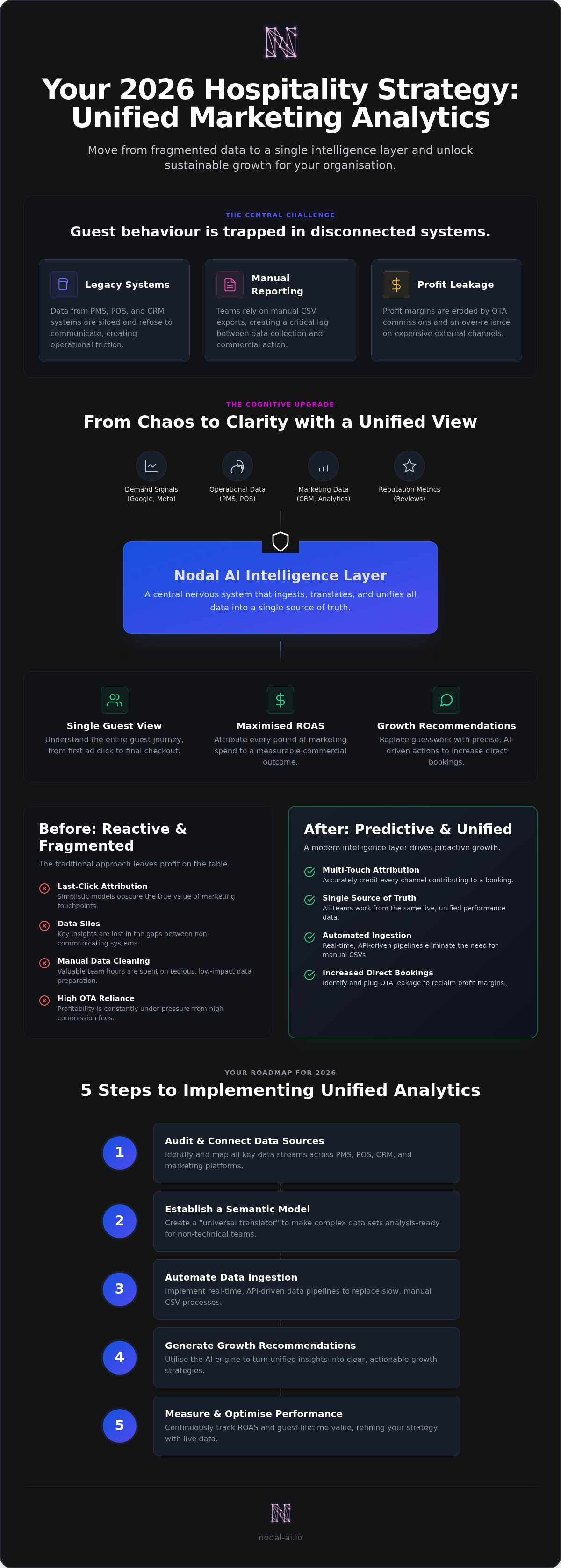
5 Steps to Implementing Unified Analytics in 2026
Transitioning from fragmented silos to a streamlined intelligence layer requires a disciplined framework. You can't simply plug in a tool and expect results. It begins with a deep audit of your current data silos across marketing, operations, and revenue departments. You must identify which systems hold the most valuable guest intelligence; often, this is hidden within your PMS or POS. Assessing the quality of this historical data is vital before you attempt to scale, as clean inputs are the only way to generate high-value outputs.
Once the audit is complete, define your primary hospitality use cases. Are you focused on increasing bed yield during off-peak periods or improving member retention for your wellness brand? Clarity here ensures your unified marketing analytics strategy remains tethered to commercial outcomes. Select a platform that supports modular integration with your existing infrastructure, ensuring it can communicate with tools like Mews or Opera without requiring massive custom development or technical debt. This approach allows the technology to adapt to your business, rather than forcing your business to adapt to the technology.
Finally, establish a continuous feedback loop between your insights and marketing execution. This ensures that when the data signals a shift in guest behaviour, your campaigns respond instantly. It turns your marketing department from a cost centre into a profit-generating engine that learns and adapts with every guest interaction. This rhythm of constant improvement is what separates market leaders from those struggling with manual, tedious reporting tasks.
Auditing Your Hospitality Data Ecosystem
Every successful implementation starts with mapping the current landscape. You need to verify that your customer journey mapping is technically sound and reflects reality. Clean data is the fuel for your intelligence engine; without it, even the most advanced AI will produce flawed recommendations. Identify the "dead zones" where guest information is lost between booking and check-in to ensure a total view of performance.
Leveraging External Demand Signals
In 2026, internal data is only half the story. You must integrate external signals like FX rates, tourism trends, and flight demand to achieve predictive accuracy. By using predictive modelling, you can forecast occupancy based on local events or real-time weather patterns. This allows you to adjust ad spend dynamically. For instance, you could increase social spend for a luxury wellness retreat when a rainy weekend is forecast in your primary feeder markets, capturing demand exactly when it peaks.
Book a demo to see the modular architecture in action
Turning Insights into Intelligence with Nodal AI
The Nodal Platform functions as the central nervous system for your hospitality brand. It replaces the daily anxiety of manual data cleaning with the confidence of streamlined, high-level perspectives. By deploying unified marketing analytics, you transform your fragmented data into a single, modular intelligence layer. This is not just a functional tool; it is a cognitive upgrade that turns passive data points into active participants in your commercial performance. Unlike generic platforms that provide only the raw metrics, we provide the strategic path through a unique blend of SaaS technology and expert AI consultancy.
Customisation is at the heart of our approach. We deliver role-based dashboards that provide clarity for every stakeholder in your organisation. A General Manager gains an immediate view of total commercial yield and the protection of assets, while a Revenue Director can interrogate specific acquisition costs and bed yield. This ensures that every member of your team is working from a single source of truth, obsessed with measurable returns and long-term stability. You move from a state of reactive reporting to a culture of proactive growth.
Tailored Insights for Different Hospitality Models
Our modular architecture adapts to the specific demands of your business model. For hotels, the focus remains on balancing occupancy with direct revenue growth, ensuring you reclaim profit from third-party intermediaries. QSR and F&B operators use the platform to measure footfall and the specific order mix that drives the highest margins across multiple locations. Private members’ clubs benefit from tracking retention patterns and on-property spend, allowing for a deeper understanding of member lifetime value. Unified marketing analytics provides the transparency needed to optimise these unique commercial levers without deep technical specialisation.
Getting Started with Your Unified Strategy
Success begins with a professional onboarding process that maps your data sources with surgical precision. We ensure every signal from your PMS, POS, and CRM is captured correctly to create a reliable intelligence layer. This foundation allows you to identify early signs of guest churn or upcoming need periods before they impact your bottom line. You can then adjust your marketing execution dynamically, responding to market shifts with the speed and accuracy of an industry leader. It is time to move beyond intuition and embrace a future driven by data-driven insight. Take the next step to secure your margins and book a demo with Nodal AI.
Mastering the Future of Hospitality Performance
Hospitality success in 2026 depends on your ability to turn chaotic data into high-value commercial outcomes. By implementing unified marketing analytics, you move beyond the anxiety of fragmented systems and manual reporting. You've seen how a modular intelligence layer can transform your guest journey, identifying exactly where profit is lost to third-party commissions. This shift allows you to replace guesswork with the confidence of automated growth recommendations, ensuring every marketing pound is tethered to measurable yield.
The impact of this cognitive upgrade is already proven. Our clients have realised a 24.5% increase in ROAS, while Ovolo Hotels achieved a 15.3% reduction in acquisition costs. These results, combined with our Gold win at the Performance Marketing Awards, demonstrate the power of a truly integrated intelligence engine. It's time to stop the leak and start driving direct revenue with absolute clarity.
Book a demo to see how Nodal AI unifies your hospitality data
Take control of your performance and lead your organisation into a more profitable era.
Frequently Asked Questions
What is unified marketing analytics and how does it differ from a standard dashboard?
Unified marketing analytics is a modular intelligence engine that consolidates fragmented data into a single source of truth. While a standard dashboard merely visualises historical metrics, this system provides predictive growth recommendations by linking marketing spend directly to commercial yield. It transforms passive records into active participants in your business strategy, replacing the anxiety of manual data cleaning with the confidence of streamlined, high-level perspectives.
Can unified analytics integrate with legacy Property Management Systems?
Yes, the Nodal Platform uses a modular architecture specifically designed to connect with legacy systems like Opera or Mews. By employing API-driven data pipelines, it bridges the gap between your operational data and marketing performance. This ensures that even older Property Management Systems contribute to your central intelligence layer, allowing you to realise a single view of guest behaviour without a total infrastructure overhaul.
How does unified marketing analytics help reduce OTA commission costs?
It identifies specific points of OTA leakage where potential direct guests choose third-party platforms over your own website. By understanding these friction points, brands can refine their audience targeting and multi-touch attribution. This strategy has helped hospitality leaders achieve a 15.3% reduction in acquisition costs by reclaiming their direct booking share and protecting their profit margins from expensive commission taxes.
Why is predictive modelling essential for hospitality marketing in 2026?
Predictive modelling is essential because it allows you to move from reactive occupancy-filling to proactive yield optimisation. In 2026, market volatility makes it vital to forecast need periods before they occur. By anticipating guest behaviour and demand shifts, you can adjust promotional spend with surgical precision. This ensures your budget supports your most profitable channels first, protecting your margins from market fluctuations.
What external signals should be included in a unified marketing view?
A comprehensive view should include external signals such as weather patterns, flight demand, FX rates, and local event schedules. These factors significantly influence international booking propensity and local footfall. Combining these signals with your internal data provides a more accurate forecast of occupancy. This allows you to adjust ad spend dynamically, capturing demand exactly when it peaks in your primary feeder markets.
How long does it typically take to implement a unified analytics platform?
Implementation typically takes several weeks, depending on the complexity of your current data ecosystem and the number of properties involved. This period includes a professional onboarding process to map data sources across your PMS, POS, and CRM systems. Establishing this foundation ensures that your unified marketing analytics strategy is technically sound and ready to deliver measurable improvements in commercial performance.
Will unified analytics help my team save time on manual reporting?
Yes, automated reporting can save marketing teams over 20 hours per week by eliminating manual CSV exports and data cleaning. This shift replaces the anxiety of manual labour with the confidence of streamlined, real-time outputs. By freeing your team from tedious tasks, you allow them to focus on high-level strategy and growth recommendations, turning your data into a high-value commercial asset.
What is the ROI of moving to a unified intelligence layer for hotels?
The ROI is realised through a combination of increased ROAS, reduced acquisition costs, and higher direct booking revenue. Hospitality clients have documented a 24.5% increase in ROAS after consolidating their data into a single intelligence layer. By optimising every pound of spend against actual commercial yield, the platform functions as a cognitive upgrade that delivers long-term stability and measurable financial returns.


