

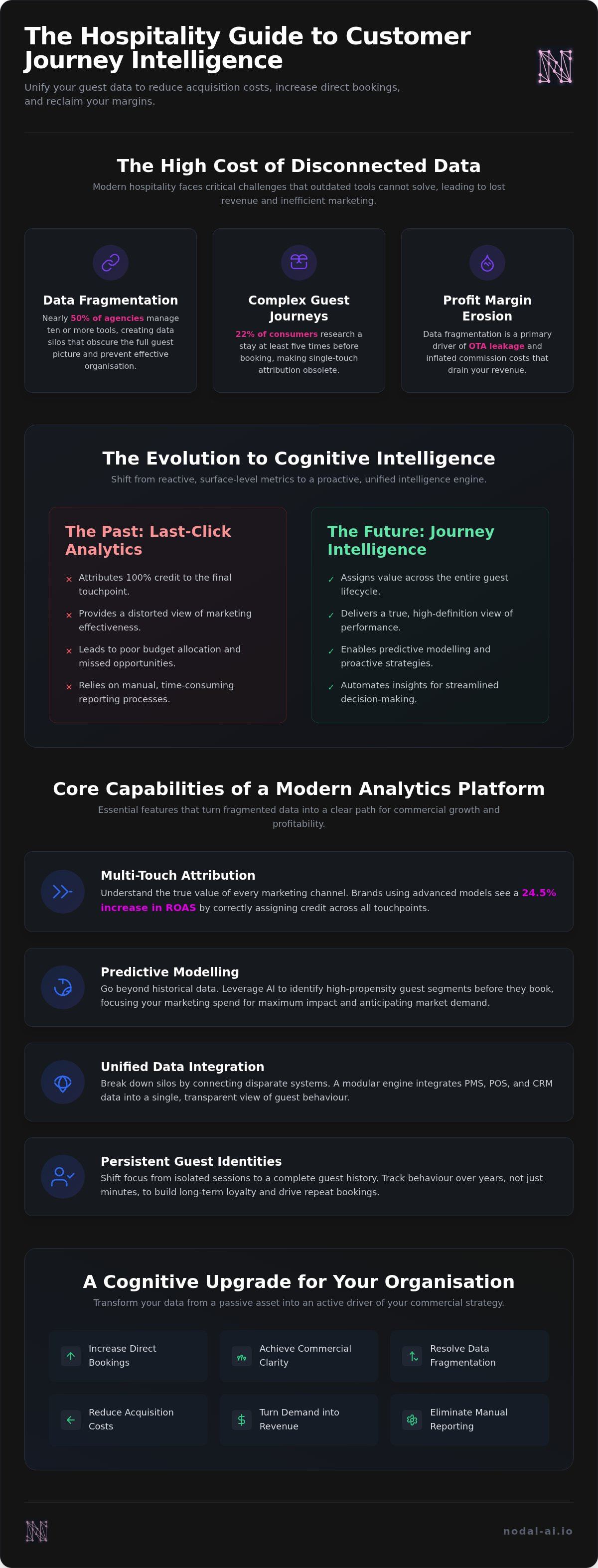
What if your guest data stopped being a collection of silent, disconnected files and started acting as your most aggressive sales team? You likely recognise the frustration of watching high-value guests slip away to third-party platforms while your own marketing feels like a shot in the dark. In 2026, managing a customer journey analytics platform is no longer a luxury for the tech-obsessed; it's a commercial necessity for any hospitality brand aiming to reclaim its margins. With nearly 50% of agencies now managing ten or more tools, the resulting data fragmentation often leads to crippling OTA leakage and inflated commission costs that eat into your bottom line.
We understand that the manual, time-consuming reporting processes of the past are no longer sustainable in a market where 22% of consumers research a stay at least five times before booking. This guide will show you how to unify these chaotic inputs into a single, high-definition view of guest performance. You'll discover the exact strategies needed to reduce acquisition costs, increase direct booking contributions, and transform your passive data into a cognitive upgrade for your entire organisation. From predictive modelling to seamless journey mapping, we'll outline the roadmap to commercial clarity and measurable growth.
Key Takeaways
- Learn why traditional last-click metrics fail and how to transition toward a comprehensive view of the guest lifecycle.
- Identify the essential features of a modern customer journey analytics platform to ensure your technology stack supports multi-touch attribution.
- Discover specific methods for integrating PMS, POS, and CRM data to eliminate manual reporting and resolve data fragmentation.
- Understand how to leverage external signals and predictive modelling to turn market demand into direct revenue growth.
- Explore how a modular intelligence engine can reduce acquisition costs and drive a more profitable commercial strategy.
Understanding the Customer Journey Analytics Platform
A customer journey analytics platform acts as the central intelligence hub for your entire commercial operation. It moves beyond the surface-level metrics of clicks and views to provide a unified record of every guest interaction across digital and physical touchpoints. Traditional analytics models, particularly the outdated last-click attribution, fundamentally fail to capture the reality of modern travel planning. When a guest researches a property at least five times before booking, as 22% of consumers now do according to 2026 data from Insider Intelligence, credit cannot simply go to the final link they clicked. You need to see the whole story.
By shifting the focus from isolated sessions to persistent identities, you gain the ability to track guest behaviour over years, not just minutes. This transformation turns passive data into commercial intelligence, providing the clarity needed to make high-value decisions that drive direct bookings and long-term loyalty.
The evolution from web analytics to journey intelligence
Journey analytics represent a significant leap forward from standard web tracking or basic CRM reports. While tools like GA4 are useful for measuring top-of-funnel traffic, they lack the depth required for predictive accuracy in 2026. True intelligence requires the ingestion of deep historical data to understand patterns and anticipate guest needs before they even arise. This move toward automated, real-time intelligence ensures that your marketing spend is always optimised for the highest possible return, replacing the anxiety of manual reporting with the confidence of streamlined perspectives.
Why hospitality data fragmentation requires a specialised approach
Hospitality brands often struggle with dark data, which is valuable guest information that remains locked inside legacy PMS and POS systems. This disconnected environment is a primary driver of profit margin erosion. When your marketing team cannot see what is happening inside the hotel or at the restaurant, they cannot effectively target the customer journey to prevent OTA leakage.
Fragmentation isn't just a technical hurdle; it's a financial drain. A modular intelligence engine solves this by connecting disparate software stacks into a single, transparent view. This connectivity allows brands to organise their data modules effectively, turning fragmented inputs into a streamlined path for commercial growth. By unifying these sources, you transform your data from a passive asset into an active participant in your business strategy.
Key Features to Evaluate in a Journey Analytics Platform
Selecting the right customer journey analytics platform requires looking past technical jargon and focusing on tangible commercial outcomes. In 2026, the priority for any enterprise-grade solution is the ability to turn complex, multi-channel data streams into actionable growth triggers. You need a system that replaces the anxiety of manual data entry with the confidence of automated, high-level perspectives. This shift allows your team to stop acting as data processors and start acting as strategic growth partners.
Your chosen platform must provide total clarity across the guest lifecycle. It should act as a cognitive upgrade for your organisation, removing ambiguity and providing a streamlined path to direct revenue. Look for a solution that prioritises these core capabilities to ensure long-term stability and measurable returns.
Multi-touch attribution and predictive modelling
Moving beyond last-click is the only way to understand the true value of your marketing spend. Multi-touch attribution assigns credit to every interaction, from the first social media impression to the final direct booking. This level of transparency is essential for increasing your Return on Ad Spend (ROAS). Properties using advanced attribution models have documented a 24.5% increase in ROAS by identifying which channels actually drive revenue rather than just observing the final click.
Predictive modelling takes this a step further by identifying high-propensity guest segments before they even book. By analysing historical patterns and behavioural signals, the platform can predict which guests are most likely to convert; this allows you to focus your budget where it has the most impact. This proactive approach transforms your marketing from a reactive expense into a strategic investment that anticipates market demand.
Modular architecture and data flexibility
A modular approach is non-negotiable for hospitality brands with diverse portfolios. Your platform should offer specific modules for different business functions, such as Guest, Commercial, and Operational modules. This structure allows you to explore the core features that matter most to your specific role without being overwhelmed by irrelevant data. It ensures that behavioural data from disparate sources is standardised and ready for analysis.
Scalability is equally important for future-facing brands. As your property portfolio grows, your platform must adapt without requiring a total system overhaul. A modular architecture ensures that you can add new data sources or properties seamlessly, maintaining a single view of performance across the entire organisation. This flexibility is exactly what allows leading hospitality groups to achieve a 15.3% reduction in acquisition costs while maintaining high-level protection of their data assets.
Finally, ensure the interface is accessible to non-technical teams. Even the most powerful predictive engine is useless if your commercial managers cannot extract value from it. Prioritise a user-friendly design that delivers streamlined, high-level perspectives at a glance, enabling rapid decision-making across all departments.
Integrating Operational and Commercial Data Sources
Generic e-commerce tools often fail in hospitality because they ignore the physical reality of the guest stay. A truly effective customer journey analytics platform must bridge the gap between digital intent and on-property reality. This requires deep integration with your Property Management System (PMS) and Point of Sale (POS) environments. By connecting these disparate sources, you transform fragmented "dark data" into a single, high-definition view of your commercial performance. This transparency is the first step toward reclaiming margins lost to inefficient processes or third-party dependencies.
The synergy between CRM data and transactional POS data is where you find your most profitable insights. When you understand exactly what a guest buys at the bar versus what they booked online, you can personalise offers with surgical precision. Adding reputation signals from platforms like TripAdvisor and Google further refines this journey; it allows you to see how public sentiment influences the booking path in real time. You can explore the Nodal Platform features to see how these specific integrations create a cognitive upgrade for your entire hotel group, turning passive records into active growth drivers.
Connecting PMS and booking engines
Your PMS is the heartbeat of your operational data. Systems like Mews, Oracle OPERA, and Cloudbeds hold the keys to understanding guest longevity and stay extensions. Mapping the journey from the initial search on your booking engine to the final checkout allows you to identify exactly where potential direct bookings drop off. This level of transparency is vital for reducing OTA leakage. By pinpointing the friction points in the reservation flow, you can reclaim your margins and stop over-relying on high-commission third-party channels. It's about ensuring the path to a direct booking is as frictionless as possible.
Leveraging POS and F&B data for guest value
On-property spend is often the most overlooked part of the guest lifecycle. Integrating reservation platforms like OpenTable or SevenRooms with your POS data provides a complete picture of guest value beyond the room rate. In upscale F&B environments, identifying repeat visit patterns helps you protect your margins by distinguishing between high-value locals and one-time visitors. You can also measure the mix between delivery and dine-in services to ensure your operational costs align with actual revenue. This integrated approach ensures that every touchpoint, whether a dinner reservation or a spa booking, contributes to a holistic understanding of your commercial growth and long-term stability.
Advanced Analytics: External Signals and Predictive Growth
Internal data provides a strong foundation; however, it remains incomplete without external context. In 2026, a sophisticated customer journey analytics platform must ingest external signals to provide a truly visionary perspective on market demand. These signals act as the connective tissue between global trends and your specific commercial strategy. By identifying "need periods" or low occupancy windows months in advance, you can deploy AI-generated growth recommendations to fill rooms before a quiet patch becomes a financial burden. This proactive approach replaces the anxiety of reactive discounting with the confidence of planned, high-value acquisition.
The impact of weather, FX rates, and local events
Weather patterns, fluctuating FX rates, and major local events dictate the flow of international travellers with surprising consistency. A sudden shift in currency value can instantly make your property more attractive to specific global markets, while flight demand trends signal upcoming surges in tourism. Similarly, local festivals or stadium events allow you to predict spikes in both F&B covers and room demand with high precision. Integrated analytics enable you to adjust marketing spend in real time based on these external demand signals. You stop wasting budget on disinterested audiences and start capturing high-intent traffic exactly when it appears in the market. This level of transparency ensures that every pound spent is tethered to a concrete business outcome.
AI-driven audience segmentation and retention
AI doesn't just observe historical data; it predicts future behaviour. By segmenting audiences based on property type or location, you can identify high-value guest profiles with surgical precision. For private clubs or wellness centres, predicting churn risk in membership models is essential for long-term stability. The platform analyses subtle behavioural shifts to flag members who may be disengaging, allowing for proactive retention efforts that protect your assets. Personalising the guest journey based on predicted lifecycle value ensures that your most loyal patrons receive the attention they deserve. This turns a standard stay into a high-value, long-term relationship, effectively transforming your guest list from a passive spreadsheet into an active participant in your growth strategy.
The Nodal Platform: Connecting the Dots for Hospitality
Generic enterprise tools often feel like cold algorithms designed for retail or generic B2B cycles. Nodal AI offers a specialised alternative. We've built the only customer journey analytics platform that understands the specific nuances of hospitality, from room nights to F&B covers. Our London-based team brings years of performance marketing expertise to every partnership, ensuring that our technology is always tethered to concrete business outcomes. We don't just provide a tool; we provide a commercial intelligence engine that drives more revenue while eliminating waste. To understand the foundational principles of this approach, you can consult The Definitive Guide to the Customer Journey.
Proven results: The Ovolo Hotels case study
The impact of this approach is best seen through the success of Ovolo Hotels. By unifying their fragmented data, they realised a 15.3% reduction in acquisition costs. This wasn't just a technical win; it was a commercial transformation. Their team achieved a 24.5% increase in ROAS by finally seeing which channels were actually driving high-value guests. Automated reporting replaced their manual, time-consuming processes, saving their marketing teams hours of manual labour and allowing them to focus on strategy rather than spreadsheets. This shift from chaotic inputs to high-value outputs is the core promise of our modular architecture.
Getting started with commercial intelligence
Transitioning to a state of commercial intelligence is a structured, frictionless process. We guide you through the initial technical setup, ensuring your PMS, POS, and CRM data flows seamlessly into our modular engine. Once the connection is live, we build custom dashboards that provide the streamlined, high-level perspectives your leadership team requires to make rapid, informed decisions. Nodal provides ongoing strategic advice alongside the technology, acting as a cognitive upgrade for your entire organisation. This capable partnership ensures you remain competitive in a rapidly evolving market.
Take the next step toward mastering marketing attribution by exploring our detailed guide for 2026. This is the ultimate roadmap to reducing OTA dependency and securing long-term financial stability for your property portfolio. By transforming your passive assets into active participants in your sales process, you can finally reclaim your margins and drive sustainable growth.
Secure Your Commercial Future in 2026
The path to commercial dominance in 2026 requires a fundamental shift from monitoring sessions to mastering guest identities. By unifying your PMS, POS, and CRM data into a single, transparent view, you eliminate the profit erosion caused by OTA leakage and fragmented reporting. A specialised customer journey analytics platform acts as the bridge between chaotic inputs and high-value growth, providing the streamlined perspective needed for rapid, intelligent decision-making.
The results of this transition are both documented and measurable. Our strategies have already secured a 15.3% reduction in acquisition costs for Ovolo Hotels and a 24.5% increase in ROAS, earning Nodal Gold at the Performance Marketing Awards. This expertise is now ready to help your organisation turn passive data into an active sales participant. It is time to replace the overwhelm of manual tasks with the calm efficiency of automated, predictive intelligence that protects your margins and secures your assets.
Book a demo of the Nodal Platform today
Start your journey toward total clarity and watch your direct bookings thrive in an increasingly competitive global landscape. We are ready to help you lead the market with confidence.
Frequently Asked Questions
What is a customer journey analytics platform?
It is a centralised intelligence engine that connects disparate data sources to track the guest lifecycle from discovery to checkout. This customer journey analytics platform replaces fragmented silos with a single, transparent view of commercial performance. By unifying inputs from your PMS, POS, and CRM, it transforms chaotic data into a cognitive upgrade for your entire team. It allows you to see every touchpoint, ensuring no guest interaction remains hidden.
How does journey analytics differ from traditional attribution?
Journey analytics moves beyond the limitations of last-click attribution to provide a holistic view of the guest path. Traditional models often ignore the fact that 22% of consumers research a stay at least five times before booking. A customer journey analytics platform uses multi-touch attribution to assign value to every interaction across the lifecycle. This transparency ensures that top-of-funnel marketing efforts receive the credit they deserve for driving long-term revenue.
Can Nodal AI integrate with my existing PMS or POS?
The Nodal Platform is designed specifically to bridge the gap between operational and commercial systems. We integrate seamlessly with industry standards such as Mews, Oracle OPERA, Cloudbeds, and SevenRooms. This connectivity allows you to resolve the problem of dark data sitting in legacy software. By linking your PMS and POS, we turn these passive assets into active participants in your growth strategy, providing the relief that comes from resolving complexity.
What are the main benefits of using AI in customer journey mapping?
AI enables predictive modelling and automated audience segmentation that human analysis cannot match. It identifies high-propensity guest segments and predicts churn risk in real time. This proactive intelligence allows you to deploy growth recommendations during low-occupancy periods. Instead of reacting to market shifts, you use AI to anticipate demand and personalise the guest journey for maximum commercial impact. It replaces the anxiety of manual tasks with the confidence of streamlined perspectives.
How does the platform help in reducing OTA leakage?
The platform reduces OTA leakage by identifying exactly where potential direct bookings drop off in the reservation path. By tracking the entire journey, you can see if guests leave your site to book on third-party platforms due to price friction or technical hurdles. Resolving these pain points helped Ovolo Hotels achieve a 15.3% reduction in acquisition costs. This level of clarity allows you to reclaim margins and increase your direct booking contribution effectively.
Is automated reporting included in the Nodal Platform?
Automated reporting is a core feature designed to save your marketing and commercial teams hundreds of hours of manual labour. It replaces tedious data collection with streamlined, high-level perspectives delivered in real time. These reports provide total clarity on guest performance and marketing efficiency. You can focus on high-level strategy and visionary leadership while the platform handles the complex task of data consolidation, ensuring your outputs are always high-value and accurate.
What kind of external signals can be integrated into the analysis?
We integrate a variety of external demand signals including weather patterns, FX rates, flight demand, and local event schedules. These factors often dictate international booking flows and F&B covers more than internal marketing spend alone. By layering these signals over your guest data, the platform provides a cognitive upgrade that explains why demand shifts occur. This allows for precise adjustments to your commercial strategy based on real-world context rather than just internal metrics.
How long does the implementation and onboarding process take?
Our onboarding process is designed for rapid efficiency and minimal disruption to your daily operations. The timeline varies based on the complexity of your software stack; however, we typically move from technical setup to live dashboards within a few weeks. Our London-based team provides strategic advice throughout this journey to ensure your team feels empowered. We prioritise a frictionless transition that delivers immediate value and measurable returns for your property portfolio.


