

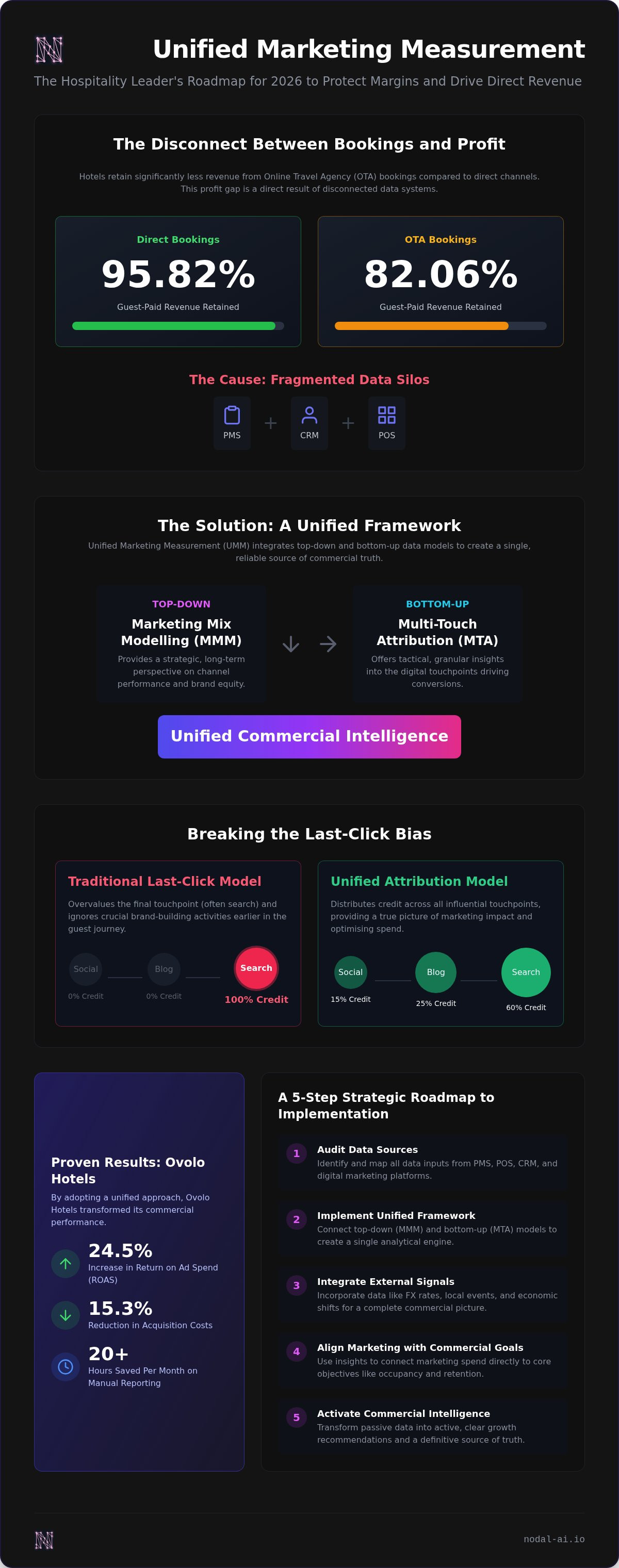
Hotels retain 95.82% of guest-paid revenue from direct bookings, yet only 82.06% from OTA channels. This gap represents a significant loss of profit that most hospitality brands struggle to reclaim because their data is trapped in silos across PMS, POS, and CRM systems. If you feel overwhelmed by fragmented reporting and the rising cost of acquisition, you aren't alone. Transitioning to a strategy of unified marketing measurement is the only way to protect your margins by connecting operational data with strategic marketing signals.
This 2026 guide provides the roadmap to integrate your disparate systems into a single, high-level perspective. You'll learn how to move beyond inaccurate last-click models to drive direct revenue and optimise marketing spend. We'll show you how to transform passive assets into active growth engines, much like Ovolo Hotels, which achieved a 15.3% reduction in acquisition costs and a 24.5% increase in ROAS. We preview the modular technology required to gain clear growth recommendations for low-occupancy periods and establish a definitive source of truth for your commercial performance.
Key Takeaways
- Discover how to bridge the gap between PMS data and digital spend by implementing a unified marketing measurement framework that connects top-down modelling with bottom-up attribution.
- Master the architecture of modular intelligence engines to balance strategic channel performance with granular, real-time tactical adjustments.
- Eliminate the inaccuracies of last-click models that consistently undervalue brand-building efforts and over-attribute revenue to search channels.
- Follow a strategic five-step roadmap to audit your existing data sources and align your marketing output with core commercial goals such as occupancy and retention.
- Learn how to transform passive data assets into active participants in your business to achieve measurable reductions in acquisition costs and significant increases in ROAS.
What is Unified Marketing Measurement and Why does Hospitality Need it?
Unified marketing measurement (UMM) is a strategic framework that integrates top-down statistical analysis with bottom-up attribution data. It provides hospitality leaders with a single, high-level perspective by combining Marketing Mix Modeling (MMM) and Multi-Touch Attribution (MTA). In the complex ecosystem of 2026, where privacy regulations have rendered traditional cookie-based tracking unreliable, UMM offers the clarity needed to drive direct revenue and protect margins.
The hospitality industry faces a unique measurement crisis. Property Management Systems (PMS) and digital marketing spend often operate in separate silos, creating a blind spot where hoteliers cannot see how a specific campaign influences a booking made via a call centre or a direct web portal. UMM solves this by creating a single version of performance truth to drive direct bookings and reduce OTA dominance.
The Fragmentation Problem in Hospitality Analytics
Data silos in systems like Oracle OPERA or Mews lead to significant wasted marketing spend. When guest data is trapped within a PMS and disconnected from your advertising platforms, you're essentially flying blind. This fragmentation creates a financial risk that erodes profit margins, as brands over-invest in channels that appear successful on the surface but fail to deliver high-value guests. Transition from chaotic manual reporting to a streamlined commercial perspective that turns these passive data points into active participants in your growth strategy.
Commercial Intelligence: The New Standard for 2026
Commercial intelligence represents the evolution of standard marketing analytics for the hospitality sector. Standard reports tell you what happened; commercial intelligence tells you why it happened and how to replicate it. By using unified marketing measurement, organisations can identify the most valuable guest segments across property types, from luxury resorts to hostels. This approach ensures every pound spent is an investment in long-term stability.
The results are measurable. Ovolo Hotels achieved a 15.3% reduction in acquisition costs and a 24.5% increase in ROAS by moving away from fragmented silos. Unified marketing measurement empowers leaders to make faster, more profitable decisions by providing a cognitive upgrade to the entire organisation.
The Technical Foundation: Connecting MMM, MTA, and External Signals
The architecture of a modern unified marketing measurement system relies on modular intelligence engines that process vast data sets at scale. It represents a shift from static, historical reporting to a dynamic commercial engine that lives and breathes with your business. Marketing Mix Modelling (MMM) provides the strategic, long-term perspective, identifying which channels build brand equity and drive base demand over several seasons. Conversely, Multi-Touch Attribution (MTA) offers tactical, campaign-level insights, showing exactly which digital touchpoint sparked a booking in the last twenty-four hours. By transforming measurement into a strategic asset, hospitality leaders can finally see how these two distinct views interact to influence the bottom line.
A truly robust system doesn't stop at marketing spend. It integrates external signals such as foreign exchange (FX) rates, local event calendars, and even global economic shifts. These elements are the hidden levers of hospitality performance. When these signals are personified into active participants in your modelling, they provide a level of transparency that traditional analytics simply cannot match. This technical foundation acts as a cognitive upgrade for your entire commercial team, replacing guesswork with high-value outputs that ensure long-term financial stability.
Unifying Internal Operational Data
Connecting PMS data from platforms like Oracle OPERA or Mews with your POS and marketing spend creates total clarity across the guest journey. This process used to be a manual nightmare for marketing departments, requiring days of data cleaning and mapping. The Nodal Platform automates this consolidation, saving marketing teams over 20 hours per month that were previously lost to tedious spreadsheet work. This automation ensures that your data remains a reliable source of truth rather than a collection of conflicting reports. Maintaining strict UK compliance standards like GDPR is central to this process, ensuring that your quest for commercial intelligence never compromises guest security. You can explore these modular intelligence features to see how they integrate with your existing technology stack.
The Power of External Demand Signals
Hospitality performance is deeply tethered to external factors that often feel outside of a marketer's control. Flight demand data, for example, acts as a predictive marker for future booking surges in serviced apartments and hostels. Similarly, weather patterns significantly impact footfall for QSR and upscale F&B locations, where a sudden rainstorm can shift demand in minutes. A robust unified marketing measurement framework ingests these signals to provide specific growth recommendations during identified "need periods." Instead of reacting to low occupancy after it happens, you can anticipate it and adjust your spend accordingly. This proactive approach turns passive environmental factors into active participants in your revenue strategy, allowing you to optimise your marketing budget precisely when the market is most likely to convert.
Breaking the Last-Click Bias: UMM vs Traditional Attribution Models
Relying on last-click attribution is akin to crediting the final checkout counter for every sale in a department store. In the luxury hotel sector, where the guest consideration cycle often spans weeks or months, this bias frequently overvalues generic search terms and undervalues the critical brand-building efforts that first introduced the property to the traveller. While Multi-Touch Attribution (MTA) offers a granular view of digital touchpoints, it often fails to account for the broader market forces that influence a guest's decision. Conversely, Marketing Mix Modelling (MMM) provides a holistic perspective on long-term trends but lacks the tactical precision needed for day-to-day campaign adjustments.
Unified marketing measurement bridges this gap by fusing experimental and marketing mix data to create a comprehensive view of performance. This approach addresses the concept of incrementality, helping hoteliers identify which bookings were truly driven by marketing efforts and which would have occurred regardless of spend. By looking at aggregate revenue and spend rather than individual user paths, UMM also solves the "walled garden" problem. It allows brands to see the true impact of their investments even when platforms like Meta or Google restrict access to granular tracking data.
Reducing OTA Leakage through Better Attribution
Understanding the true cost of acquisition is the first step toward reclaiming profit from third-party channels. Research indicates that hotels retain 95.82% of revenue from direct bookings, compared to only 82.06% from OTA channels. When brand-level attribution is neglected, marketing teams often find themselves trapped in a cycle of over-spending on search terms that simply capture existing demand rather than creating it. By following a mastering marketing attribution guide, hospitality organisations can better quantify how their top-of-funnel awareness campaigns encourage direct booking contributions, effectively reducing OTA leakage and protecting long-term margins.
Quantifying True Return on Ad Spend (ROAS)
There is a significant difference between reported platform ROAS and incremental commercial ROAS. Platform reports often claim credit for bookings that were inevitable, leading to a false sense of campaign efficiency. Unified insights allow hospitality leaders to achieve a 24.5% increase in ROAS by reallocating budget toward truly incremental channels. Ovolo Hotels utilised these unified insights to achieve a 15.3% reduction in acquisition costs, proving that a cognitive upgrade in measurement leads directly to financial stability. This transformation turns passive reporting into an active growth engine, ensuring that every pound spent on advertising contributes to measurable revenue growth.
Implementing a Unified Framework: A 5-Step Strategic Roadmap
Transitioning from fragmented silos to a streamlined commercial perspective requires a disciplined, multi-step journey. Implementing a unified marketing measurement framework is more than a technical integration; it's a cognitive upgrade for your entire organisation. By following this structured roadmap, you can transform chaotic data inputs into high-value growth recommendations that protect your long-term margins. This process replaces the anxiety of manual reporting with the confidence of automated, real-time insights.
Step 1: The Hospitality Data Audit
Identifying your primary data sources is the critical first step in establishing a single source of truth. You must map every touchpoint across systems like Cloudbeds, Stayntouch, and SevenRooms to ensure no revenue signal is lost. Historical data ingestion from legacy systems, such as Oracle OPERA, is essential for building stable models that account for long-term seasonal trends. UK-based enterprises must also implement a modern data governance framework to maintain transparency and compliance with local regulations. Establishing a standardised taxonomy across all marketing channels ensures that your KPIs remain consistent as you scale your operations.
Step 2: Define Commercial Goals and Select Your Platform
Once your data is audited, define your commercial goals with absolute precision. Focus on tangible outcomes such as increasing occupancy during identified "need periods," boosting ancillary spend at the POS, or improving member retention within your CRM. After setting these objectives, evaluate modular integration capabilities. Your chosen platform must connect seamlessly to your existing tech stack to ensure that all commercial functions, including revenue and sales, work from the same real-time data. Nodal AI is purpose-built for this stage, offering pre-built connectors to the hospitality systems your teams already rely on, eliminating costly custom development and accelerating your time to insight.
Step 3: Build Your Unified Data Layer and Attribution Model
With your goals defined and your platform selected, the next step is to consolidate all data sources — CRM, finance, media, and guest experience — into a single, centralised repository. This unified data layer becomes the statistical backbone of your entire measurement programme. From here, configure your attribution model to distribute credit accurately across every channel, from paid search and metasearch to email and OTA-driven demand. Layering multi-touch attribution with marketing mix modelling at this stage ensures you capture both the granular, campaign-level signals and the broader strategic view of channel contribution. A well-constructed data layer also positions your organisation to meet ongoing data privacy obligations, an essential consideration for hospitality brands operating across multiple jurisdictions.
Step 4: Predictive Modelling for Future Growth
Move beyond historical reporting by leveraging AI for predictive modelling. This technology identifies high-propensity guest segments before they even begin their search journey, allowing you to allocate spend where it will have the most impact. AI-driven insights help hospitality brands prepare for seasonal demand shifts by translating market signals into actionable advice. Automated reporting provides real-time visibility for global marketing teams, ensuring that every regional campaign remains aligned with the central commercial strategy and contributes to a measurable reduction in acquisition costs.
Step 5: Continuous Validation and Iterative Optimisation
The final stage is to establish a continuous validation loop. Use in-market testing to compare model predictions against actual revenue results, refining your accuracy over time. This iterative process ensures that your unified marketing measurement framework stays sharp and responsive to changing market conditions. By constantly validating your signals, you ensure that your marketing spend is always optimised for maximum profit and direct revenue growth.
Book a demo to see the Nodal AI Platform in action
Driving Commercial Intelligence: How Nodal AI Transforms Fragmented Data
The Nodal Platform acts as a cognitive upgrade for hospitality organisations, transforming passive data into active participants in the commercial process. By consolidating fragmented inputs from PMS, POS, and CRM systems, it replaces the anxiety of manual labour with the confidence of streamlined, high-level perspectives. This shift is essential for leaders who need results without deep technical specialisation. Partnering with an efficient expert that understands the specific nuances of hospitality allows your team to focus on strategy while the platform handles the heavy lifting of attribution and predictive modelling.
Success in 2026 is measured by tangible financial performance. Ovolo Hotels serves as a definitive benchmark for this transition, achieving a 15.3% reduction in acquisition costs and a 24.5% increase in ROAS through successful implementation. These results provide a concrete weight to the value of moving from intuition-based decisions to a data-driven, strategic growth model. This transition ensures that every marketing pound is tethered to long-term stability and measurable returns, providing the relief that comes from resolving operational complexity.
Tailored Insights for Every Hospitality Sector
The Nodal Platform features are designed to support the diverse needs of the modern hospitality landscape, including hostels, spas, and private members clubs. Unlike generic analytics tools, it measures guest lifecycle value and on-property spend performance with granular precision. This allows commercial leaders to track "need periods" across global property portfolios, ensuring that marketing efforts are always aligned with real-time occupancy requirements. By personifying these passive assets, the platform provides the transparency needed to optimise spend during periods of low demand, effectively turning potential losses into high-value growth opportunities.
Book a Demo: Transform Your Data into Intelligence
Start your journey toward total clarity today. Commercial leaders are invited to book a Nodal AI demo to see their own fragmented data unified into a single source of truth. The onboarding process is designed for calm efficiency, including a comprehensive technical setup and the configuration of custom dashboards tailored to your specific commercial goals. This streamlined approach ensures that while the underlying technology is complex, the user experience remains effortless and results-oriented. Make more, waste less, and reclaim your margins with unified marketing measurement.
Master Your Commercial Future
The era of fragmented data and guesswork is ending. By adopting unified marketing measurement, hospitality leaders can finally bridge the gap between complex operational silos and strategic marketing signals. This framework turns chaotic inputs into high-value growth recommendations, ensuring every pound spent drives direct revenue rather than disappearing into OTA commissions. It is a cognitive upgrade that moves your organisation from reactive reporting to proactive revenue generation.
The results speak for themselves. Ovolo Hotels achieved a 15.3% reduction in acquisition costs and a 24.5% increase in ROAS by personifying their passive assets into active commercial participants. Our modular intelligence engine is built to integrate with your existing tech stack, replacing manual anxiety with automated clarity. Step into a future of total transparency and measurable returns; your data is ready to work for you. Reclaim your margins and lead your brand with absolute confidence.
Book a Nodal AI Demo to Optimise Your Marketing Spend
Frequently Asked Questions
What is the difference between marketing mix modelling and unified marketing measurement?
Unified marketing measurement is the overarching framework that combines top-down marketing mix modelling with bottom-up multi-touch attribution. While traditional modelling focuses on long-term strategic trends, this unified approach integrates granular digital signals to provide a single version of performance truth. It ensures that short-term tactical wins don't cannibalise long-term brand equity. This methodology allows hospitality leaders to see the whole commercial picture rather than just disconnected pieces of a puzzle.
How much historical data is required to implement UMM in a hotel business?
Most hospitality businesses require between 24 and 36 months of historical data to establish stable, reliable models. This duration is necessary to account for seasonal fluctuations, local event impact, and evolving guest behaviours across multiple years. If your records from systems like Oracle OPERA or Mews are well-structured, the initial ingestion process is significantly faster. This historical depth ensures that your growth recommendations are rooted in proven commercial patterns rather than temporary statistical noise.
Can unified marketing measurement help reduce our reliance on OTAs?
Yes, this framework identifies exactly which marketing touchpoints drive direct bookings versus those that lead to OTA leakage. By understanding the true incremental value of your brand campaigns, you can reallocate budget away from OTA-dominated channels to protect your profit margins. Direct bookings typically retain significantly more revenue than third-party channels. This transparency allows you to personify your digital assets into active participants that prioritise direct revenue growth over expensive commissions.
Is unified marketing measurement suitable for mid-market hospitality brands?
Unified marketing measurement is highly suitable for mid-market brands, particularly those managing multiple properties or diverse portfolios. The modular architecture of the Nodal Platform means that smaller organisations can start with core integrations before scaling. It provides the same high-level commercial intelligence used by global hotel chains, allowing mid-market leaders to compete effectively. By optimising every marketing pound for maximum direct revenue, mid-sized brands can achieve financial stability and predictable growth in a competitive market.
How does UMM account for external factors like weather and flight demand?
The Nodal Platform treats external factors as active participants in the business process rather than mere background noise. Weather patterns and flight demand signals are integrated into the data set to explain booking fluctuations that marketing spend cannot account for. By personifying these demand signals, the system provides accurate growth recommendations. This foresight helps you anticipate "need periods" and adjust your pricing or promotional strategies well before occupancy dips actually occur in your property portfolio.
What are the common pitfalls when unifying hospitality data systems?
The most common pitfall is failing to establish a standardised taxonomy across all marketing channels and internal systems. Disconnected data sources and inconsistent naming conventions create technical friction that delays the consolidation process. Another risk is ignoring historical PMS data, which provides the necessary context for long-term modelling. Ensuring robust data governance from the outset prevents these hurdles and maintains a clear, high-level perspective of your commercial performance without the need for deep technical specialisation.
How long does it take to see actionable growth recommendations from the Nodal Platform?
Actionable growth recommendations are typically available within four to six weeks after the initial technical setup is complete. This period allows the modular intelligence engine to ingest historical data and calibrate models against your specific commercial goals. Once this baseline is established, automated reporting provides real-time visibility into your marketing performance. You'll quickly identify opportunities to optimise spend, leading to measurable reductions in acquisition costs and significant increases in your overall return on ad spend.
Does unified marketing measurement comply with UK GDPR standards?
Yes, the platform is designed to comply strictly with UK GDPR standards and modern data governance requirements. We prioritise the security of guest data by using aggregated signals rather than individual user tracking for strategic modelling. This approach ensures that your organisation gains high-value commercial intelligence without compromising guest privacy or falling foul of regulatory changes. It provides a cognitive upgrade for your business while maintaining total transparency and the high-level protection of your digital assets.


