

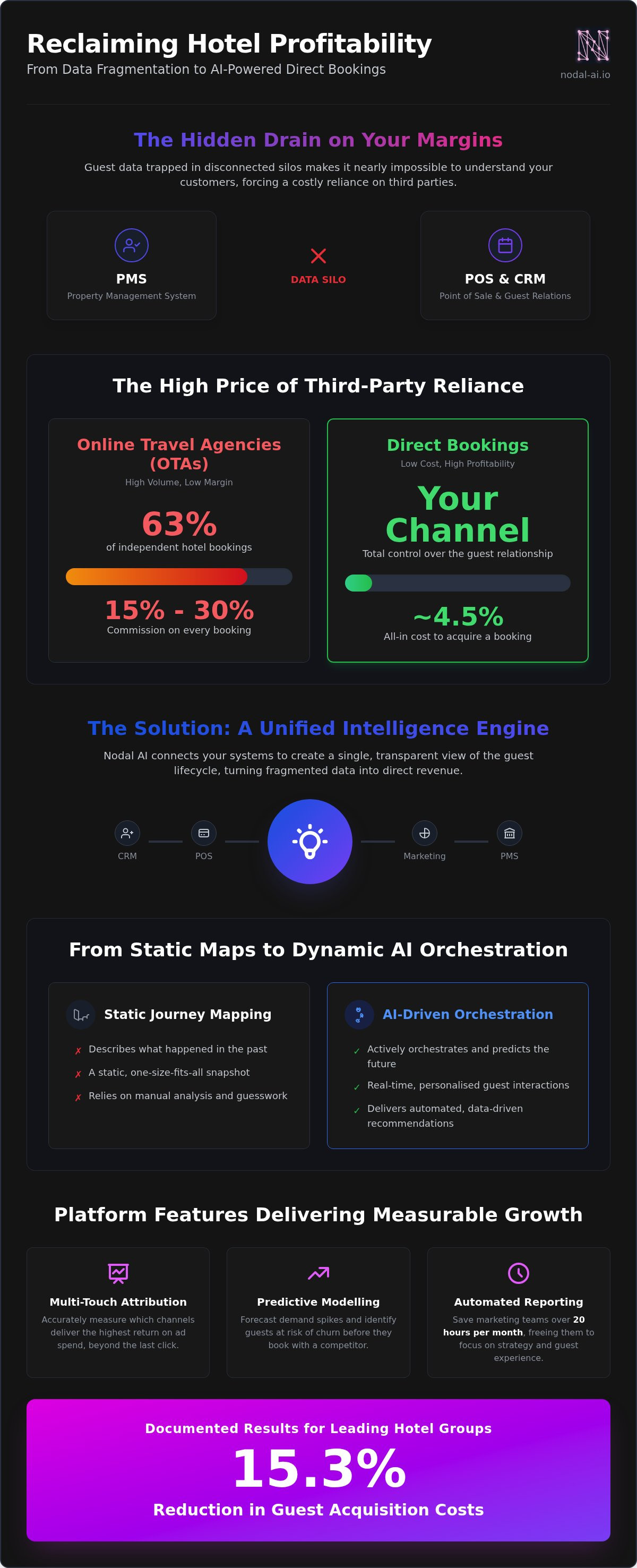
Did you know that Online Travel Agencies (OTAs) now handle 63% of all independent hotel bookings while charging commissions as high as 30%? In 2026, the gap between guest discovery and actual profitability has never been wider. You likely feel the constant frustration of guest data trapped in disconnected silos across your PMS, POS, and CRM systems. This fragmentation makes it nearly impossible to track a guest from their first click to their third repeat visit. It's a common struggle that often leads to a heavy, expensive reliance on third-party channels.
Choosing a dedicated customer journey optimization platform is no longer just a marketing choice; it's a vital strategy to reclaim your margins. This article reveals how the Nodal Platform helps you unify fragmented data and drive direct bookings using advanced AI. We will explore how to leverage the latest 2026 UK data reforms to turn chaotic inputs into a single, clear view of your customer. You'll discover how to replace manual tasks with automated growth recommendations that finally move the needle on your direct revenue and marketing performance.
Key Takeaways
- Stop profit leakage by connecting your PMS, POS, and CRM systems to eliminate the high costs of guest data fragmentation.
- Identify how an AI-powered customer journey optimisation platform unifies guest data into a single view for more effective targeting.
- Transition from static journey maps to real-time orchestration to ensure your guest interactions are always relevant and timely.
- Use multi-touch attribution and automated reporting to accurately measure which channels deliver the highest return on ad spend.
- Discover how the Nodal Platform delivers measurable growth, including a documented 15.3% reduction in acquisition costs for leading hotel groups.
Why Hospitality Data Fragmentation Destroys Profit Margins
Profit margins in the hospitality sector are currently under siege from invisible forces. Data fragmentation is the primary culprit; it occurs when your Oracle OPERA PMS, Mews, or OpenTable systems operate in total isolation. When these platforms don't communicate, you lose the essential single view of the guest that drives repeat business. This chaos makes it impossible to track the full lifecycle from initial awareness to a repeat visit, leaving you blind to the true value of your customers. Without a unified customer journey mapping strategy, your marketing spend effectively subsidises your competitors by pushing guests toward third-party booking sites.
The Challenge of Siloed Hospitality Systems
Disconnected systems mean your booking engine and CRM are likely working in total silence. This silence is expensive. If you cannot identify that a guest is a high-propensity spender across multiple properties, you cannot tailor their experience or offer relevant upgrades. A robust customer journey optimization platform bridges these gaps by transforming static records into actionable insights. It replaces the anxiety of manual spreadsheets with the confidence of real-time data, allowing you to recognise loyalty before the guest even arrives at the front desk. Transitioning from manual reporting to automated commercial intelligence ensures that your team focuses on guest experience rather than data entry.
Reclaiming Revenue from Third-Party Platforms
In 2026, Online Travel Agencies (OTAs) handle roughly 63% of bookings for independent hotels. This dominance comes at a significant price; commission rates often range from 15% to 30% for preferred placement. In contrast, the all-in cost for a hotel to acquire a direct booking is approximately 4.5%. This massive discrepancy makes a customer journey optimization platform an essential tool for any hotelier looking to protect their bottom line. By identifying guest intent early, you can steer traffic away from high-commission channels and toward your own booking engine.
Relying on last-click attribution is a common mistake that misallocates budgets toward the final booking step rather than the awareness phase. This narrow perspective ignores the three or four interactions that happened before the final click, leading to missed opportunities to capture guests during need periods when occupancy is low. Identifying these gaps early allows you to deploy targeted campaigns that secure direct revenue. To understand how to structure these stages effectively, consult The Definitive Guide to the Customer Journey.
Defining the Modern Customer Journey Optimisation Platform
A modern customer journey optimisation platform is far more than a simple visual dashboard; it is a unified intelligence engine that turns chaotic guest data into high-value commercial outcomes. While traditional tools merely describe what happened in the past, a sophisticated platform actively orchestrates the future. It connects the dots between your PMS, POS, and digital marketing channels to create a single, transparent view of the guest lifecycle. This transformation from fragmented silos to a cohesive strategy allows hoteliers to replace guesswork with the certainty of data-driven decisions. By personifying passive data points into active participants in your business strategy, you gain a cognitive upgrade for your entire organisation.
The distinction between simple journey mapping and active orchestration is critical. Mapping provides a static snapshot of a typical guest path; orchestration involves real-time intervention based on live behaviour. As AI is changing the hospitality customer journey, the ability to predict the next best action for a specific guest segment becomes a significant competitive advantage. This shift ensures that your marketing efforts are always relevant, timely, and aligned with the guest's current needs.
Core Features of an Enterprise-Grade Platform
To deliver measurable returns, an enterprise-grade platform must include multi-touch attribution. This ensures that every marketing pound spent is tracked across multiple touchpoints, revealing the true drivers of direct bookings rather than just the final click. Predictive modelling adds another layer of intelligence by forecasting demand spikes and identifying guests at risk of churn before they move to a competitor. Perhaps most importantly, automated reporting can save marketing teams over 20 hours per month. This efficiency allows professionals to shift their focus from manual data extraction to high-level strategic growth and creative execution.
Hospitality-Specific Integrations and Signals
The true power of a platform lies in its ability to speak the language of hospitality. It must integrate seamlessly with operational systems such as Oracle OPERA, Mews, or Cloudbeds to pull real-time guest data. Beyond internal systems, the most advanced platforms incorporate external signals like local weather patterns, FX rates, and flight demand to refine their recommendations. The Nodal Platform uses a modular intelligence engine to process these diverse inputs, providing the specific insights each hotel needs without unnecessary complexity. If you are ready to see how these signals can transform your revenue, you might want to explore our modular features today.
Static Mapping vs AI-Driven Journey Orchestration
Traditional journey maps are often little more than a post-mortem of guest behaviour. They rely on static personas that fail to account for the fluid nature of the 2026 hospitality market. By the time a manual map is finalised, the underlying data has likely shifted, rendering the insights obsolete. A sophisticated customer journey optimization platform solves this by moving beyond static imagery into real-time orchestration. It replaces the slow, manual process of plotting paths with a dynamic system that responds to guest actions as they happen. This shift ensures your organisation remains agile, turning chaotic data points into a clear, actionable strategy.
Transitioning to AI-driven orchestration allows hoteliers to move from reactive troubleshooting to proactive growth. Instead of wondering why a booking was lost, you gain the intelligence to intervene before the guest even leaves your site. It's the difference between looking in a rear-view mirror and using a high-definition navigation system. By personifying your data, the platform identifies high-propensity guest segments, ensuring your marketing spend is always directed toward the most profitable opportunities. This replaces the anxiety of manual guesswork with the confidence of streamlined, high-level perspectives.
The Limits of Traditional Journey Mapping
Static personas are a major weakness in traditional mapping. They assume guests fit into neat, unchanging boxes, but real behaviour is far more complex and unpredictable. Manual data ingestion exacerbates this problem, as it frequently leads to human error and significant delays in decision-making. When your team spends hours consolidating spreadsheets, they aren't spending time on high-value strategy. To move beyond these limitations, you must adopt a framework that prioritises accuracy and speed. Understanding how to track these moving parts is essential, as detailed in our guide on Mastering Marketing Attribution.
The Advantage of Predictive Analytics
Predictive analytics represents the next level of commercial intelligence for the hospitality sector. By using machine learning, a customer journey optimization platform can identify guest segments at risk of churn before they stop engaging with your brand. This allows you to deploy targeted offers that secure loyalty and protect your revenue in real-time. More impressively, these systems can often predict the next sale before the customer even begins an active search, based on historical patterns and external signals. Leveraging predictive modelling ensures that your organisation is always looking forward, turning potential risks into measurable growth. This proactive approach replaces the anxiety of fluctuating occupancy with the calm efficiency of a data-driven strategy.
Building a Strategy for Direct Booking Growth
Audit your current data infrastructure to identify exactly where fragmentation is leaking revenue. Most hospitality brands suffer from a persistent disconnect between their PMS and digital marketing tools, which obscures the actual path to purchase. By implementing a customer journey optimization platform, you can bridge these gaps and gain a unified view of your guest. This clarity allows you to move beyond the limitations of last-click attribution. Instead, use multi-touch attribution to identify the specific channels that drive value at the awareness stage, ensuring your budget is allocated for maximum impact.
Targeting guests with the highest propensity to book requires more than basic demographics. Use AI-driven segmentation to analyse historical behaviour and real-time intent signals. This approach transforms passive guest lists into active growth opportunities. Automate your commercial reporting to free your team from manual data entry, allowing them to focus on high-level strategic execution. When your reporting is automated, you can continuously refine your approach based on actionable growth recommendations provided by the platform, ensuring your strategy remains agile and effective.
Optimising the Path to Purchase
Reduce friction in your booking engine to ensure that interested guests don't abandon their search due to technical hurdles. Personalise the digital experience from the very first touchpoint by using guest data to offer relevant room types or packages. Leveraging 'Z-state' data allows for real-time decision making; it captures the moment of highest intent and enables you to serve the perfect offer at the perfect time. This level of precision turns a generic website visit into a tailored guest experience that drives significantly higher conversion rates.
Measuring Success Beyond the First Visit
Track ancillary spend and stay extensions to understand the true value of your guests beyond the initial room rate. This is particularly vital for hostels and multi-location hotel groups where on-property spend can significantly boost margins. Understanding the full guest lifecycle value allows you to justify higher acquisition costs for loyal segments. In the context of hospitality performance, Return on Ad Spend (ROAS) calculates the total gross revenue generated from bookings compared to the specific marketing investment required to secure them. By focusing on long-term value, you replace the anxiety of short-term fluctuations with the confidence of sustained, profitable growth.
Book a demo to see how Nodal identifies high-propensity segments
Scaling Commercial Intelligence with Nodal AI
Nodal AI provides the cognitive upgrade required to turn passive data into active commercial value. As a dedicated customer journey optimization platform, it connects the dots across every facet of hospitality performance. By integrating directly with operational systems like Oracle OPERA and Mews, the Nodal Platform eliminates the ambiguity that typically surrounds guest behaviour. This level of data clarity allows you to replace manual, tedious tasks with the confidence of high-level perspectives. It is the bridge that links disparate sources to a final goal of total commercial transparency.
The impact of this clarity is measurable and immediate. Ovolo Hotels achieved a 15.3% reduction in acquisition costs by using Nodal to identify and target high-propensity guest segments. Similarly, our partners have realised an average 24.5% increase in Return on Ad Spend (ROAS) through superior data attribution. These aren't just abstract improvements; they represent a fundamental shift in how hospitality brands manage their margins. By personifying your data, you transform it from a passive record into a competitive asset that actively drives direct bookings.
Success requires more than just technology; it demands a cultural shift toward data-driven decision making. Our AI consultancy programme works alongside your team to build this internal expertise. We help you move from a state of digital overwhelm to one of calm efficiency, ensuring your organisation is equipped to handle the complexities of the 2026 travel landscape. This partnership ensures that the insights generated by the customer journey optimization platform are translated into long-term commercial stability.
Tailored Solutions for Every Hospitality Niche
Every sector within hospitality faces unique data challenges. For serviced apartments and short-term stays, we provide advanced demand forecasting that incorporates external signals like flight demand and weather patterns. Private clubs and wellness centres benefit from member retention strategies that identify churn risks before they impact your bottom line. Meanwhile, upscale F&B and QSR brands use Nodal to track footfall and link digital marketing spend directly to on-property revenue. This modular approach ensures that regardless of your niche, you have the specific intelligence needed to grow.
Getting Started with the Nodal Platform
Onboarding is designed to be as frictionless as the technology itself. We guide you through the initial technical setup, connecting your PMS and POS systems to our modular intelligence engine. From there, we build custom dashboards that highlight the growth recommendations most relevant to your specific goals. Because the Nodal Platform uses a modular architecture, you only ever pay for the intelligence modules you actually use. This ensures a high-value output without the bloat of unnecessary features. To see how these tools can transform your organisation, book a demo to see the Nodal Platform in action.
Transform Your Guest Data into Commercial Growth
The future of hospitality belongs to those who turn fragmented data into a high-definition view of the guest experience. By integrating your PMS and POS systems into a single intelligence engine, you replace the anxiety of manual reporting with the clarity of automated growth recommendations. This strategic shift allows you to reclaim profit margins from third-party platforms and build a direct booking engine that scales with your ambition.
Adopting a customer journey optimization platform is the definitive way to move beyond static mapping and into real-time orchestration. With a Gold win in the Performance Marketing Awards, the Nodal Platform has already delivered a 15.3% reduction in acquisition costs and a 24.5% increase in ROAS for our partners. You now have the power to turn chaotic data into a measurable competitive advantage and a cognitive upgrade for your entire organisation.
Book a demo of the Nodal Platform today
Take the first step toward total commercial transparency and let your data work as hard as your team does.
Frequently Asked Questions
What is a customer journey optimisation platform?
It is a unified intelligence engine that connects fragmented data across all guest touchpoints to drive direct bookings. By integrating sources like your PMS and booking engine, it creates a single view of the guest lifecycle. This allows hoteliers to identify high-value segments and deliver personalised experiences. Unlike static tools, a customer journey optimization platform actively orchestrates future interactions to maximise commercial returns and operational efficiency.
How does AI improve the hospitality customer journey?
AI improves the journey by identifying patterns in guest behaviour that are invisible to manual analysis. It uses machine learning to predict guest intent, allowing you to serve the right offer at the perfect moment. This moves your strategy from reactive fixes to proactive orchestration. By personifying passive data assets, AI ensures every digital touchpoint is relevant, which increases guest satisfaction and encourages loyal, repeat visitors who book directly.
Can a journey platform integrate with my existing PMS and POS?
Yes, the Nodal Platform is designed to integrate seamlessly with leading hospitality systems like Oracle OPERA, Mews, and Cloudbeds. It acts as a modular layer that sits above your existing infrastructure, pulling real-time data without requiring a total system overhaul. This connectivity ensures that on-property spend recorded in your POS is linked directly to the marketing channels that brought the guest to your door, providing total commercial transparency.
What is the difference between journey mapping and journey optimisation?
Journey mapping is a static exercise that describes past guest paths, whereas journey optimisation is an active process of improving future outcomes. Mapping often involves manual data entry and results in outdated personas. Optimisation uses real-time data to intervene in the guest lifecycle, steering traffic toward direct channels. A customer journey optimization platform replaces the anxiety of slow, manual mapping with the confidence of automated, high-level orchestration that responds to live behaviour.
How long does it take to implement a platform like Nodal AI?
Implementation typically follows a structured onboarding process that moves from technical connection to custom dashboard creation within a few weeks. The modular architecture allows for a phased rollout, so you can start seeing insights from specific data sources almost immediately. Because the platform is designed for hospitality professionals rather than deep technical specialists, the user experience is streamlined to ensure your team can begin strategic execution without lengthy training periods.
How do I measure the ROI of journey optimisation?
You measure ROI by tracking the increase in direct booking revenue and the subsequent reduction in third-party commission payments. Multi-touch attribution allows you to see the exact return on ad spend for every channel, revealing which touchpoints truly influence a booking. By comparing your all-in acquisition costs before and after implementation, you can quantify the financial impact. Automated reporting ensures these results are transparent and ready for high-level commercial review.
Can journey optimisation help reduce OTA commissions?
Reducing OTA reliance is a primary objective of the platform. By identifying guests at the awareness stage and providing reasons to book directly, you steer them away from high-commission third-party sites. The platform uses predictive signals to capture intent early, allowing you to offer personalised incentives that protect your margins. This shift turns the high cost of guest acquisition into a controlled, lower-cost direct relationship that strengthens your bottom line.
Is predictive modelling necessary for small hotel groups?
Predictive modelling is highly beneficial for small groups because it allows them to compete effectively with larger chains and OTAs. It helps smaller operators forecast demand and identify guests at risk of churn, ensuring that limited marketing budgets are spent only on high-propensity segments. By using modular intelligence, small hotels can access sophisticated analytics that replace manual guesswork with the calm efficiency of data-driven growth recommendations tailored to their specific niche.


