

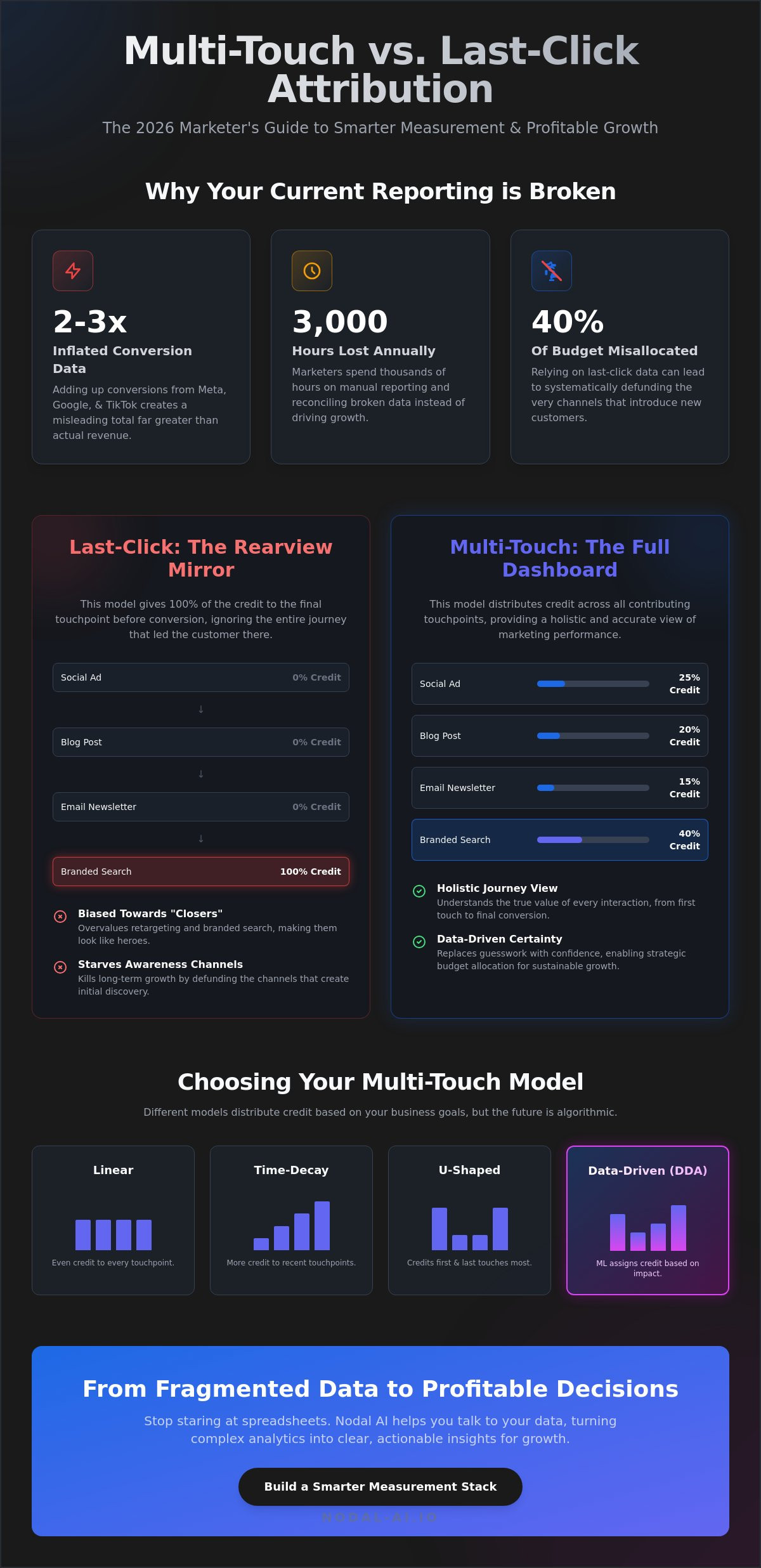
If you add up the conversions reported by Meta, Google, and TikTok, you'll likely find a total that's two to three times higher than your actual revenue. It's a frustrating reality for marketers who spend 3,000 hours a year on manual reporting just to justify their top-of-funnel spend. You know your marketing works, but your current tools can't prove it. This disconnect is the core of the multi-touch attribution vs last-click attribution debate in 2026, where third-party cookie deprecation has made old tracking methods obsolete.
We believe your data should provide clarity, not confusion. You need a way to talk to your data and receive actionable insights instead of staring at fragmented silos. Discover why last-click attribution is costing you revenue and how multi-touch models transform fragmented data into profitable growth. We'll explore how to connect the dots across complex customer journeys and build a smarter measurement stack that gives you total confidence in your budget allocation.
Key Takeaways
- Stop using the rearview mirror; learn why relying on last-click data can lead to misallocating up to 40% of your marketing budget.
- Master the shift between multi-touch attribution vs last-click attribution to see the true value of every customer interaction, not just the final click.
- Audit your fragmented data ecosystem to break down silos and connect the dots across the entire 2026 buyer journey.
- Move from manual reporting to automated growth recommendations by defining a North Star metric that prioritizes revenue over vanity metrics.
- Discover how to talk to your data to turn complex analytics into clear, profitable decisions that fuel sustainable growth.
Beyond the Last Click: Why Marketing Attribution Needs a Cognitive Upgrade
Imagine a marathon where only the person holding the ribbon at the finish line gets the trophy. That's last-click attribution. It ignores the miles of effort, the strategic pacing, and the endurance that made the win possible. In 2026, relying on this model is like driving a high-performance car using only your rearview mirror. You can see exactly where you've been, but you're completely blind to the sharp turns and opportunities waiting ahead. Most modern brands are hitting a ceiling because they operate within a fragmented data ecosystem. Their valuable insights are trapped in disconnected silos, making it impossible to see the full picture. To scale in a privacy-first market, you need a cognitive upgrade. Effectively, marketing attribution serves as the vital bridge between raw, chaotic data and profitable decisions.
The Illusion of the Last Click
Last-click creates a heavy bias toward "closers" like branded search and retargeting. These channels appear to be high-performing heroes because they happen to be the final interaction before a conversion. However, if you only optimize for these metrics, you'll eventually starve your awareness channels. You'll stop investing in the discovery phases that actually introduce new customers to your brand, which eventually kills your long-term growth. This is a massive pain point for London marketing teams who lose thousands of hours annually to manual reporting and reconciling broken data. They're stuck in a cycle of digging into spreadsheets rather than making a real impact. The debate of multi-touch attribution vs last-click attribution is really about whether you want to reward the person who signed the contract or everyone who helped build the relationship.
Connecting the Dots in a Multi-Channel World
The 2026 customer journey is a complex web of 20 or more touchpoints across various devices and platforms. In this reality, intuition-based spend is a liability. You can't afford to guess which video ad or social post sparked the initial interest. You need data-driven certainty to justify every pound of your budget. When you connect the dots across the entire journey, you replace the anxiety of "not knowing" with the confidence of actionable insights. It's the difference between guessing and knowing. By moving toward a model that lets you talk to your data, you gain the clarity needed to turn complex interactions into a predictable path for sustainable growth. This smarter approach ensures your budget isn't just spent, but strategically invested.
Multi-Touch Attribution (MTA) Explained: Connecting the Journey
While last-click attribution focuses solely on the final handshake, Multi-Touch Attribution (MTA) acts as a smarter partner that values every introduction along the way. It provides a holistic view of the customer journey, from the first spark of discovery to the final conversion. Instead of the all or nothing credit assigned by traditional models, MTA uses nuanced weighting to distribute value across every touchpoint. This shift is essential when evaluating multi-touch attribution vs last-click attribution; one rewards the closer, while the other understands the entire team's effort. By adopting this model, you move from a reactive stance to a proactive strategy. You begin to see the value in the "invisible" interactions that build brand equity long before a user searches for your name.
A comprehensive guide to marketing attribution reveals that businesses using sophisticated models often uncover growth opportunities that were previously hidden in fragmented data. MTA allows you to talk to your data to find these trends. It turns raw numbers into a narrative of how people actually interact with your brand. This clarity replaces marketing anxiety with the confidence of knowing exactly which levers to pull to drive revenue. It's about seeing the marathon, not just the finish line.
Common Multi-Touch Models
Choosing the right model depends on your specific business goals. You might use Linear attribution to reward every step equally, or Time-Decay to give more credit to interactions closer to the sale. U-Shaped models are excellent for focusing on both acquisition and conversion. However, the industry is rapidly moving toward Data-Driven Attribution (DDA). DDA uses machine learning to assign credit based on actual conversion patterns unique to your brand. If you're ready to implement these models, exploring specialized multi-touch attribution software UK can help you find the right tool for your tech stack.
The Mechanism of Clarity
Clarity comes from unified metrics. MTA resolves the fragmented data problem by pulling information from social platforms, search engines, and even offline events into a single journey map. It's critical to capture CRM data and loyalty-ID matching to see how digital ads translate into real-world sales. AI-powered engines identify complex patterns that human analysts simply miss, such as a specific sequence of ads that consistently leads to higher lifetime value. You can connect the dots automatically to transform these insights into profitable decisions without the manual grind. This automated approach ensures your growth recommendations are based on the full picture, not just a lucky final click.
The Practical Comparison: Last-Click Simplicity vs. Multi-Touch Clarity
Last-click is seductive because it's nearly instantaneous to set up. It's the "easy" button for reporting. However, that simplicity masks a dangerous reality for your bottom line. When you choose between multi-touch attribution vs last-click attribution, you aren't just picking a reporting style; you're deciding how to value your entire marketing engine. Simplicity is often the enemy of accuracy. While last-click offers immediate setup speed, it provides a distorted view of performance that can lead you to make expensive mistakes.
Internal audits for high-growth brands often reveal a "Hidden Cost" to this simplicity. Relying on last-click can lead to misallocating up to 40% of ad spend. This happens because the model over-values the final touchpoint while completely ignoring the channels that actually built the demand. It's time to move from blind spend to targeted investment. By adopting a multi-touch approach, you transform raw performance data into automated growth recommendations. This shift allows you to connect the dots between early-stage discovery and final revenue, ensuring every pound is working toward a profitable outcome.
When Last-Click Fails: Three Critical Scenarios
There are moments where last-click isn't just inaccurate; it's detrimental to your strategy. Consider these three scenarios common in the 2026 market:
- High-consideration B2B sales: With buyers averaging 8 to 12 touchpoints, a last-click model only sees the final demo request. It ignores the months of whitepapers, webinars, and social proof that built the necessary trust.
- Multi-device journeys: A customer might discover your brand via a TikTok ad on their phone but wait until they're at their desktop to complete the purchase. Last-click often loses this connection, crediting "Direct" traffic instead of the paid social campaign that started it.
- Brand awareness campaigns: If you're running top-of-funnel video ads, they rarely get the final click. Last-click makes these campaigns look like failures, leading you to cut the very activity that fuels your retargeting pools.
The ROI of Being Right
MTA reveals the true value of your "introducer" channels. These are the touchpoints that do the heavy lifting of finding new audiences. When you have this level of clarity, you stop saving time on reports and start making faster decisions on growth. You can finally talk to your data to understand which specific sequences lead to the highest customer lifetime value. To validate these findings, many UK marketing leaders now use incrementality testing. This ensures that the credit assigned by your attribution model translates into actual revenue growth that wouldn't have happened otherwise. It's about replacing marketing anxiety with the confidence of data-driven certainty.
Transitioning to MTA: A Smarter Framework for Growth
Moving from a legacy system to a modern measurement stack is a strategic shift from data chaos to revenue clarity. The choice between multi-touch attribution vs last-click attribution is the first step toward reclaiming your marketing budget from inefficient channels. You don't need to rebuild your entire tech stack overnight. Instead, follow a logical journey from fragmented data to profitable decisions.
- Step 1: Audit your fragmented data ecosystem. Identify where your customer interactions are being lost. Look for silos in your social platforms, search ads, and CRM to find the gaps in your journey map.
- Step 2: Define your North Star metric. Stop chasing vanity clicks. Decide if your primary goal is immediate Return on Ad Spend (ROAS), long-term Customer Lifetime Value (LTV), or pure revenue growth.
- Step 3: Implement a unified tracking layer. Use server-side tagging, robust UTM parameters, and first-party cookies. This ensures your data remains reliable even as third-party tracking continues to fade.
- Step 4: Move toward foresight. Once your data is clean, transition from historical reporting to predictive modelling. This allows you to simulate future spend scenarios and allocate budget with total confidence.
Overcoming the Complexity Barrier
Many marketers hesitate to switch because they believe MTA requires a PhD in data science. It doesn't. Modern platforms handle the heavy lifting of data unification automatically. This shift to automated reporting can save your team 20 or more hours every week, allowing you to focus on strategy rather than spreadsheets. In the UK, a primary challenge is the walled garden problem. These closed ecosystems often hide the true impact of your cross-channel efforts. A smarter partner helps you look over those walls to see how your social spend actually influences your search conversions.
Validating with Incrementality
Attribution tells you who gets the credit, but incrementality tells you if the conversion would have happened anyway. It's the ultimate truth-teller for your marketing engine. By running simple lift tests, you can prove the accuracy of your multi-touch attribution vs last-click attribution findings. This moves your conversation from "What happened?" to "What if?" You'll gain the ability to predict how a 10% increase in top-of-funnel spend will impact your bottom line. Ready to stop guessing? Connect your data to the Nodal Platform today to start making smarter, profit-driven decisions.
From Fragmented Data to Profitable Decisions: The Nodal Advantage
Stop digging into spreadsheets and start making an impact. The debate over multi-touch attribution vs last-click attribution ends when you have a partner that automates the complexity. Nodal AI acts as that smarter partner, connecting the dots across your entire marketing ecosystem without the manual grind. We don't just provide a dashboard; we provide a cognitive upgrade for your business. By turning fragmented data into actionable growth recommendations, the Nodal Platform ensures you never have to guess where your next customer is coming from. It's time to move from the anxiety of ambiguity to the relief of strategic clarity.
Our unique "Talk to your data" feature transforms your analytics from a passive asset into an active conversational partner. Instead of spending days building custom reports to justify your spend, you can simply ask for the insights you need. Get instant answers on channel performance, customer journey bottlenecks, and revenue drivers. This seamless interaction allows you to stay focused on high-level strategy while our AI handles the heavy lifting of data unification. You'll gain the confidence to allocate budgets based on truth, not just the loudest platform's reported metrics.
AI-Powered Business Intelligence
The Nodal engine is built for speed and precision. It processes thousands of hours of historical and real-time data in seconds, identifying patterns that are invisible to the human eye. This allows you to shift from reactive reporting to proactive automated media planning. You aren't just looking at what happened; you're seeing what will happen if you scale specific channels. We prioritize your security as much as your growth. With enterprise-level encryption, your data remains secure and private while being transformed into profitable decisions. It's high-tech innovation tethered to traditional business value.
Smarter Growth Starts Here
Nodal is the preferred choice for London's most ambitious marketing teams because we deliver "Day One" value. You get instant visibility into your true channel performance the moment you connect your data sources. There is no long implementation period or steep learning curve. We've simplified the journey from data chaos to sustainable growth into three simple steps. You can finally prove the ROI of your brand-building efforts and optimize your bottom-of-funnel conversions with total certainty. Ready to see the future of your analytics? Transform your fragmented data into profitable decisions with Nodal AI and start growing smarter today.
Master the Customer Journey and Grow Smarter
The choice between multi-touch attribution vs last-click attribution defines your competitive edge in a privacy-first market. You've seen how last-click hides the true value of your brand-building efforts, while multi-touch models reveal the profitable path from discovery to conversion. It's time to stop digging into spreadsheets and start using a cognitive upgrade that turns fragmented data into actionable insights. Moving from ambiguity to clarity isn't just a technical shift; it's a strategic advantage that ensures every pound of your budget works toward sustainable growth.
Nodal AI provides the relief of total visibility. Our platform saves teams over 3,000 hours a year on manual reporting by automating the entire measurement stack from end to end. With enterprise-level encryption and full GDPR compliance, your data stays secure while our AI-powered growth recommendations fuel your ROI. You don't have to navigate the complexity of 2026 analytics alone. You just need a smarter partner to connect the dots and show you the way forward.
Ready to transform your marketing engine? Connect the dots and talk to your data with Nodal AI today. The future of your analytics is clear, and it starts with a single, smarter decision.
Frequently Asked Questions
What is the main difference between last-click and multi-touch attribution?
Last-click attribution gives 100% of the credit for a sale to the very last interaction a customer had with your brand. Multi-touch attribution (MTA) provides a holistic view by distributing that credit across every touchpoint in the journey. The multi-touch attribution vs last-click attribution choice determines whether you value only the "closer" or the entire team that built the relationship. MTA acknowledges that a first discovery on social media is just as vital as the final search click.
Is last-click attribution still relevant in 2026?
Last-click remains a useful metric for simple, high-intent actions like brand search where the path to purchase is nearly instantaneous. However, it's no longer sufficient for strategic budget planning in a multi-channel world. With third-party cookies deprecated across all major browsers as of 2026, relying solely on last-click creates a massive blind spot. It fails to account for the long nurture cycles and cross-device interactions that define modern consumer behavior.
How does multi-touch attribution handle social media 'walled gardens'?
Modern MTA models use a combination of server-side tagging and first-party data to bridge the gaps created by closed ecosystems like Meta or TikTok. Instead of relying on platform-reported pixels, these models sync with your CRM and internal sales data to verify outcomes. This approach allows you to see how social impressions influence later searches. It turns fragmented data from these walled gardens into a unified map of your customer's true path to conversion.
Can I use multi-touch attribution if I have a small marketing budget?
You definitely can, and you probably should. Small budgets have less room for waste, making accurate measurement even more critical. Automated platforms have removed the need for expensive data science teams, making sophisticated modeling accessible to growing brands. By identifying which early-stage introductions actually lead to revenue, you can stop wasting spend on "cheap clicks" that never convert. It's about making your limited budget work harder through smarter decisions.
What is the best attribution model for a B2B SaaS company?
Most B2B SaaS companies find success with U-Shaped or W-Shaped models. These models specifically reward the first touchpoint that creates awareness and the lead conversion touchpoint that moves a prospect into the sales funnel. Since B2B journeys in 2026 average 8 to 12 touchpoints, these "position-based" models ensure you don't starve your top-of-funnel discovery. They provide the clarity needed to justify long nurture cycles and high-consideration sales efforts.
How do I know if my attribution data is accurate?
Accuracy is verified through incrementality testing and lift studies. You compare a group of users who saw your ads against a control group who didn't to see the actual "lift" in revenue. If your attribution model predicts a 20% increase in sales from a specific campaign and your bank account reflects that growth, your model is calibrated correctly. This process moves your measurement from theoretical reporting to tangible financial certainty.
What role does AI play in modern marketing attribution?
AI acts as the engine that processes thousands of data points in real-time to identify patterns humans miss. It moves your reporting from descriptive (what happened) to prescriptive (what to do next). AI-powered engines can automatically adjust your budget allocation based on shifting conversion patterns and predictive modeling. This technology allows you to talk to your data and receive instant growth recommendations, replacing manual analysis with automated media planning.
How long does it take to transition from last-click to a multi-touch model?
The technical connection often provides "Day One" value by giving you instant visibility into your existing data silos. However, fully calibrating a custom model typically takes two to four weeks of fresh data collection. This period allows the AI to observe your specific customer journey sequences and assign accurate weights to each channel. The transition is a structured journey that quickly replaces marketing anxiety with the confidence of clear, actionable insights.


