

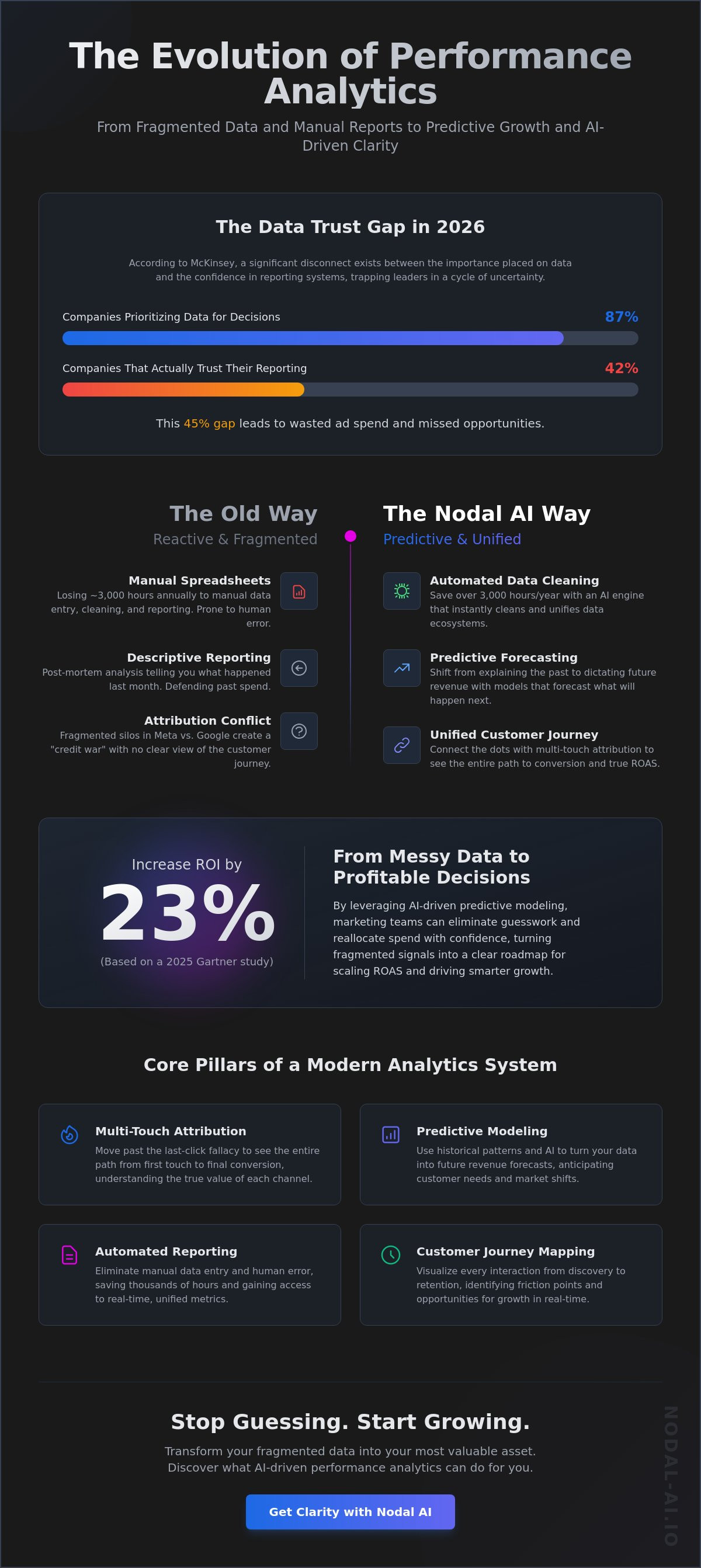
According to a 2026 McKinsey report, 87% of companies prioritize data for their decisions, yet only 42% actually trust their reporting systems. This gap leaves most marketing leaders trapped between fragmented data silos in Meta and Google and the pressure to drive predictable growth. You've likely felt the frustration of losing thousands of hours to manual spreadsheet reporting while trying to master your performance analytics. It's time to stop digging into rows of data and start making profitable decisions.
You know that inaccurate attribution is costing you a fortune in wasted ad spend. In this guide, you'll learn how to use AI-driven insights to eliminate silos and connect the dots across the entire customer journey. We'll explore four real-world examples of how predictive modeling can increase your ROI by 23%, based on a 2025 Gartner study. From fragmented data to clarity, this is your roadmap to scaling ROAS and driving smarter growth in 2026.
Key Takeaways
- Shift from tracking past results to forecasting future revenue by adopting predictive performance analytics models that drive smarter growth.
- Connect the dots across fragmented channels to end the attribution conflict between Meta and Google and see the true customer journey.
- Use real-world cohort analysis to predict churn and implement growth recommendations that protect your long-term retention.
- Turn messy, fragmented data into profitable decisions using automated cleaning processes that remove the need for manual spreadsheet work.
- Learn how conversational AI tools allow you to talk to your data for instant, enterprise-level insights without technical complexity.
What is Performance Analytics in the AI Era?
Performance analytics in 2026 is no longer a post-mortem exercise. It's the synthesis of raw marketing data into actionable growth intelligence. Traditional models focus on descriptive reporting, telling you what happened last month or last quarter. Modern systems use predictive performance models to forecast what will happen next. This shift moves your team from defending past spend to dictating future revenue. You're no longer just looking at a dashboard; you're looking at a roadmap.
The 2026 cookieless landscape makes this transition urgent. With 20 US states now enforcing comprehensive data privacy laws and the EU AI Act in full effect, relying on third-party signals is a recipe for blind spots. You must pivot to a unified "Connect the Dots" philosophy centered on first-party data. This approach turns fragmented signals into a coherent narrative of the customer journey. To truly scale, you must understand What is Analytics in the context of high-speed business intelligence.
The Move from Fragmented Data to Strategic Clarity
Marketing teams currently drown in data noise. They possess thousands of data points from Meta, Google, and various CRMs, yet they starve for actual insights. As of 2026, the complexity of the digital ecosystem has reached a breaking point where manual analysis is impossible. An AI-powered business intelligence engine acts as your Smarter Partner by instantly cleaning these fragmented ecosystems. It automates the tedious data preparation that used to consume 3,000 hours of manual labor annually. This transformation moves you from a state of constant overwhelm to a position of high-level authority over your marketing spend.
Key Metrics vs. Actionable Intelligence
Vanity metrics like clicks or impressions often mask deeper inefficiencies in your funnel. You need unified metrics that drive actual revenue across every channel. While knowing what is roas is only half the battle, understanding the underlying drivers of that return is where the profit lies. Actionable intelligence tells you where to reallocate your next pound of spend to maximize impact. Performance analytics is the bridge between raw data and profitable decisions.
By focusing on unified metrics, you eliminate the "credit war" between platforms. You stop guessing which channel actually drove the sale. Instead, you gain a clear, enterprise-ready view of your entire growth engine. This clarity allows you to talk to your data and receive instant, reliable recommendations for your next move.
The Core Components of a Modern Performance Analytics System
A modern performance analytics system functions as an integrated engine rather than a static collection of charts. It replaces the "spreadsheet lag" that kills marketing agility with real-time, unified metrics. By 2026, the standard for success has moved beyond simple tracking to active intelligence. This transformation relies on four critical pillars that turn complexity into clarity.
- Multi-touch attribution: This component moves you past the last-click fallacy to see the entire path from first touch to final conversion.
- Predictive modelling: This uses historical patterns to turn your data into future revenue forecasts.
- Automated reporting: You can save up to 3,000 hours a year by eliminating manual data entry and human error.
- Customer journey mapping: This visualises every interaction from discovery through to long-term retention, identifying friction points in real-time.
Relying on fragmented data silos is no longer an option for marketing teams aiming for sustainable growth. You need a system that doesn't just store information but actually understands it. This is where the "Smarter Partner" persona of AI becomes invaluable, providing a cognitive upgrade for your entire business operations. It allows you to move from the anxiety of guesswork to the confidence of data-backed certainty.
Multi-Touch Attribution and Incrementality
Moving beyond the last-click fallacy is essential for scaling ROI. Multi-touch attribution identifies which channels actually drive new revenue by assigning value to every touchpoint in the customer journey. This provides a clear view of incrementality; the process of measuring what would have happened to your sales if you hadn't spent that extra pound on ads. This advanced level of insight is built on the foundation of predictive modelling, which allows you to anticipate customer needs before they even arise. It's about connecting the dots between a social media impression and a CRM conversion weeks later.
AI-Driven Growth Recommendations
The most significant evolution in performance analytics is the shift from "reporting" to "advising." Instead of just showing you what happened, a modern platform provides specific recommendations for budget reallocation. These insights are fueled by real-time data ingestion, ensuring your decisions are based on what's happening right now, not last week. This data-backed certainty reduces the anxiety of decision-making and allows you to talk to your data for instant strategic clarity. You stop fighting the "credit war" between Meta and Google and start focusing on profitable decisions that move the needle. When you turn fragmented data into a unified vision, your path to sustainable growth becomes inevitable.
Performance Analytics in Action: 4 Real-World Examples
Theory only takes you so far. To scale marketing ROI in 2026, you need to see these systems in motion. High-level performance analytics doesn't just report numbers; it reveals the story behind the spend. While a 2026 McKinsey report shows that 87% of companies prioritize data, only 42% trust their systems. These four examples demonstrate how to bridge that trust gap and drive predictable growth.
- The Multi-Channel E-commerce Brand: Solving the "credit war" where Meta and Google both claim 100% of the same sale.
- The High-Growth SaaS Startup: Using cohort analysis to flag churn risks 30 days before they cancel.
- The Enterprise B2B Firm: Mapping a 12-month sales cycle to identify the "hidden" whitepaper that influenced a six-figure deal.
- The London Retailer: Connecting online search ad performance directly to physical footfall in high-street locations.
These scenarios represent the shift from fragmented data to strategic clarity. By using an AI-powered business intelligence engine, these brands stop digging into spreadsheets and start making profitable decisions. They've moved from reacting to what happened to predicting what will happen next. It's about turning your data into a Smarter Partner that works for you 24/7.
Solving the Attribution Credit War
Imagine a customer sees a Meta ad on Monday, clicks a Google Search link on Wednesday, and finally buys on Friday. Both platforms will claim that revenue in their own dashboards, leading to a "credit war" that inflates your perceived success while draining your actual cash. By using a unified platform, you connect the dots to see the true path. This level of visibility is vital for understanding your content marketing roi. When you properly attribute value to the long-form content or videos that started the journey, you stop cutting the very channels that feed your funnel.
Predicting Customer Lifetime Value (CLV)
A 2025 Gartner study found that companies using advanced reporting increase ROI by an average of 23%. This growth is often driven by identifying high-value segments early in their journey. Instead of waiting for a customer to stop spending, you use predictive modelling to forecast future behavior. The "Talk to your data" approach allows you to ask the AI specific questions like "Which segment will spend most in Q3?" The system analyzes historical patterns to provide growth recommendations that shift your spend toward high-retention audiences. This move from anxiety to certainty ensures your budget is always working where it matters most.
Overcoming the "Messy Data" Objection
The biggest hurdle to adopting AI isn't the technology; it's the belief that your data isn't "ready." You might feel that your fragmented data ecosystem is too chaotic for high-level analysis. This fear keeps many leaders stuck in a manual reporting cycle that consumes thousands of hours. Waiting for perfect data is a strategy for falling behind. By January 2026, more than 60% of enterprises have already deployed AI-powered anomaly detection tools to handle data inconsistencies.
Modern performance analytics platforms are designed to thrive in the mess. They don't just consume data; they clean it. Through automated data cleaning, the system identifies duplicates, fixes naming conventions, and bridges the gaps between your CRM and social platforms. This process is supported by a data governance framework that ensures long-term clarity and compliance with the 20 US state-level privacy laws currently in effect.
Seamless Integration: The Cure for Data Silos
The days of months-long API implementations are over. Modern platforms connect to your tech stack in minutes, not months. You move from manual API management to automated, AI-led data ingestion. This shift eliminates the human error that often plagues manual reporting. While the technology is complex, your experience remains effortless. Every connection is backed by enterprise-level encryption to avoid the severe penalties of new US data transfer regulations, which can reach $368,136 in civil fines. By automating these connections, you reclaim the 3,000 hours a year typically lost to spreadsheet maintenance.
From Fragmented to Unified in 3 Simple Steps
You can transform your marketing operation through a logical, three-step journey. First, connect disparate sources including social, CRM, and web data. Second, the AI-led mapping engine identifies every touchpoint in the customer journey. Finally, the system provides instant generation of growth recommendations. This rhythm creates a sense of frictionless progress. You stop worrying about the "mess" and start focusing on the outcomes. Performance analytics turns your data from a burden into a cognitive upgrade. If you're ready to see how your current stack can become a revenue engine, it's time to connect the dots with Nodal AI.
Choosing the Right Performance Analytics Platform for 2026
Selecting a platform in 2026 requires looking beyond basic data visualization. The performance analytics market is projected to reach $24.60 billion by 2034, driven by a shift toward proactive, AI-led intelligence. To stay competitive, your choice must balance enterprise-level security with the agility required by modern marketing teams. You need a system that scales with your ambition, integrates with your stack in minutes, and offers conversational capabilities that humanize complex algorithms.
For London-based marketing leaders, the challenge isn't just collecting data; it's achieving strategic clarity in a landscape governed by the EU AI Act and shifting privacy laws. Many traditional platforms act as rigid control towers that require a team of data scientists to operate. You need a solution that functions as a cognitive upgrade for your entire business. This means moving from static, descriptive dashboards to interactive models that predict revenue and retention before they appear on a balance sheet.
Why the Nodal Platform is the Smarter Partner
The Nodal Platform replaces the anxiety of manual reporting with the confidence of actionable intelligence. By automating media planning and reporting, our users save an average of 3,000 hours a year. This isn't just about efficiency; it's about reclaiming the time to focus on high-level strategy. We don't just provide raw reporting. We deliver specific growth recommendations that turn your analytics from a cost centre into a revenue engine. Connect your dots and transform your decisions today to ensure your brand remains a leader in the fragmented data ecosystem of 2026.
The Future of Analytics: Conversational Intelligence
The most significant gap in current enterprise tools is the lack of a conversational interface. While competitors offer rigid benchmarks, Nodal AI allows you to talk to your data. You can ask complex questions like "Which channel will drive the highest incrementality next month?" and receive instant, data-backed answers. This approach humanizes the algorithm for non-technical marketers, removing the friction between insight and action. It's time to move from data silos to a unified vision of your customer journey. You have the power to transform fragmented data into profitable decisions with Nodal AI and lead your team toward sustainable, predictable growth.
Turn your data from a passive asset into an active participant in your success. In the 2026 landscape, the winners aren't those with the most data, but those with the clearest insights. Stop digging into spreadsheets. Start talking to your data. The relief of clarity is just one integration away.
Master Your Marketing ROI with Strategic Clarity
Moving beyond the last-click fallacy is no longer a luxury; it's a requirement for 2026 growth. You've seen how performance analytics transforms fragmented silos into a clear, unified customer journey. By connecting the dots between Meta, Google, and your CRM, you eliminate the attribution credit war and focus your budget on true incrementality. This shift from descriptive reporting to predictive intelligence is what separates market leaders from those drowning in data noise.
Reclaim your time and stop losing 3,000 hours a year to manual spreadsheet maintenance. With Nodal AI, you get AI-powered growth recommendations delivered daily to your inbox. Our London-based expert support ensures your implementation is seamless, turning your analytics from a cost centre into a revenue engine. It's time to Transform fragmented data into profitable decisions with Nodal AI.
You're ready to lead your team from the anxiety of guesswork to the confidence of data-backed certainty. The future of your business is waiting for you to connect the dots.
Frequently Asked Questions
What is the difference between marketing analytics and performance analytics?
Marketing analytics typically describes past events, but performance analytics provides the bridge to profitable decisions. While standard analytics might show you clicks or impressions, performance models synthesize that data into actionable growth intelligence. It moves you from vanity metrics to unified metrics that correlate directly with revenue and sustainable growth.
Can performance analytics help with cookieless tracking in 2026?
Yes, it's designed to thrive in the 2026 landscape where first-party data is the primary signal. With 20 US states enforcing comprehensive privacy laws and the EU AI Act in full effect, these systems use AI to bridge tracking gaps. You maintain attribution accuracy without relying on the third-party cookies that have become obsolete.
How long does it take to see results from a performance analytics platform?
You gain day one value through automated data cleaning and the elimination of manual reporting. Most marketing teams start acting on high-level growth recommendations within 14 to 30 days of initial data ingestion. This speed allows you to pivot your budget based on real-time insights rather than waiting for monthly post-mortems.
Is performance analytics only for large enterprises with massive budgets?
It's accessible for any growth-focused brand, from SaaS startups to London retailers. A 2025 Gartner study found that companies using advanced reporting increase their ROI by an average of 23%. You don't need a massive budget to start making smarter decisions; you just need a system that connects your existing dots.
How does AI improve the accuracy of performance marketing attribution?
AI identifies the true incrementality of your spend by assigning value to every touchpoint in the customer journey. It ends the credit war between Meta and Google where both platforms claim 100% of the same sale. This provides a clear, data-backed view of which channels actually drive new revenue for your business.
What happens if my data is currently stored in multiple different silos?
Fragmented silos are the primary problem an AI-powered business intelligence engine is built to solve. Modern platforms connect to your disparate sources in minutes, not months. This automation turns a fragmented data ecosystem into strategic clarity, saving your team the 3,000 hours a year typically lost to manual spreadsheet reporting.
Can I use performance analytics to predict future sales trends?
Yes, predictive modelling allows you to forecast future customer behavior based on historical patterns. You can talk to your data to ask specific questions about which segments will spend most in the coming quarter. This moves you from the anxiety of guesswork to the confidence of making proactive, profitable decisions.


