

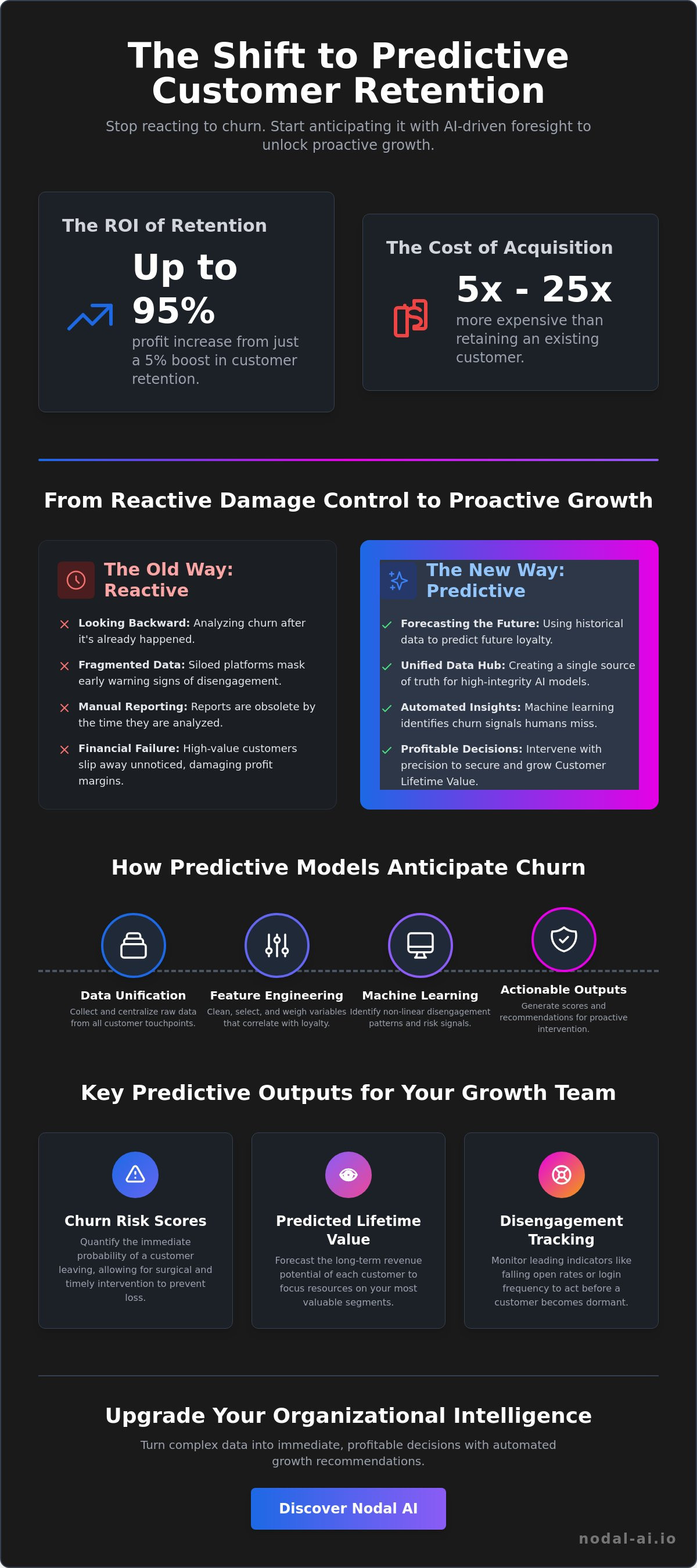
A 5% increase in customer retention can skyrocket company profits by as much as 95%. Yet, most organizations still struggle with acquisition costs that are 5 to 25 times higher than the price of keeping an existing client. You've likely felt the drain of fragmented data and manual reporting that's already obsolete by the time it reaches your desk. It's time to stop reacting to churn and start anticipating it. By leveraging predictive analytics for customer retention, you transform passive data into an active partner in your commercial success.
You need the clarity of a streamlined, high-level perspective to drive sustainable growth. We'll show you how to replace the anxiety of manual tasks with the confidence of automated growth recommendations. This guide provides a definitive framework for proactive engagement, helping you navigate new 2026 privacy laws while scaling your Customer Lifetime Value. Master the predictive signals that turn chaotic inputs into high-value outputs and secure your competitive edge through a total cognitive upgrade of your retention strategy.
Key Takeaways
- Shift from reactive damage control to proactive growth management by using historical data to forecast future loyalty.
- Identify non-linear disengagement patterns using machine learning to anticipate churn signals before they become permanent losses.
- Master the link between multi-touch attribution and predictive analytics for customer retention to pinpoint the channels that drive maximum lifetime value.
- Build a unified performance marketing hub to eliminate data fragmentation and ensure high-integrity inputs for your predictive models.
- Upgrade your organizational intelligence with automated growth recommendations that turn complex data into immediate, profitable decisions.
Beyond the Churn Rate: The Strategic Shift to Predictive Retention
Stop looking in the rearview mirror to manage your growth. Traditionally, brands have treated retention as a game of damage control, reacting only after a customer has already stopped spending. This reactive stance is a recipe for stagnation. Predictive analytics for customer retention changes the equation by using historical data to forecast future loyalty. It transforms your data from a passive record of the past into an active partner that anticipates the future. This is the strategic shift from reactive survival to proactive growth management.
In 2026, the commercial priority has moved decisively from top-of-funnel acquisition to bottom-of-funnel lifecycle value. With acquisition costs rising up to 25 times higher than the cost of retention, your existing customer base is your most profitable asset. Predictive analytics allows you to identify the quiet signals of disengagement long before they turn into a final exit. By mapping these patterns, you can intervene with precision, ensuring that your resources are spent on the customers most likely to stay and grow.
The High Cost of Reactive Retention
Waiting for a customer to "lapse" is a financial failure. By the time a user reaches a "churned" status in a manual report, they have likely already checked out mentally and emotionally. Research from Rivo in May 2026 confirms that a mere 5% increase in customer retention can skyrocket profits by 25% to 95%. You cannot achieve these gains with tedious, manual reporting that is always out of date. These delays create a blind spot where high-value customers slip away unnoticed. Real-time foresight is the only way to protect your margins in a high-speed market.
Turning Fragmented Data into a Competitive Advantage
Most organizations struggle with a "siloed" marketing stack where customer data is scattered across multiple platforms. This fragmentation masks the early churn signals that your team needs to see. Fragmented data is the primary barrier to AI-driven marketing clarity. When your data is broken, your predictive models are blind. Unifying these touchpoints is the essential first step toward building a high-performance retention engine. Once you centralize these inputs, you replace the anxiety of complexity with the confidence of a streamlined, enterprise-ready perspective. You stop guessing why customers leave and start knowing exactly how to make them stay.
The Mechanics of Foresight: How Predictive Models Anticipate Churn
Predictive models don't rely on magic; they rely on a rigorous engineering process. To master predictive analytics for customer retention, you must first transform raw data into a structured asset. This journey begins with collection across all touchpoints, followed by deep cleaning to remove noise. The final, most critical step is feature engineering. This is where you select and weight the specific variables that actually correlate with loyalty. By refining these inputs, you create a high-fidelity engine capable of seeing what human analysts often miss.
Machine learning excels at identifying non-linear patterns of disengagement. Unlike simple spreadsheets, AI can detect subtle shifts in behavior that don't follow a straight line. It looks at the interplay between purchase frequency, support ticket sentiment, and browsing habits. When these variables align in a specific way, the model flags a risk. This sophisticated Predictive Modelling capability turns your passive data into a cognitive upgrade for your entire growth team.
Identifying Key Retention Signals
The most effective models focus on three primary outputs. First, Churn Risk Scores quantify the immediate probability of a customer leaving. This allows for surgical intervention by identifying flight risk factors before the relationship ends. Second, Predicted Lifetime Value (pCLV) forecasts the long-term revenue potential of each segment. Finally, models track engagement decline, such as falling email open rates or reduced login frequency, as leading indicators of future churn. You stop chasing every customer and start protecting the ones who drive your stability.
Machine Learning vs. Static Reporting
Traditional reporting tells you what happened; machine learning tells you what to do next. Static "last-click" or "last-purchase" reports are descriptive but ultimately blind to the future. They fail because they assume past behavior is a linear map. In contrast, AI creates "lookalike" retention profiles. It finds your most loyal customers and identifies common traits among them. This allows you to move from descriptive analytics to prescriptive analytics. Instead of mourning lost revenue, you receive automated Growth Recommendations that guide your next move with total clarity.
By integrating these complex models into your daily workflow, you replace manual guesswork with streamlined efficiency. If you're ready to stop the drain of customer churn, exploring how a unified performance marketing analytics platform can automate these insights is the logical next step for your brand.
The Attribution Link: Why Journey Mapping is the Key to Loyalty
True loyalty doesn't begin at the point of sale. It starts the moment a prospect first interacts with your brand. If you wait until the transaction is complete to think about retention, you've already missed the most critical window. By integrating multi-touch attribution into your growth strategy, you uncover which specific channels attract long-term partners versus one-time buyers. This visibility is essential for predictive analytics for customer retention because it identifies the source of your highest-value relationships.
Understanding the "path to purchase" is only half the battle. You must also map the "path to retention." When you align your attribution data with journey mapping, you see exactly where loyalty is built or broken. This synergy allows you to move beyond generic outreach. Instead, you deliver a personalized experience that mirrors the customer’s unique history with your brand. You turn a chaotic sequence of clicks into a structured, predictable journey toward advocacy. It's a cognitive upgrade that transforms how you view every customer interaction.
Attribution-Aware Retention Strategies
Not all acquisition channels are created equal. Some provide a quick burst of volume but lead to immediate churn. Others might be slower to convert but deliver customers who stay for years. These are your "Goldilocks" channels, and identifying them requires a blend of attribution and foresight. By linking predictive modelling to your attribution data, you optimize your marketing spend for long-term stability rather than short-term vanity metrics. You stop wasting budget on high-churn segments and start investing in the leads most likely to become brand advocates. This isn't just marketing; it's high-level asset protection for your revenue stream.
Mapping the Predictive Customer Journey
Every customer journey has "moments of truth" where a user either deepens their commitment or begins to drift. Using predictive analytics for customer retention, you can visualize these friction points before they cause a drop-off. You might discover that a specific delay in onboarding or a lack of engagement after the second purchase correlates with a spike in churn risk. Mapping these signals allows for surgical, proactive intervention. For a structural deep dive into this process, consult our definitive guide to the customer journey. Replace the anxiety of the unknown with the clarity of a mapped, optimized lifecycle that guarantees measurable returns.
A Framework for Implementation: From Raw Data to Automated Growth
Execution is where visionary strategy meets commercial reality. Implementing predictive analytics for customer retention requires a move away from fragmented silos and toward a unified performance marketing hub. You cannot scale loyalty on a foundation of broken data. This framework provides a logical, multi-step journey to transform your passive assets into active drivers of revenue. It replaces the anxiety of manual labor with the calm efficiency of a streamlined, enterprise-ready system.
- Step 1: Centralise your data. Bring every touchpoint into a single performance marketing hub to eliminate the blind spots caused by fragmented platforms.
- Step 2: Secure your foundation. Establish a robust data governance framework to ensure the integrity and transparency of every input.
- Step 3: Score customer health. Deploy predictive algorithms that calculate churn probability and lifetime value in real-time, providing immediate visibility into your most at-risk segments.
- Step 4: Automate your insights. Transition from manual data manipulation to automated reporting that delivers high-level perspectives directly to your decision-makers.
- Step 5: Trigger proactive growth. Use automated growth recommendations to execute personalized marketing interventions the moment a predictive signal is detected.
The Role of Automated Reporting
In the race to prevent churn, real-time is the only speed that matters. Manual reporting is a productivity drain, often requiring 20 or more hours of tedious data manipulation every week. By the time these reports are finished, the opportunity to intervene has usually passed. Automated reporting acts as the early warning system for your retention strategy, allowing you to see disengagement patterns as they form. This shift replaces the stress of outdated spreadsheets with the confidence of a live, high-fidelity dashboard that never sleeps.
Executing Growth Recommendations
Insights only have value if they lead to action. The final mile of predictive analytics is the transition from knowing what might happen to executing a specific response. Effective growth recommendations turn complex algorithmic outputs into simple, actionable steps. For example, a high-risk churn signal might trigger an automated VIP re-engagement offer or a loyalty-building experiential reward. Proactive outreach of this nature has been shown to provide a 14% lift in retention. By measuring the incremental lift of these interventions, you prove the measurable returns of your predictive engine. Stop guessing and start growing by integrating these automated growth recommendations into your marketing stack today.
Scaling Loyalty with Nodal AI: The Cognitive Upgrade for Your Brand
Fragmentation is the enemy of foresight. When your customer data is scattered across disconnected platforms, your retention strategy remains trapped in a reactive loop. The Nodal Platform serves as the definitive solution to this complexity. It transforms your chaotic marketing inputs into a single, high-value stream of actionable intelligence. By unifying your data, you don't just see what happened; you gain the clarity needed to decide what happens next. This is the shift from managing chaos to mastering growth.
What sets Nodal AI apart is its unique ability to combine multi-touch attribution with predictive analytics for customer retention. Most tools treat acquisition and loyalty as separate problems, but we treat them as a single, continuous journey. This integration allows you to identify which specific marketing spend drives the highest lifetime value, ensuring that every pound invested contributes to long-term stability. It’s a cognitive upgrade for your entire marketing team, removing the crushing burden of manual analysis and replacing it with automated, future-facing recommendations. You stop being a reactive participant and become a visionary leader of your brand's destiny.
Why London Enterprises Choose Nodal AI
High-growth organizations in London require more than just a software tool; they need a highly capable partner. Our expertise lies in managing complex customer journeys and the seamless ingestion of historical data. The Nodal Platform delivers the high-level perspectives that CMOs need to protect their assets and drive measurable returns. We turn the noise of thousands of disparate signals into a clear, rhythmic cadence of growth. Your team stops wasting time on tedious reporting and starts focusing on high-level strategic execution. This creates a sense of frictionless progress, where the underlying technology is complex but the user experience is effortless.
Get Started with Predictive Retention
The path to proactive growth is faster than you think. Our onboarding process is designed for calm efficiency, moving rapidly from technical setup to custom dashboard configuration. We understand that your time is a finite resource. Nodal AI’s professional implementation ensures that your data integrity is established from day one, leading to a rapid and verifiable ROI. You gain a partner that is intelligent, technologically advanced, and obsessed with your commercial success. It's time to replace the anxiety of churn with the confidence of a streamlined, intelligent retention engine. If you're ready to stop churn before it happens, explore the Nodal Platform today and secure your organization's future growth.
Master the Future of Your Customer Relationships
The transition from reactive damage control to proactive growth management is the definitive requirement for sustainable success in 2026. You've seen how unifying your marketing touchpoints eliminates the blind spots caused by fragmented data. By mastering predictive analytics for customer retention, you transform your data from a passive record into an active partner that anticipates every churn signal. This isn't just a technical shift; it's a cognitive upgrade that replaces the anxiety of manual labor with the calm efficiency of automated foresight.
The Nodal Platform provides the streamlined, high-level perspective required to resolve complexity and drive measurable returns. Our system combines advanced multi-touch attribution with AI-powered growth recommendations, all backed by expert London-based technical support. You stop guessing why customers leave and start knowing exactly how to make them stay. This high-level authority over your data ensures that your resources are always focused on your most valuable segments.
Transform your fragmented data into profitable growth with Nodal AI. Step into the future of visionary retention today. Your most valuable customers are waiting for you to lead the way with confidence and clarity.
Frequently Asked Questions
What is predictive analytics for customer retention?
Predictive analytics for customer retention is the strategic use of historical data and machine learning to forecast future loyalty. It transforms your data from a passive record of the past into an active partner that identifies which customers are likely to stay and which are at risk. This move from reactive damage control to proactive growth management is the definitive requirement for sustainable success in 2026.
How does AI help in predicting customer churn?
AI identifies non-linear patterns in customer behavior that traditional reporting often misses. It analyzes the subtle interplay between purchase frequency, support sentiment, and site engagement to flag "flight risk" factors before a customer checks out mentally. By using machine learning, your team receives automated growth recommendations that turn complex signals into simple, actionable interventions.
Can predictive analytics work with messy or fragmented data?
Yes, but unification is the essential first step toward accuracy. Fragmented data is the primary barrier to AI-driven marketing clarity, as it masks the early churn signals your team needs to see. A high-performance platform centralizes these silos into a unified hub, transforming chaotic inputs into high-value outputs that your predictive models can actually use.
What is the difference between retention and churn analytics?
Churn analytics is descriptive and focuses on what happened in the past, while retention analytics is prescriptive and focuses on what to do next. Churn data tells you who left; predictive analytics for customer retention tells you who is about to leave and how to stop them. One mourns lost revenue, while the other protects your future stability.
How much does acquisition cost compared to retention in 2026?
Acquiring a new customer remains 5 to 25 times more expensive than retaining an existing one. This economic pressure makes lifecycle value more critical than ever. Since a 5% increase in customer retention can skyrocket profits by 25% to 95%, the financial argument for shifting focus to your existing base is undeniable and immediate.
What are the most important retention signals to track?
The most critical signals include Churn Risk Scores, Predicted Lifetime Value (pCLV), and engagement decline. Tracking falling email open rates or reduced login frequency acts as an early warning system for your brand. These signals allow for surgical, proactive intervention that targets your most valuable segments before they disengage completely.
How do I integrate predictive analytics into my existing marketing stack?
Integration begins by centralizing your fragmented data into a unified performance marketing hub. Once your foundation is secure, you establish a data governance framework to ensure the integrity of every input. Finally, you deploy predictive algorithms that feed real-time insights directly into your marketing automation tools for seamless execution.
What is the ROI of implementing a predictive retention framework?
The ROI is measured through increased Customer Lifetime Value and a significant reduction in wasted marketing spend. Proactive outreach based on predictive signals has been shown to provide a 14% lift in retention. By replacing manual reporting with automated foresight, you reclaim hundreds of hours of productivity while securing measurable, long-term commercial returns.


