

In a market where inbound visits to the UK are projected to reach 45.5 million this year, most hospitality leaders are still losing the battle for direct bookings to OTAs that hold a 37.24% market share. You likely feel the weight of this fragmentation every Friday afternoon as you spend hours toggling between Oracle OPERA, GA4, and manual spreadsheets to make sense of the noise. It is exhausting to manage 20 or more hours of reporting per week while watching acquisition costs climb and margins compress under the weight of new 2026 data regulations. You know that your data should be an asset, yet it often feels like a liability that demands more time than it returns in value.
This guide will show you how to stop drowning in raw numbers and start extracting actionable marketing insights that drive measurable commercial growth. You will learn to bridge the gap between fragmented systems and revenue by identifying the specific levers that increase direct bookings and lower acquisition costs. We will explore how to unify your PMS and CRM data into a single, automated view that provides clear growth recommendations, mirroring the success of brands like Ovolo Hotels that have already realised a 24.5% increase in ROAS.
Key Takeaways
- Distinguish between vanity metrics and commercial intelligence by focusing on observations that directly influence your budget or tactics.
- Unify fragmented data from sources like Oracle OPERA and GA4 to extract truly actionable marketing insights for your organisation.
- Combat OTA leakage by identifying the specific customer journey touchpoints that drive high-margin direct bookings.
- Optimise your predictive modelling by layering internal hospitality data with external signals like local events and flight demand.
- Replace 20 hours of manual reporting with automated intelligence that empowers your team to focus on strategic growth.
Defining Actionable Marketing Insights: Beyond Vanity Metrics
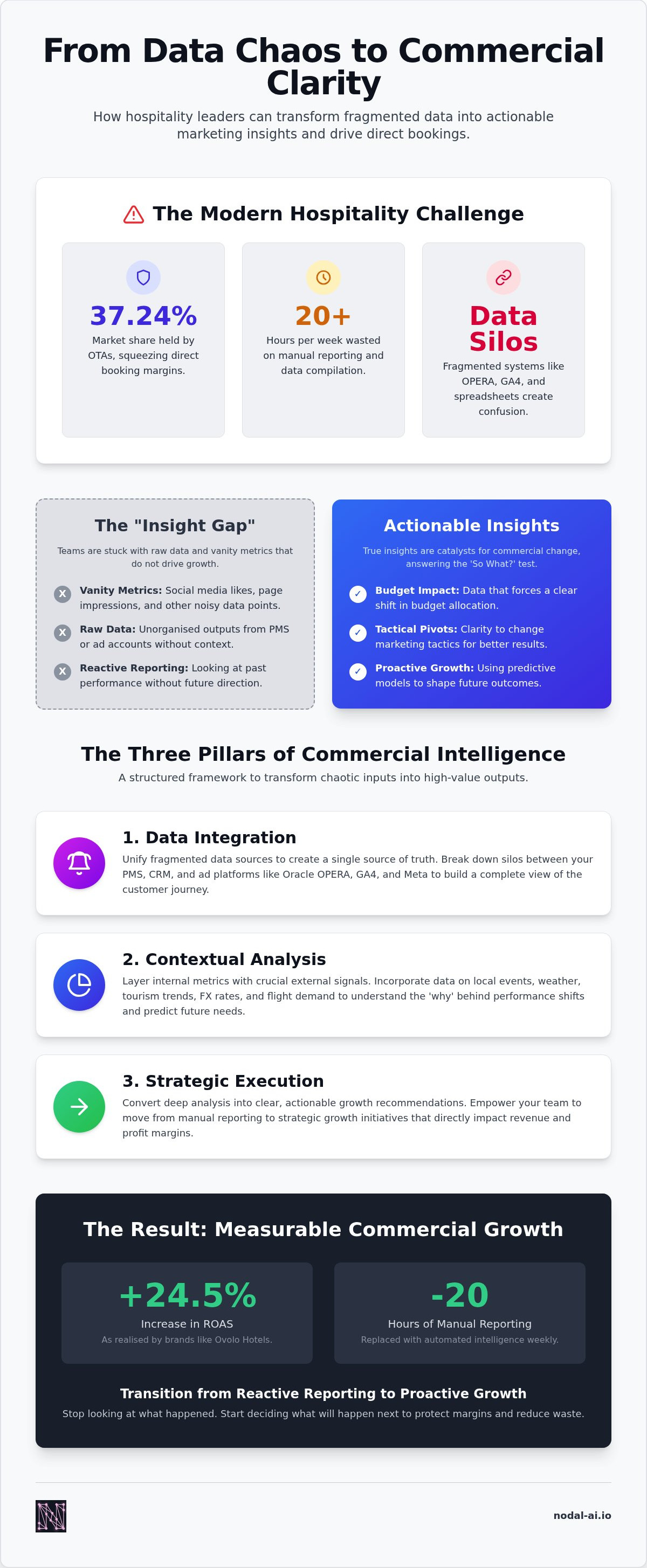
Actionable marketing insights are the catalysts for commercial change. If a data point does not force a shift in your budget or a pivot in your tactics, it is merely noise. In a hospitality sector where margins are constantly squeezed by OTA commissions and rising operational costs, distinguishing between vanity metrics and commercial intelligence is the difference between stagnation and growth. Vanity metrics like social media likes or page impressions might look impressive in a monthly deck, but they do not fill rooms or improve bed yield. True value lies in customer insights that track lifetime value and direct booking contributions.
Every report your team produces must pass the 'So What?' test. If you cannot explain exactly why a specific metric matters for the bottom line, it is a distraction. Many organisations currently suffer from an 'Insight Gap'. They possess mountains of raw data across disparate systems like Oracle OPERA or GA4, yet they remain stuck with zero direction. They have the 'what' but lack the 'now what', leading to 20 or more hours of manual reporting every week that yields no strategic progress.
The Difference Between Data, Information, and Insights
Data is the raw, unrefined output from your PMS or ad accounts. It is the foundation, but it lacks inherent meaning. Information happens when you organise that data to show a trend, such as noting that your occupancy is down 5% for the coming month. Insights, however, reveal the 'why' and the 'how'. An insight tells you that occupancy is down because a shift in FX rates has priced out your primary feeder market. It provides the clarity needed to reallocate spend to more profitable regions immediately.
Why Actionability is the Gold Standard in 2026
The 2026 marketing landscape moves at the speed of automated intelligence. Slow decision-making has become a terminal competitive liability. Real-time actionable marketing insights allow you to identify 'need periods' weeks before an occupancy drop occurs. By utilising Predictive Modelling, you move from reactive reporting to proactive growth. This transition ensures you aren't just looking at what happened; you're deciding what will happen next to protect your profit margins and reduce waste. You can explore how these tools integrate into a single view via the Nodal Platform features to ensure your data finally starts working as hard as your team does.
The Three Pillars of Commercial Intelligence
Commercial intelligence in 2026 is built on a foundation of structural clarity. It is no longer enough to simply collect data; you must architect it to serve your profit margins. This framework rests on three specific pillars that transform chaotic inputs into high-value outputs. First, Data Integration unifies fragmented sources like Oracle OPERA, GA4, and Meta into a single source of truth. Second, Contextual Analysis layers your internal metrics with external signals such as local events, weather, and flight demand. Finally, Strategic Execution converts this analysis into growth recommendations that your team can implement immediately. Nodal AI utilises a modular architecture to support these pillars, ensuring that whether you manage a boutique hotel or a multi-location QSR, your data becomes an active participant in your business growth.
Unifying Fragmented Data Sources
Data silos are the silent killers of hospitality productivity. When your CRM and booking engine fail to communicate, you lose the ability to see the true value of a guest. This fragmentation forces marketing teams into a cycle of manual labour, where 20 hours a week are wasted on CSV exports and fragile VLOOKUPs. Automated reporting replaces this anxiety with calm efficiency. By integrating these disparate systems, you create the necessary environment for predictive modelling to thrive. This unification process is the first step toward generating actionable marketing insights that actually move the needle on your revenue targets.
The Role of External Signals
Your internal metrics only tell half the story. To achieve total clarity, you must look beyond your own four walls. Commercial intelligence requires you to incorporate tourism trends, FX rates, and shifting flight demand into your decision-making process. If a major local event is scheduled, your ad spend and pricing should adjust dynamically to capture the spike in demand. This approach differs fundamentally from standard digital marketing analytics because it accounts for the real-world variables that dictate guest behaviour. When you layer these external signals over your internal capacity, you gain a cognitive upgrade that allows for more precise budget allocation. If you are ready to see how these dots connect across your own performance data, you might choose to arrange a tailored demonstration of our modular intelligence engine.
By mastering these pillars, you replace reactive reporting with a proactive strategy. You stop wondering why occupancy dropped and start predicting when it will rise. This shift ensures that every pound spent on marketing is tethered to a concrete business outcome, fulfilling the 'make more, waste less' philosophy that defines successful hospitality brands in 2026. These actionable marketing insights provide the transparency needed to reclaim your time and focus on high-level strategic growth.
Overcoming Data Fragmentation in Hospitality and Performance Marketing
Data fragmentation is the primary barrier to profitability in the modern hospitality sector. For hotels, hostels, and QSRs, the challenge isn't just collecting data but managing occupancy, bed yield, and footfall across multiple locations simultaneously. When your PMS, POS, and CRM operate in isolation, you suffer from 'OTA Leakage'. This occurs when guests choose third-party platforms because your direct booking experience or marketing feels disconnected. By generating actionable marketing insights, you can identify exactly where this leakage occurs and implement strategies to shift bookings back to your direct channels.
Margin erosion is a constant source of anxiety for operators facing rising costs in 2026. Protecting your profitability requires a modular approach to intelligence. Different hospitality segments require specific data modules to remain competitive. For instance, serviced apartments might prioritise length-of-stay performance, while a luxury spa needs to track treatment-specific yield and therapist utilisation. Data-driven strategies act as a shield, ensuring that every operational decision is backed by commercial reality rather than guesswork.
Direct Booking Focus: Reclaiming Your Margin
Reclaiming your margin starts with precision. Using AI-driven audience segmentation allows you to identify high-propensity guest segments who are most likely to book direct. Sophisticated marketing attribution reveals which specific channels, from TikTok ads to email newsletters, drive the most valuable direct bookings. Even a modest 5.5% increase in average booking value, achieved through better targeting and reduced commission, can significantly transform a property's overall profit profile. This shift reduces the 37.24% market share currently held by OTAs and puts control back into your hands.
Industry-Specific Use Cases
Different segments demand tailored solutions to turn fragmented data into growth. Hotels must balance occupancy with direct revenue growth by using real-time demand forecasting to stay ahead of the competition. In the QSR and F&B world, success depends on measuring footfall and the delivery versus dine-in mix to optimise site-specific trading periods. Meanwhile, members' clubs rely on tracking on-property spend and member retention to identify churn risks before they become lost revenue. Each of these use cases requires a unified view that connects the dots across hospitality performance, fulfilling the 'make more, waste less' philosophy that defines the industry's leaders.
Five Steps to Generating Actionable Insights for Your Team
Generating actionable marketing insights is not a one-off task; it is a repeatable process designed to replace guesswork with commercial certainty. To move from data overload to strategic growth, your organisation must follow a structured path that connects technical integration with financial performance. This transition requires a shift in mindset, moving away from passive reporting and toward active intelligence that dictates your next move.
- Step 1: Audit your data ecosystem. Identify every touchpoint in your guest's world, from the first TikTok ad they see to the final check-out entry in your PMS.
- Step 2: Define your North Star metrics. Ignore vanity figures. Focus on ROAS, acquisition costs, and revenue per head to ensure your marketing spend is tethered to profit.
- Step 3: Implement multi-touch attribution. Stop relying on last-click data that miscalculates your true ROI and rewards the wrong channels.
- Step 4: Automate the reporting layer. Move from descriptive reports that say what happened to prescriptive intelligence that tells you exactly what to do next.
- Step 5: Test and optimise. Use growth recommendations to run controlled experiments on your ad spend, doubling down on what works and cutting what doesn't.
Moving from Last-Click to Multi-Touch Attribution
Last-click attribution is a dangerous trap for hospitality brands. It rewards the final touchpoint while ignoring the weeks of research that actually built the guest's intent. This narrow view fails to account for the complexity of the customer journey, leading to misallocated budgets and missed opportunities. By mapping the full journey, brands like Ovolo Hotels have realised a 15.3% reduction in acquisition costs. This approach uses incrementality to prove the true value of your marketing spend, showing you exactly which ads are driving new revenue versus those that are simply claiming credit for guests who would have booked anyway.
Automating Growth Recommendations
Manual reporting is a drain on your most valuable asset: strategic time. Most teams spend 20 or more hours per week wrestling with spreadsheets, leaving little room for actual analysis. Automated reporting solves this by providing 'early signs of a need period' alerts for the next six weeks. This allows you to deploy targeted promotions before occupancy drops. AI-driven actionable marketing insights identify which offers are genuinely increasing revenue rather than just shifting existing demand. This cognitive upgrade ensures your team spends their time executing growth strategies instead of just documenting past performance.
Book a demonstration to see how these five steps apply to your data
Optimising Commercial Intelligence with the Nodal Platform
The Nodal Platform serves as the definitive modular solution for hospitality data fragmentation. It transforms chaotic data streams into high-value commercial outputs; it is the engine that drives your "make more, waste less" philosophy. By integrating your PMS, POS, and CRM into a single view, we provide the transparency needed to reclaim your strategic time. This is more than a reporting tool; it is a cognitive upgrade for your entire organisation. It empowers your team to move beyond intuition and embrace a future where every decision is backed by actionable marketing insights.
Real-world results validate this approach. Ovolo Hotels utilised Nodal to achieve a 24.5% increase in ROAS and a 20% increase in paid search revenue. These aren't just abstract percentages. They represent a fundamental shift in how a brand connects with its guests and protects its profit margins. By identifying exactly where to allocate spend, they reduced waste and maximised their commercial growth in a highly competitive 2026 landscape. This success story demonstrates that when you connect the dots across hospitality performance, the transition from complexity to growth becomes inevitable.
A Modular Engine for Every Hospitality Need
The flexibility of our modular intelligence engine ensures that your site-specific challenges are addressed with precision. Whether you need to focus on operational efficiency, demand forecasting, or guest retention, we provide the specific tools required for your segment. You don't need to replace your existing infrastructure. We integrate seamlessly with systems like Mews, Cloudbeds, and SevenRooms, connecting the dots without disrupting your current workflow. We invite you to explore the features that turn fragmented marketing data into profitable decisions.
Start Your Journey Toward Total Clarity
Our professional onboarding process removes the anxiety of technical implementation. We handle the heavy lifting, mapping your complex customer journeys and historical data to ensure your platform is ready to deliver value from day one. This streamlined perspective replaces the overwhelm of manual reporting with the confidence of high-level clarity. You gain the peace of mind that comes from knowing exactly where your revenue is coming from and where your next growth opportunity lies. Stop wrestling with spreadsheets and start leading with intelligence.
Book a demo to see the Nodal Platform in action
Reclaim Your Strategic Time and Drive Commercial Growth
Transforming fragmented data into a single source of truth is no longer a luxury; it is a necessity for hospitality leaders facing the complexities of 2026. By unifying your PMS and CRM systems, you replace the anxiety of manual reporting with the clarity of actionable marketing insights. You've seen how this shift allows you to move beyond vanity metrics and focus on the commercial levers that actually drive direct bookings while protecting your profit margins.
The results achieved by Ovolo Hotels, including a 15.3% reduction in acquisition costs and a 24.5% increase in ROAS, prove that modular architecture is the key to scalable growth. You now have the roadmap to audit your ecosystem, implement multi-touch attribution, and automate your growth recommendations. It's time to stop wrestling with spreadsheets and start leading with a cognitive upgrade that empowers your entire team to make more and waste less.
Book a demo of the Nodal Platform
Your data is ready to become an active participant in your business success. Take the first step toward total clarity and sustainable revenue growth today.
Frequently Asked Questions
What exactly makes a marketing insight actionable?
A marketing insight is actionable if it directly dictates a change in strategy or budget. It must move beyond descriptive reporting, which simply states what happened, to prescriptive intelligence that provides a clear next step. Truly actionable marketing insights pass the 'So What?' test by connecting data points to commercial outcomes. If an observation does not empower you to pivot a campaign or reallocate spend, it is merely noise in your dashboard.
How do actionable insights help reduce OTA leakage for hotels?
These insights identify the specific friction points where guests drop out of your direct booking funnel to return to third-party platforms. By using AI-driven audience segmentation, you can target high-propensity guests with personalised offers that incentivise direct relationships. This strategy has proven highly effective; for instance, Ovolo Hotels achieved a 15.3% reduction in acquisition costs by using intelligence to reclaim their margin and shift focus away from high-commission OTA channels.
Can Nodal AI integrate with my existing PMS and CRM systems?
Yes, the Nodal Platform is built on a modular architecture designed to unify data from fragmented systems without requiring you to replace them. We integrate with leading operational tools like Oracle OPERA, Mews, and Cloudbeds, alongside CRM and guest platforms such as HubSpot, Revinate, and Cendyn. This connectivity ensures that your revenue and marketing data finally communicate in a single view, providing the structural clarity needed to track performance across every guest touchpoint.
Why is multi-touch attribution better than last-click for hospitality?
Last-click attribution is misleading for hospitality because it ignores the complex research phase that defines the guest's journey. Most travellers interact with multiple channels, from social media ads to email newsletters, before making a final booking. Multi-touch attribution provides a cognitive upgrade by assigning value to every touchpoint. This transparency prevents you from cutting budgets for top-of-funnel channels that actually build intent, ensuring your ROI calculations reflect the true commercial reality of your marketing spend.
How much time can my marketing team save with automated reporting?
Most hospitality marketing teams save 20 or more hours per week by moving away from manual data extraction and spreadsheet management. Automated reporting replaces the tedious process of exporting CSVs from disparate systems like GA4 and your PMS. This shift eliminates the anxiety of human error and frees up your team to focus on high-level strategic planning. Instead of just documenting the past, they spend their time executing growth recommendations that increase revenue.
What are the most important growth metrics to track in 2026?
In 2026, you should prioritise metrics that reflect actual profit rather than vanity figures. Focus on Return on Ad Spend (ROAS), acquisition costs, and revenue per head. For hostels and hotels, tracking bed yield and direct booking contributions is vital for protecting margins. These metrics provide actionable marketing insights because they directly correlate to your bottom line. Brands like Ovolo Hotels have seen a 24.5% increase in ROAS by shifting their focus to these commercial indicators.
How does predictive modelling help with demand forecasting?
Predictive modelling uses historical data and external signals, such as flight demand and local events, to identify 'need periods' up to six weeks in advance. This allows you to be proactive rather than reactive. Instead of reacting to low occupancy after it happens, you can deploy targeted campaigns to fill rooms before the dip occurs. This forward-thinking approach ensures you are not just shifting existing demand but are actively generating new revenue during potentially quiet trading periods.
Do I need a data science team to use actionable marketing insights?
You don't need an internal data science team to benefit from advanced analytics. The Nodal Platform is designed to be approachable for users without deep technical specialisation while maintaining enterprise-ready power. Our professional onboarding process handles the complex technical setup, data source integration, and customer journey mapping for you. We transform chaotic inputs into clear, high-value outputs, giving your existing marketing team the tools they need to make faster, more profitable decisions.


