

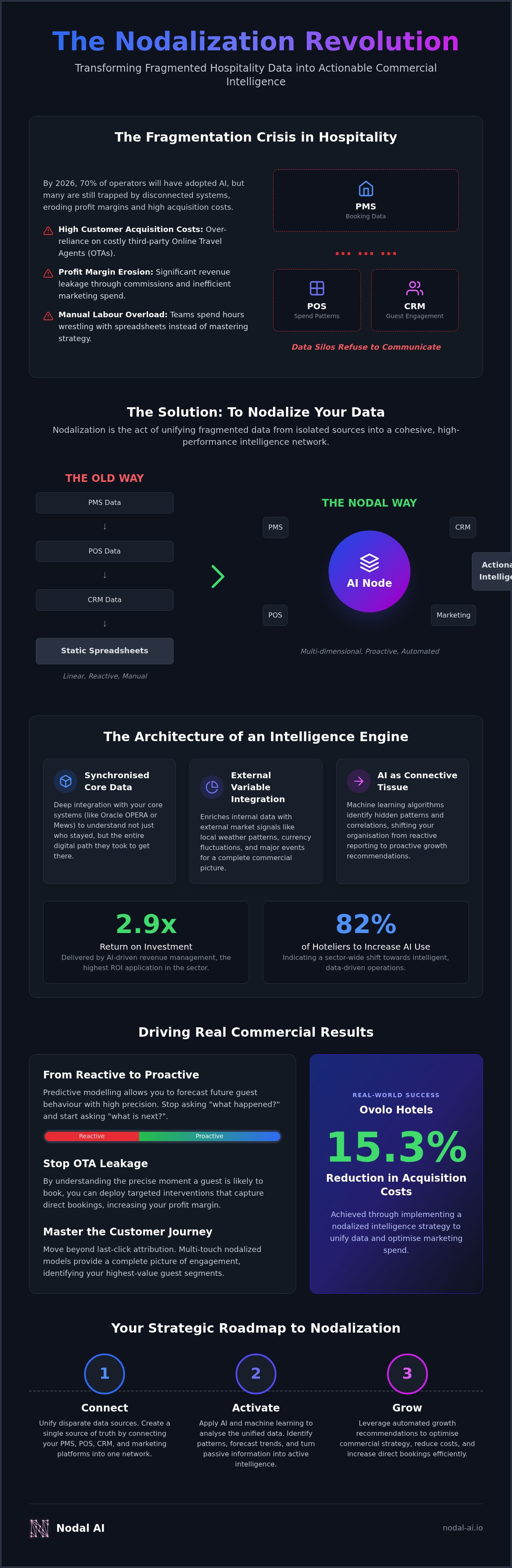
By 2026, 70% of hospitality operators have adopted AI, yet many remain trapped by high customer acquisition costs and fragmented systems that refuse to communicate. You likely recognise the frustration of juggling disconnected data from your PMS, POS, and CRM while watching margins erode through OTA leakage. It's time to stop managing spreadsheets and start mastering your network. To nodalize your data is to transform these chaotic, isolated inputs into a high-performance engine of actionable commercial intelligence.
You understand that the future of hospitality lies in personalisation and precision, yet the manual labour required to identify high-value guest segments often feels overwhelming. Discover how to nodalise your fragmented hospitality data into a high-performance network of actionable commercial intelligence. In this guide, we will explore the transition from data silos to a unified view of your marketing and revenue; we will also examine the power of predictive modelling and the path to increased direct bookings through automated growth recommendations.
Key Takeaways
- Understand the transition from passive data storage to active intelligence by learning what it truly means to nodalize your hospitality data.
- Explore the modular architecture required to connect PMS signals with performance marketing for a total view of commercial health.
- Recognise why traditional silos lead to profit margin erosion and how a unified network stops expensive OTA leakage.
- Analyse real-world success stories, including the strategies that delivered a 15.3% reduction in acquisition costs for Ovolo Hotels.
- Master the roadmap for implementing a modular intelligence engine tailored to the specific needs of your hotel or restaurant organisation.
Defining Nodalization in the Age of Hospitality AI
Linguistically, the term stems from the concept of a Node (computer science), which represents a point of connection within a larger network. To nodalize is to take information that is currently floating in isolation and concentrate it into these strategic points of intersection. In a commercial sense, it's the act of unifying fragmented data into a cohesive intelligence network. Traditional hospitality reporting is often linear; it moves from a single source like a PMS to a static spreadsheet. This approach is no longer sufficient for modern operators. A nodalized strategy allows for multi-dimensional insights where guest sentiment, spend patterns, and marketing attribution converge into one clear picture.
For hospitality brands facing intense margin pressure in 2026, this shift isn't just a technical upgrade. It's a survival requirement. You need to see how your data points interact to protect your bottom line. By concentrating your data at specific nodes, you transform passive information into a dynamic map of your entire commercial landscape.
From Fragmented Inputs to Nodalized Outputs
The current state of hospitality data is often chaotic and disconnected. You have booking data in your PMS, beverage spend in your POS, and engagement metrics in your CRM. These systems rarely talk to each other. When you nodalize these inputs, you create a single view of the truth across your entire operation. This process replaces the anxiety of manual data entry with the clarity of automated commercial intelligence. The goal is simple: turn passive assets into active participants in your growth strategy. By connecting these disparate sources, you can finally see how a marketing campaign in London directly impacts a weekend stay in Edinburgh or a dinner booking in Manchester.
The Role of AI in Modern Nodalization
Artificial intelligence acts as the connective tissue in this new architecture. Machine learning algorithms identify patterns across disparate nodes that the human eye would likely miss. This is where predictive modelling becomes a competitive advantage. Rather than looking at last month's performance, you can forecast future guest behaviour with high precision. Research indicates that 82% of hoteliers expect their organisation's use of AI to increase in the next year, and for good reason. AI-driven revenue management currently delivers a 2.9x return on investment, the highest ROI application in the sector. This technology facilitates a shift from reactive reporting to proactive growth recommendations. Instead of asking what happened, your organisation starts asking what's next. You move from managing complexity to mastering it.
The Architecture of Nodalized Data: Connecting the Dots
The foundation of a high-performance intelligence network lies in its architecture. Unlike traditional data warehouses that merely store information, the Nodal Platform operates as a modular engine designed to breathe life into stagnant records. This system functions by establishing digital bridges between your internal operations and the external market. By choosing to nodalize your data, you replace manual cross-referencing with a transparent, automated process that removes the ambiguity often found in legacy reporting.
The engine begins by synchronising deep PMS data from systems like Oracle OPERA or Mews with real-time marketing signals. This isn't just about knowing who stayed in a room; it's about understanding the specific digital path they took to get there. To add further depth, the platform integrates external variables such as local weather patterns, currency fluctuations, and major events. This creates a multi-layered view where a sudden shift in the FX rate or a festival announcement in London becomes a visible driver of demand rather than a mystery in your month-end report. If you're ready to see these connections in action, you can explore the interface today.
Mapping the Customer Journey through Nodes
Traditional analytics often rely on last-click attribution, which oversimplifies the guest's path and masks the true value of your marketing spend. Effective customer journey mapping identifies high-propensity guest segments by tracking every interaction across the network. This shift to multi-touch nodalized models allows you to see the full picture of engagement. When you understand the exact moment a guest is likely to book, you can deploy targeted interventions that reduce OTA leakage. Instead of losing margin to third-party platforms, you capture the guest directly at the peak of their intent.
The Power of Modular Intelligence
Every hospitality group has unique requirements, which is why a one-size-fits-all approach to data always fails. The Nodal Platform features a modular design that allows organisations to customise their intelligence engine based on their specific sector. Whether you are managing a portfolio of hostels, upscale F&B outlets, or serviced apartments, you can activate the specific modules that matter most to your bottom line:
- Operational: Streamline staffing and resource allocation.
- Demand: Forecast occupancy with precision using external signals.
- Commercial: Protect margins and optimise pricing strategies.
- Guest: Build comprehensive profiles for hyper-personalisation.
This modularity ensures that the system scales as your business grows. You don't need to rebuild your tech stack every time you add a new property; you simply expand your network. This flexibility transforms your data from a heavy administrative burden into a lightweight, agile asset that drives measurable commercial returns.
Overcoming the Fragmentation Crisis in Hospitality
Many operators believe their existing Property Management System (PMS) or Customer Relationship Management (CRM) tool is sufficient for data intelligence. While these systems are excellent at recording transactions, they often act as isolated islands of information. They don't communicate with your marketing channels or external market signals. This fragmentation leads to significant profit margin erosion because you cannot see the friction points in the guest journey. When you choose to nodalize your data, you bridge these gaps, transforming passive records into a unified intelligence network that protects your bottom line.
This approach specifically addresses the "Walled Garden" problem in digital marketing. Platforms like Google and Meta often hide the full path to conversion, making it difficult to justify your ad spend. By connecting these external signals with your internal booking data, you regain transparency. Beyond the financial gains, the operational relief is substantial. Automated reporting removes the need for manual data cleaning, saving commercial teams over 20 hours per week. This allows your staff to stop acting as data entry clerks and start acting as strategic growth partners.
Solving the OTA Leakage Problem
It is a common frustration: a guest visits your direct website, spends time browsing, yet ultimately completes their booking on an OTA. This leakage happens because of a lack of real-time, personalised incentives. Nodalized insights allow you to identify exactly where a guest is in their journey, enabling you to offer the right direct booking incentive at the perfect moment. Understanding the true value of each channel requires sophisticated marketing attribution. By moving away from simplified models, you can identify which touchpoints actually drive high-value bookings and which are simply draining your budget.
Demand Forecasting and Need Periods
The ability to predict the future is no longer a luxury. Modern intelligence engines can identify early signs of low occupancy, known as "need periods," over a six-week horizon. Traditional methods often rely on deep, last-minute discounts that damage your brand equity and slash your margins. Instead, nodalize your demand signals to shift interest toward these quiet periods using targeted AI recommendations. This proactive strategy has a measurable impact on performance across different sectors:
- Hostels: Optimise bed yield by identifying group booking patterns before they happen.
- Serviced Apartments: Improve length-of-stay performance by targeting corporate segments during traditional lulls.
- Upscale F&B: Predict table turnover and staffing needs based on local event nodes.
By shifting demand rather than just cutting prices, you maintain your rate integrity while ensuring your assets are always working at peak efficiency. You replace the anxiety of empty rooms with the confidence of data-backed growth.
Driving Commercial Results through Nodal Intelligence
The transition from theory to practice is where commercial leaders find the most significant relief. To nodalize your data is to replace guesswork with precision. Real-world implementation shows that this shift isn't just about better charts; it's about better margins. For instance, Ovolo Hotels achieved a 15.3% reduction in acquisition costs by unifying their fragmented sources. This efficiency stems from a clearer understanding of guest intent and a refusal to overpay for low-value traffic.
Marketing budgets often suffer from invisible waste. By choosing to nodalise your commercial intelligence, you can achieve a 24.5% increase in ROAS. This isn't magic; it's the result of identifying and doubling down on high-propensity guest segments. This targeted approach also supports a 5.5% increase in average booking value. When you stop marketing to everyone and start engaging with high-value segments, your revenue per guest naturally rises.
Operational Efficiency and Margin Protection
Smart data allocation leads to a 3.6% reduction in overall spend. Using predictive modelling allows your team to identify low-propensity audiences before you spend a penny on them. For upscale F&B venues, this intelligence translates to better cover management and a significant increase in average spend per head. You protect your margins by ensuring every marketing pound is tethered to a high-value outcome.
Case Study: The Ovolo Hotels Transformation
Ovolo Hotels faced a classic industry challenge: fragmented data scattered across multiple properties and systems. They needed a way to see the truth behind their performance. By implementing the Nodal Platform, they were able to nodalise their commercial data into a single, high-performance network. The results were immediate and measurable. They saw a 13.8% increase in total bookings and a 20% increase in revenue specifically from paid search. This transformation proved that unified data is the most powerful tool in a hotelier's arsenal.
Book a demo to see these commercial results for your organisation
Strategic Implementation: How to Nodalize Your Organisation
Moving from a state of data fragmentation to one of unified intelligence requires a deliberate, phased approach. To nodalize your organisation is to commit to a new standard of commercial discipline where intuition is secondary to evidence. This journey begins with a fundamental shift in how your leadership team perceives information; it transforms data from a passive record into a competitive asset. Professional onboarding ensures that your initial configuration aligns with your specific commercial objectives, providing the relief of a system that works for you rather than creating more manual labour.
Step 1: Data Source Audit and Integration
The first practical step is a comprehensive audit of your existing technology stack. You must identify every isolated system, including your PMS, POS, and reputation management tools, that currently holds your information in a silo. Establishing secure, real-time connections to the Nodal engine is the priority here. By using pre-built integrations for major systems like Mews, Oracle OPERA, or HubSpot, you can create a frictionless flow of data. During this phase, focus on data governance to ensure your global marketing teams remain compliant with evolving privacy standards while maintaining a transparent view of the customer journey.
Step 2: Configuration and Insight Generation
Once your systems are connected, the focus moves to tailoring the platform to your business model. You need to define the specific commercial questions that will drive your next phase of growth. Whether you are managing a portfolio of serviced apartments or a collection of upscale F&B venues, you can configure the modular architecture to highlight the metrics that matter most. This is the moment where you begin to review the initial growth recommendations generated by the AI engine. These insights act as a cognitive upgrade, allowing your team to see patterns in occupancy and spend that were previously masked by fragmentation.
Step 3: Continuous Optimisation and Scaling
Successful implementation is not a one-time event but a cycle of continuous improvement. Use automated reporting to monitor performance across all properties, allowing you to react to market shifts in real-time. By refining your audience segments through AI-driven propensity scores, you ensure that your marketing resources are always allocated to the highest-value opportunities. As your organisation expands, the modular nature of the platform allows you to add new properties or modules without increasing technical complexity. If you are ready to start this transformation, reach out to our team to book a demo and see the roadmap in action.
Master Your Commercial Intelligence Network
The hospitality landscape is shifting toward a data-driven reality where fragmented systems are no longer sustainable for growth. By choosing to nodalise your commercial intelligence, you transform passive records into active participants in your business strategy. This process replaces the anxiety of manual reporting with the clarity of automated, actionable insights. You move from managing chaos to mastering a high-performance network that identifies opportunities before your competitors realise they exist.
You've already seen the measurable impact of this transition. Ovolo Hotels achieved a 24.5% increase in ROAS by unifying their signals through our modular architecture. This shift empowers your organisation to focus on high-value guest segments while reducing the financial drain of OTA leakage. Our London-based team provides the global expertise needed to protect your margins and scale with confidence. It's time to stop reacting to the market and start leading it.
Book a demo to nodalize your hospitality data today
Your high-performance network is waiting to be activated.
Frequently Asked Questions
What does it mean to nodalize data in a business context?
To nodalize data is to concentrate fragmented information into strategic points of connection within a unified network. In hospitality, this means taking chaotic inputs from your PMS, POS, and CRM and transforming them into cohesive commercial intelligence. It allows your organisation to move away from isolated spreadsheets and toward a multi-dimensional view of performance. This process ensures that every data point contributes directly to your high-level commercial objectives.
How does the Nodal Platform differ from a standard CRM?
While a standard CRM is designed to record guest communication and history, the Nodal Platform acts as a modular intelligence engine. It goes beyond simple record-keeping by connecting guest profiles with operational signals and external market variables. This allows you to understand not just who your guests are, but the specific drivers behind their booking behaviour. It provides a cognitive upgrade that turns static data into predictive, actionable growth recommendations.
Can nodalization help reduce my dependence on OTAs?
A nodalized strategy identifies high-propensity guest segments who are likely to book direct. By understanding the specific path a guest takes before booking, you can deploy personalised incentives that discourage them from moving to a third-party site. This approach specifically targets OTA leakage, ensuring you retain a higher percentage of your profit margins. It transforms your direct website from a passive brochure into an active revenue driver.
What types of hospitality businesses benefit most from nodalizing their data?
Any hospitality group managing multiple systems will benefit, particularly those in the hotel, hostel, and serviced apartment sectors. Upscale F&B venues and private members' clubs also see significant gains by unifying their on-property spend and member retention data. The modular architecture is designed to scale, making it as effective for a single boutique property as it is for a global organisation with a complex portfolio of disparate assets.
How long does it take to implement a nodalized intelligence model?
The implementation timeline is typically determined by the number of data sources and the complexity of your current tech stack. Our professional onboarding team manages the technical setup, data source integration, and initial dashboard configuration to ensure a smooth transition. Most organisations begin to realise the benefits of automated reporting and predictive modelling within a few weeks of the initial audit, allowing for a rapid move toward data-driven decision-making.
Is my data secure when using the Nodal AI platform?
Security is a central pillar of our platform, which is built to meet the highest global standards for data protection. As a London-based technology company, we employ secure, encrypted connections for all integrations with your internal systems. We maintain strict data governance protocols to protect your commercial assets and guest information. This ensures that while your data becomes more accessible for analysis, it remains entirely protected within a secure, enterprise-ready environment.
Do I need a dedicated data science team to use these insights?
You do not need a dedicated data science team to extract value from the platform. The engine is designed to handle the complex heavy lifting of multi-touch attribution and predictive modelling automatically. It translates chaotic data into clear, human-readable growth recommendations and automated reports. This empowers your existing commercial and marketing teams to focus on strategy and execution rather than spending hours every week cleaning and cross-referencing manual spreadsheets.
What are the most common integrations for the Nodal engine?
The Nodal engine establishes bridges with the most critical systems in the hospitality ecosystem. Operational integrations often include Oracle OPERA, Mews, and Cloudbeds, while marketing demand is captured through GA4, Google Ads, and Meta. We also connect with CRM and guest platforms like HubSpot and Revinate. These links ensure your information moves from isolated silos into a unified view, removing the technical hurdles that typically hinder commercial growth.


